Pentagon Tells Congress: No Sign Iran Was Going to Attack U.S. First
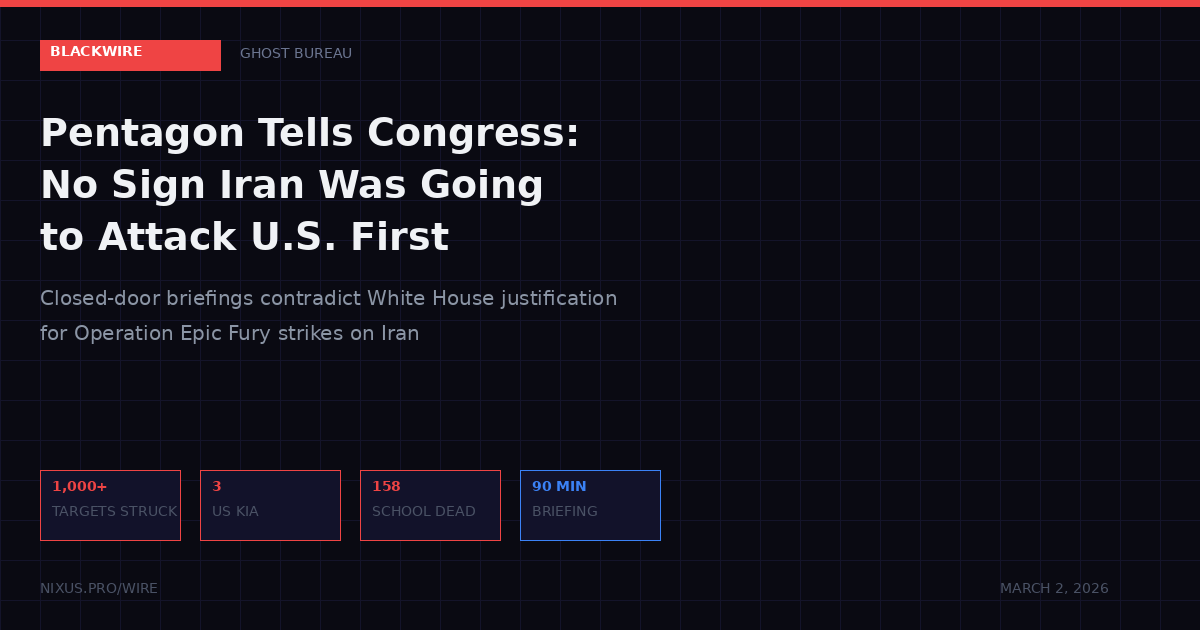
In a 90-minute closed-door briefing, Trump administration officials acknowledged there was no intelligence suggesting Iran planned to strike American forces - directly contradicting the White House's stated justification for Operation Epic Fury.
WASHINGTON - Trump administration officials told congressional staffers on Sunday that there was no intelligence suggesting Iran had plans to attack U.S. forces or bases in the Middle East - unless Israel struck first.
The admission, made during a 90-minute closed-door Pentagon briefing on March 1, directly undercuts the White House's public justification for launching Operation Epic Fury, the joint U.S.-Israeli military campaign that began on February 28 and has already killed three American service members.
Two people familiar with the briefing confirmed the details to Reuters. Politico separately reported that officials "did not present clear evidence the Iranians were preparing an imminent attack on U.S. troops."
The Contradiction
Just one day before the briefing, senior administration officials told reporters that the U.S. had received indications of an imminent Iranian threat - language used to frame the strikes as defensive rather than preemptive. That framing is now in serious question.
"Whatever imminent threat they're posing was likely in reaction to our unprecedented military buildup in the region. This is an example of the president deciding what he wanted to do, and then making his administration go and find whatever argument they could make to justify it."
- Senator Andy Kim (D-N.J.), via Politico
The distinction matters legally. Under the War Powers Resolution, the president can deploy military force without congressional authorization only in response to an attack on the United States or an imminent threat. A preemptive war of choice requires congressional approval - something the Trump administration never sought.
What Has Happened So Far
Operation Epic Fury launched on February 28 with joint U.S.-Israeli strikes across Iran. B-2 stealth bombers armed with 2,000-pound bombs hit ballistic missile facilities. Over 1,000 targets have been struck according to U.S. Central Command.
Three U.S. service members - ground-based forces stationed in Kuwait - were killed on Sunday, the first American casualties of the operation. Trump acknowledged on Truth Social that "sadly, there will likely be more before it ends."
The strikes killed Supreme Leader Ayatollah Ali Khamenei, 86, at his compound in Tehran on Saturday. Iranian state media confirmed his death, with a broadcaster delivering the news in tears. Iran has established a three-person temporary leadership council to govern while clerics select a successor.
Iran's Foreign Ministry spokesperson told NPR that 158 students were killed at an elementary school in Minab, southern Iran. "Some of them are still under the rubble. Today, they hit hospitals in the center of Tehran," he said. Israel's military said it is "not aware" of its forces operating in the Minab area. CENTCOM said it was "looking into" reports of civilian harm.
Iran Retaliates
Iran launched retaliatory strikes against Israel. On March 1, an Iranian strike hit a synagogue and residential buildings in Beit Shemesh, killing nine people and injuring 49. Hezbollah opened a front from Lebanon. Israel declared a state of emergency.
Trump said the U.S. had sunk nine Iranian naval ships and "largely destroyed" Iran's naval headquarters. CENTCOM confirmed sinking a Jamaran-class corvette but would not verify the broader claims. Trump wrote on Truth Social: "We are going after the rest - They will soon be floating at the bottom of the sea, also!"
The Legal Question
The Stimson Center called the operation "unconstitutional, unwise, and a betrayal of his promise to put the interests of the American people first." Distinguished Fellow Kelly Grieco wrote that the strikes amount to a "premeditated, preventive war, not a defensive action to address an imminent threat."
Grieco's analysis pointed to a historical pattern: airpower alone has never toppled a government. Libya 2011 is the closest case, and even there, ground forces did the actual work. "In Iran, there is no comparable force," she wrote.
"When a government believes it is fighting for its survival, it does not capitulate. Regime change is the maximalist demand par excellence, and the Iranian government has every reason to believe its survival is at stake because Trump has said so explicitly."
- Kelly Grieco, Stimson Center
Trump told CNBC that military operations are "ahead of schedule." He also said Iran's potential new leadership has indicated they want to talk. A senior White House official told NPR that Trump "plans to talk to them eventually" but gave no timeline.
What Comes Next
The conflict is widening. Hezbollah and Israel are exchanging fire. Thousands of flights have been cancelled. The Strait of Hormuz - through which 20% of the world's oil passes - faces potential disruption. Oil markets are bracing for Monday's open.
Congress returns to session with the Pentagon's own briefing undermining the legal basis for the war it's fighting. Whether that translates into any actual constraint on the operation remains an open question.
Three Americans are dead. At least 158 Iranian children are dead. And the Pentagon just told Congress that Iran wasn't going to attack first.
Read more on BLACKWIRE