The Man Going Back: Jafar Panahi, Two Oscars, and a Country on Fire
Iran's most defiant filmmaker arrives at the 98th Academy Awards on Sunday with two Oscar nominations for a film about political prisoners confronting their torturer. His co-writer was released from an Iranian prison six weeks ago. And when the ceremony ends, Jafar Panahi plans to go home - back to the country being bombed right now, the country that has imprisoned him four times, the country he has spent 35 years refusing to leave.
The 98th Academy Awards take place on March 15, 2026, two days from now. The Dolby Theatre in Hollywood will fill with the usual spectacle - red carpet, speeches, the long sweep of a ceremonial year in cinema. [AP]
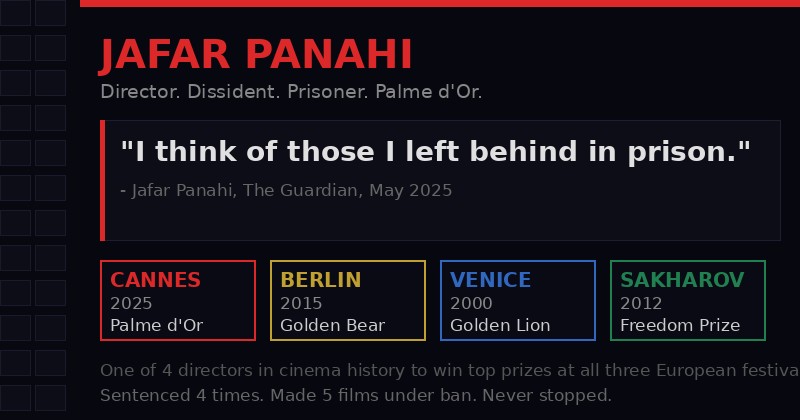
But sitting somewhere in that audience will be a 65-year-old man from Mianeh, Iran, who served in the Iran-Iraq War, who was captured by Kurdish rebels at age 21 and held for 76 days, who has been sentenced to prison by the Iranian Islamic Republic four separate times, who made five films while legally banned from making films, and who - as the bombs fall on Tehran and Bushehr and Minab - still calls Iran home.
The ceremony's most decorated American film, Ryan Coogler's "Sinners," arrives with a record-breaking 16 nominations. But the most extraordinary presence at this year's Oscars may be the film that made Cannes weep and made Tehran authorities reach for the arrest warrant: "It Was Just an Accident," by Jafar Panahi.
A Film About What We Do With Our Torturers
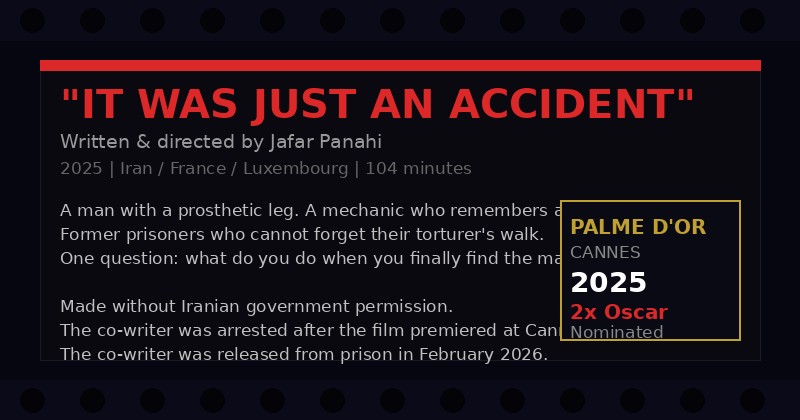
"It Was Just an Accident" begins with something mundane: a car hitting a dog at night. The driver - a man with a prosthetic leg - goes to a garage for repairs. The mechanic, Vahid, an ethnic Azerbaijani, recognizes the man from a sound. A particular scrape and thud. The sound a prosthetic leg makes. [Wikipedia / Film Synopsis]
He has heard that sound before. In prison. In the dark. When the man he knew as "Eghbal" - nicknamed "peg leg," a torturer and interrogator - would walk the corridors.
What follows is 104 minutes of moral vertigo. Vahid kidnaps the man. He finds other survivors - a photographer named Shiva, a young woman named Goli who was tortured before her wedding, a man named Hamid who identifies the prisoner instantly by touch alone. They are unable to see the man's face when they were imprisoned, but they can feel him, smell him, hear him. Each memory is embedded in their bodies.
The film asks a question that has no clean answer: what does justice look like when the system that imprisoned you is still standing? When the torturer's daughter calls and asks where her father is? When his wife gives birth to a son while he is tied to a tree in the desert?
"I think of those I left behind in prison." - Jafar Panahi, interviewed by The Guardian after his Cannes triumph in May 2025
The film won the Palme d'Or at Cannes in May 2025, making Panahi one of only four directors in cinema history - alongside Henri-Georges Clouzot, Michelangelo Antonioni and Robert Altman - to have won the top prizes at all three of Europe's major festivals: Venice, Berlin, and Cannes. [Wikipedia]
The Academy of Motion Picture Arts and Sciences nominated it for Best International Feature Film (submitted by France, one of the film's co-production countries) and Best Original Screenplay. [AP / 98th Academy Awards]
It was made without official Iranian filming permission. Panahi shot it in secret, in a country where his name on a film is already a political act.
A Career Built Inside the Walls They Put Around Him
Panahi was born in 1960 in the provincial city of Mianeh, to an Azerbaijani family his father described as working-class. His father was a house painter. When Panahi was ten, someone gave him an 8mm film camera. That was the end of the story of the man who would become a house painter. [Wikipedia / Jafar Panahi biography]
He studied at Iran's College of Cinema and TV. He served in the Iran-Iraq War as an army cinematographer. He was captured by Kurdish rebels and held for 76 days. He returned, enrolled in film school, became the apprentice of Abbas Kiarostami - perhaps the greatest Iranian filmmaker who ever lived - and in 1995, his debut feature "The White Balloon" won the Camera d'Or at Cannes. The first major Cannes award ever given to an Iranian film.
His films kept winning. They also kept getting banned. "The Circle" (2000) won the Golden Lion at Venice and was immediately suppressed in Iran for its portrayal of women trapped by a merciless legal system. "Crimson Gold" (2003) was written by Kiarostami himself and banned again. "Offside" (2006) followed teenage girls trying to sneak into a football stadium - illegal for women to attend in Iran.
In 2010, Iranian authorities ran out of patience. Panahi was arrested, sentenced to six years in prison and a 20-year ban on filmmaking, directing, writing scripts, or leaving the country. The charge: "propaganda against the Islamic Republic." [Wikipedia / BBC]
He made films anyway.
"This Is Not a Film" (2011) was shot inside his apartment with a phone and a friend's camera while he was under house arrest. It was smuggled out of Iran on a USB drive hidden inside a birthday cake and shown at Cannes. "Closed Curtain" (2013) was filmed in a single house. "Taxi" (2015) was shot entirely inside a Tehran taxi cab with hidden cameras - and won the Golden Bear at Berlin. His car was his studio. [The Guardian / Wikipedia]
"No Bears" (2022) was filmed while Panahi was facing another prison sentence. He surrendered himself to authorities in July 2022 to protest the imprisonment of fellow filmmaker Mohammad Rasoulof. He was held for seven months.
In 2025, he made "It Was Just an Accident" and won the Palme d'Or. By October 2025, Iranian authorities had sentenced him again - in absentia - to another year in prison for "propaganda activities." [The Guardian]
Panahi was in France when the sentence was announced. He went to Cannes to collect his prize. He gave interviews. He said he planned to go back to Iran.
Panahi Timeline: The Artist vs. The State
The Co-Writer Who Was Still in Prison Three Weeks Ago
The "Jafar Panahi" on the Oscar nomination is not alone. Every film is a collaboration. "It Was Just an Accident" had a co-writer. That co-writer was arrested inside Iran after the film's success became impossible for the regime to ignore.
The Guardian reported in February 2026 that the co-writer of the film had been released from an Iranian prison following their arrest connected to the film. That release came just weeks before the Oscars - less than a month before the ceremony that will celebrate the work they helped create. [The Guardian, February 2026]
The arrest fits a pattern that runs through Iranian cinema like a wound. When "The Seed of the Sacred Fig" - fellow Iranian filmmaker Mohammad Rasoulof's film - was submitted for the Oscars in 2025, Rasoulof was in exile, having fled Iran under sentence of arrest and flogging. He directed his film from his sofa, with crew members who could be arrested at any time.
Making films in Iran, if you are honest about what you see, is not a career choice. It is a risk calculation made every morning.
"After my arrest, I told myself: don't hold back." - Mohammad Rasoulof, fellow Iranian director, in an interview with AP before the 97th Academy Awards
The co-writer's release is not a sign that the regime has softened. It is a coincidence of timing, or perhaps a political calculation ahead of an international ceremony that the world will be watching. Either way, they are free for now. The sentence against Panahi still stands. The bombs are still falling. The calculus is still the same.
And Panahi still intends to return.
What the Film Means to Iranians Watching the War
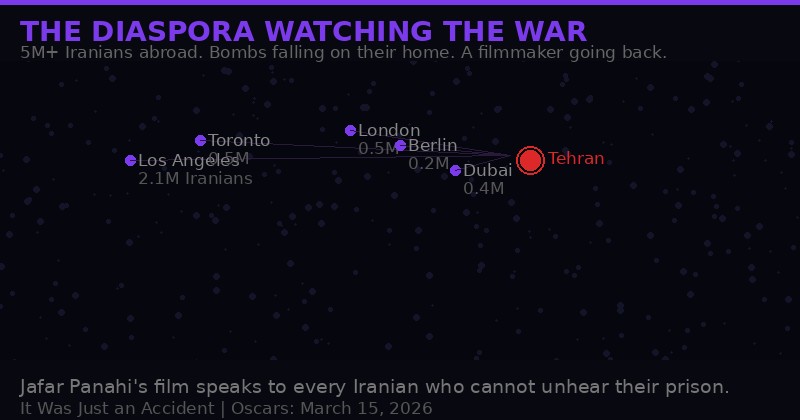
There are more than five million Iranians living outside Iran. In Los Angeles, in London, in Toronto, in Berlin, in Dubai. For the past three weeks they have been watching the country they left - or fled, or were expelled from - be bombed into a new shape. [BLACKWIRE coverage of Iranian diaspora grief, March 2026]
"It Was Just an Accident" is not a film about the war. It was made before the war. But for the Iranian diaspora, it lands differently now than it did at Cannes in May 2025.
The film is about what you do when the people who hurt you are still walking around, still living their lives, still having children - and the system that empowered them has never been held accountable. It is about the impossibility of formal justice and the poison of informal revenge. It is about the moment you have your torturer tied to a tree and you have to decide who you want to be.
For Iranians who lost family members to Evin Prison, to the mass executions of 1988, to the "disappearances" of dissidents across three decades - this is not metaphor. This is their family history, rendered in 104 minutes, with a Palme d'Or ribbon on it.
The diaspora at BLACKWIRE reported on last week was complicated: many who once called for regime change watched the bombs fall and felt something closer to dread than victory. The regime was always the enemy; the country was never just the regime. The men who tortured Panahi's fictional characters are real men, and some of them are now themselves in rubble. That does not feel like resolution. [BLACKWIRE Diaspora Reporting, March 2026]
But Panahi's film, whatever Iran becomes after this war, is now part of the permanent record. It exists in theaters in France and the United States and Japan. It will be watched for fifty years. The regime cannot burn a Palme d'Or. It cannot arrest an Oscar nomination.
This is what cinema does that nothing else can: it archives the human cost.
"The regime cannot burn a Palme d'Or. It cannot arrest an Oscar nomination. Cinema archives what states want erased."
Why He Goes Back: The Logic of Remaining
The question that everyone asks about Jafar Panahi - and about every artist who stays under authoritarianism rather than leaving - is some version of: why?
He has options. He has an international reputation that could land him a comfortable professorship at any film school in the world. He could live in Paris, near his French co-producers. He could live in Los Angeles, where his films play at the Egyptian Theatre to standing ovations. He could make films with French money, on French locations, without the daily possibility of arrest.
In interviews, Panahi's answers circle back to the same core: his work only means something if it comes from inside Iran. His cinema is not about Iran as a concept for foreign audiences. It is about specific streets, specific voices, specific light. The fruit seller at a specific corner. The specific sound a prison door makes at a specific hour.
His films have always been low-budget, shot with small crews, on real locations with non-actors. "The White Balloon" starred a child who had never acted before. "Taxi" was shot from a dashcam. "This Is Not a Film" was shot on an iPhone in his apartment. The constraint was always part of the work. Limitation as method.
If he leaves, he becomes a different filmmaker. Perhaps a better-funded one. Perhaps even a more comfortable one. But something in the specific friction of making art in a place that wants to stop you - that, for Panahi, appears to be what the art is made of.
"Khamenei regime will not be able to keep control of Iran," Panahi told The Guardian in January 2026, before the war began. He was already predicting the unraveling - from inside the country being unraveled. - The Guardian, January 2026
He said that from inside Iran. He is now outside Iran, at the Oscars, watching his prediction accelerate past anything he could have imagined. And when the ceremony ends, his plan is to return.
This is either profound courage or something that only makes sense from inside a psychology shaped by decades of defiance - perhaps both, perhaps neither. The man who was captured by Kurdish rebels at 21 and held for 76 days. The man who made a film in a taxi to prove a point to a government that said he could not make films. The man who filmed his own apartment ceiling as an act of artistic resistance.
The word for what Panahi is doing might simply be: consistent.
The Oscars Race and What a Win Would Mean
The 98th Academy Awards are the most remarkable in recent Oscar history, and that is not primarily because of "Sinners," though Coogler's vampire epic with its record-breaking 16 nominations is justifiably the dominant narrative. [AP, 98th Academy Awards]
The international film category alone this year contains a kind of political weight that is difficult to remember in recent Oscar history. "It Was Just an Accident" competes for Best International Feature Film. It was submitted by France, one of the film's co-production countries, because Iran - predictably - did not submit it. [Wikipedia]
If Panahi wins Best International Feature Film, he would be accepting an Oscar for a film his own government has condemned, made while under a filming ban, about political prisoners confronting a torturer who represents the Islamic Republic's own apparatus of repression - while that Islamic Republic is actively being bombed.
The symbolism would not be lost on anyone in the Dolby Theatre. Or anyone watching on ABC and Hulu.
The screenplay nomination is, in some ways, even more pointed. Best Original Screenplay is awarded to the writer. To the person who decided which words would be said. Panahi is that person. The Islamic Republic sentenced him in absentia for writing those words. Hollywood's most prestigious organization may reward him for the same act.
His competition in the international film category includes formidable films from France, Germany, Spain, and Denmark - all worthy, all the products of free societies where filmmakers face no prospect of arrest. Only Panahi made his film in genuine defiance of state authority, on stolen camera time, in a country where the wrong film can land you in Evin Prison.
Whether that matters to the Academy voters is a separate question. But it matters to the human story.
Iranian Cinema's Long Tradition of Making Art Under Siege
Panahi is not an anomaly in Iranian cinema. He is a culmination.
Abbas Kiarostami, his mentor, made films that looked like children playing in fields and were actually investigations into memory, truth, and the gap between what we see and what we understand. "Close-Up" (1990) recreated a real court case in which a man impersonated a filmmaker. "Taste of Cherry" (1997) won the Palme d'Or. All of it made under the watchful eye of a regime that was simultaneously the subject and the censor.
Asghar Farhadi has won two Oscars for Best International Feature Film - for "A Separation" (2012) and "The Salesman" (2017). "The Salesman" he accepted via video message because he refused to enter the United States during Trump's first travel ban. His films are meticulous explorations of moral compromise in modern Iranian society - domestic dramas that are quietly devastating about everything that official Iranian culture pretends does not exist.
Mohammad Rasoulof fled Iran in 2024 under sentence of arrest and flogging. His film "The Seed of the Sacred Fig" went on to be nominated for the Academy Award for Best International Feature Film at the 2025 ceremony. [AP / The Guardian]
There is a specific quality to cinema made by people who know that making it might cost them their freedom. It tends to be precise where other cinema is vague. Careful where other cinema is careless. Fully committed to every frame, because every frame was a risk.
Panahi's work has that quality compounded by repetition. He has been arrested. He has been released. He has made another film. He has been arrested again. He has been released again. He has made another film. And another. For thirty years, this cycle has produced some of the most remarkable cinema of the modern era - a body of work made almost entirely under conditions designed to prevent it from existing.
The Islamic Republic wanted to silence Jafar Panahi. What it got instead was a Palme d'Or, two Oscar nominations, and a film about political prisoners that will be watched for fifty years after the regime itself is a footnote.
"The Islamic Republic wanted to silence Jafar Panahi. What it got was a Palme d'Or and a film about its own torturers."
The Night After the Ceremony
On the night of March 15, 2026, the 98th Academy Awards will end. Conan O'Brien will make his last joke. The lights will come up in the Dolby Theatre. The winners will hold their trophies.
Somewhere in the audience, or backstage, or watching from a hotel room - Jafar Panahi will make his decision about what comes next.
The war in Iran is ongoing. The new supreme leader, Mojtaba Khamenei, has vowed to block the Strait of Hormuz. Israel continues its strikes on Lebanese and Iranian targets. Tehran has been hit. The school strike in Minab, which killed more than 160 people, remains under investigation. The country Panahi grew up in is being remade by forces entirely outside any filmmaker's control. [BBC, March 2026]
His co-writer, released from prison in February, is presumably watching the ceremony from somewhere. Wondering what the next arrest will look like. Wondering if the war changes the calculus at all, or whether the Islamic Republic's habit of arresting filmmakers will survive even the bombs falling on its military installations.
For the Iranian diaspora watching - the millions in Los Angeles and London and Toronto who fled or were expelled or left because they were afraid - Panahi's insistence on returning is either incomprehensible or the truest thing they have ever seen. Possibly both.
Art does not stop wars. Cinema did not stop the Islamic Republic from running Evin Prison for forty years. "It Was Just an Accident" will not deliver justice to any real survivor of any real Iranian prison. The man on trial is fictional. The torturers who inspired him are not.
But here is what art can do, what it has always done: it names the thing. It holds the camera up to the face of the man with the prosthetic leg and says: we remember the sound you made. We remember what you did to us. We remember, and we have put it on film, and no government on earth can unfilm it.
Jafar Panahi has spent 35 years doing that, through imprisonment and ban and in-absentia sentences and regime change and war. He will be at the Oscars on Sunday. And then, if he keeps his word, he will go home.
To the country that cannot make him stop.
Get BLACKWIRE reports first.
Breaking news, investigations, and analysis - straight to your phone.
Join @blackwirenews on Telegram