OpenAI Kills Its Side Quests: Sora, Atlas, and Gadgets Shelved as the Company Bets Everything on Coding
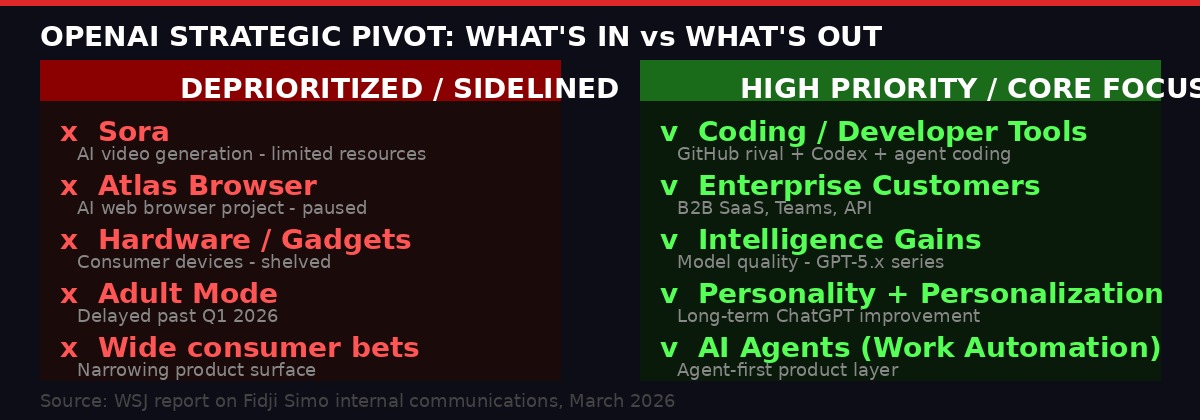
Fidji Simo, OpenAI's CEO of applications, told staff this week the company will stop spreading itself thin. Sora gets deprioritized. The Atlas browser project goes on hold. Consumer gadgets get shelved. The mission now: win coding and win enterprise. It's the biggest internal strategic retreat since GPT-4 launched, and it reveals something uncomfortable - OpenAI spent two years building things that went nowhere.
The Internal Message That Changes Everything
The Wall Street Journal broke the story on March 17, citing internal communications from Simo to OpenAI staff. The directive was stark: the company that spent the last 18 months launching AI video generation tools, testing a proprietary browser, and exploring consumer hardware is now telling employees those projects are not the priority anymore.
Simo joined OpenAI as CEO of applications in mid-2024 after her tenure at Instacart. Her mandate was to take OpenAI's raw model capability and turn it into products people actually pay for. Nine months into the role, the answer she has landed on is the same one every enterprise software company eventually arrives at: build for developers and build for businesses. Consumer bets are expensive and slow. B2B and developer tools convert faster, retain better, and scale more predictably.
This is not just a product management decision. It's a signal about where the money is, what the board is thinking, and which product lines will get headcount and compute in 2026.
What Simo told staff, per WSJ: OpenAI will prioritize coding and enterprise users over the wide array of projects it has been pursuing - including Sora, the Atlas browser, and hardware gadgets.
The message lands at a peculiar moment. OpenAI just launched GPT-5.3-Instant, acquired AI security startup Promptfoo, is building a GitHub competitor, and had its head of robotics resign over the Pentagon contract. There is no shortage of things happening at the company. But Simo is drawing a box around what matters, and a lot of what OpenAI launched publicly over the past year is outside that box.
What's Being Sidelined - and What It Cost
Sora launched to significant fanfare in early 2024 as OpenAI's challenge to Runway and Pika in the AI video generation space. The product was technically impressive, capable of generating cinematic-quality short video clips from text prompts. It got an extended public beta, integration into select ChatGPT tiers, and heavy marketing attention.
The problem: video generation is brutally compute-intensive, the market is crowded, and the actual enterprise use cases for AI video are still being figured out. Runway raised a fresh round and kept iterating. Google's Veo model kept improving. Sora, for all its early splash, did not become a must-have product that enterprise customers were demanding.
Atlas was a more secretive project - OpenAI's exploration of building its own AI-native web browser. The concept made strategic sense on paper. If ChatGPT is how a growing segment of users starts their digital interactions, why shouldn't OpenAI own the browser layer too? The problem is that browsers are notoriously hard to build, the distribution challenge is immense, and Google and Apple control the on-ramps. According to the WSJ reporting, Atlas is now on hold.
The hardware push was perhaps the most speculative. OpenAI explored various consumer device concepts in 2025, though nothing was ever publicly confirmed at launch stage. The gadget space has been a graveyard for ambitious tech company pivots - the category requires massive retail relationships, supply chain expertise, and consumer marketing budgets that are entirely different from software. Shelving that ambition is probably the sanest decision on this list.
There's also the delayed "adult mode" for ChatGPT, which was supposed to launch in Q1 2026 but got pushed. An OpenAI spokesperson told The Verge the company is pushing it out to "focus on work that is a higher priority for more users right now, including gains in intelligence, personality improvements, personalization, and making the experience more proactive." That's the polite version of what Simo's memo says more directly.
The Kill List - What's Being Deprioritized
- Sora (video AI) - Limited resources, no clear enterprise monetization path found
- Atlas Browser - AI-native browser project, paused indefinitely
- Consumer Gadgets / Hardware - Device exploration shelved
- Adult Mode (ChatGPT) - Delayed past Q1 2026, no new timeline given
- Wide consumer product surface - Narrowing to core use cases
The Coding Bet - Why It Makes Sense, and Why It's Risky
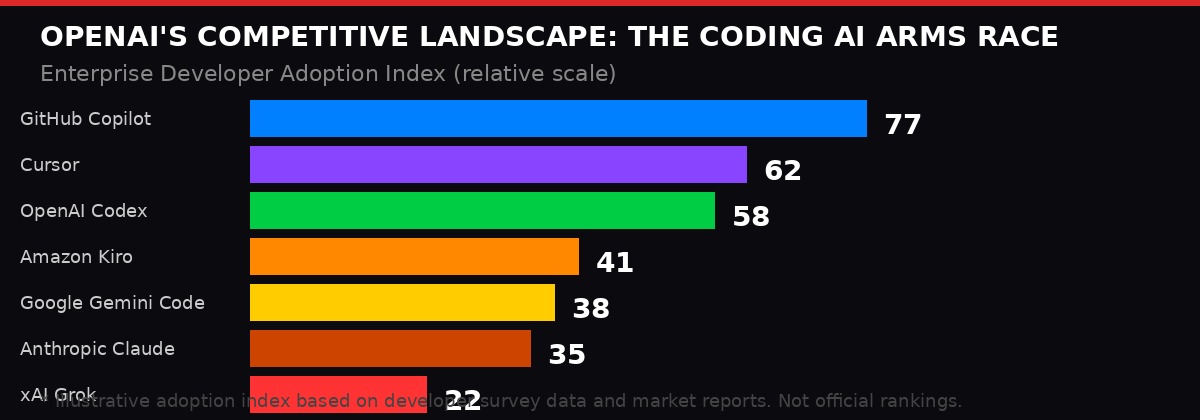
Coding AI has become the clearest, most monetizable use case for large language models. The evidence is everywhere. GitHub Copilot reached $100 million ARR faster than virtually any Microsoft product in history. Cursor, a small startup building an AI-first code editor, reportedly hit $100M ARR within its first year of meaningful revenue. Amazon's Kiro, launched in early 2026 to address concerns about AI coding agents going off-script, grabbed immediate enterprise attention.
The reason coding converts so well is simple: developers know immediately whether AI output is useful, the value proposition is measurable (time saved, bugs caught, features shipped faster), and the buyer - the engineering team or CTO - has budget and technical sophistication. There's no need to convince a developer that AI coding assistance has ROI when they can benchmark it themselves in an afternoon.
OpenAI's position in this market is genuinely strong but not unassailable. Codex, the company's coding-focused model layer, powers a huge chunk of GitHub Copilot through Microsoft's licensing deal. OpenAI just launched Codex Security, a research preview agent focused on identifying and fixing app security issues. The company is also, per a March 3 Verge report, building its own GitHub competitor - an internal code repository that would put OpenAI in direct competition with Microsoft, one of its largest investors.
That last point deserves emphasis. OpenAI building a GitHub rival is a remarkable act of strategic aggression against a company that holds a significant ownership stake. The motivation reportedly accelerated after GitHub experienced notable outages in late February 2026. OpenAI saw an opportunity to capture developer loyalty at the infrastructure level - not just at the AI assistant level. If you host your code with OpenAI, the switching cost to any other AI provider gets much higher.
The Simo Factor - Who Is Running This Company's Products?
To understand why this pivot is happening now, you need to understand who Fidji Simo is and what authority she actually holds. Simo spent years at Facebook before becoming CEO of Instacart, where she took the grocery delivery company through its 2023 IPO. She is a methodical operator - the kind of executive who thinks in terms of unit economics, retention cohorts, and market sizing rather than vision statements.
Her hire at OpenAI was significant because it signaled the company was finally trying to build the application layer with the same rigor it had applied to the model layer. Sam Altman is a visionary CEO who moves fast and bets broadly - that temperament is what built ChatGPT into a 300-million-user product in two years, but it's also what created a sprawling product portfolio with unclear priorities.
Simo's job, implicitly, is to bring discipline to that portfolio. Her March 2026 internal communication is exactly what that looks like in practice. Kill the projects that aren't winning. Double down on what's working. Be explicit about the hierarchy.
The second-order effect here is talent signaling. When a company publicly announces it's deprioritizing a set of projects, the people working on those projects start thinking about their options. Some of Sora's most talented engineers are, at this moment, probably fielding calls from Runway, Pika, and Google DeepMind. That's a talent cost OpenAI is accepting knowingly. The bet is that the gains from focus outweigh the losses from attrition in sidelined divisions.
This is not a new calculation in tech. When Microsoft under Satya Nadella killed Windows Phone in 2016, it lost some talented mobile engineers. But it also freed up enormous resources and management attention for the cloud bet that ultimately made Azure. When Google shut down most of its Google+ team, those resources flowed to products that actually had users. Strategic retreat, when timed correctly, is often the smartest move available.
Thinking Machines Lab, Nvidia, and the Competition Closing In
OpenAI's pivot doesn't happen in a vacuum. The competitive pressure that's forcing this consolidation is real and accelerating.
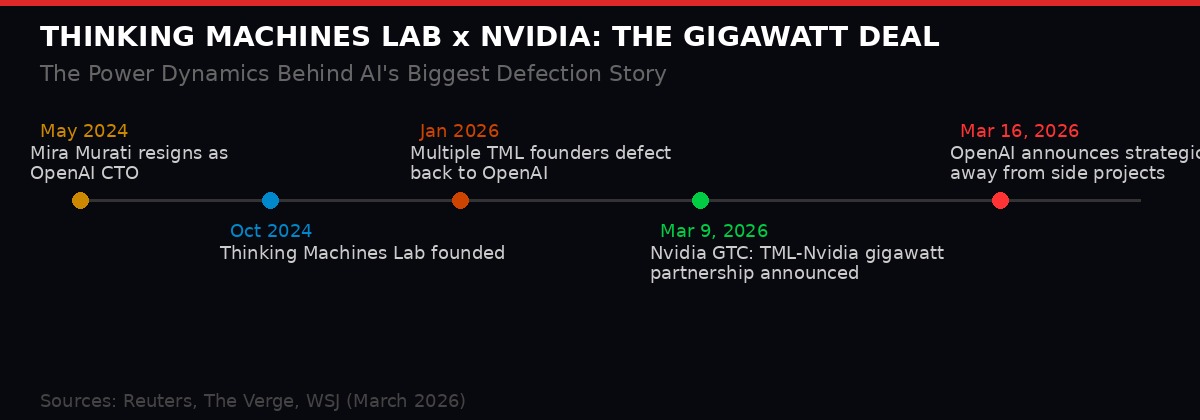
The most significant competitive development of the week: Thinking Machines Lab, the startup founded by former OpenAI CTO Mira Murati after her 2024 resignation, announced a "long-term gigawatt scale strategic partnership" with Nvidia at GTC 2026 on March 9. This is not a small deal. Gigawatt scale means Thinking Machines Lab will have access to Nvidia computing infrastructure at a level that lets it train and run frontier models competitively.
The TML story has a subplot that matters here. Earlier in 2026, multiple founding members of Thinking Machines Lab left the startup to return to OpenAI. At the time, that looked like a defection - a sign of confidence problems at TML and a win for OpenAI. But Murati didn't fold. She locked in the Nvidia partnership and positioned TML as a serious long-term competitor rather than a casualty of talent drain.
The implication for OpenAI is that there are now multiple well-capitalized, talent-dense organizations working on frontier AI models with Nvidia compute backing. Anthropic has its own Nvidia partnership. Google DeepMind operates at scale. Meta's open-source Llama models have created an ecosystem that's giving enterprises an alternative to paying OpenAI's API prices. The competitive moat OpenAI had for most of 2023 and 2024 is meaningfully narrower now.
Against that backdrop, trying to win at video generation, browsers, gadgets, and enterprise coding simultaneously is a resource allocation problem. Something has to give. Simo decided what gives.
What This Means for Enterprise Customers
If you're an enterprise CTO deciding whether to standardize on OpenAI, Anthropic, or Google for your AI infrastructure this year, the Simo memo is actually good news. It means OpenAI is increasingly organizing itself around your needs rather than around consumer experiments that don't affect your IT stack.
The coding focus in particular has direct enterprise implications. OpenAI's Codex platform, Codex Security (the new agent for vulnerability detection and remediation), and the rumored GitHub competitor are all infrastructure-level plays - the kind of sticky, deeply integrated tools that enterprise IT departments don't rip out easily once deployed. If OpenAI can get its coding tools embedded in engineering workflows at major companies, the switching cost becomes substantial.
The Promptfoo acquisition, announced March 9, fits this enterprise-first strategy precisely. Promptfoo is a tool used by 25% of Fortune 500 companies to "identify and remediate vulnerabilities in AI systems during development," per OpenAI's statement. That's not a consumer play. That's a B2B security and compliance product aimed directly at the CISOs and security teams who are increasingly nervous about AI-generated code shipping to production without proper validation.
Combine Codex with Codex Security with Promptfoo with a potential GitHub competitor, and OpenAI is building a complete developer and enterprise coding stack. Write code with Codex. Test it for vulnerabilities with Codex Security and Promptfoo. Host it in OpenAI's code repository. The customer who adopts all of this is deeply locked in - in ways that just having a ChatGPT Enterprise subscription never achieved.
OpenAI's Enterprise Coding Stack - The Full Picture
- Codex / GitHub Copilot - AI code completion, still the dominant product in market
- Codex Security - Launched March 2026, AI agent for vulnerability detection and automated fixes
- Promptfoo (acquired) - Enterprise-grade AI prompt testing and security validation; used by 25% of Fortune 500
- GitHub competitor (in development) - Internal code repository, direct challenge to Microsoft's GitHub
- ChatGPT for Enterprise - The existing B2B subscription layer, 1M+ enterprise seats as of late 2025
The Pentagon Overhang - Politics Complicates the Strategy
Any discussion of OpenAI's enterprise strategy in March 2026 has to acknowledge the politics. The company's deal with the Pentagon, finalized in late February after weeks of public turbulence, remains a live issue that affects enterprise customer decisions.
Caitlin Kalinowski, OpenAI's head of robotics, resigned over the deal on March 7, citing insufficient protections against warrantless surveillance and concerns about granting AI "lethal autonomy without human authorization." Her departure was public and pointed. It came days after the QuitGPT protest movement claimed 1.5 million people had taken some form of action in opposition to the Pentagon contract.
Sam Altman's response was to update the contract language - adding clauses about prohibitions on domestic mass surveillance and "human responsibility for the use of force." Whether those additions are substantive or performative remains contested. But they signal that OpenAI is trying to thread a needle: maintain the military contract revenue while not driving away the enterprise customers and developer talent who have ethical objections.
The enterprise coding strategy actually helps here, at least in terms of optics. A company focused on helping engineering teams write better code and ship fewer security vulnerabilities reads as less threatening than a company building autonomous weapon systems. Simo's pivot narrows OpenAI's public profile toward the relatively non-controversial. That's not an accident.
Timeline: OpenAI's Strategic Shifts in 2026
The Second-Order Effects Nobody Is Talking About
OpenAI abandoning Sora doesn't kill AI video generation. It probably accelerates it. When OpenAI stops competing seriously in a space, the resources and talent that were fighting it there - at Runway, Pika, Luma, and Google DeepMind's Veo team - can stop defensively matching OpenAI's every move and start innovating offensively. The companies that were worried about being crushed by OpenAI entering their market now have room to breathe.
The Atlas browser pause has a similar effect on the browser AI space. Perplexity has been building an AI-native browser. Arc from The Browser Company has been experimenting with AI integration for two years. Neither of them has to worry about an OpenAI browser funded by $50 billion in compute resources. That's a real relief for their product roadmaps and their investor conversations.
The coding consolidation will intensify what was already a vicious market. When OpenAI focuses hard on something, it typically wins or at minimum transforms the category. GitHub Copilot will likely see renewed resources and investment through the Microsoft relationship. Cursor and other independent players need to build defensible differentiation now, before OpenAI's engineering focus reaches them at full force. The acquisition pace in AI developer tools should accelerate as smaller players try to get acquired before the window closes.
There's also a policy dimension. Congress has been holding hearings on AI regulation, and one of the consistent concerns from legislators is that AI companies are pursuing too many high-risk applications simultaneously with insufficient oversight. An OpenAI that's explicitly focused on coding tools and enterprise software reads as more tractable to regulate than an OpenAI that's simultaneously in video, browsers, gadgets, robotics, and military contracts. The pivot, intentionally or not, makes OpenAI a smaller target for aggressive AI governance.
Finally, watch what happens to OpenAI's relationship with Microsoft. The GitHub competitor is a live grenade in that partnership. If OpenAI is actively building a product designed to displace GitHub - Microsoft's $7.5 billion acquisition - while simultaneously taking billions in Microsoft Azure credits and having Altman on friendly terms with Satya Nadella, something has to give. The enterprise coding battle may end up being the arena where OpenAI and Microsoft's interests fully diverge for the first time.
What Comes Next
The immediate consequences to watch: headcount movement out of the Sora and Atlas teams over the next 60 days. Any public comment from Altman about the scope of the pivot. Whether OpenAI's GitHub competitor gets publicly announced, quietly killed, or leaked further. And how the enterprise developer market responds - specifically whether Codex and the new security products actually accelerate enterprise contract signings in Q2 2026.
The medium-term question is whether this focus holds. OpenAI has made strategic pivots before and found itself drawn back into wide-bet mode by the pressure to justify its $150 billion-plus valuation. Investors who bought at those prices need a story bigger than "we make good coding tools." The tension between investor-driven growth narrative and operator-driven discipline is not resolved by one internal memo.
Simo has credibility precisely because she is not a visionary. She is an operator who took Instacart public and knows how to build businesses that actually generate revenue. If anyone can hold OpenAI to a focused roadmap against the gravitational pull of Altman's expansive ambitions, it's her. Whether that's enough to win the enterprise coding market against GitHub Copilot, Cursor, Amazon Kiro, and every other well-funded player also fighting for developer wallets in 2026 - that's the question the next two quarters will answer.
The AI company that tried to do everything has decided to do less. That's usually either the moment a company finds its discipline and becomes great, or the moment it admits it's on the defensive. Which one this is won't be clear until the revenue numbers tell the story.
Get BLACKWIRE reports first.
Breaking news, investigations, and analysis - straight to your phone.
Join @blackwirenews on Telegram