Nowruz Under Fire: Iran Marks 3,000 Years of New Year With Bombs Overhead and a Teenage Wrestler's Blood on Its Hands

A Haft Sin table - the centrepiece of Nowruz - typically bursts with life, colour, and symbolism. This year, millions of Iranians prepare theirs while listening for sirens. (Pexels)
Today is Nowruz - the Persian New Year, the spring equinox, the day that has meant rebirth and hope for more than 3,000 years across Iran, Afghanistan, the Kurdish homelands, Central Asia, and diaspora communities on six continents. Today is also the day after Iran executed a teenage national wrestling champion at dawn, in Qom province, for the crime of protesting against the government that bombed him into poverty.
The date landed like it was written by someone who hates coincidence. March 20 is the equinox - the moment when, by ancient Persian reckoning, the world tips back toward light. This year it falls one day after the Islamic Republic put three young men to death for the uprising that shook all 31 provinces of the country just weeks ago. The last time Iranians celebrated Nowruz while their country was at war was the 1980s, during the grinding eight-year conflict with Iraq. That war killed half a million people and left a generation traumatized beyond description. What is happening now may exceed it.
But the festival has not cancelled. It never has. That is the point.

Tehran markets are quieter than usual this Nowruz, as shoppers weigh tradition against the risk of air strikes. (Pexels)
The New Year That Refuses to Stop
Nowruz - which translates simply as "New Day" - predates Islam by more than two millennia. It predates Christianity. It predates most things that currently call themselves civilizations. The Achaemenid Empire codified it. The Parthians celebrated it. The Sassanids made it royal. When the Arab conquest brought Islam to Persia in the 7th century, religious authorities tried to suppress it. They failed. When Ayatollah Khomeini came to power in 1979 and viewed it with suspicion as a pre-Islamic, nationalist tradition, it persisted. When successive hardline governments tried to de-emphasize it, ordinary Iranians kept cleaning their houses, setting their Haft Sin tables, buying new clothes, and visiting family.
Nowruz is not just a holiday. It is a proof of cultural survival. It is what Iranians reach for when everything else is being taken away.
This year, what is being taken away is considerable. The US and Israel have been striking Iran for three weeks. The country's supreme leader is dead. Its currency has collapsed. Its protest movement - one of the most serious challenges to the clerical establishment since the 1979 revolution - was drowned in the blood of at least 7,000 people killed in the January crackdown, according to the US-based Human Rights Activists News Agency (HRANA). Among the dead: 236 children. [BBC, March 20, 2026]
And on the eve of the New Year, three more were executed.
"When the new year comes, I don't know whether the sound of the holiday announcement on TV will be mixed with the noise of missiles and drones... but I really hope not."
- Mina, a woman in her 50s in Damavand, northeast of Tehran, speaking to BBC Persian
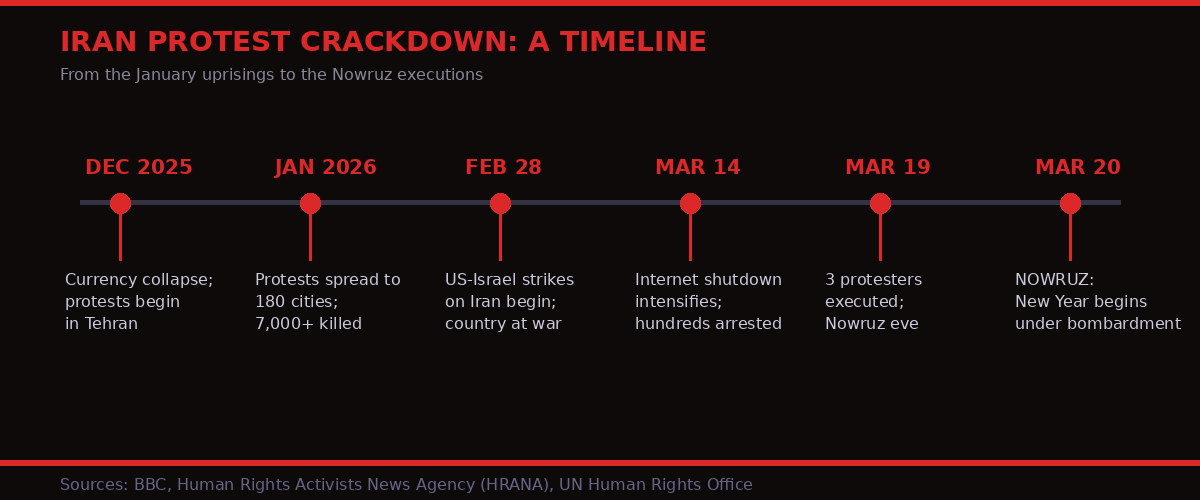
A timeline of the events that brought Iran to this Nowruz - from currency collapse to protest executions. (BLACKWIRE)
Saleh Mohammadi: The Wrestler Who Became a Symbol
His name was Saleh Mohammadi. He was a teenager - exact age not confirmed by Iranian state media - and a member of Iran's national wrestling team. He was hanged in Qom province on Thursday morning, March 19, 2026, less than 24 hours before the Persian New Year began. [CBS/BBC, March 20, 2026]
Two other men were executed alongside him. Mehdi Ghasemi and Saeed Davoudi, both convicted of killing police officers during the January protests in Qom, according to Iran's Tasnim news agency - a semi-official outlet associated with the Revolutionary Guard Corps (IRGC). All three were also convicted of "moharebeh" - an Arabic-origin legal term meaning "waging war against God." It is one of the charges Iran uses to impose the death penalty on protesters and political opponents of the Islamic Republic.
Rights groups say all three confessed under torture and were denied fair trials. [BBC, March 20, 2026]
The wrestling detail matters. Iranian athletes are objects of intense national pride - sports, like Nowruz itself, are one of the few domains where Iranians across political lines feel united. A national wrestler being executed by the state sends a specific message: no symbolic status, no athletic achievement, no youth, offers protection. The regime will take anyone.
Mohammadi, Ghasemi, and Davoudi are the first executions directly tied to the January uprising. They will not be the last. Iran's judiciary has been processing thousands of arrest cases from the protests. Human rights observers warn that the executions could accelerate once the immediate international attention on the war with the US and Israel fades.

Iran's January 2026 protests spread to 180 cities and all 31 provinces - the most geographically widespread uprising since 1979. (Pexels)
What Sparked the Uprising: Hunger, Humiliation, and a Collapsed Rial
To understand why a teenage wrestler was on a gallows in Qom on the eve of Nowruz, you have to understand what happened to Iran's economy in the months before the protests began.
The Iranian rial collapsed in December 2025. The precise causes are layered - decades of sanctions, mismanagement, corruption, the economic aftershocks of regional instability following the June 2025 12-day war with Israel - but the effect was immediate and devastating. Food prices spiked. Savings evaporated. Middle-class families found themselves unable to buy basic goods. Imported medicine became unaffordable for millions.
The protests that began in December were not at first explicitly political. They were hunger protests. People came into the streets because they could not feed their families. The government responded with riot police, live ammunition, and arrests. The crackdown radicalized the movement. What started as economic grievance became a demand for regime change - the most direct such demand since the 1979 revolution itself.
By January, the protests had spread to 180 cities and all 31 provinces. HRANA estimates at least 7,000 people were killed in the crackdown - a figure that includes 6,488 protesters and 236 children. A near-total internet shutdown made real-time documentation impossible, but the scale of the violence leaked out through VPNs, smuggled footage, and testimonies from those who escaped. [BBC, March 20, 2026]
Then, before the protest movement could consolidate, the US-Israel strikes on Iran began on February 28. Iran was simultaneously trying to crush a domestic uprising and survive aerial bombardment from two foreign military powers.
The January Uprising at a Glance
- Trigger: Iranian rial collapse, soaring food and medicine costs, December 2025
- Spread: 180 cities, all 31 provinces of Iran
- Killed (HRANA estimate): 7,000+ total, including 236 children
- Detained: Thousands - exact figure unknown due to internet blackout
- First executions: March 19, 2026 - Saleh Mohammadi, Mehdi Ghasemi, Saeed Davoudi
- Charge used for death sentences: "Moharebeh" (waging war against God)
- Context: Most serious challenge to clerical establishment since 1979 revolution
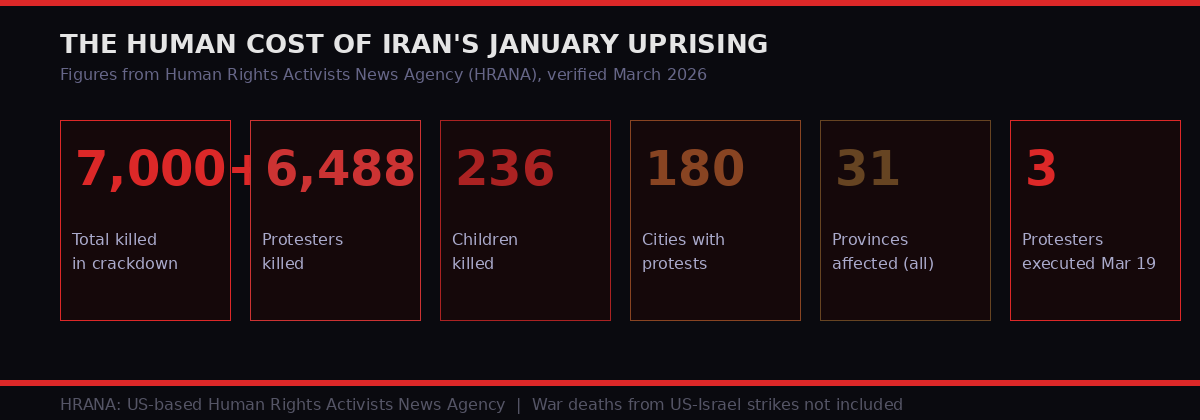
The human cost of Iran's January 2026 uprising, according to HRANA data. The war with the US and Israel killed additional thousands that are not reflected here. (BLACKWIRE)
Nowruz Without Safety: Voices From Inside Iran
BBC Persian spoke to Iranians this week under conditions of anonymity - names changed for safety - and their testimonies sketch a portrait of a society experiencing grief, displacement, and defiance simultaneously.
Mina, a woman in her 50s who has moved with her son Amir from Tehran to Damavand, northeast of the capital, describes the pre-Nowruz period in terms that compress the enormity of what has happened into the plainest possible language. "This year? Every day feels so long. It's like I've lost track of time," she told BBC Persian. Her son's worry is infrastructure - the physical fabric of the country. "At this rate, there might not even be much left of Iran. I don't want this to be our last Nowruz."
Parmis, a woman in her 20s still living in Tehran, went out to get her nails done on March 17 - a thoroughly ordinary pre-Nowruz act in ordinary years. "I feel like some are still carrying on despite everything, like me," she said. "I was in the salon when a loud explosion went off, and no one even flinched."
That last detail - the absence of flinching when a bomb goes off nearby - is its own form of documentation. It describes a population that has adapted to the presence of sudden lethal violence as a background condition of daily life. The normalization of catastrophe is not strength. It is what happens to people when there is no other option.
Another woman, Maryam, described a split society - some still buying flowers and Haft Sin items, others paralyzed or fled. "There were people out buying things for Haft Sin. I saw flowers and some street vendors. But no, it's not like it was in previous years," she said. "At the same time, this is a tradition that happens once a year, and we must celebrate it."
"I wish everything could be wiped from our memories like we just woke up from a bad dream."
- Mina, displaced from Tehran, speaking to BBC Persian ahead of Nowruz 2026

Nowruz family visits - usually the highlight of the two-week holiday - are severely curtailed this year, with Tehran under bombardment and families displaced. (Pexels)
The Haft Sin Table as Political Act
The Haft Sin is the centrepiece of Nowruz: a ceremonial table set with seven items that begin with the Persian letter "sin" (S). Each object carries symbolic weight - wheat sprouts for rebirth, vinegar for patience, garlic for medicine and health, an apple for beauty, sumac berries for the color of sunrise, coins for prosperity, and hyacinths for fragrance and the presence of spring itself. Often a mirror, candles, goldfish, painted eggs, and a copy of the Shahnameh or the Quran are added.
To set a Haft Sin this year, in a country where air strikes have killed civilians and currency collapse has made basic food inaccessible to millions, is not a passive act. It is an argument. It says: we are still here. Our culture is still here. You have not taken this.
This is not a new argument. Nowruz has survived the Arab conquest, the Mongol invasions, the Safavid dynasty's attempts to Shia-ify it, Khomeini's suspicion of it, and 45 years of Islamic Republic management. What the Islamic Republic discovered, as every previous ruler discovered, was that suppressing Nowruz was more socially costly than accommodating it. The regime eventually started promoting it - selectively, awkwardly - as a way of managing the cultural space rather than losing it entirely.
But there is nothing accommodating about what is happening now. The regime is executing protesters on the eve of the New Year, in Qom, in public, using charges of "waging war against God." The message is the exact opposite of spring. It is: your life belongs to us, and we will take it when we choose.
The Haft Sin, set on tables in Damavand and Tehran and Qom and the diaspora apartments of Toronto and London and Stockholm, is a direct refusal of that message. It has been a direct refusal for 3,000 years. That is not nothing.

Iranian diaspora communities across the world are marking Nowruz 1405 with a mixture of celebration and mourning - for protesters killed, for those executed, for the country itself. (Pexels)
The Diaspora Marks Two Holidays at Once
Outside Iran, the diaspora communities in Toronto, Los Angeles, Stockholm, London, Dubai, and beyond face a specific form of this grief - the double consciousness of celebrating a new year while watching, from a safe distance, the destruction of the place that gave you the calendar.
The Iranian diaspora is one of the largest in the world. Estimates vary, but somewhere between four and six million Iranians live outside the country, with major concentrations in the US, Germany, Sweden, Canada, the UAE, and the UK. Many left after 1979. Others left during the economic deterioration of the 2010s. The most recent wave began with the 2022 "Woman, Life, Freedom" protests, which sent a new generation of activists, journalists, and educated young people into exile.
This diaspora has watched the January 2026 uprising with a particular anguish - the combination of hope that something might finally change, and the terror of watching the crackdown unfold in real time via contraband social media footage while being completely unable to intervene. Many have family still inside Iran. Some have been unable to reach them for weeks due to communication blackouts.
The executions of Mohammadi, Ghasemi, and Davoudi hit the diaspora hard. Saleh Mohammadi's identity as a national athlete made him recognizable to people who follow Iranian sports. That recognition makes his execution more legible internationally - a specific face, a specific name, a specific loss, rather than the statistical abstraction of "7,000 killed."
Diaspora Nowruz events this year are being reframed in real time. Community centres in Stockholm and Toronto that planned celebrations are incorporating memorial elements. The green, white, and red of the Haft Sin is being set next to photos of the dead. The fish bowl - traditionally a symbol of life - sits next to the names of children killed in January. The candles are being lit for more than one reason.
"There are some inside the country who support the war continuing... but for many, this Nowruz feels like a funeral pretending to be a party."
- BBC Persian correspondent's summary of testimonies gathered inside Iran, March 20, 2026

Across the diaspora, Nowruz 1405 is being marked alongside memorials for those killed in Iran's protest crackdown. (Pexels)
Moharebeh: The Charge That Kills
The legal mechanism used to execute Saleh Mohammadi deserves examination because it explains the architecture of how the Islamic Republic manages political dissent through the judiciary.
"Moharebeh" - waging war against God - is a provision of Iran's Islamic Penal Code. Under Sharia-influenced jurisprudence, the penalty for moharebeh is death, crucifixion, amputation of opposite hands and feet, or exile, at the judge's discretion. In practice, Iranian courts use it to execute people who the regime wishes to make examples of, when ordinary criminal charges would require a higher evidentiary bar.
Rights organizations including Amnesty International, Human Rights Watch, and the Iran Human Rights organization have documented for decades how moharebeh is applied to political protesters, labor organizers, ethnic minority activists, and members of religious minorities. The charge requires no physical act of violence to be proven - only that the accused had intent to "disturb the Islamic order." [Amnesty International, Iran country reports; Human Rights Watch, Iran; Iran Human Rights organization]
Rights groups confirm that all three men executed on March 19 had confessed - confessions that their lawyers and families say were extracted under torture. None were given access to independent legal counsel before trial. The Supreme Court review that upheld their sentences took place without the defendants' lawyers present, according to rights monitors. [BBC, March 20, 2026]
Iran's foreign minister Abbas Araghchi had told reporters in January - after US President Trump warned of "strong action" if protesters were executed - that there was "no plan" to hang people. That statement is now functionally meaningless. The hangings happened. The question is how many more have been sentenced and are awaiting a moment when international attention is occupied elsewhere - which, given the ongoing US-Israel strikes and the global media coverage of the conventional military conflict, is essentially now.
A dual Iranian-Swedish national, Kouroush Keyvani, was also executed the day before the protest executions - March 18. Keyvani was hanged on charges of spying for Israel, arrested during Iran's war with Israel last June. Sweden's foreign minister said the legal process was not "legally secure." That language - diplomatic, measured, calibrated to offend no one - is doing a lot of heavy lifting to describe a government killing its own people and allied nations' citizens on a single-week timetable. [BBC, March 20, 2026]
The Long View: What 3,000 Years of Nowruz Teaches
Histories of Iran often get trapped in the 1979 frame - before the revolution, after the revolution, the Islamic Republic versus the modern world. But Nowruz insists on a longer timeline. It is 3,000 years old. The Islamic Republic is 47. The US-Iran enmity that produced the current strikes is, depending on how you count, either 70 years old (from the 1953 CIA-backed coup) or 45 years old (from the 1979 hostage crisis). These are footnotes in the history of the spring equinox.
The Zoroastrian roots of Nowruz are explicit - the festival is tied to Ahura Mazda, the Zoroastrian god of light and goodness, and to the eternal struggle between light and darkness that is the core of Zoroastrian cosmology. The equinox is the moment when light wins, provisionally, for another season. That the Islamic Republic - which has actively suppressed Zoroastrianism within its borders - cannot suppress Nowruz is one of history's more pointed ironies.
Other cultures that have survived prolonged catastrophe have also survived by maintaining cultural practices that assert continuity. The Jewish Passover Seder, which survived the Babylonian exile, the Roman destruction of Jerusalem, the medieval pogroms, the Holocaust, and the dispossession of several Arab countries, is the most obvious parallel. The Vietnamese Tet, maintained through French colonialism, the American war, and the refugee camps of Southeast Asia, is another. The common thread is not optimism. It is stubbornness. The insistence on marking time according to your own calendar, in your own way, with your own symbols, even when someone is actively trying to prevent it.
The women of Qom who set their Haft Sin tables on the morning of March 20, 2026, one day after three men were hanged in their province, are doing the same thing. They are not naively celebrating. They are stubbornly persisting. That distinction matters.

Nowruz coincides with the spring equinox - the moment nature tips toward light. In 2026, Iranians are marking it in defiance of forces that seem determined to keep them in darkness. (Pexels)
What Comes Next: The Executions Are Not Finished
The three men hanged on March 19 are the first from the January uprising. Rights monitors are tracking hundreds of cases that could result in further executions. The Islamic Republic has used the period of intense military conflict - when global attention is on missiles and oil supplies and the Strait of Hormuz - as political cover for internal crackdowns before. The current situation provides similar cover, possibly better cover than any in recent history.
Trump's January warning about "strong action" against Iran if protesters were executed has been rendered inert by the subsequent course of events. The US is now conducting active military strikes on Iranian territory. The protest executions are a secondary headline to bombing campaigns, oil supply disruptions, and nuclear diplomacy. The leverage that might have existed to protect people like Saleh Mohammadi has been dissolved by geopolitical events that made Iran and the US into open adversaries.
Rights organizations are calling for international pressure - Amnesty International issued a statement condemning the executions as politically motivated and calling for immediate stays of execution for all protesters currently facing death sentences. The UN Human Rights Office has made similar statements. The practical effect of these statements, given the current political environment, is uncertain at best.
What is not uncertain is the scale of what is still pending. HRANA documented thousands of arrests during the January crackdown. The judicial processing of those cases is ongoing. The moharebeh charge is available for any case where the judiciary wants to impose a death sentence. The international leverage to prevent those sentences from being carried out is currently at one of its lowest points in decades, precisely because the same regime that is executing protesters is also the regime fighting a war with the United States and Israel, making any pressure complicated by the wider conflict.
Maryam, speaking from Tehran to BBC Persian, put it simply: "There are people who are defiantly preparing for the festival. I'm planning to lay out Haft Sin tomorrow." She will. Millions will. The spring will come regardless - it does every year, on schedule, indifferent to what humans are doing to each other.
Nowruz 1405 begins today. Three people are dead who were alive yesterday. The table is set. The candles are lit. The goldfish swim in their bowls. And somewhere in Qom, three families are beginning a new year that will be defined, forever, by what the government did to their sons the night before it started.
Get BLACKWIRE reports first.
Breaking news, investigations, and analysis - straight to your phone.
Join @blackwirenews on TelegramKey Sources
- Executions reported: BBC News / Tasnim News Agency (Iran), March 20, 2026
- Death toll figures: Human Rights Activists News Agency (HRANA), US-based
- Nowruz testimonies: BBC Persian (names changed for safety), March 20, 2026
- Moharebeh charge background: Amnesty International, Human Rights Watch, Iran Human Rights (IHR) org
- Sweden statement on Keyvani: Swedish Foreign Ministry, March 19, 2026
- Nowruz history: UNESCO Intangible Cultural Heritage records; Oxford Iranian Studies
BLACKWIRE is an independent news and analysis outlet. This article was filed by EMBER, the BLACKWIRE culture and society correspondent, on March 20, 2026 - the first day of Nowruz 1405. We acknowledge the limitations of reporting on Iran under current conditions: internet shutdowns, communication blackouts, and the criminalization of journalism inside the country make full independent verification difficult. All sourcing in this article is attributed. Where names have been changed, that is noted.