Netflix Paid $600M for Ben Affleck's AI Startup. Hollywood Is Next.

Hollywood's production pipeline is being rebuilt around AI tools. (Photo: Pexels)
Netflix just dropped $600 million on an AI company most people had never heard of. That the founder happens to be Ben Affleck is almost beside the point. The real story is what Netflix is trying to buy - and what it signals about where the next trillion-dollar battle in entertainment is headed.
The deal, confirmed this week, makes Netflix the first major streaming platform to outright acquire an AI production startup rather than simply license tools or run experiments. According to reporting by The Verge, Affleck's company takes a deliberately different approach to generative AI than most startups cluttering the space - something Netflix's executives apparently found compelling enough to pay nearly a billion dollars for.
It lands at a peculiar moment. Just days earlier, BuzzFeed - the media company that bet its entire future on AI content generation three years ago - disclosed a net loss of $57.3 million for 2025 and warned investors of "substantial doubt" about its ability to continue as a going concern. Its stock hovers at 70 cents. Meanwhile Meta delayed its flagship next-generation model by at least two months after it underperformed against competitors. And Anthropic is fighting the US Department of War over whether its AI systems can be used to automate mass surveillance and lethal weapons targeting.
The entertainment industry is watching all of this unfold while trying to figure out which side of the AI story it belongs on. Netflix just placed its bet. Here is what they bought - and why the rest of Hollywood should be paying very close attention.
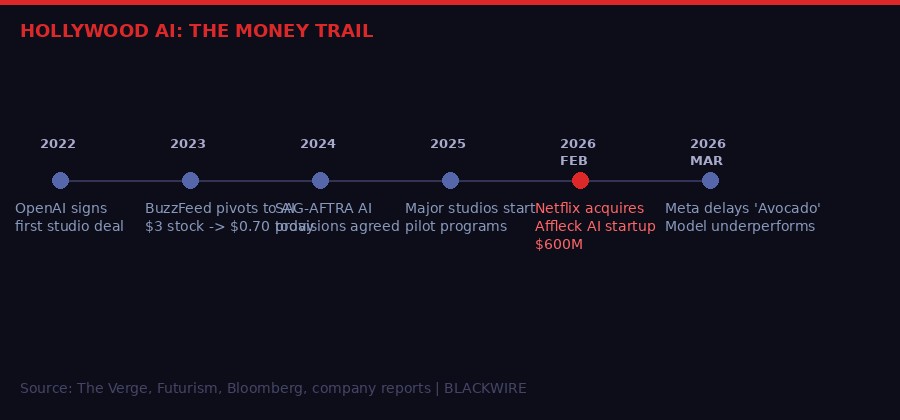
The money trail: Hollywood's AI investment journey from 2022 through Netflix's $600M acquisition. (BLACKWIRE)
What Netflix Actually Bought
The specific technology inside Affleck's startup has not been disclosed in detail. But the framing matters: The Verge described it as a company with "a different approach to gen AI" - language that carries weight in a market increasingly recognizing that most generative AI tools are not fit for professional entertainment production.
The central problem with most gen AI applied to Hollywood is that it is optimized for quantity, not quality. The tools flooding the market can generate scripts in seconds, but they produce content that feels generic, derivative, and unpleasantly familiar - what the AI research community has started calling "model collapse," where outputs trend toward the statistical mean of everything that came before.
Creative professionals need the opposite of that. A director needs tools that help them articulate and execute a specific vision, not tools that smooth every rough edge into something indistinguishable from a thousand other projects. The studios that have quietly piloted generative AI tools over the past two years have learned this the hard way.
What distinguishes the successful AI applications in production - VFX enhancement, audience analytics, script analysis for budget estimation, location scouting automation - is that they function as tools for human decision-making rather than as decision-makers themselves. That distinction sounds simple. It has proven extremely difficult to get right in practice.
"The problem isn't whether AI can write a script. It's whether the output is worth anything once it does." - Industry observer quoted by The Verge in coverage of Netflix's AI strategy
Affleck's involvement as a filmmaker - Academy Award winner for Good Will Hunting's screenplay, director of critically respected films like Gone Baby Gone and Argo - suggests his company may be approaching AI from the practitioner side rather than the pure technology side. That practitioner perspective is precisely what most AI startups selling to Hollywood lack.
The BuzzFeed Warning Everyone Ignored
Three years before Netflix's $600 million bet, BuzzFeed made the opposite gamble. In January 2023, CEO Jonah Peretti announced a hard pivot to AI content generation. The company's stock briefly spiked from $3 to $15 on the news. Then the reality arrived.
The AI-generated quizzes were underwhelming. The AI articles were sloppy and repetitive. Readers noticed immediately. The Pulitzer Prize-winning BuzzFeed News division had already been shut down - a casualty of cost-cutting before the AI pivot - removing the credibility anchor that might have kept audiences engaged through the transition.
By 2025, BuzzFeed had accumulated a net loss of $57.3 million for the full year. As of March 2026, its shares trade at approximately $0.70 - down roughly 95 percent from that brief AI-enthusiasm peak. The company's own financial disclosures include the phrase "substantial doubt about the Company's ability to continue as a going concern."
Despite all of this, CEO Peretti has announced plans to bring "new AI apps to market" this year. The lesson apparently did not penetrate.
The BuzzFeed failure offers a precise diagnosis for why most AI-in-media experiments go wrong. Peretti promised in May 2023 that AI would "replace the majority of static content" on the site - framing AI as a cost-reduction engine rather than a creative enhancement tool. That framing produces bad content. Bad content drives away audiences. No audience, no revenue. The math is merciless.
The BuzzFeed Collapse - By the Numbers
- January 2023: AI pivot announced, stock spikes from $3 to $15
- April 2023: BuzzFeed News division shut down (Pulitzer-winning journalism unit)
- May 2023: CEO promises AI will "replace majority of static content"
- 2024: AI-generated articles draw reader backlash and coverage quality criticism
- Full year 2025: Net loss of $57.3 million reported (CNN, March 2026)
- March 2026: Stock at $0.70, filing warns of going concern doubt
- March 2026: CEO announces new AI apps are planned anyway
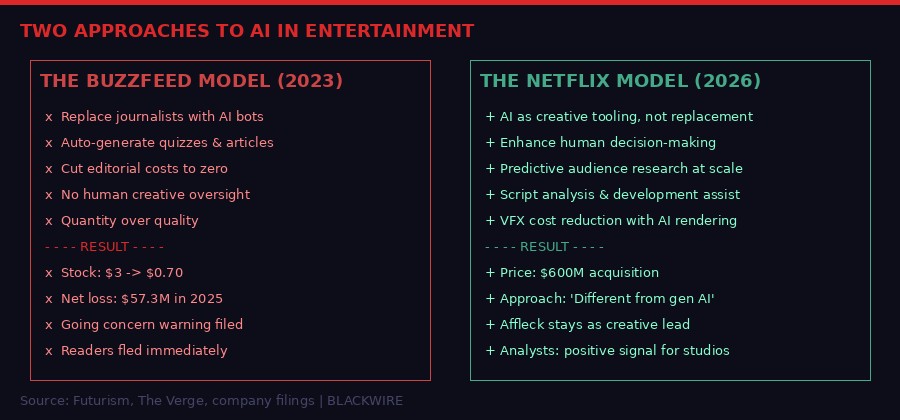
Two approaches to AI in entertainment: what separates a $600M acquisition from a going-concern warning. (BLACKWIRE)
Meta's Stumble and What It Means for Everyone Else
Netflix's timing is notable in another respect. It came just days after Meta announced it was delaying its next major AI model - codenamed Avocado - from its planned March release to at least May. The reason, according to the New York Times: performance falls short of rivals like Google.
Meta has spent enormous sums trying to reclaim its position in the AI race. After Llama 4's disappointing release - compounded by revelations that Meta had been gaming AI benchmarks to make performance look better than it was - Zuckerberg brought in Scale AI CEO Alexandr Wang and restructured the company's AI efforts around a secretive internal group called TBD Lab, which operates in a "siloed space" near Zuckerberg's office at Meta's Menlo Park headquarters.
The Avocado delay has a specific implication for the entertainment sector: Facebook and Instagram are the platforms where much entertainment marketing happens, and Meta's AI capabilities directly influence how well studios can target and convert audiences. A Meta that is running two months behind Google and OpenAI is a Meta that can offer less precise audience intelligence to the studios and streamers spending hundreds of millions on content promotion through its platforms.
More importantly, the delay signals that building leading-edge AI models has gotten harder and more expensive, not easier. The competitive gap between the top three players - OpenAI, Google, and Anthropic - and everyone else is widening. Meta, despite its massive data advantages from Facebook and Instagram, is struggling. Disney, Warner Bros, and Paramount lack Meta's technical resources and are nowhere near building their own models.
This dynamic explains exactly why Netflix chose to acquire rather than build. At $600 million, Affleck's startup costs less than what Meta spends in a single quarter on AI research and development. But it arrives with proven technology, existing creative relationships, and - crucially - a founding team that already understands what film and television production actually requires.
Meta's Avocado model was "supposed to be Meta's answer to GPT-5 and Gemini Ultra" - but it isn't ready, and the delay has reset competitive expectations across the entire industry. (Bloomberg, March 2026)
Hollywood's Labor Battlefield
Any analysis of AI in entertainment that ignores the labor dimension is incomplete. The 2023 SAG-AFTRA and WGA strikes were explicitly triggered in part by AI concerns - specifically, studios' stated desire to use AI to generate scripts and to digitally replicate actors' likenesses without fair compensation or consent.
The deals that ended those strikes included specific AI provisions: writers must be compensated if their work is used to train AI models, and actors must consent to and receive payment for digital replicas. But the agreements were written for a technological landscape that has already shifted. The tools available in March 2026 are more capable than anything imagined when those contracts were negotiated.
Netflix's acquisition raises immediate questions about compliance. If Affleck's AI tools assist in the scriptwriting or production process, does that constitute using AI-generated content under the WGA agreement? If the technology produces synthetic performances or background elements using actors' likenesses, how does that interact with SAG-AFTRA protections?
SAG-AFTRA and the WGA have not yet commented publicly on the Netflix acquisition. But both unions have sophisticated legal teams who have been preparing for exactly this scenario. The agreement language is complex and the edge cases are multiplying fast.
The unions' concern is not abstract. Real wages for working writers and actors are under pressure. Mid-tier scripted television - the training ground for new talent, the career sustainer for experienced writers - has contracted sharply over the past three years as streaming platforms pulled back on content volume and turned to AI tools for early development work like coverage, pitch analysis, and rough scene generation. These are exactly the roles that entry-level writers historically filled.
Netflix's argument will likely be that AI tools improve production efficiency without displacing workers - that they make the remaining human creative work more effective. The unions will argue that "efficiency" is a cover for headcount reduction. Both sides have evidence to support their positions. The litigation and contract renegotiation is coming.
Key AI Provisions in Entertainment Labor Agreements
- WGA (2023): Studios must disclose when AI is used in script development; AI-generated material cannot be used as source material without consent
- SAG-AFTRA (2023): AI digital replicas require individual consent and fair compensation; scanned likenesses cannot be repurposed without agreement
- Residual uncertainty: "Training data" provisions remain contested in arbitration
- Renegotiation windows: Both major agreements come up for renewal in 2026-2027
- Enforcement challenge: Production increasingly distributed across international co-productions where US labor law does not reach
The Second-Order Effects: Who Loses When Netflix Wins
Netflix's acquisition does not just change how Netflix makes content. It changes what every other studio has to do to remain competitive.
Amazon has already deployed AI tools through its MGM acquisition pipeline - using machine learning for script coverage, audience targeting, and marketing optimization. Disney has internal AI research programs that have been running for several years, with applications ranging from VFX to park operations. Apple TV+ has been quieter publicly but has substantial AI resources through Apple's broader research division.
The studios without those resources - Lionsgate, A24, independent production companies, international co-production houses - are now facing a structural disadvantage that money alone cannot easily fix. You cannot buy your way to AI capability just by writing a check for tools. You need the institutional knowledge to use those tools effectively within a creative production pipeline, and that knowledge takes years to develop.
The mid-tier studio model was already under existential pressure from streaming consolidation. AI adds another layer of structural disadvantage. Companies that cannot afford to acquire AI capability will find themselves increasingly reliant on whatever tools the major platforms make available to them - likely at premium pricing and on terms that favor the platform.
There is a parallel here with what happened to independent record labels in the early streaming era. Spotify's algorithm gave enormous distribution advantages to major labels that could afford to pay for playlist placement and data analytics services. The independent music ecosystem did not die, but it restructured dramatically around the major platforms' rules.
The entertainment version of that restructuring is beginning now. Netflix paying $600 million to bring AI capability in-house rather than buying it from a vendor is the same logic that drove Spotify to build its own podcast production division: control the infrastructure, control the terms.
The Platform Wars Get a New Weapon
Netflix's strategic logic goes deeper than production efficiency. The company has spent two years building out its advertising business - a fundamental shift from its original ad-free model. That advertising business lives or dies on audience intelligence: understanding who is watching what, predicting what they will watch next, and helping advertisers reach them precisely.
AI is the engine of all of that. Netflix's recommendation system is already among the most sophisticated in consumer technology, responsible for approximately 80 percent of what subscribers end up watching according to internal figures the company has referenced in investor materials. But recommendation is only one dimension of audience intelligence. Understanding why people watch, predicting cancellation risk, optimizing thumbnail and title selection, modeling the revenue impact of different content investment decisions - these all require AI capabilities that are increasingly becoming differentiating infrastructure rather than commodity tools.
By acquiring Affleck's startup outright, Netflix keeps whatever proprietary technology it contains out of competitors' hands. Even if Amazon, Apple, or Disney had been willing to pay $700 million or $800 million, Netflix could have outbid them simply by valuing the competitive exclusion as part of the deal price.
The streaming wars phase one was about content volume - who could spend the most on programming. That phase produced unsustainable content budgets across the industry and a wave of consolidation as weaker players ran out of cash. Phase two was about profitability - the drive to cut content spending while retaining subscribers. That phase produced the wave of cancellations, layoffs, and "password sharing crackdowns" that defined 2023 and 2024.
Phase three is about infrastructure advantage. Who has the most sophisticated tools for deciding what to make, for whom, at what cost, and how to market it. Netflix just made its opening move.

The streaming war's next phase is infrastructure and AI - not just content volume. (Photo: Pexels)
The Brendan Carr Factor: Regulation Looms
There is a wildcard in all of this that most entertainment industry analysis ignores: the regulatory environment under the current FCC leadership.
FCC Chairman Brendan Carr has been aggressively threatening broadcast licenses of networks whose coverage he views as unfavorable to the Trump administration. The Verge has reported on multiple instances of Carr using license renewal processes as leverage against news organizations. This is not primarily an AI story, but it is deeply connected to one.
The media companies most vulnerable to AI-driven disruption - legacy broadcasters, cable news networks, newspaper chains with digital presences - are also the companies most exposed to regulatory pressure from an FCC chairman who has shown willingness to use licensing authority as a political weapon.
If a network faces license scrutiny and simultaneously faces competitive pressure from Netflix's AI-enhanced content production, the resulting squeeze creates a specific kind of institutional fragility. Companies under regulatory threat tend to pull back on risky editorial decisions. Companies losing audience share to better-targeted streaming content cut editorial budgets. Both pressures point in the same direction: less quality journalism, less original content, more reliance on cheap AI-generated filler.
The BuzzFeed case demonstrates what happens to media companies that make the wrong AI bet under financial pressure. The question is whether the regulatory pressure Carr is applying will push other media organizations toward the same wrong bet, just to cut costs fast enough to survive.
Timeline: The Current AI-in-Hollywood Landscape
- March 5: Palantir publishes detailed case study of AI military targeting tools, now widely deployed through NATO's Maven Smart System
- March 11: Anthropic upgrades Claude's spreadsheet and productivity tools; Pentagon negotiations over lethal autonomous weapons continue
- March 12: BuzzFeed reports $57.3M net loss for 2025, warns of going concern doubt after failed AI content pivot
- March 12: Netflix confirms acquisition of Ben Affleck's AI startup for approximately $600 million
- March 13: Meta delays Avocado AI model from March to at least May; cites performance gap versus Google
- March 15: Brendan Carr "threatening people's broadcast licenses again" - per The Verge reporting
- March 16: Netflix and Affleck yet to detail specific technology acquired; labor unions preparing response
What Happens Next
The Netflix-Affleck deal is a starting gun, not a finish line. Expect a wave of similar acquisitions or deeper partnership deals from Amazon (through MGM), Apple (through its Silicon/AI division), and potentially Comcast/Universal over the next 18 months. Disney is the most interesting open question: it has the brand value and the IP library to justify massive AI investment, but it also has the most complex labor relationships of any major studio, given its theme park workforce and its unionized animation guilds.
The technology itself will keep advancing faster than any of these companies' acquisition strategies can track. The real competitive advantage will not be which studio bought which AI startup in 2026 - it will be which studio built the organizational culture and workflows to use AI tools effectively as those tools change every six months. That is an institutional challenge, not a technology challenge.
BuzzFeed failed because it treated AI as a cost-reduction engine and deployed it with no human creative judgment in the loop. Netflix is betting that there is a better model - one where AI enhances rather than replaces the creative process. The $600 million question is whether Affleck's startup actually has the technology to make that model work at scale, or whether Netflix just paid a premium for a good story and a famous founder.
The answer will become visible over the next two to three years in Netflix's content quality metrics, its subscriber retention, and its content production cost per hour. If the tools work, every other major studio will be scrambling to replicate the capability by 2028. If they do not, it will join a long list of expensive technology acquisitions that produced more press releases than products.
Either way, Hollywood will never go back to the pre-AI production pipeline. The question is not whether these tools get integrated into film and television production - that is already happening across hundreds of productions right now, often without public disclosure. The question is who controls the tools, on what terms, and at whose expense.
Netflix just answered that question for itself. Everyone else now has to decide whether they are buying, building, or being left behind.
Get BLACKWIRE reports first.
Breaking news, investigations, and analysis - straight to your phone.
Join @blackwirenews on Telegram