Hip-Hop Won Nepal. Now a 35-Year-Old Rapper Is About to Run a Country.
When Khadga Prasad Sharma Oli woke up on the morning of March 12, he had been Nepal's dominant political force for the better part of four decades. By evening, he had lost his own parliamentary seat - beaten in his home constituency by a 35-year-old civil engineer who used to rap about potholes and corruption between beatboxing sets.
This is not a metaphor. This actually happened. And it matters far beyond the Himalayas.
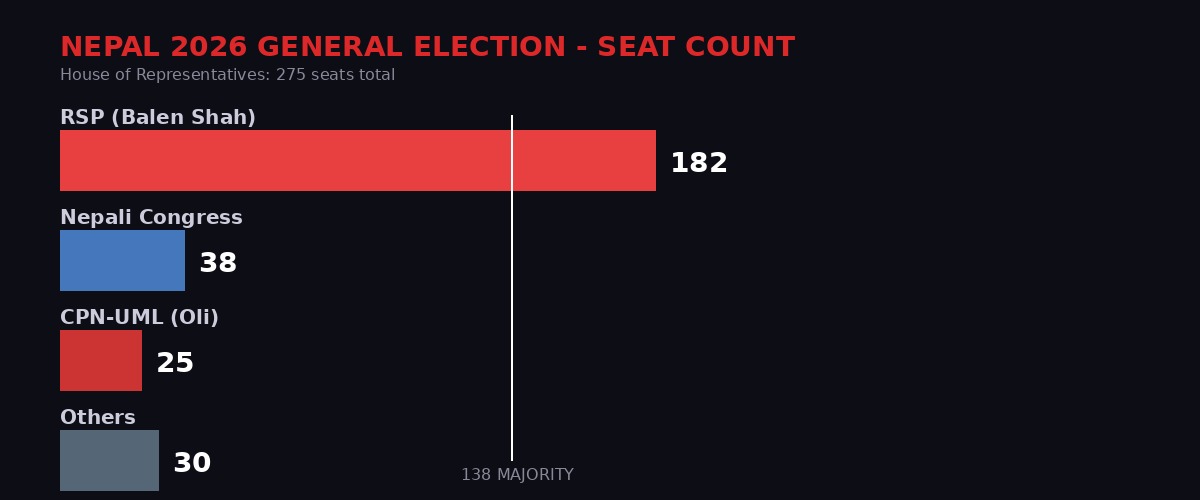
Balendra Shah - known to millions simply as "Balen" - has led his Rastriya Swatantra Party (RSP) to one of the most decisive electoral victories in Nepal's post-monarchy history. The RSP won 182 seats in the 275-member lower house of parliament, according to Nepal's Election Commission. The Nepali Congress finished with 38. Oli's Communist Party of Nepal won 25. A four-year-old party that didn't exist when the last election was held just turned Nepal's political establishment into rubble.
The world was watching Ukraine, Iran, the US economy. Nobody was watching Nepal. They should have been.
From the Streets to the Ballot: The Uprising That Made This Possible
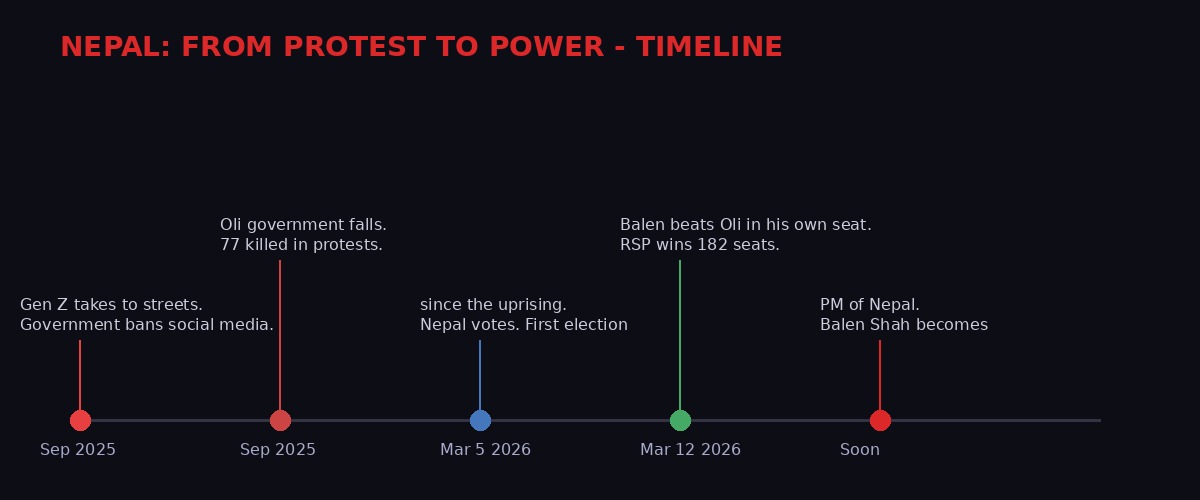
To understand why this victory is seismic, you have to go back to September 2025. Not to an election - to a ban.
The Oli government, facing mounting public frustration over corruption and economic stagnation, made a fateful miscalculation: it tried to restrict social media. Nepal's young people, already furious about unemployment rates that hovered above 40 percent for youth and a political class that had recycled the same faces for a generation, took it as a declaration of war.
What started as outrage over TikTok and Facebook restrictions exploded into the largest street protests Nepal had seen since the 2006 People's Movement that ended the monarchy. Tens of thousands filled Kathmandu's Durbar Square and spread across provincial cities. They were not carrying party flags. They were carrying phones and handmade signs and, in some cases, songs.
"I came to vote mainly because of the protest and so many people gave their lives in the hope of a change, in hope of seeing a better Nepal." - Luniva, first-time voter, to the Associated Press, March 5, 2026
At least 77 people were killed in the demonstrations, according to Al Jazeera. Security forces cracked down. Images of teenagers in bloodied shirts circulated globally. The Oli government, besieged and delegitimized, fell. New elections were called for March 2026 - Nepal's first since the uprising ripped the previous order apart.
The September 2025 protests were not led by politicians or party structures. They were led by young people who had grown up watching their country fail them - and by a musician who had been documenting that failure in bars and verses for years.
The Rapper Who Wrote Their Rage Before He Could Fix It
Balendra Shah was born in 1990 in Kathmandu. He studied civil engineering - a practical choice in a country where infrastructure felt perpetually half-finished. He also rapped, under the name Balen, channeling frustration at the state of roads, at the cost of gas cylinders, at the ritual humiliation of being young and Nepali and watching the same ministers shuffle between offices decade after decade.
His was not the polished social-media hip-hop of branded content and brand deals. It was observational, pointed, and sometimes devastatingly funny about the absurdity of Nepali governance. He built a real following - not celebrity worship, but the kind of loyalty that comes from a voice saying what millions already feel but couldn't articulate.
In 2022, Shah ran for mayor of Kathmandu as an independent candidate - no party affiliation, no political machine behind him. He won, becoming the city's first independent mayor. He inherited crumbling roads, garbage infrastructure and a city that had essentially stopped believing government could work. He started fixing pavements. He cracked down on encroachments. He actually showed up.
By the time the September 2025 protests hit, Shah had proof of concept. He wasn't just an artist angry at the system. He had run part of the system and made it less broken. That combination - credibility as critic, credibility as operator - was something Nepal's traditional parties couldn't manufacture.
His song Nepal Haseko - "Nepal Smiling" - accumulated more than 10 million YouTube views during the 2025 unrest. A song about hope and resilience became the sound of a movement. Not because it was propaganda, but because it was honest.
A Song That Did What Speeches Couldn't
There is a long tradition of music as political mobilization - from the US civil rights movement's anthems to South Africa's freedom songs to the nueva cancion movement in Latin America. What Balen Shah represents is something newer and, arguably, more direct: an artist who moved from providing the emotional vocabulary of a movement to actually executing its demands.
Music's power in political moments is well-documented. But usually the artist stays in the stadium and the politician goes to the parliament. Shah collapsed that distance. He was in the street during the protests - not performing, but present - and then he filed to run for parliament, bringing the same bluntness he'd used on record into campaign speeches.
The RSP's campaign was not traditional. It leaned heavily on social media infrastructure and was significantly backed by diaspora funding, particularly from Nepali communities in the United States, according to Al Jazeera's reporting. The Nepali diaspora - concentrated in the US, UK, Australia and Gulf states - had been watching the country deteriorate from abroad, sending remittances home, watching corruption eat the money before it reached families. They backed Shah not just with money but with reach: sharing content, translating campaign materials, organizing watching parties for livestreamed debates.
This is the digital-era insurgent campaign playbook. It worked in a small South Asian democracy before it worked anywhere with a larger spotlight on it.
What a 40-Year-Old Losing His Seat to a Rapper Tells You
The personal detail that no analysis has quite done justice to: Balen Shah didn't just win his own constituency. He ran directly against Khadga Prasad Sharma Oli - the four-time Prime Minister, the man whose ouster his movement helped engineer - in Oli's home seat. And beat him.
This is not normal. Defeating an incumbent party leader in their stronghold constituency is a statement. Running against them specifically, and winning, is a generational declaration.
Oli, 74, congratulated Shah on X (formerly Twitter), wishing him a "smooth and successful" term. The formal gesture barely masked what the numbers showed: Nepal's communist old guard, which had traded the premiership back and forth with the Nepali Congress for three decades, is now a rump party with 25 seats in a parliament where the RSP holds 182.
More than 40 percent of Nepal's nearly 30 million citizens are under the age of 35, according to the country's census data. For years, that demographic had watched itself systematically frozen out of political power - a country run by its 70-year-old party leaders with no visible pathway for anyone under 50 to matter. The September 2025 uprising was the consequence of that exclusion. The March 2026 election was its resolution.
"Shah said his victory was a signal of refusal to take 'the easy way out' and a reckoning with the 'problems and betrayals that have affected the country.'" - Al Jazeera, March 12, 2026
Political analyst Puranjan Acharya had warned Reuters before the vote that if newly elected leaders were seen as unfit to address youth aspirations from the protests, "there is a risk of further trouble." What no one quite anticipated was the scale of the RSP sweep - or that it would happen this cleanly.
The Hard Part: Running a Country Isn't a Mixtape
This is where the story stops being romantic and starts being real.
Balen Shah is the likely next Prime Minister of Nepal. But becoming Prime Minister under Nepal's constitutional process requires the support of at least half of all parliamentary members - 138 votes. The RSP has 182. That's a comfortable majority, but Nepal's proportional representation system still requires formal procedures: parties must submit names to fill proportionally allocated seats, parliament must be formally summoned by the president, and coalition arithmetic - even with a commanding position - takes time.
As of March 13, a new prime minister is not expected to be confirmed for several days, according to Al Jazeera. The mechanics are bureaucratic, not dramatic. But the political direction is set.
What Shah faces when he actually takes power is less cinematic. Nepal's challenges are structural: a remittance-dependent economy where an estimated 1 in 4 working-age Nepali adults works abroad, chronic corruption in procurement and infrastructure contracts, a geography that makes development brutally expensive, and a civil service that has spent decades operating under the assumption that ministers come and go but the system stays the same.
He has shown he can fix a pothole. Can he fix an economy? Can he reform a civil service that predates him by generations? Can he manage Nepal's delicate geopolitical position between India and China without the institutional experience that Oli - for all his flaws - accumulated over 40 years?
India's Prime Minister Narendra Modi was quick to congratulate Shah, pledging "close cooperation" with the incoming government. That warmth is not purely congratulatory - India has significant economic and strategic interests in Nepal, from hydropower development to border management, and will be watching closely to see whether the new PM's outsider credentials translate into a different posture toward New Delhi than the oscillating alignment Nepal has practiced under its traditional parties.
China will be watching too. The RSP's base is youth and reform, not geopolitical realignment. But running Nepal means navigating the India-China fault line regardless of what you campaigned on.
Why This Is a Global Story, Not a Regional One
Nepal has a population of around 30 million. It is not a major economic power. It generates little global news outside of Everest deaths and earthquake disasters. A reasonable question is: why does this matter beyond South Asia?
Because what happened in Nepal is a template - and templates travel.
The pattern is visible across multiple countries in the past decade: a youth population locked out of traditional political structures; a protest movement triggered by something specific but powered by accumulated grievance; cultural figures - artists, athletes, online personalities - filling the credibility vacuum left by discredited party politicians; and then, in a handful of cases, those cultural figures making the jump to direct political power.
It happened partially in the Philippines, where boxing champion Manny Pacquiao built a Senate career. It happened in Ukraine, where comedian Volodymyr Zelensky won the presidency. It's happening in fragments across West Africa, where musicians and actors are among the most credible public voices in countries where formal institutions have collapsed in reputation. And now it's happened - more completely, more cleanly, with a genuine supermajority - in Nepal.
None of these cases are identical. Zelensky's presidency was tested in ways nobody anticipated. Pacquiao's political career was complicated by his beliefs. Being a good artist does not make someone a good administrator - the skills don't map cleanly.
But the underlying force is consistent: when institutions fail young people long enough, and the gap between their lived reality and what formal politics offers becomes unbridgeable, they look for someone who speaks their language. Sometimes literally.
"Pop music's bias towards English is fading. Songs in 16 languages featured in the global chart last year, as genres like Brazilian funk explode." - Spotify data reported by the BBC, March 2026
That Spotify note matters more than it seems. The global spread of non-English music - K-pop, Afrobeats, reggaeton, Latin trap, Nepali hip-hop - is not just a streaming statistic. It represents cultures that once consumed others' cultural exports now generating their own. Nepal Haseko going to 10 million YouTube views is part of the same shift. The world is listening to more voices. Some of those voices are now running countries.
The Diaspora Factor: Who Really Funded This Revolution
One thread that deserves more examination than it's received: the role of Nepal's diaspora in making this outcome possible.
Nepal's overseas worker community is enormous relative to its population. Millions of Nepali men and women work in the Gulf states - Qatar, UAE, Saudi Arabia, Kuwait - in construction, hospitality and service industries. Others are in Southeast Asia, the UK and, in smaller numbers, the United States and Australia. They send back billions of dollars annually in remittances that prop up a domestic economy that cannot generate enough formal employment.
These workers were not able to vote from abroad. Nepal does not have a comprehensive non-resident voting system. But they did something perhaps more durable: they funded the campaign. The RSP's ability to run a modern, social-media-forward campaign - with content, production value, translated materials reaching global Nepali communities - depended on diaspora financial support, particularly from Nepali communities in the United States, according to Al Jazeera's reporting.
There is a generational logic here. Nepal's migrant workers, many of them under 40, left because Nepal couldn't employ them. They have been watching from Doha and Dubai and Dallas as their country's politicians cycled in and out of power without changing the conditions that drove them abroad. When a candidate emerged who seemed to actually mean it - who had fixed potholes as mayor, who had faced tear gas in the streets, who sang about what was broken rather than pretending it wasn't - the diaspora mobilized.
This is a model that will recur. Diasporas of countries with dysfunctional political systems are increasingly funding and organizing for change from abroad. They have the financial resources their home countries lack. They have the digital infrastructure to coordinate without borders. And they have skin in the game - they want a home country worth returning to.
What Comes Next: Nepal's Unknown Territory
On paper, the RSP's path to governing is straightforward. The numbers are decisive. The mandate is clear. But Nepal has been here before - or somewhere resembling here. The country has had more than a dozen governments since it abolished the monarchy in 2008. The constitution was written and rewritten. Peace agreements were signed and partially implemented. International aid flooded in and disappeared into procurement corruption.
What Balen Shah has that none of his predecessors did is genuine popular legitimacy rooted in cultural identity rather than party machinery. The young Nepalis who voted for him didn't do so because their father's cousin was an RSP official. They voted for him because his music was playing on their phones during the protests, and because he had showed up when it mattered, and because - in a country where politician credibility hovers near zero - he had actually done something tangible as Kathmandu's mayor.
That's a different kind of mandate. It's also a different kind of burden. The young people who put 77 of their peers in graves during the September uprising did not die for incremental reform or diplomatic photo opportunities. They died for the promise of a Nepal that functions - that employs its young, that punishes its corrupt, that doesn't require a generation to leave for the Gulf before they can afford to feed their families.
Shah knows this. His victory speech was not triumphalist. He described the win as "a reckoning with problems and betrayals that have affected the country." That's the right register. What the country needs now is not another politician who speaks correctly. It needs someone who governed a city to govern a nation - and to do it in full view of a population that has proven it will take to the streets again if it gets betrayed.
The Journalist, the First-Time Voter, and the Question Nobody Can Answer Yet
Luniva, the first-time voter who told the AP she voted to honor those who died in the uprising, represents tens of thousands of Nepalis who treated March 5 as a kind of sacred obligation. They didn't vote for Balen Shah because they liked his music. They voted because their peers bled on Kathmandu's streets demanding that voting mean something. To stay home would have been to dishonor those deaths.
Nepalese journalist Pranaya Rana told Al Jazeera that Shah embodies "the outsider spirit that many young Nepalis are looking for to shake up the status quo." That's accurate but incomplete. Outsider spirit is easy to maintain from a recording studio or a mayor's office. Running Nepal - managing relations with India and China simultaneously, reforming a civil service system built over generations, actually reducing the unemployment that sent millions abroad - requires something the outsider spirit alone cannot provide.
What Shah has proven is that the political conversation in Nepal has been permanently reset. The old parties are not dead - Nepali Congress at 38 seats is still a presence - but they are no longer the default options. The RSP's dominance means Shah has room to govern without constant coalition bargaining. Whether he uses that room wisely will determine whether Nepal's Gen Z revolution becomes a genuine turning point or another chapter in a long story of disappointed hopes.
The world keeps producing these moments: a culture figure, speaking an authentic language, catching the wave of genuine popular fury and riding it to power. The question is always what happens on day 366 - after the euphoria, before the next election, when governance is grinding work and the songs have already been sung and the kids in the street have gone back to their lives and are watching to see whether anything actually changes.
Balen Shah knows what Nepal sounds like when it's hurting. Now he needs to know how to make it stop.
Get BLACKWIRE reports first.
Breaking news, investigations, and analysis - straight to your phone.
Join @blackwirenews on Telegram