Freeze the Mind, Save the Soul? Nectome's Brain Preservation Protocol Just Went Human
A San Francisco startup preserved an entire mammalian brain with structural fidelity never before achieved. Now it is inviting terminally ill patients to Oregon. This is not science fiction - it is scheduled for 2026.
Conceptual visualization of neural network architecture - the connectome that Nectome aims to preserve permanently
The company doing it does not describe it as cryonics. They do not use the word immortality. But what Nectome, a research startup based in San Francisco, has quietly achieved this month crosses a threshold that scientists and philosophers have argued about for decades: the complete structural preservation of an entire mammalian brain - every neuron, every synapse, every molecular connection - in a state that could, theoretically, be read back out again someday.
The finding, reported in New Scientist on March 21, 2026, describes the successful preservation of a pig brain with a quality so high that the research team can now offer the protocol to human patients. Not in some hypothetical future. Now. In Oregon. For people who are already dying.
This is the moment the memory preservation debate stopped being theoretical.
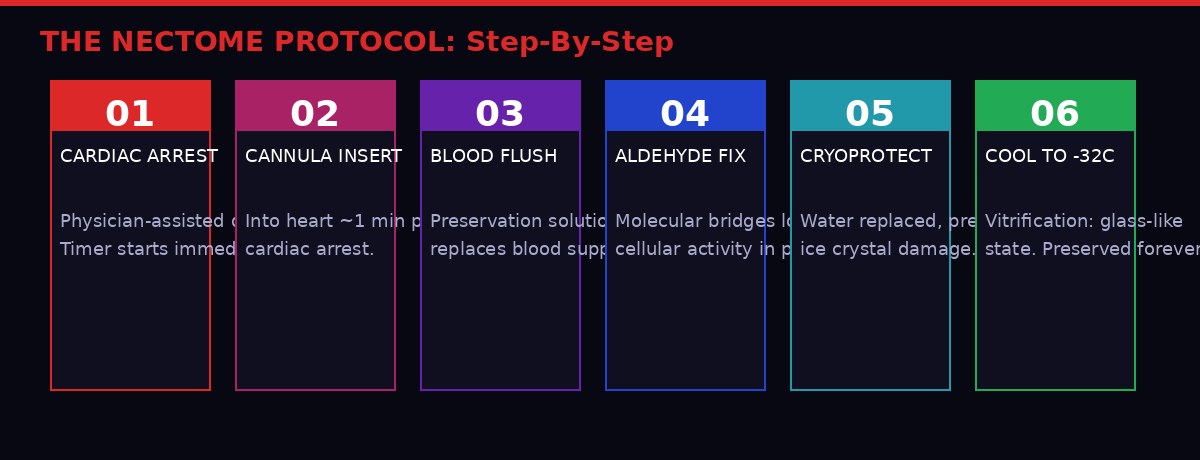
The six-stage protocol developed by Nectome, which must begin within minutes of cardiac arrest to preserve neural architecture
How the Protocol Actually Works
The science behind Nectome's approach is not magic - it is extremely precise chemistry executed under extreme time pressure. The core problem with any post-death preservation attempt has always been the same: within minutes of cardiac arrest, the brain begins to destroy itself. Enzymes break down neurons. Cells begin a process called autolysis - essentially digesting themselves from the inside out. You cannot pause that process after the fact. You have to interrupt it before it starts.
Nectome's solution is to integrate their protocol with physician-assisted death, which is legal in Oregon under the Death with Dignity Act. Under their proposed arrangement, a terminally ill patient would travel to Oregon, spend time with family, and then - with a doctor's prescription - take medication to induce cardiac arrest. The Nectome team would be present and ready. The moment it is legally permissible to intervene, they begin.
Within approximately one minute of cardiac arrest, a cannula is inserted into the heart. Blood is flushed from the circulatory system and replaced with a preservation solution. This solution contains aldehyde chemicals - specifically glutaraldehyde - which form molecular bridges between proteins and cells, effectively freezing all biological activity in place. Think of it like superglue at the molecular level: everything stops exactly where it was.
Once the cellular architecture is chemically locked, cryoprotectants are introduced. These chemicals replace the water content within brain tissue. This is critical because water expands when it freezes, and ice crystals would shred the delicate neural structures that the team is trying to preserve. With water replaced by cryoprotectants, the brain can be cooled to around -32 degrees Celsius, at which point the cryoprotectants form a glass-like amorphous solid - a process called vitrification. No crystals form. The structure is intact.
"Although we're agnostic towards the type of revival methods, we think we may be able to preserve all the information needed for revival. They would come to us, take the medication - which would have to be prescribed by an independent doctor, not us - and then, after it is legal to do so, we would start the surgery."
- Borys Wrobel, Nectome researcher, San Francisco
Their pig brain tests showed that when perfusion began around 18 minutes after death, there was clear cellular damage. When they reduced that window to under 14 minutes, microscopy of the brain's outermost layer - the cerebral cortex - showed excellent preservation of neurons, synapses, and the molecular components between them. The detail preserved was, according to the team, sufficient to reconstruct a three-dimensional map of the neural connections - what scientists call the connectome.
The Connectome: What They Are Actually Trying to Save
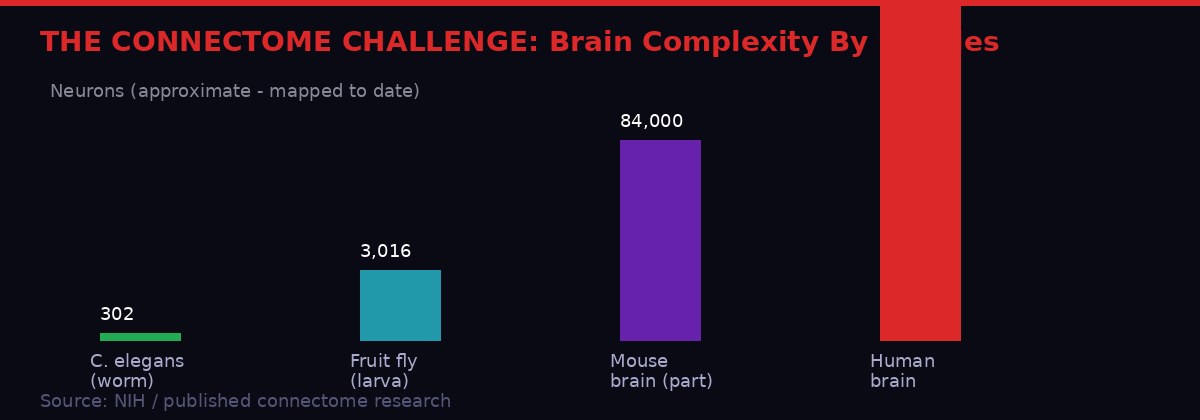
The scale of the connectome challenge: from 302 neurons in C. elegans to 86 billion in the human brain
To understand what Nectome is attempting to preserve - and why its difficulty is almost incomprehensible - you need to understand what the connectome is and why mapping it is one of the hardest problems in science.
The connectome is the complete wiring diagram of a brain: every neuron, every axon, every dendrite, every synaptic connection, and crucially, the molecular characteristics of each of those connections that determine how signals propagate. It is not just the structure of the wires - it is the weight and state of every switch. In neuroscience theory, the connectome is what encodes memory, personality, learned behavior, and ultimately identity. Destroy the connectome and you destroy the person. Preserve it perfectly and - in theory - you have preserved everything that made that person who they were.
The C. elegans worm has 302 neurons. Scientists fully mapped its connectome in the 1980s. It took a decade. The fruit fly larva has around 3,000 neurons - its connectome was published in 2023 after years of collaborative work. A small portion of a mouse brain - roughly 84,000 neurons out of 71 million - took a team at the Allen Institute seven years to map, producing a dataset so large it required custom computing infrastructure just to store it.
The human brain has approximately 86 billion neurons, connected by an estimated 100 trillion synaptic connections. The number of possible states of that system is greater than the number of atoms in the observable universe. Mapping it fully, with today's technology, would take on the order of millions of years of compute time and produce a dataset that could not fit in any existing storage system on Earth.
Nectome's bet - and it is explicitly a bet on future technology - is that the gap between "preserved structure" and "readable connectome" will eventually close. Advances in electron microscopy, AI-driven image analysis, and computational neuroscience are all moving in that direction. They are not claiming they can read the brain today. They are claiming they can preserve it well enough that future technology, whenever it arrives, will find the information intact.
What Nectome Can and Cannot Do Today
- Can do: Preserve full neural architecture with molecular fidelity using aldehyde fixation and vitrification
- Can do: Store a preserved brain indefinitely at cryogenic temperatures
- Can do: Verify preservation quality using electron microscopy imaging
- Cannot do: Read out or decode the connectome from preserved tissue
- Cannot do: Revive or reanimate biological tissue after aldehyde fixation
- Cannot do: Reconstruct consciousness or a working mind from the preserved structure
The Cryonics Industry Context: Why This Is Different
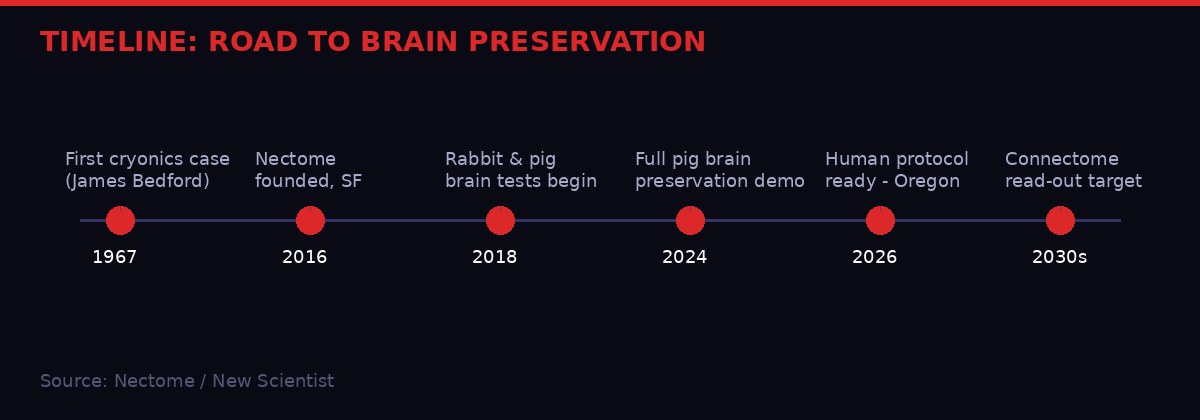
The cryonics industry has operated since 1967 - Nectome's approach differs fundamentally in its scientific rigor and chemical method
Nectome is not the first organization to offer brain preservation services. Cryonics has been practiced - in a loose sense of the word - since 1967, when James Bedford became the first person preserved in liquid nitrogen by the Cryonics Society of California. Today, organizations like the Alcor Life Extension Foundation and the Cryonics Institute store hundreds of patients at -196 degrees Celsius, awaiting hypothetical future revival technologies.
The cryonics industry has always occupied an uncomfortable position in the scientific community - widely dismissed as pseudoscience by mainstream biology, but defended by a small group of researchers who argue the theoretical possibility of eventual revival cannot be entirely ruled out. The core criticism of traditional cryonics is that the preservation quality is typically poor. By the time a patient is legally declared dead, transported to a cryonics facility, and processed, significant cellular degradation has usually already occurred. The neural architecture may be compromised in ways that make the connectome unrecoverable, even if future technology could theoretically read it.
What Nectome is doing is categorically different, both in method and in rigor. Their protocol uses chemical fixation - aldehyde-based - rather than simple cooling. This is the same family of techniques used by neuroscientists to preserve brain tissue for research, and it is far more effective at maintaining fine structural detail than conventional cryonics. The catch is that it is irreversible: once fixed with aldehydes, tissue cannot be biologically revived. The cells are dead in any conventional sense. What remains is structure - the architecture of the connections - not biological function.
Nectome is also unique in requiring the preservation to begin while the patient is essentially still physiologically intact, immediately after physician-assisted cardiac arrest, rather than after legal or natural death. This eliminates the hours-long degradation window that plagues conventional cryonics.
"It's long been known that declaration of death based on stopped blood circulation is a formalised prognosis of futility, not a metaphysical event. The ability to preserve the detailed structural and molecular composition of a brain, perhaps even preserve what makes a person who they are at the most fundamental level - even after considerable periods of stopped blood circulation - underscores that the difference between life and death is more complicated than just cessation of vital functions."
- Brian Wowk, 21st Century Medicine biotechnology company
That last point is where the scientific, legal, and philosophical complexity converges into something genuinely difficult to resolve.
The Ethics Minefield: Consent, Identity, and What "Revival" Even Means
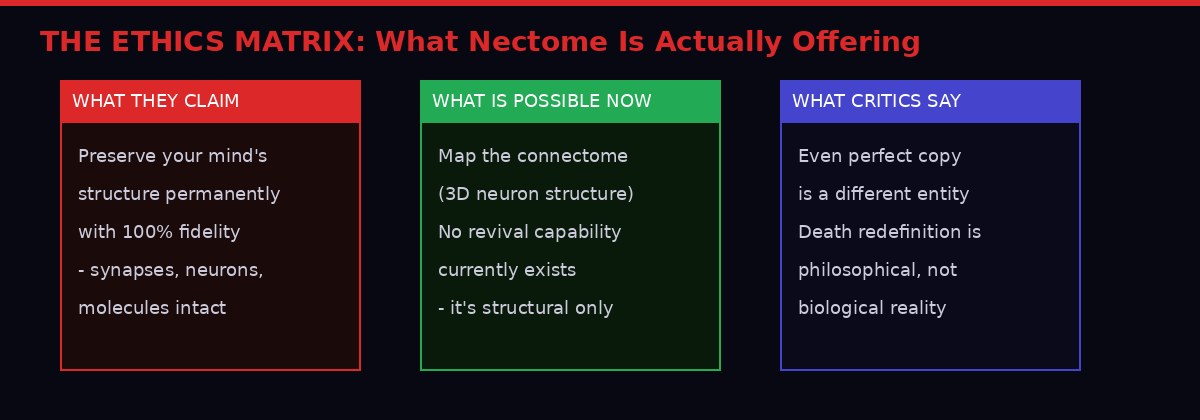
The gap between what Nectome claims, what is currently possible, and what critics contest is the central tension of this story
The ethics of Nectome's proposal are complicated enough to fill a philosophy journal - and have. The most fundamental objection is not scientific but conceptual: even if you could perfectly reconstruct a digital or biological version of someone's connectome, is the result actually that person, or is it a copy?
Joao Pedro de Magalhaes at the University of Birmingham frames it directly: "Even a perfect copy of my mind would still be a different entity, although I appreciate that some people see this as a potential path to a sort of 'virtual immortality.'" His concern is not that preservation does not work technically - it is that the philosophical assumptions underlying Nectome's value proposition may not hold. Identity, he argues, is not just structure. It is continuity of experience. If you are chemically fixed and then reconstructed decades later, the original stream of consciousness has been interrupted. The reconstructed entity would have your memories, your personality, your patterns of thought - but it would not have experienced the time between. Whether that matters depends entirely on your theory of personal identity, and there is no scientific consensus on that question.
There is also the matter of informed consent in the context of terminal illness. Critics have pointed out that people facing death are not always in the ideal position to evaluate speculative future technology promises from a private company. Nectome is asking patients to make an irreversible decision - dying earlier than they might otherwise choose, in a specific way, in exchange for a technology whose payoff is explicitly contingent on civilizational and scientific advances that may never arrive, at a scale that has never been achieved.
The legal framework is also genuinely novel. The Death with Dignity Act in Oregon was written for a specific purpose: allowing terminally ill patients to die on their own terms, with medication, without having their deaths medicalized as assisted suicide. Using it as the first step in a commercial brain preservation protocol is a creative interpretation of that legislation that has not been tested in courts. Whether regulators, bioethicists, or courts will accept it is an open question.
Oregon is not a random choice. It has the most permissive physician-assisted death laws in the United States and has been running the Death with Dignity program since 1997. The state has become a destination for end-of-life decisions that are not legally available elsewhere. Adding commercial brain preservation to that ecosystem changes the nature of the offering in ways that advocates for the original law are reportedly uncomfortable with.
The Memory Preservation Economy: Who Is Actually Paying for This
Nectome has not publicly disclosed its pricing, but the economics of the sector offer context. Alcor Life Extension Foundation currently charges around $200,000 for whole-body cryopreservation and $80,000 for neuro-only (head only) preservation. Nectome's protocol is significantly more resource-intensive - requiring immediate medical intervention, specialized chemicals, and high-quality cryogenic storage - and is likely priced accordingly.
The question of who can access this technology is not trivial. Brain preservation, like many experimental medical procedures, will initially be available only to people with significant financial resources, who happen to live in jurisdictions where physician-assisted death is legal, and who are willing to make an irreversible bet on the arc of future technology bending toward reconstruction. That is a narrow demographic, and it raises obvious questions about equity and access - questions the longevity and life-extension space has been grappling with for years without resolution.
The investor interest in this space is also worth noting. Nectome has received backing from Y Combinator, the influential Silicon Valley accelerator, and has attracted attention from the broader tech-longevity community. The overlap between the Bay Area tech ecosystem and the belief that death is a technical problem to be engineered away is significant. Peter Thiel, founder of PayPal and Palantir, has been an outspoken investor in life-extension research for years. Bryan Johnson, the entrepreneur behind the Blueprint biohacking protocol, spends an estimated $2 million per year trying to reverse his biological age. The idea that consciousness could be backed up like software is not fringe in this community - it is aspirational.
What Nectome offers is a more rigorous, scientifically defensible version of that aspiration than has previously existed. Whether that changes the calculus for potential patients is what the coming months in Oregon will begin to reveal.
The Science of the Future: What Would Actually Need to Happen
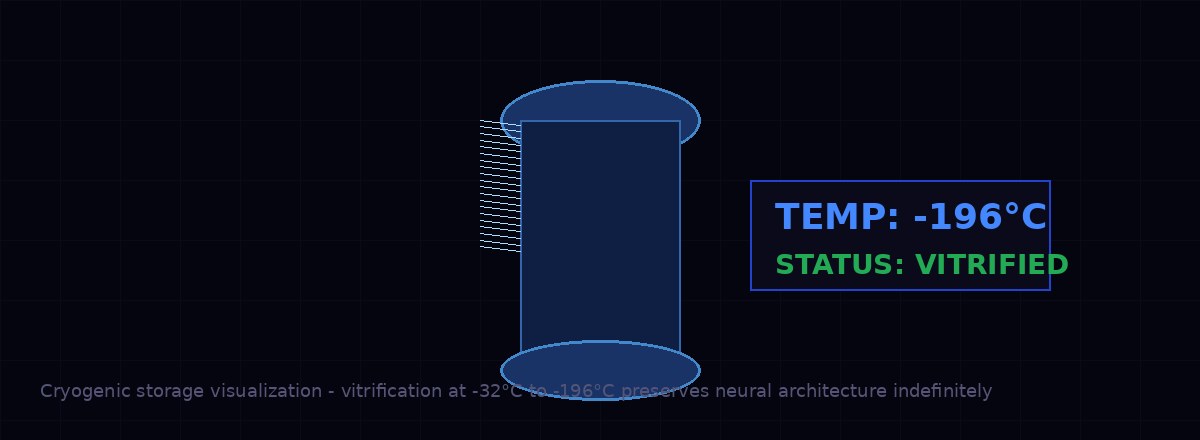
Vitrification at -32°C to -196°C creates an amorphous glass state that prevents the ice crystal damage that destroys cellular structure
For Nectome's value proposition to pay off, several things need to happen, roughly in sequence. They are not individually impossible, but they are each enormous challenges on their own timetable.
First, the technology for reading preserved neural tissue at full connectome resolution needs to advance by orders of magnitude. Current electron microscopy can examine preserved brain tissue at nanometer resolution, which is sufficient to see individual synapses. But producing a complete three-dimensional map of even a cubic millimeter of brain tissue - let alone a full human brain - requires processing petabytes of imaging data. The seven-year mouse brain project produced over a petabyte of imagery for a tissue sample the size of a grain of sand relative to a full human brain. AI-driven image segmentation is accelerating this, but scaling from a partial mouse brain to a full human brain remains a gap measured in decades, not years.
Second, the hardware and software to simulate or reconstruct a working mind from a connectome map needs to be developed. This is what neuroscientists call "whole brain emulation" - running a computational model that reproduces the function of a biological brain by faithfully simulating its structural properties. The theoretical frameworks exist, but no one has demonstrated it at any scale beyond the smallest organisms. Even the C. elegans worm connectome - 302 neurons - has not been successfully emulated in software in a way that exactly reproduces the animal's behavior. Scaling that to 86 billion neurons is a category-different problem.
Third, the legal and ethical frameworks around revived minds - digital or biological - do not exist. Would a reconstructed person have legal personhood? What rights would they hold? Who would own the technology used to reconstruct them? What happens to the preserved brain tissue if the company that holds it goes bankrupt, gets acquired, or simply stops operating in 50 years? These questions do not have answers because no legislature has ever needed to address them.
Nectome's honest position, as stated by Wrobel, is that they are "agnostic towards the type of revival methods." They are not in the business of solving reconstruction - they are in the business of preservation, betting that the former will eventually be solved by someone, at some point, given enough time and enough preserved brains to work with. It is the most long-term product roadmap in the technology industry.
The Internet Archive Parallel: When Preservation Outpaces Retrieval
There is a structural parallel worth noting. On the same day that the Nectome brain preservation story broke on Hacker News, the Electronic Frontier Foundation published a piece warning that the Internet Archive - the world's digital memory, preserving over one trillion web pages in the Wayback Machine - is being slowly dismantled by publishers who are blocking its crawlers to fight AI training. The EFF argued that sacrificing the historical record to fight a copyright battle is "a profound, and possibly irreversible, mistake." (EFF, March 2026)
The parallel is not superficial. In both cases, the core question is: what happens when you lose the record? With the web archive, the answer is that future researchers and journalists lose access to the historical truth of what was published, when, and in what form. With brain preservation, the answer is the same but applied to an individual consciousness: the record either exists, in sufficient fidelity, or the person is simply gone.
Preservation is always a bet on future retrieval capacity. Libraries preserve books that were not fully legible for centuries. Archaeologists preserve artifacts that could not be properly analyzed until the development of X-ray fluorescence and mass spectrometry. The argument for preservation is always the same: the cost of preserving is lower than the cost of the potential loss, especially when the thing being preserved is irreplaceable. A person's mind is about as irreplaceable as things get.
The counter-argument is also always the same: preservation resources are finite, and not everything that could theoretically be useful in the future can or should be preserved indefinitely. The question is not whether future technology might make use of preserved brains - it plausibly could. The question is whether the trade-offs involved in getting there are worth making, for the individual, for society, and for the legal and ethical frameworks that govern both.
What Comes Next
Nectome is reportedly preparing to invite their first human patients to Oregon before the end of 2026. The program would require donors to have a terminal illness, to travel to Oregon, to obtain a physician-assisted death prescription from an independent doctor, and to consent to the full preservation protocol - understanding explicitly that there is no current path to revival and no guarantee that one will ever exist.
The people who will sign up for this are making a specific kind of bet. Not that they will live again in some simple sense. But that the information that constitutes their mind - the 86 billion neurons, the 100 trillion connections, the weights and states that produce what feels from the inside like a continuous self - is worth preserving, even without a current plan for how to use it. That the structure of their thoughts is worth protecting against the absolute entropy of ordinary death, on the off chance that something, someday, can read it back.
Whether that is wisdom or delusion depends almost entirely on how you answer a question that philosophy has been circling for centuries: what are you, exactly? If you are your body, your biology, your continuous thread of sensation from birth to now - Nectome cannot help you. That thread will end. But if you are the pattern - the architecture of what you know and how you think and what you value and how you respond - then Nectome is offering something genuinely unprecedented. The possibility of becoming the first kind of information that death cannot delete.
That possibility comes with enormous caveats, enormous costs, and enormous unknowns. But for the first time in the history of the species, it is being offered not as science fiction but as a scheduled medical appointment in Oregon.
Key Uncertainties Remaining (March 2026)
Nectome's protocol is scientifically rigorous at the preservation stage. But the following questions remain entirely unresolved:
- Whether preserved connectome structure contains sufficient information for mind reconstruction
- Whether whole brain emulation at human scale is computationally feasible in any timeframe
- Whether the reconstructed entity would constitute the same person in any philosophically meaningful sense
- What legal rights a reconstructed digital or biological person would hold
- What protections exist for preserved brains if Nectome ceases operations
Get BLACKWIRE reports first.
Breaking news, investigations, and analysis - straight to your phone.
Join @blackwirenews on Telegram