The King's Crown, Britain's Shame: How Bermuda and Cayman Islands Pipelines Bank Myanmar's Killing Machine
Two gas pipeline companies registered in Britain's own overseas territories have channeled hundreds of millions of dollars to Myanmar's military junta since the 2021 coup - while the UK government argues over whether its sanctions even apply. A new investigation names the entities, exposes the revenues, and asks why nobody has been stopped.

Gas pipelines connecting Myanmar's Andaman Sea fields to Thailand have been at the center of a sanctions evasion scandal involving UK overseas territories. Photo: Pexels
The military government that seized Myanmar in a coup on February 1, 2021, has since killed thousands of civilians, bombed schools and hospitals, and driven millions from their homes. The international community responded with sanctions, diplomatic isolation, and outrage. But cash kept flowing into the junta's accounts - and investigators have now found a significant part of that pipeline runs through two islands under British sovereignty.
A joint investigation published this month by Finance Uncovered and activist group Justice For Myanmar reveals that two companies - one registered in Bermuda, one in the Cayman Islands - have continued to operate gas pipeline joint ventures with Myanmar's junta-controlled state energy company since the coup. Leaked financial statements and PTT's own annual reports indicate those ventures generated over $754 million in pipeline revenues between 2021 and 2024 alone. The UK government, which sanctions both Bermuda and the Cayman Islands under the umbrella of its overseas territories, has taken no enforcement action.
Both territories were warned. Legal complaints were filed by Justice For Myanmar in April 2024. The governors passed the complaints to relevant authorities. And then, as far as anyone can establish, nothing happened.
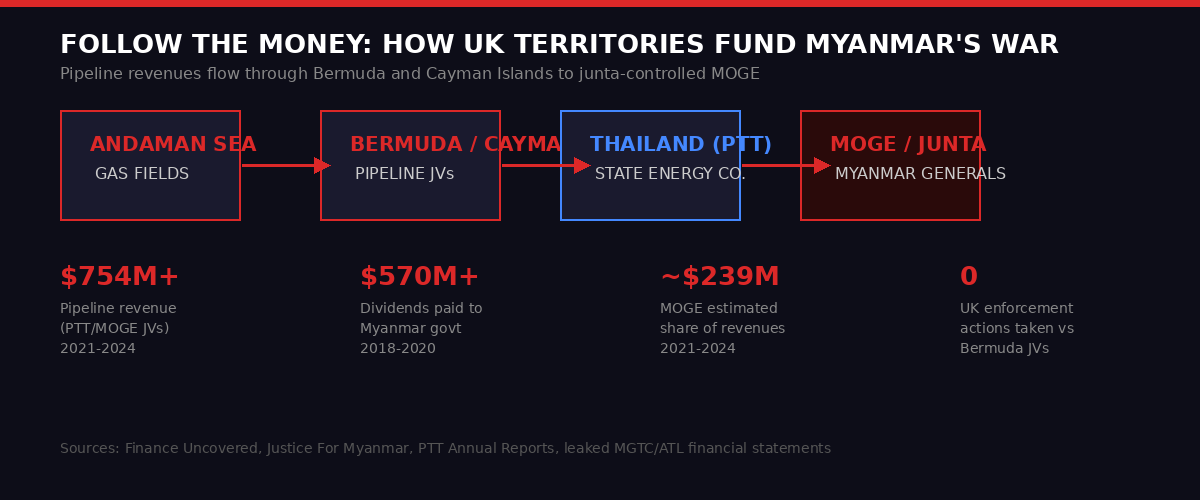
How gas revenues flow through Bermuda and Cayman Islands pipeline joint ventures to Myanmar's junta-controlled MOGE. Sources: Finance Uncovered, PTT Annual Reports, Justice For Myanmar.
The Two Companies Nobody Wants to Name

Gas infrastructure in the region has become a financial lifeline for Myanmar's military government, despite international sanctions. Photo: Pexels
The first company is Moattama Gas Transportation Company Limited - known as MGTC - registered in Bermuda. It operates the pipeline carrying gas from Myanmar's largest offshore field, Yadana, to the Thai border. The Yadana field sits in the Andaman Sea and has been producing gas for decades. The pipeline to Thailand has been MOGE's most reliable revenue generator for years.
The second is Andaman Transportation Limited - ATL - registered in the Cayman Islands. It services the Zawtika gas field. Like MGTC, it operates as a joint venture with Thailand's state energy company, PTT, and with MOGE - the Myanma Oil & Gas Enterprise, which the junta directly controls and which is considered the generals' primary source of hard foreign currency.
Both companies were set up long before the 2021 coup, when Myanmar had a nominally civilian government. Their stated justification for using Bermuda and the Cayman Islands was the same as hundreds of other multinationals operating in the region: low administration costs, ease of doing business, and favorable tax treatment. France's TotalEnergies was for years the dominant shareholder in MGTC, along with PTT's upstream arm PTTEP and the American company Unocal (later absorbed into Chevron).
But the coup changed everything - or was supposed to. Within months, the international energy majors began exiting Myanmar. TotalEnergies announced it would suspend MGTC dividend payments to shareholders, including MOGE. Under international pressure, the French company ultimately completed its withdrawal from Myanmar in 2022, citing "the absence of sufficient improvement in the human rights situation." Chevron followed suit.
After the Western firms left, MOGE's position in the joint ventures did not evaporate. The pipelines kept running. Gas kept flowing. Revenue kept accumulating. And the junta kept collecting.
"These companies are bankrolling a junta that is slaughtering children and bombing schools and hospitals with impunity. Authorities need to act now to enforce sanctions and end this dirty business." - Yadanar Maung, spokesperson, Justice For Myanmar
The Sanctions Gap Britain Created
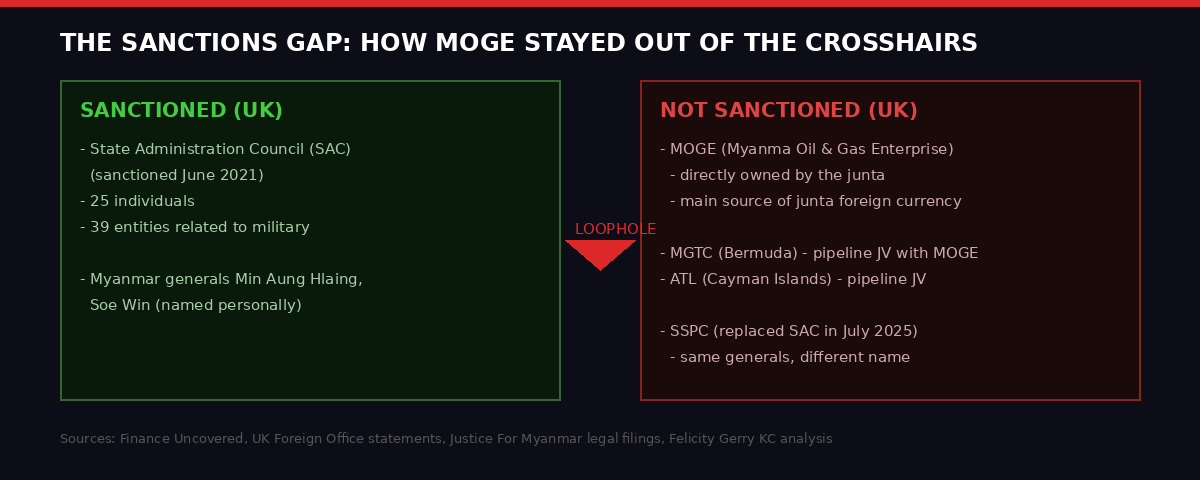
The UK sanctioned the junta's State Administration Council but left MOGE - the junta's primary revenue source - off the list, creating a legally ambiguous gap that enabled hundreds of millions to flow through. Source: Finance Uncovered analysis.
When the UK sanctioned Myanmar's military government in June 2021, it targeted the State Administration Council - the SAC, the governing body the generals had used to seize power. Twenty-five individuals and thirty-nine entities ended up on the UK sanctions list. The language was strong. The intent seemed clear.
But MOGE - the Myanma Oil & Gas Enterprise, the entity that actually controls Myanmar's gas revenues and serves as the junta's primary foreign currency earner - was never directly sanctioned by the UK. Unlike the EU, which moved more aggressively, the UK's restrictions targeted the SAC as a body, and left legal experts arguing over whether those restrictions automatically extended to SAC-controlled entities like MOGE.
Felicity Gerry KC, a lawyer with Libertas chambers, called it a "quagmire of confusion." Speaking to Finance Uncovered, she said the situation was "a prime example of us not really knowing what control means to the UK government," and added that the UK-Bermuda-Cayman pipeline ventures "still warrant investigation" for the revenues they had earned for the junta.
"There appears to be evidence of control that obliges the UK government to investigate and react," Gerry said. "The UK can't just issue sanctions and wait for something to happen - they should have a follow-up system of investigating whether sanctions are being breached."
The ambiguity only deepened in July 2025 when the junta dissolved the SAC - the sanctioned body - and replaced it with a new entity called the State Security and Peace Commission (SSPC). The SSPC serves the same functions, is run by the same generals, and exercises the same powers. But it has a different name. And as Justice For Myanmar noted, this deliberate rebranding created a "dangerous loophole" in the international sanctions regime, allowing the generals to argue they were technically no longer operating under a sanctioned entity. The UK government has not yet sanctioned the SSPC.
Letters to Governors, Silence in Return

Legal complaints filed with the governors of Bermuda and the Cayman Islands in April 2024 appear to have produced no enforcement response. Photo: Pexels
In April 2024, Justice For Myanmar filed formal legal complaints to the governors of both Bermuda and the Cayman Islands, urging them to investigate potential breaches of UK sanctions. The complaints detailed the pipeline ventures, the revenues flowing to MOGE, and the legal arguments for why the UK sanctions should apply.
The Governor of Bermuda's office said the complaint had been passed to the Bermuda government. The Governor of the Cayman Islands' office said it had been passed to "competent authorities." Neither office confirmed whether any investigation had been launched. Neither PTT nor MOGE responded to requests for comment from Finance Uncovered reporters.
Labour peer Margret Hodge called it an "outrage" that the territories had "seemingly failed to act" after receiving the warnings. Speaking to Finance Uncovered, she said: "This is yet another example of how the secrecy in our overseas territories could be abused by bad actors for evil purposes."
Conservative MP Andrew Mitchell added that UK overseas territories had for too long "twisted and turned like a fish on the line" to avoid introducing financial transparency reforms.
A Foreign Office spokesperson told Finance Uncovered that Britain's Overseas Territories are committed to "robust sanctions enforcement" and that the UK was "supporting the Overseas Territories to investigate and act on any allegations of possible sanction breaches." The spokesperson declined to answer the specific question of whether UK sanctions against the SAC applied to MOGE.
Myanmar's Gas: A History of Extraction and Repression

Myanmar's offshore gas fields in the Andaman Sea have been producing for decades - and have funded successive military regimes throughout. Photo: Pexels
Gas extracted from the Andaman Sea has been a cornerstone of Myanmar's government revenue for more than three decades. The Yadana field, which feeds into the MGTC pipeline, was developed in the 1990s under a previous generation of military rulers. From the beginning, the revenue structure concentrated wealth in the hands of whoever controlled MOGE - which, in Myanmar, has almost always been the military.
The pattern was documented long before the 2021 coup. Earthrights International and other organizations spent years mapping how gas revenues flowed through MOGE to fund the Tatmadaw - the formal name for Myanmar's armed forces, which had been committing documented atrocities against ethnic minorities for decades before the coup, including the 2017 mass killings and expulsions of Rohingya Muslims that are now the subject of genocide proceedings at the International Court of Justice.
The coup of February 2021 did not change the underlying structure. It removed the civilian government and placed the Tatmadaw unambiguously in charge of everything - including MOGE. Senior General Min Aung Hlaing, who led the coup, was already personally sanctioned by the UK along with his deputy Soe Win. But the enterprise that earns the generals their operating budget kept running.
Pinpointing MOGE's exact earnings since the coup is difficult because of limited financial disclosure requirements in Bermuda and the Cayman Islands. Production has also fallen as international operators pulled out and the junta has struggled to attract new investment. But the Finance Uncovered analysis makes clear that even with reduced production, the revenues remain significant. Gas, for a cash-strapped military facing a civil war on multiple fronts, is not optional.
"Collective[ly] that gives them a complete idea of our strength, resolve, philosophy and our military capability. The fact that they're carrying oil [or gas] and that they get money in as well is a bonus." - Adapted from analysis by defense advisor Glen Grant, referencing how authoritarian states exploit commercial operations for dual strategic purposes
The Overseas Territories Problem
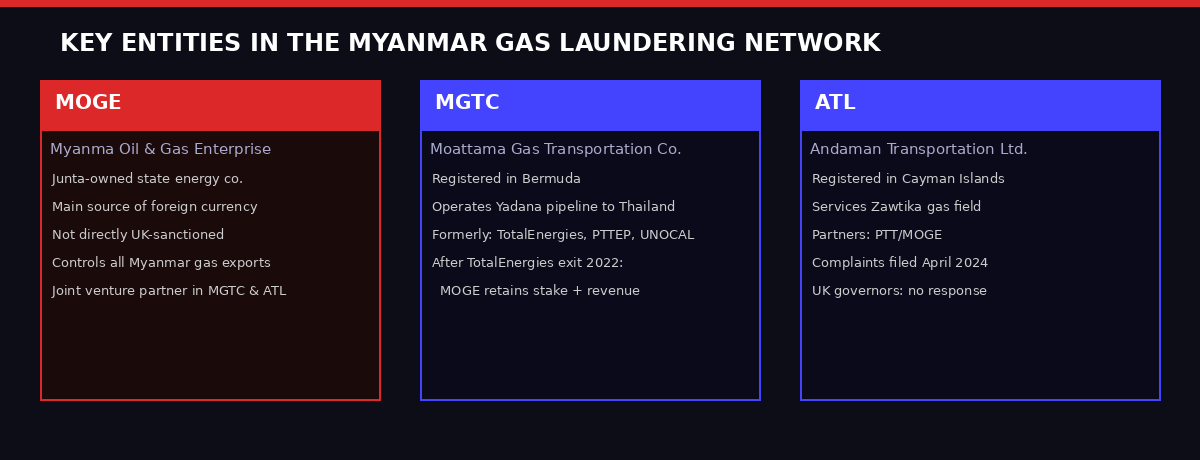
The three central entities in the Myanmar pipeline sanctions gap: MOGE (junta-owned, not UK-sanctioned), MGTC (Bermuda-registered), and ATL (Cayman Islands-registered). Source: Finance Uncovered, OCCRP.
The Bermuda-Cayman pipeline story sits within a broader, well-documented problem: Britain's overseas territories have long served as financial infrastructure for operations that UK policy technically opposes. The British Virgin Islands, the Cayman Islands, Bermuda, and other territories under the Crown have been central to the global offshore finance architecture for decades - hosting shell companies, trusts, and joint ventures that shield their true owners from scrutiny in ways that would be illegal on mainland Britain.
This is not new. The role of UK territories in facilitating financial opacity was a recurring theme in the Panama Papers, the Pandora Papers, and countless smaller investigations before and since. What makes the Myanmar case notable is its directness: these are not shell companies obscuring beneficial owners in a tax haven. These are operational pipeline companies - real infrastructure moving real gas - and their profits flow in part to a government the UK has formally designated as a sanctions target.
UK Labour MP Phil Brickell, chair of the UK parliament's all-party group on anti-corruption, made the point clearly in response to a related Finance Uncovered investigation into UK corporate transparency failures in Uzbekistan: "This troubling case calls into question the effectiveness of some of our first lines of defence against suspect financial activity." The same diagnosis applies to the Myanmar situation, with higher stakes.
What makes it additionally troubling is that both Bermuda and the Cayman Islands had received specific legal warnings - not vague press reporting, but formal legal complaints with named entities and documented revenues - and appear to have done nothing. The question of who, precisely, is responsible for enforcing UK sanctions in overseas territories is genuinely unclear. The Foreign Office said it was "supporting" the territories to investigate. But supporting is not investigating. And the junta's treasury did not pause while the lawyers argued jurisdiction.
The Human Cost Behind the Pipeline Revenues

Myanmar's civil war has displaced millions and killed thousands of civilians since the 2021 military coup. Gas revenues flowing through UK overseas territories are a primary source of junta funding. Photo: Pexels
Since February 2021, Myanmar's military has killed thousands of civilians. Amnesty International, Human Rights Watch, the United Nations, and Myanmar's own civil society organizations have documented mass executions, airstrikes on villages and hospitals, systematic torture of detainees, and the deliberate destruction of food supplies as a weapon of war. Over two million people have been internally displaced. Hundreds of thousands more have fled across borders into Thailand, India, and Bangladesh.
The generals who ordered these operations need money to keep them running - to buy weapons, pay soldiers, and sustain an increasingly expensive counterinsurgency campaign against a nationwide resistance that has taken the Tatmadaw by surprise with its resilience and coordination. Gas revenues from MOGE remain the single most reliable source of that money, especially as the junta has been unable to attract significant new foreign investment and Myanmar's currency has collapsed.
Every dollar that flows through MGTC and ATL to MOGE is a dollar that potentially becomes a bullet, a fuel payment for an airstrike, a salary for a soldier who may participate in a massacre. The connection between pipeline revenue and atrocity is not metaphorical. It is operational.
Justice For Myanmar's Yadanar Maung said in response to the Finance Uncovered investigation: "Authorities need to act now to enforce sanctions and end this dirty business." The key word is now. The complaints were filed in April 2024. It is now March 2026. Twenty-three months later, the pipelines still run, the revenues still accumulate, and MOGE has yet to be directly sanctioned by the UK government.
Timeline: From Coup to Continued Revenue
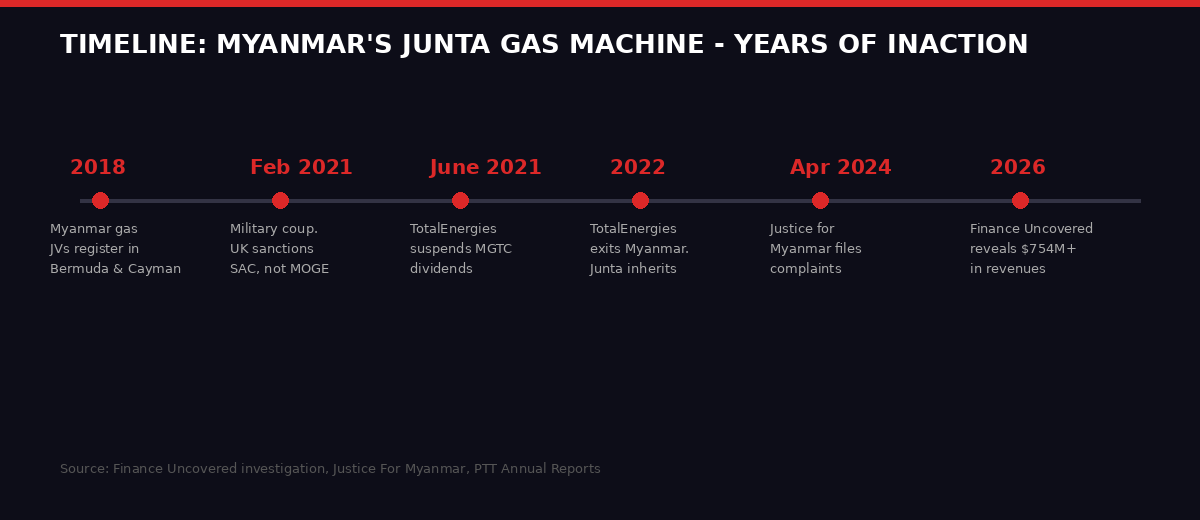
A chronology of the Myanmar coup, Western corporate exits, legal complaints, and continued revenue flows. Source: Finance Uncovered, Justice For Myanmar, PTT Annual Reports.
- Pre-coup (2018-2020) MGTC and ATL generate over $570 million in dividends and income taxes for Myanmar's government. TotalEnergies, Chevron/PTTEP are key shareholders. MOGE holds minority stakes but receives substantial revenue.
- February 1, 2021 Military coup. General Min Aung Hlaing seizes power. The State Administration Council (SAC) is installed as governing body. Mass protests begin.
- June 2021 UK sanctions SAC and 25 individuals. MOGE is not directly sanctioned. Lawyers begin debating whether SAC sanctions extend to MOGE entities.
- Late 2021 TotalEnergies suspends MGTC dividend payments to shareholders. Decision follows sustained pressure from shareholders, NGOs, and governments.
- 2022 TotalEnergies completes withdrawal from Myanmar, including exit from MGTC stake. Chevron/PTTEP also exits. MOGE's position in the pipelines effectively strengthens as Western shareholders depart.
- 2021-2024 MGTC and ATL together generate more than $754 million in pipeline revenues, per analysis of PTT annual reports and leaked financial statements. MOGE's estimated share: close to $239 million.
- April 2024 Justice For Myanmar files formal legal complaints to governors of Bermuda and the Cayman Islands, alleging potential sanctions breaches by MGTC and ATL. Both governors pass complaints to relevant authorities. No investigation confirmed.
- July 2025 Myanmar junta dissolves the SAC - the sanctioned body - and replaces it with the SSPC (State Security and Peace Commission). Same generals, different acronym. UK sanctions not updated to cover SSPC.
- March 2026 Finance Uncovered publishes investigation. UK Foreign Office reiterates support for overseas territories' "robust sanctions enforcement." No enforcement action announced. Pipelines continue operating.
What Happens Next - and What Should

Legal experts say the UK government has the authority to directly sanction MOGE and close the overseas territories loophole - but has declined to do so. Photo: Pexels
The legal path forward, according to experts consulted by Finance Uncovered, is not complicated. The UK can directly sanction MOGE. It can update its sanctions to explicitly cover the SSPC and any entity owned or controlled by it. It can instruct the governors of Bermuda and the Cayman Islands to freeze assets and suspend operations in MGTC and ATL pending investigation. It has the authority. What it lacks, apparently, is the will.
The Foreign Office spokesperson told Finance Uncovered that the UK had sanctioned 25 individuals and 39 entities related to the Myanmar military since the coup. That is technically accurate. But it avoids the question of why MOGE - the primary revenue engine of the regime - remains off the list more than four years after the coup. It is not as if MOGE's role was ambiguous. The UN's special rapporteur for Myanmar said it was controlled by the SAC. Legal experts concurred. Activist groups documented it repeatedly.
The answer may lie in the complexity of UK overseas territory governance, or in concerns about precedent in the energy sector, or in quiet lobbying from interests that profit from the status quo. Probably all three. Whatever the reason, the result is the same: a junta that bombs schools and kills civilians retains access to revenues flowing through islands that fly a British-linked flag.
Labour MP Phil Brickell's all-party anti-corruption group is one of the bodies with standing to push for legislative action. Margret Hodge and Andrew Mitchell have both spoken publicly about the problem. The Finance Uncovered and Justice For Myanmar investigation provides the factual foundation for a parliamentary inquiry. Whether the inquiry materializes - and whether it produces action before the junta consolidates further - is the question that matters.
What is beyond dispute is the basic arithmetic. Gas revenues are a lifeline. MOGE is the pipeline. MGTC and ATL are registered in British territories. The complaints have been filed. The evidence has been published. And Myanmar's civilians are still being bombed.
The Broader Pattern: When Transparency Is Theater

The Myanmar case is part of a wider pattern of UK overseas territories and Companies House being used to obscure beneficial ownership and circumvent sanctions regimes. Photo: Pexels
The Myanmar pipeline story is not an isolated failure. It sits within a pattern that investigative journalists have been documenting for years - and that BLACKWIRE has covered extensively in recent months.
In Iran, the sanctioned financier Babak Zanjani registered two cryptocurrency exchanges, Zedcex and Zedxion, at a London address using a stock-footage model as the supposed director. The exchanges processed an estimated $94 billion in transactions over three years. The UK corporate registry, operating on an "honesty box" principle, accepted the filings without verification. (OCCRP, February 2026)
In Uzbekistan, a network of UK-registered shell companies won over $200 million in state procurement tenders from the country's flagship mining complex while filing dormant accounts with Companies House. A 71-year-old British bookkeeper was listed as the controlling person of one entity. A ping-pong official and a Colombian national with no mining background appeared and disappeared from the filings within weeks of reporters making inquiries. (OCCRP/Finance Uncovered, February 2026)
In both cases, as in Myanmar, the UK's regulatory infrastructure enabled the problem. Companies House accepted filings from non-existent directors. Overseas territory governors received formal complaints and apparently took no action. The sanctions regime that was supposed to strangle authoritarian revenues had enough holes in it that gas could flow through.
The Economic Crime and Corporate Transparency Act 2023 is supposed to address some of these structural weaknesses in UK corporate registration. The overseas territories are being pressed - with varying success - to implement public beneficial ownership registers. These are real reforms, years in the making, grudgingly implemented.
But reforms are not retroactive. The coup happened in 2021. The revenues began flowing then. By the time any new law fully closes the loophole, the junta will have collected hundreds of millions more, and Myanmar's civilians will have paid the price in displacement, imprisonment, and death.
The question BLACKWIRE is asking is the same one Justice For Myanmar has been asking for four years: who, specifically, is responsible for enforcing UK sanctions in Bermuda and the Cayman Islands? Who received the April 2024 complaints? What did they do with them? Who decided not to act, and on what legal basis?
Those questions should be answerable. They should be on the record. And the people whose names appear on the answers should be held accountable for what flows from their silence.
Get BLACKWIRE reports first.
Breaking news, investigations, and analysis - straight to your phone.
Join @blackwirenews on TelegramPrimary sources: Finance Uncovered, "Companies registered in UK's overseas territories generating huge revenues for Myanmar military regime" (2026); Justice For Myanmar, legal complaints to Governors of Bermuda and Cayman Islands (April 2024); PTT Public Company Limited Annual Reports 2021-2024; leaked MGTC and ATL financial statements as analyzed by Finance Uncovered and Justice For Myanmar; UK Foreign Office statements on sanctions enforcement; Felicity Gerry KC legal analysis via Finance Uncovered; statements from Yadanar Maung (Justice For Myanmar), Margret Hodge, Andrew Mitchell, Phil Brickell (UK Parliament).