Nadella Rewires Microsoft: The AI Power Shift Hiding in a Promotions Announcement
A routine org chart update buried the most significant realignment in Microsoft's recent history. Windows and Office now report directly to Satya Nadella - while OpenAI builds software that competes with Microsoft products and Anthropic moves into Copilot. The CEO is centralizing control at the exact moment his AI strategy is pulling in three directions at once.
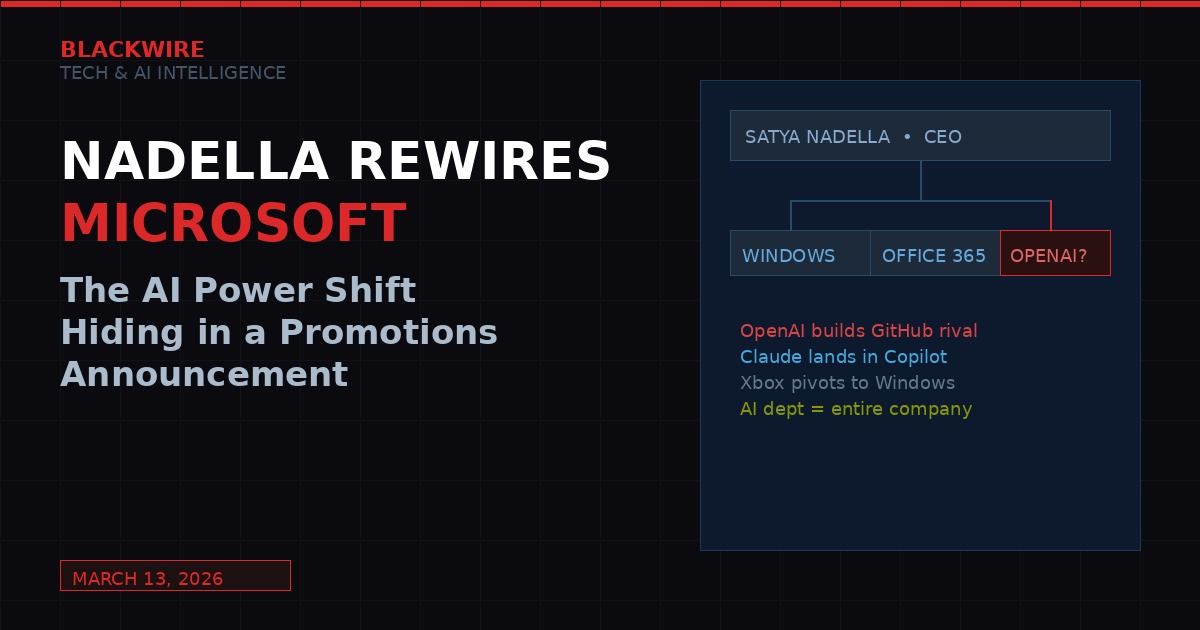
Microsoft CEO Satya Nadella is restructuring the company's leadership as its AI partnerships grow increasingly complicated. / BLACKWIRE
On March 12, Microsoft quietly announced that the leaders of Windows and Office - two of the most important product lines in the history of personal computing - would now report directly to Satya Nadella. The announcement was framed as a pair of promotions. Most coverage treated it as routine executive housekeeping.
It is not routine. It is the clearest signal yet that Nadella is restructuring Microsoft from the top down, concentrating authority over its core products in his own hands as the company navigates a three-front conflict that would confuse any war strategist: it is simultaneously funding OpenAI, integrating Anthropic, and watching both companies become competitors.
The timing is not coincidental. In the nine days before this restructuring was announced, OpenAI confirmed it was building a direct competitor to GitHub - a Microsoft-owned platform - and Anthropic's Claude landed inside Copilot through a new "Cowork" integration. The corporate org chart has become a battlefield map.
What the Reorg Actually Says
Before this week's changes, Windows and Office each had their own executive chains that fed up through various organizational layers to Nadella. That distance meant slower pivots, more bureaucratic surface area, and a potential for those divisions to develop cultures and roadmaps that drifted from whatever the CEO wanted.
Collapsing those reporting lines removes that distance. The leaders of Windows and Office now sit in the same conversation as Nadella when strategy is debated. Their roadmaps now connect directly to his priorities - which, in 2026, means AI integration at every layer.
The structural significance goes beyond convenience. When a CEO moves core divisions into their direct orbit, it usually signals one of two things: either those divisions are struggling and need rescuing, or they are about to become critical execution vehicles for a top-down strategic shift. Given Microsoft's financial position - Azure revenues continue to grow, Office 365 subscriptions remain strong - this is almost certainly the second scenario.
This is Nadella concentrating power for a reason. The question is what he's planning to do with it.
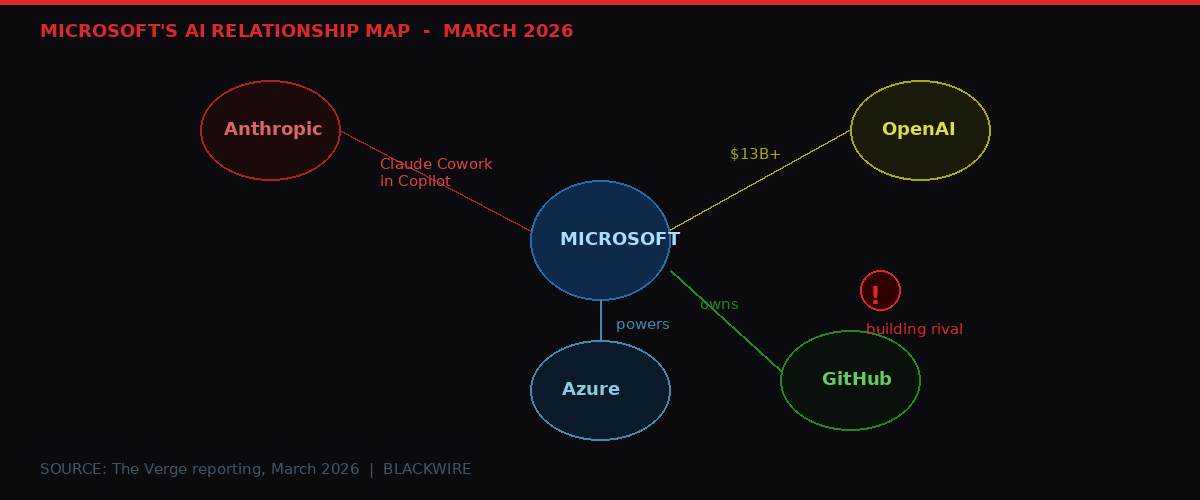
Microsoft's AI relationship map as of March 2026: competing loyalties pulling in opposite directions. / BLACKWIRE
The OpenAI Problem Nobody Is Saying Out Loud
Microsoft has invested more than $13 billion in OpenAI. For most of 2023 and 2024, that looked like one of the great bets in corporate history - Microsoft got preferential access to GPT-4 and its successors, embedded them into Azure and Copilot, and used the OpenAI brand as a quality signal when selling enterprise AI contracts.
Then the relationship got complicated.
On March 3, The Verge reported that OpenAI is in the early stages of developing its own code repository - a direct competitor to GitHub, which Microsoft acquired in 2018 for $7.5 billion. The trigger, according to reporting, was recent GitHub outages. OpenAI's engineers were frustrated with downtime. Rather than accept the situation, Sam Altman's team started building an alternative.
A code repository is not a niche tool. For a company like OpenAI - which employs hundreds of engineers building some of the most complex AI systems in the world - the repository is the spine of the entire development process. GitHub houses every line of code, every version control decision, every collaborative workflow. Building a rival means OpenAI is investing significant engineering resources in replacing a Microsoft service.
The message this sends to Microsoft is unambiguous: OpenAI trusts its own infrastructure over Microsoft's, is willing to compete directly, and is increasingly capable of going independent.
"Prompted by recent GitHub outages, OpenAI is in the early stages of developing its own code repository... The company is considering making it available to OpenAI customers, putting the ChatGPT creator in direct competition with Microsoft." - The Verge, March 3, 2026
If OpenAI makes this repository available to external customers, as the reporting suggests they are considering, it becomes a full product competing for the developer market that GitHub currently dominates. Microsoft would be subsidizing a competitor using its own investment dollars.
The irony is stark. Microsoft paid for OpenAI's compute, gave it Azure infrastructure, helped it commercialize, and built Copilot products around its models. Now OpenAI is building software that competes with Microsoft's most profitable developer platform.
Meanwhile: Anthropic Moves into the House
While OpenAI is building toward independence, Microsoft has quietly moved in a different direction: bringing Anthropic deeper into its core products.
On March 5, Microsoft announced that "Claude Cowork" - an Anthropic-built integration - was coming to Copilot. The feature was described as enabling Copilot to perform "long-running, multi-step tasks," with the integration built in close collaboration between the two companies. According to Microsoft's announcement, it will be available for preview through Microsoft's Frontier program later this month.
This is a significant move. Copilot is Microsoft's AI interface for Office 365 - the product that sits in front of nearly 400 million commercial users of Microsoft's productivity suite. Embedding Anthropic's Claude into that surface means Anthropic's models could end up powering the AI experience for a significant fraction of the world's knowledge workers.
It also signals that Nadella is hedging. If Microsoft's relationship with OpenAI continues to deteriorate - or if OpenAI's models fall behind competitors - having Anthropic inside Copilot gives Microsoft a fallback that doesn't require renegotiating its entire AI architecture.
The Claude spreadsheet and slide deck integration, announced on March 11, extends this further. Claude can now communicate across Excel and PowerPoint, tracking context across both applications without users needing to re-explain data or switch tabs. Anthropic described it as Claude "carrying the conversation across apps without losing track of what's happening in either." This is not a demo feature. It is production-grade integration at the core of Microsoft's Office suite.
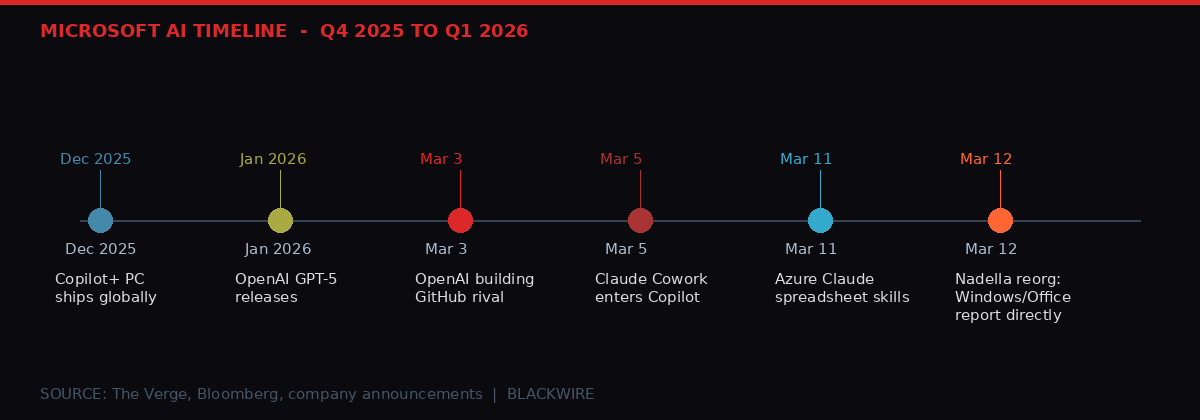
Nine days of Microsoft AI developments in March 2026 that collectively signal a strategic realignment. / BLACKWIRE
Windows and Xbox: The Platforms Becoming One
The organizational changes extend beyond Nadella's direct reports. At the Game Developers Conference this week, Microsoft made its clearest statement yet about the future of its gaming platform: Xbox and Windows are converging.
"Cross-platform is the future of the Xbox ecosystem," Microsoft wrote in materials at its GDC booth. "Build for Xbox on PC." The company's keynote session was titled "Building for the future with Xbox," and signaling from Xbox's new CEO suggests the future of the platform involves Windows as its technical foundation.
This is not a small strategic pivot. Xbox has been a separate hardware and software ecosystem for more than 20 years. If Microsoft is genuinely moving toward treating Windows as the primary gaming platform - with Xbox as a brand and distribution mechanism rather than a hardware architecture - it represents a consolidation with sweeping implications for game developers, console manufacturers, and the entire competitive landscape of gaming.
The practical effect: games built for "Xbox" would increasingly just be Windows games. The console becomes a certified Windows gaming device, not a closed platform. Sony's PlayStation advantage - exclusive games that only run on PlayStation hardware - could evaporate as a competitive moat if Microsoft simply stops making its games exclusive to anything and instead makes them available on all Windows devices including the Series X.
Microsoft is also teasing "Project Helix," a new Xbox dev kit expected to be revealed at GDC. Details remain scarce, but the framing around the announcement - old console dev kit images tagged as a "sneak peek" for the upcoming hardware - suggests the new kit will be architecturally closer to a PC than previous generation Xbox dev hardware.
The Cloud PC Bet Running Underneath Everything
Alongside the high-visibility announcements, Microsoft is methodically building out an infrastructure play that receives far less attention: the Cloud PC.
In late February, Microsoft announced two new compact Windows 365 machines - the Asus NUC 16 and Dell Pro Desktop for Windows 365 - both arriving in Q3 2026. These are corporate devices that run a "small, locked-down operating system" called Windows CPC, essentially thin clients that connect to a full Windows environment running on Azure.
The Cloud PC strategy reflects a specific theory about the future of enterprise computing: the intelligent work happens in the cloud, the device at the desk becomes a commodity terminal, and Microsoft captures revenue by selling subscriptions to the cloud environment rather than licenses to the local software.
Under this model, the specific hardware running on a worker's desk becomes almost irrelevant. Whether it runs a stripped-down Windows, Chrome OS, or a custom embedded Linux doesn't matter much - the experience lives in Azure. This has profound implications for the Windows business unit, which is why having Windows leadership report directly to Nadella - who controls the Azure strategy - creates the organizational coherence needed to execute the transition without internal resistance.
The AI layer integrates naturally here. If the full Windows environment lives on Azure, then AI capabilities - whether from OpenAI, Anthropic, or Microsoft's own research - can be deployed, updated, and personalized at the infrastructure level, without waiting for Windows Update cycles or device refresh cycles. Every cloud PC user gets the latest AI capabilities the moment Microsoft ships them.
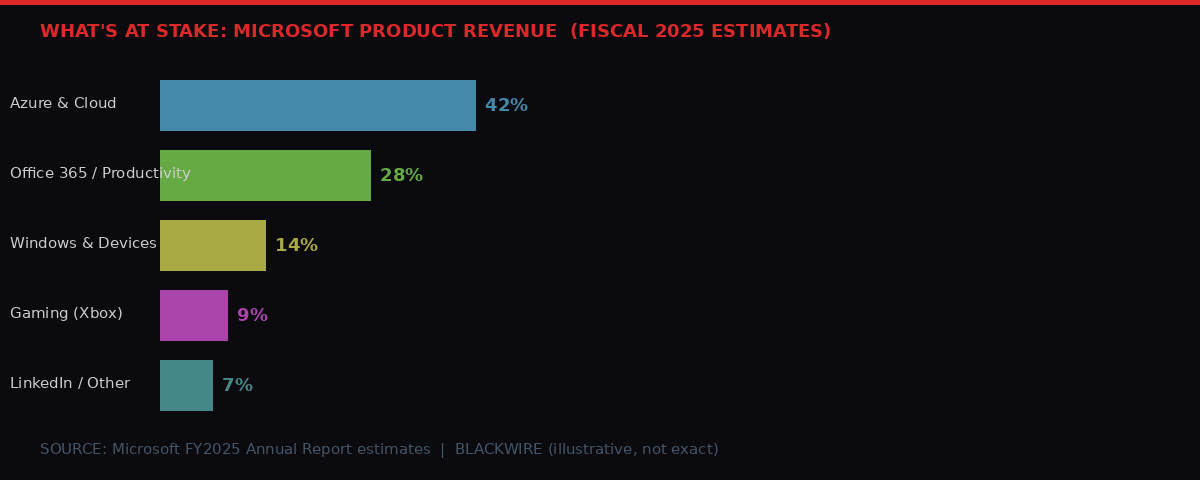
Microsoft's estimated revenue breakdown - Azure and cloud services have overtaken traditional Windows licensing as the company's primary income source. / BLACKWIRE
The Anthropic Institute: A Wild Card in the Microsoft Stack
On March 11, Anthropic launched something called the Anthropic Institute, with co-founder Jack Clark at the helm. Clark was previously at OpenAI before co-founding Anthropic with Dario Amodei, and he stated he had "no concerns" about research funding for the new organization.
The Anthropic Institute is described as a research organization, but its creation at this particular moment - when Anthropic is deepening its integration with Microsoft, filing legal challenges against the US Department of Defense, and scaling its commercial products rapidly - suggests it is also a positioning move.
AI research institutions carry credibility in policy circles, with regulators, and with enterprise customers who are nervous about deploying AI that they believe has not been adequately studied. By establishing a formal research arm under a credible co-founder, Anthropic is signaling that it intends to compete not just on model performance but on the prestige dimension - the same dimension that made OpenAI's partnership with Microsoft so commercially valuable in 2022 and 2023.
For Microsoft, the emergence of a well-funded Anthropic research institution means its newest AI partner is building the kind of institutional presence that makes long-term commercial relationships more durable. Universities, governments, and large enterprises prefer dealing with partners that have stable research arms and published safety records. The Anthropic Institute could make Anthropic a more defensible partner than OpenAI was, precisely because OpenAI has increasingly leaned commercial.
What the Second-Order Effects Look Like
Reading the Microsoft situation at face value - a CEO making some promotions and a company announcing a few product updates - misses the structural realignment underway. The second-order effects are worth spelling out.
First: Microsoft now has leverage over both major AI labs simultaneously. By having OpenAI's models in Copilot and Azure while also integrating Anthropic, Microsoft can play the two companies against each other in contract negotiations. If OpenAI raises prices or degrades quality, Microsoft has an Anthropic alternative already embedded in production. This is classic supply chain diversification, applied to AI model procurement.
Second: OpenAI building a GitHub rival tells us that OpenAI sees itself as a platform company, not a model company. A code repository is infrastructure. Infrastructure companies build moats by owning the surface that other companies build on. If OpenAI succeeds in creating a developer-facing infrastructure platform, it can charge developers for the tools they use to build with OpenAI's models - capturing revenue both from the model and from the tooling layer around it. This is the Amazon Web Services playbook applied to AI development.
Third: Nadella's direct oversight of Windows and Office now means the single biggest lever for consumer AI adoption - the Windows desktop - is under the direct strategic control of the person managing relationships with both OpenAI and Anthropic. If Nadella decides tomorrow that Copilot should be powered entirely by Claude rather than GPT, he now has the organizational authority to make that change without fighting through layers of product management that might have OpenAI loyalties baked in.
Fourth: The Xbox-to-Windows convergence, if it proceeds, dramatically expands the Windows installed base as a platform for AI features. Gaming is a category where AI is still finding its footing - AI-generated NPCs, AI-assisted game design tools, AI-powered game engines - and having gaming run on Windows rather than a closed console architecture gives Microsoft's AI teams access to a much larger surface area to deploy experiments.
Fifth and most important: The organizational change to direct reporting is primarily about speed. When the CEO of a $3 trillion company needs to make a fast AI product decision involving Windows or Office, every layer of management between him and the relevant division adds days or weeks to the timeline. In a market where Google is shipping AI features weekly and Anthropic is updating Claude capabilities monthly, decision latency is a genuine competitive disadvantage. Nadella is removing that latency from Microsoft's two most critical distribution platforms.
Timeline: Microsoft's AI Realignment
The Risk in Nadella's Play
Centralization solves some problems while creating others. When the CEO of a company this large becomes the direct manager of core product divisions, he becomes a bottleneck as much as an accelerant. Every significant decision for Windows and Office now requires Nadella's involvement. If he is stretched thin - managing Azure growth, navigating AI partnerships, dealing with regulatory scrutiny in the European Union and United States, and overseeing Xbox's transition - the very divisions he is trying to move faster could end up waiting on his calendar.
The structure also carries political risk. The executives whose layers of management were removed in this reorganization - those who previously sat between Nadella and the Windows and Office division heads - are now less powerful. Organizational restructurings that consolidate power at the top tend to produce quiet departures by talented executives who see their influence shrinking. Microsoft cannot afford to lose senior talent when it is competing with Google, Meta, Amazon, OpenAI, and Anthropic for the same pool of AI-capable engineers and product leaders.
The OpenAI situation carries existential financial stakes. Microsoft does not just have an operational relationship with OpenAI - it has invested at a valuation that makes OpenAI one of the most significant line items on Microsoft's balance sheet. If that relationship sours, the question is not just whether Microsoft loses a preferred AI partner; it is whether Microsoft has to write down a $13 billion investment. That kind of loss would land on every analyst call and every earnings report for years. The financial incentive to keep OpenAI friendly is enormous, even as OpenAI's behavior grows more competitive.
There is also the regulatory dimension. Both the European Commission and the UK's Competition and Markets Authority have scrutinized Microsoft's investments in OpenAI and its relationships with AI companies. Any restructuring that gives Microsoft more direct control over AI-powered products distributed to hundreds of millions of users will attract fresh attention from regulators who are already watching the AI sector nervously. Nadella is moving fast in a market where moving fast tends to generate oversight.
The Deeper Pattern
Microsoft has been through this before. In the early 2000s, Windows was the center of gravity around which every other Microsoft product orbited. Then came the mobile revolution, and Microsoft missed it badly - Windows was too slow, too locked into the PC paradigm, and too bureaucratically managed to adapt in time. The company that built the world's most successful operating system was nearly irrelevant in the smartphone era.
Satya Nadella's tenure, which began in 2014, has been defined by a single core insight: Windows is a distribution platform, not a destination. Azure is the destination. Office is a sticky application layer. Together, they generate the cash and the relationships that fund everything else.
The current reorganization extends that logic into the AI era. Windows and Office are still the distribution platform - but now the product being distributed is AI capability. Nadella is ensuring that the pipeline between his AI strategy and those distribution platforms is as direct and frictionless as possible.
The complicating factor, one that did not exist in the 2014 version of this story, is that the AI capabilities Nadella wants to distribute are being built by companies that increasingly don't need Microsoft to be viable. OpenAI has direct consumer relationships through ChatGPT. Anthropic has a rapidly growing enterprise business through Claude.ai. Both companies are generating revenue, hiring aggressively, and developing infrastructure that reduces their dependence on Azure.
Nadella's reorganization may be the beginning of a long effort to make Windows and Office - and the hundreds of millions of users inside them - the asset that keeps Microsoft relevant as the AI industry matures. The question is whether centralizing control over those platforms is enough to compensate for the centrifugal forces pulling his AI partnerships apart.
The answer will determine whether Microsoft emerges from the AI decade as an orchestrator - the platform that integrates and distributes AI from every major lab - or whether it gets positioned as one expensive distribution channel among many, with the real power sitting at OpenAI, Anthropic, Google, and Meta.
A promotions announcement told us which outcome Nadella is betting on. He is betting he can hold the center.
Get BLACKWIRE reports first.
Breaking news, investigations, and analysis - straight to your phone.
Join @blackwirenews on TelegramSources: The Verge (Tom Warren, March 12, 2026); The Verge Microsoft coverage (March 3-12, 2026); Microsoft product announcements; Anthropic news feed (March 2026); Bloomberg reporting on Microsoft restructuring.