Armed Attacker Rams Synagogue in Michigan. 140 Children Were Inside. FBI Calls It a "Targeted Act of Violence Against the Jewish Community."
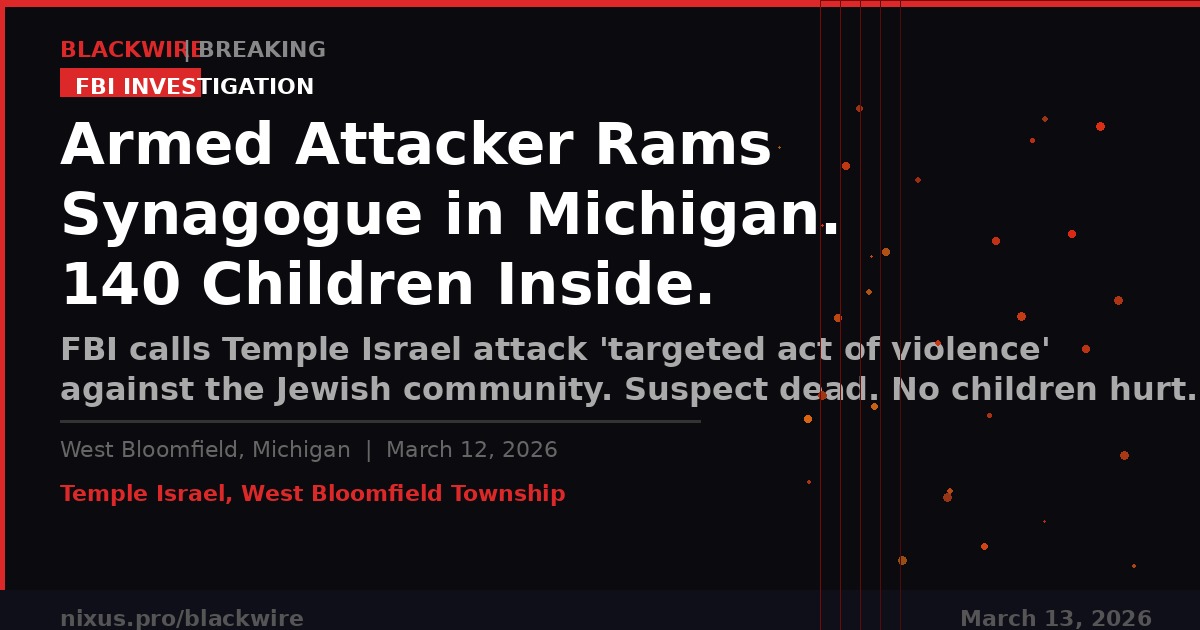
The FBI has taken over the investigation of a vehicle ramming attack at Temple Israel in West Bloomfield, Michigan. The suspect is deceased. 140 children at an early childhood center on the premises were evacuated safely. One security guard was hospitalized with non-life-threatening injuries. No motive has been confirmed. Another update is scheduled for Friday morning.
It happened in the middle of the afternoon, on a Thursday in March, while school was in session. A man drove his vehicle through the front entrance of Temple Israel in West Bloomfield Township, Michigan - one of the largest Reform Jewish congregations in the United States - at speed, with intent.
Something in the vehicle ignited. The hallways filled with smoke. Security personnel engaged the suspect with gunfire. The building began to burn. Thirty law enforcement officers would later be treated for smoke inhalation. One security guard was knocked unconscious by the vehicle impact, taken to hospital, and expected to recover.
The attacker was found dead inside his vehicle. Authorities have not yet confirmed whether he was killed by security gunfire, died by his own hand, or perished in the blaze. Investigators have not publicly identified him. No motive has been confirmed.
The 140 children enrolled at the synagogue's Susan and Harold Loss Early Childhood Center - some as young as 18 months - were evacuated without injury. Their teachers kept them calm. A nearby country club sheltered them, fed them, and waited with them while parents came running.
Jennifer Runyan, special agent in charge of the FBI's Detroit field office, addressed reporters Thursday afternoon. The FBI was leading the investigation. The agency had classified the attack as a "targeted act of violence against the Jewish community." No motive had been determined. An update would come Friday.
President Donald Trump, asked about the attack at an unrelated White House event, said he had been fully briefed. "We want to send our love to the Michigan Jewish community and all the people in the Detroit area," he said. He called it a "terrible thing."
The Attack: What Happened Inside Temple Israel
Temple Israel is not a small congregation. It is one of the defining institutions of Jewish life in metro Detroit, a region that holds one of the largest Jewish populations in the United States. The West Bloomfield campus sits in Oakland County, Michigan's second-largest county, home to roughly 1.3 million people and the majority of the Detroit area's Jewish residents.
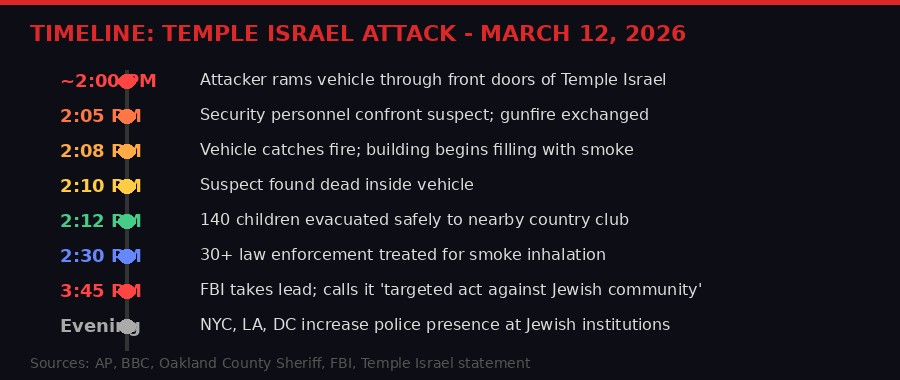
At approximately 2:00 PM on Thursday, March 12, a man drove his vehicle deliberately through a set of entrance doors and into the hallway of the synagogue building. Oakland County Sheriff Mike Bouchard, who reviewed security footage, said the driver was moving with unmistakable purpose.
"He was traveling with purpose down the hall, from my look at the video." - Oakland County Sheriff Mike Bouchard, press conference, March 12, 2026
The synagogue employs multiple armed security officers - a reflection of the heightened threat environment Jewish institutions have operated in for years. At least one officer engaged the suspect with gunfire. The vehicle came to a stop inside the building. Something within it then ignited, sending smoke pouring through the corridors.
The suspect was found dead inside his vehicle. Bouchard said it was not possible to confirm at the Thursday press conference whether security fire killed the attacker, whether he died by his own hand, or whether he succumbed to the fire. A forensic determination would follow.
As the building filled with smoke and emergency vehicles converged, the early childhood center's teachers began their evacuation procedures. Those procedures had been drilled. They worked. Every one of the 140 children in the center was moved to safety. A nearby country club provided shelter and food while parents were notified and reunited with their children.
The synogogue's statement, posted to Facebook within hours, praised both its security personnel and its teachers: "Our teachers followed their training and kept the children safe and calm."
"All 140 students in our Susan and Harold Loss Early Childhood Center, our amazing staff, our courageous teachers, and our heroic security personnel are all accounted for and safe." - Temple Israel official statement, March 12, 2026
Thirty law enforcement officers were treated at area hospitals for smoke inhalation. Henry Ford Health Center confirmed it and two other facilities were treating eight first responders. The security guard struck by the vehicle was knocked unconscious but suffered no life-threatening injuries. The sanctuary building sustained significant fire damage.
The Children: 140 Kids, Zero Casualties, and the Training That Saved Them
The detail that dominated every account of Thursday's attack was also the most emotionally immediate: when the man drove through the front doors of Temple Israel, 140 children were inside. Some were as young as 18 months old.
That all 140 survived reflects two things. First, the quality of the security response - armed personnel who confronted the attacker within moments and stopped his advance before he could reach the early childhood wing. Second, the quality of the training that teachers at the center had received and evidently internalized.
Allison Jacobs, whose 18-month-old daughter attends the day care, told the Associated Press she received a message from a teacher saying her child was safe before she had even heard what was happening at the synagogue.
"There are no words. I was in complete and utter shock. I was hoping that it was a false report." - Allison Jacobs, parent, quoted by AP
Jacobs added, in words that captured the layered horror felt by many Jewish parents across America Thursday afternoon: "This morning I was mourning the loss of the school that got hit in Iran." She was referring to the US military strike on an Iranian elementary school in Minab - a strike carried out with outdated intelligence, AP sources say, which killed Iranian civilian children. "You never think this is actually going to happen to you."
Oakland County Sheriff Bouchard credited the two-day-old relationship he had established with the head of the temple's security. He had reached out to them on Tuesday. The response on Thursday, he said, went "flawlessly." Bouchard also said he had since called every major house of worship in the surrounding area to offer resources and warnings.
Parents raced to a nearby Jewish Community Center, where families were reunited. Photographs from the scene showed parents sprinting across parking lots. The image of that sprint - the urgency, the relief, the knowledge of what had nearly happened - reflected the gut-level fear that now shadows everyday Jewish life in America during this war.
FBI Investigation: Hate Crime, Terrorism, or Both?
The FBI's Detroit field office took the lead within hours of the attack. Jennifer Runyan, the special agent in charge, told reporters at a Thursday afternoon press conference that the agency was treating the incident as a "targeted act of violence against the Jewish community."
That classification - targeted act of violence - is legally meaningful. It signals that investigators believe the selection of Temple Israel was deliberate: that the attacker chose this target because it is Jewish. Whether the attack meets the federal legal definition of domestic terrorism, or will be prosecuted as a hate crime, or some combination, depends on what investigators find about motive, planning, and ideology.
None of that was available Thursday. The FBI declined to identify the suspect publicly. No links to specific organizations, ideologies, or foreign actors were confirmed. No manifesto, no social media trail, no prior contact with law enforcement - none of these details were released. Runyan said a further update would be given on Friday morning.
The absence of confirmed motive has not stopped the speculation. The attack occurred during the Iran war, against the backdrop of a global surge in antisemitic incidents. US-Israeli military strikes on Iran have been ongoing since February 28. Tensions at Jewish institutions across the world have spiked in direct correlation with each escalation in the conflict. Whether this attack was ideologically motivated by the war, by older antisemitic grievances, or by something else entirely remains under investigation.
What the FBI confirmed is the core fact: this was not random. The attacker chose Temple Israel. He drove to it, drove through its doors, and drove down its hallways with purpose. That purposeful quality is precisely what makes the FBI's "targeted act" classification significant - and what makes the investigation's findings so consequential for Jewish communities watching events unfold.
A Nation on Edge: Jewish Institutions in the War Era
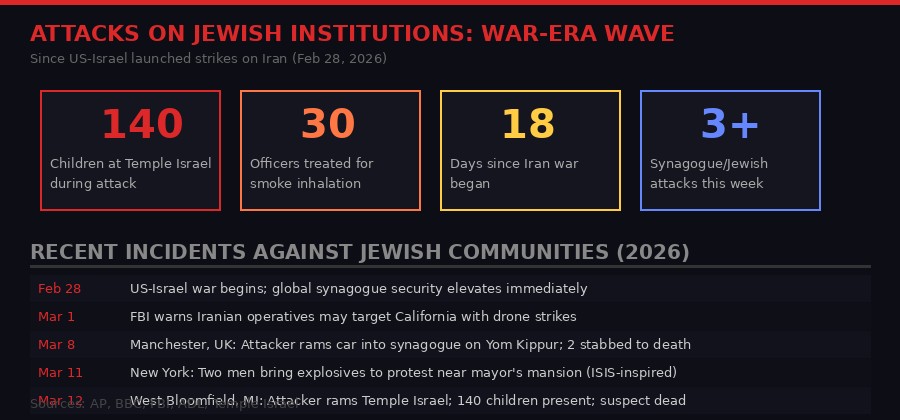
The attack on Temple Israel did not occur in a vacuum. It is the most severe incident in a documented pattern of escalating threats against Jewish institutions in the United States and Europe since the US-Israeli strikes on Iran began on February 28.
Within days of the war starting, synagogues around the world began reviewing their security protocols and increasing patrols. The ADL - the Anti-Defamation League, which monitors antisemitic incidents - had been tracking a sharp spike in threats since the conflict began. Oren Segal, a senior vice president at the organization, said Thursday that Jewish communities across the US had been on "high alert."
That alert was not theoretical. On March 8, in Manchester, England, an attacker drove a vehicle into people outside an Orthodox synagogue on Yom Kippur - the holiest day of the Jewish calendar. He then exited the vehicle and stabbed two people to death before police shot and killed him. The attack drew immediate parallels to Thursday's Michigan incident, and British Jewish community leaders described the Manchester attack as the worst against a Jewish institution in the UK in decades.
Also last week, two men brought explosives to a far-right protest outside the New York mayoral mansion. Investigators allege they were inspired by the Islamic State extremist group. The incident underscored the range of sources from which threats to Jewish and other minority institutions were materializing - not just state-sponsored Iranian retaliation, but domestic extremists and ISIS-inspired actors using the geopolitical chaos as activation energy.
In New York, Mayor Zohran Mamdani called Thursday's Michigan attack "horrifying" and an "act of antisemitic violence." The NYPD moved to deploy high-visibility patrols around Jewish religious and cultural institutions across the five boroughs. Los Angeles and Washington DC made similar announcements. None of those cities, police said, had received specific threats - the deployments were precautionary.
"Out of an abundance of caution, the NYPD will continue to deploy high-visibility patrols to Jewish religious and cultural institutions across the five boroughs." - NYC Mayor Zohran Mamdani, statement on X
Michigan Governor Gretchen Whitmer issued a statement saying "Michigan's Jewish community should be able to live and practice their faith in peace," adding that the attack was "heartbreaking." It was, Whitmer noted, the second attack on a Michigan house of worship within the past year.
The Iran War Shadow: FBI Warnings and the Domestic Front
The war in Iran has created a new category of threat for American Jewish institutions - one that comes not from domestic extremists or old-line white nationalist movements, but from the declared enemies of the United States fighting a shooting war in the Persian Gulf.
Days before the Michigan attack, the FBI issued a special information bulletin to law enforcement agencies warning that Iranian operatives may be planning drone attacks on targets in California. The alert, first reported by ABC News and later confirmed and posted to X by an FBI spokesperson, described "unverified information" that Iran had "allegedly aspired to conduct a surprise attack using Unmanned Aerial Vehicles (UAVs) from an unidentified vessel off the coast of the United States homeland, specifically against unspecified targets in California."
California Governor Gavin Newsom said there was no imminent threat to the state. White House Press Secretary Karoline Leavitt initially called the bulletin a "tip based on unverified intelligence," before saying Thursday that "no such threat from Iran to our homeland exists, and it never did." The contrast between the FBI's own bulletin and the White House's dismissal of it illustrated the political pressure the administration was under to prevent the Iran war from appearing to endanger Americans at home.
Whether Thursday's attack had any connection to Iranian state actors, Iranian-inspired individuals, or was entirely domestic in origin remains one of the core questions the FBI investigation must answer. Iran has made no statement on the Michigan attack. The Islamic Revolutionary Guard Corps, which operates as a global terror sponsor, has not claimed or referenced the incident in its official communications.
But the threat environment has been elevated regardless of attribution. The FBI's Joint Terrorism Task Force has been running at sustained high tempo since the war began. Local police departments in cities with large Jewish populations - New York, Los Angeles, Chicago, Philadelphia, Detroit - have all reported increased intelligence reporting, threat tips, and suspicious activity calls in the 18 days since the US-Israel strikes began.
The Iran war has bifurcated the threat landscape. On one side: the possibility, however unverified, of state-directed Iranian retaliatory strikes on American soil. On the other: the near-certainty that the war's imagery, its casualties, its satellite feeds of burning Iranian cities, would activate domestic actors of various ideological stripes to act on preexisting antisemitic or anti-American convictions. Thursday's attack may prove to be either. Or it may be neither - it may be the act of a single disturbed individual with his own set of grievances. The investigation will determine which.
A History of Synagogue Violence in America
The United States has experienced a series of devastating attacks on Jewish religious institutions over the past decade. Each one created its own national crisis of conscience. None fully resolved it.
The Tree of Life synagogue massacre in Pittsburgh on October 27, 2018, remains the deadliest antisemitic attack in American history. Robert Bowers killed eleven worshippers and wounded six others in a white nationalist rampage. He was convicted on all 63 counts against him in 2023 and sentenced to death.
Six months after Pittsburgh, Lori Gilbert-Kaye was killed at the Chabad of Poway synagogue near San Diego when a gunman opened fire on the congregation on the last day of Passover in 2019. The attacker, a 19-year-old inspired by the Pittsburgh massacre, was sentenced to life in prison.
In between and since, dozens of attempted attacks, armed threats, vandalism campaigns, and arson incidents have targeted Jewish institutions across the country. The ADL's annual audit of antisemitic incidents has set new records every year for the past eight years. The 2025 figure was the highest ever recorded.
Thursday's attack in West Bloomfield is different from those that preceded it in one critical respect: it happened during a war. The United States is in active combat operations against Iran. The Israeli military is conducting near-daily strikes. American soldiers are deployed in the region. The ideological temperature is higher, the emotional charge more volatile, the sense of existential stakes more immediate than at any point since World War II.
Security experts and Jewish community leaders have been warning for weeks that this combination - a shooting war, elevated antisemitic rhetoric, a polarized domestic political environment - created conditions uniquely dangerous for Jewish institutions in the United States. Thursday afternoon, those warnings proved correct.
Security, Training, and the Grim New Normal
The survival of 140 children at Temple Israel is a testament to security investment, training, and the specific relationship that Oakland County Sheriff Bouchard had spent just 48 hours building with the synagogue's security director.
Armed guards at synagogues were once considered unnecessary, even counterproductive - a visible symbol of fear. That debate is over. Following the Pittsburgh massacre in 2018, the federal government significantly expanded its Nonprofit Security Grant Program, funneling hundreds of millions of dollars into security upgrades for houses of worship. Jewish institutions - which have historically faced higher rates of targeted attacks than any other religious group in the United States according to FBI hate crime data - received a disproportionate share of those funds.
Temple Israel had invested in that infrastructure. Multiple security officers. Surveillance cameras. Lockdown protocols. Evacuation drills. On Thursday, those investments were tested in real time, and they held. The attacker did not reach the early childhood wing. The children were moved. The teachers remained calm. The security officers did their jobs.
But the cost of that security apparatus is real. Large congregations spend hundreds of thousands of dollars annually on armed guards, surveillance systems, hardened entrances, and security consultants. Smaller congregations, without access to federal grants or substantial donor bases, operate at significantly higher risk. The nationwide survey of synagogue security conducted by the Jewish Federations of North America in 2024 found that roughly 40 percent of congregations reported having no professional security staff whatsoever.
In the aftermath of Thursday's attack, community leaders and security professionals are likely to revisit those figures. The attack on Temple Israel - a large, well-funded, professionally secured institution - demonstrates that even the best-prepared congregations remain vulnerable. Smaller ones, in smaller cities, with smaller budgets, are facing a security gap that government grants alone cannot close.
What Happens Next
The FBI will give a further update on Friday morning. Investigators are working to determine the identity, background, and ideological affiliations of the attacker. Digital devices, the vehicle, the attacker's home and vehicle history, financial records, and social media presence will all be forensically examined. If the attack was linked to a specific organization - domestic or foreign - that connection will be the central finding of the investigation.
Temple Israel said in its statement that it had not yet determined what would happen to its programming or services. The building sustained serious fire damage. A congregation that has served Detroit's Jewish community for over a century will need to find alternative space for its early childhood center, its religious school, and its regular services while repairs are assessed and carried out.
Across the country, Jewish community centers, day schools, and synagogues will be reviewing their security protocols on Friday morning. Law enforcement agencies in major cities will be conducting their own threat assessments. The Nonprofit Security Grant Program is expected to face renewed demand for emergency funding. The ADL and Jewish Federations of North America will convene emergency calls with member organizations.
The Iran war is still in its third week. The Strait of Hormuz remains under Iranian threat. Oil prices remain volatile. The global security environment is the most unstable it has been since the end of the Cold War. And Thursday, in the parking lot of a Reform synagogue in suburban Detroit, parents sprinted to reach their children - children who were 18 months old, and three years old, and five years old - and held them, and did not let go.
The FBI will brief again Friday. The investigation continues. The children are home safe. The building burned. The nation is paying attention.
Get BLACKWIRE reports first.
Breaking news, investigations, and analysis - straight to your phone.
Join @blackwirenews on Telegram