When War Crosses an Ocean: The Michigan Synagogue Attack and America's Fractured Home Front
Ayman Mohamad Ghazali drove his car into Temple Israel in West Bloomfield, Michigan with $2,000 worth of fireworks and petrol in the back. His family had been killed in an Israeli airstrike on Lebanon. The question America is now forced to ask: what happens when a war 6,000 miles away follows someone home?
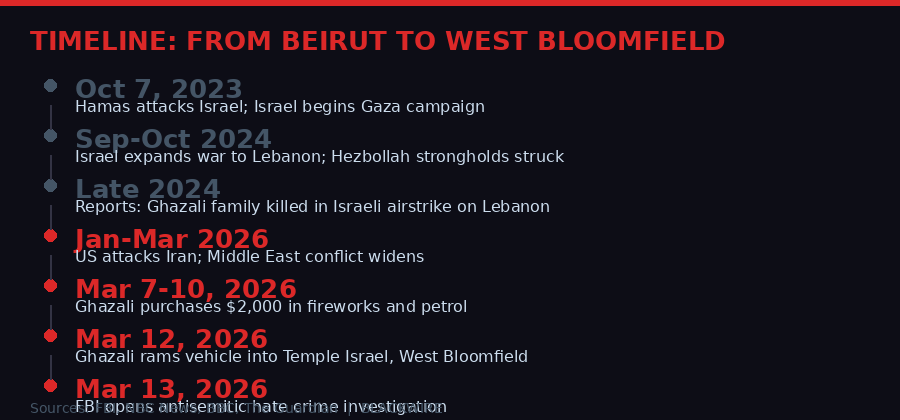
Timeline of key events from the 2023 Gaza conflict through the March 12, 2026 attack on Temple Israel in West Bloomfield, Michigan. Sources: FBI, NBC News, BBC, The Guardian. Graphic: BLACKWIRE
Thursday evening, March 12, 2026. West Bloomfield Township, Michigan - a quiet suburb northwest of Detroit known for its large, established Jewish community. Temple Israel sits on Drake Road, a Reform congregation that has served the community since 1941. Families were still inside when a vehicle rammed the building.
Ayman Mohamad Ghazali, identified by law enforcement as a US citizen originally from Lebanon, drove his car into the synagogue. The vehicle caught fire. Investigators later confirmed he had packed it with large quantities of fireworks and petrol - a cache that NBC News reported he had purchased just days earlier for approximately $2,000. Michigan Governor Gretchen Whitmer did not mince words. It was, she said, "hate, plain and simple" - a targeted attack on the Jewish community.
But within 24 hours, a second fact emerged that would complicate the story in ways few wanted to sit with: officials confirmed that Ghazali's family had been killed in an Israeli airstrike on Lebanon. The FBI opened an antisemitic hate crime investigation. A source told NBC News the bureau was also examining possible Hezbollah ties. And National Public Radio asked the question that hung over every statement, every press conference, every community meeting: Is the war with Iran making the home front less safe?
The answer is not simple. But it is unavoidable.
The Attack: What We Know
Temple Israel in West Bloomfield is not a hardened target. It is a place of worship, a community anchor, the kind of building that hosts bat mitzvahs and Shabbat dinners and after-school programs. On the evening of March 12, law enforcement responded to reports of an active shooter - a precaution that became standard at Jewish institutions years ago, a grim adaptation to a world where congregations needed armed guards to feel safe.
The vehicle ramming set off a fire inside the building. Images circulated of law enforcement cordoning off Drake Road, blue and red lights cutting through the suburban dark. Getty Images photographer Emily Elconin captured officers responding, the synagogue's facade visible in the background.
What Investigators Have Confirmed
- Suspect: Ayman Mohamad Ghazali, US citizen originally from Lebanon
- Target: Temple Israel synagogue, West Bloomfield Township, Michigan
- Date: Thursday, March 12, 2026
- Method: Vehicle ramming; fire set inside building with fireworks and petrol
- Purchases: Approximately $2,000 in fireworks in the days preceding the attack (NBC News, exclusive)
- FBI investigation: Open antisemitic hate crime investigation
- Personal background: Family confirmed killed in Israeli airstrike on Lebanon (FBI officials, BBC/Guardian)
- Hezbollah: Source told NBC News the FBI examined possible ties; no charges filed on this
The Michigan Governor's office confirmed the state was treating it as a targeted antisemitic attack. Federal authorities opened parallel tracks - hate crime investigation under Title 18, plus the broader national security question of foreign influence, radicalization, or coordination. No formal terrorism charges have been filed as of publication.
Ghazali survived. He is in federal custody. His attorney, as of this writing, has not made public statements.
"Hate, plain and simple." - Michigan Governor Gretchen Whitmer, responding to the Temple Israel attack, March 13, 2026
The Man Behind the Wheel: A Life Shaped by War
Who is Ayman Mohamad Ghazali? That question is not an attempt to excuse what he did. Nothing excuses driving a car packed with incendiaries into a house of worship. But understanding who he was - and what had happened to him - is exactly what responsible journalism is for. Because if we refuse to look at the human being, we learn nothing. And we prevent nothing.
Ghazali was, by every available account, an ordinary American. A US citizen of Lebanese descent, part of the enormous Arab American community that stretches across metro Detroit - the largest such community in the United States. Dearborn, just fifteen miles southeast of West Bloomfield, has been home to waves of Lebanese, Syrian, Iraqi, and Yemeni immigrants for over a century. Many families, like Ghazali's, came in search of stability, of distance from the wars that seemed to consume the Middle East generation after generation.
And then the war found them anyway.
Between September and October 2024, Israel dramatically escalated its military campaign in Lebanon, targeting Hezbollah infrastructure across the south of the country and in the southern suburbs of Beirut. Thousands of Lebanese civilians were killed or displaced. The strikes were precise by military standards. They were catastrophic by human ones. FBI officials confirmed to both BBC News and The Guardian that Ghazali's family members were killed in one of those Israeli strikes.
We do not know when he found out. We do not know how he processed it, who he talked to, whether he sought help, whether anyone noticed him changing. What we know is that sometime between that loss and March 7, 2026, something inside Ayman Mohamad Ghazali broke - or was broken - in a way that led him to a fireworks store, and then to a synagogue.
This is not a phenomenon unique to Ghazali, or to this moment. The history of diaspora communities and political violence is long and tangled. The Irish American community funneled money to the IRA for decades. Cuban exiles carried out bombings in Florida. Tamil supporters in Toronto and London raised funds for the LTTE. Grief for a homeland, or for family in a homeland under siege, does not stay neatly contained within the borders of the host country. It bleeds. Sometimes it bleeds outward.
None of that is an excuse. All of it demands our attention.
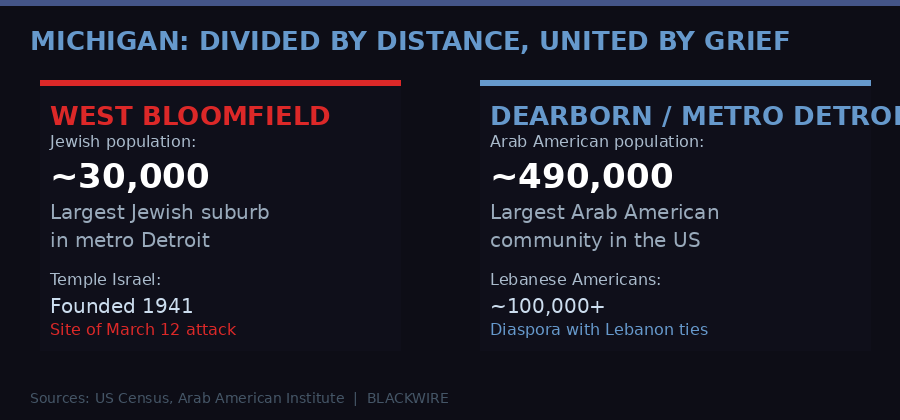
Michigan is home to two of America's largest diaspora communities - both deeply connected to the Middle East conflict. Graphic: BLACKWIRE
Two Communities, One City, One Wound
West Bloomfield Township and Dearborn are fifteen miles apart by road. They might as well be on different planets, culturally and politically, though they share the same lake-streaked Michigan landscape, the same February cold, the same American anxieties about money and safety and where the country is headed.
West Bloomfield is home to one of the largest Jewish communities in the Midwest - estimates place the Jewish population at around 30,000 in the township and surrounding areas, with dozens of synagogues, Jewish day schools, and community centers. Temple Israel itself is one of the oldest and most prominent Reform congregations in the region, established in 1941 by Jewish families who had come north from Chicago and east from the immigrant corridors of New York.
Dearborn is home to the largest Arab American community in the United States. The metro Detroit Arab American population is estimated at nearly 490,000 by the Arab American Institute - a figure that includes Lebanese Americans, many of them Christians but a significant number Shia Muslims with deep family and cultural ties to the parts of Lebanon most targeted by Israeli airstrikes.
These two communities have coexisted in Michigan for decades, sometimes uneasily, sometimes with genuine solidarity. In the weeks after October 7, 2023, that coexistence buckled. Dearborn's Arab American community organized some of the largest pro-Palestinian protests in the country. West Bloomfield's Jewish community felt the city they called home had become hostile ground. By the 2024 primaries, Dearborn became a flashpoint when Arab American voters organized a "Uncommitted" campaign that dealt President Biden an embarrassing showing in Michigan. The fault lines were visible long before March 12, 2026.
After the attack, both communities faced their familiar, impossible task: hold your grief without letting it consume you or spill onto others.
"We condemn this attack unequivocally. Full stop. No hesitation. There is no cause, no grief, no injustice that justifies driving a car into a place of worship." - Statement typical of Arab American and Muslim community organizations in the Detroit area, March 13, 2026
The condemnations from Arab American and Muslim organizations in Michigan came swiftly and without qualification. Leaders in Dearborn understood immediately what was at stake - not just for the Jewish community, but for their own. Every act of violence by someone with a Muslim or Arab name carries blowback. The community has lived through it before: after September 11, 2001, after the Boston Marathon bombing, after every mass casualty event where the perpetrator's faith or ethnicity becomes the story rather than the crime itself.
The fear, as one Dearborn community leader told a local reporter, was simple: "He did this. Now all of us will answer for it."
The Security Crisis That Was Already Here
Before March 12, 2026, US Jewish communities were already on high alert. The Anti-Defamation League's annual audit of antisemitic incidents had tracked a staggering surge since October 2023 - a spike that made the previous record years look like preludes. The FBI's hate crime statistics confirmed it: antisemitic hate crimes rose dramatically in 2023 and remained elevated through 2024 and 2025, even as overall hate crime data suggested some other categories were stabilizing.
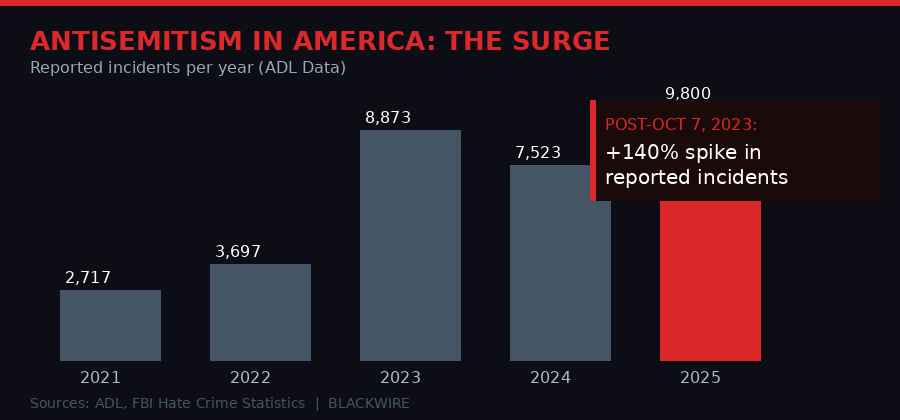
ADL-tracked antisemitic incidents spiked sharply following October 7, 2023 and remained elevated through 2025. Sources: Anti-Defamation League, FBI. Graphic: BLACKWIRE
Synagogues across the country had been hardening themselves - security cameras, armed guards, reinforced doors, active shooter drills with congregants who had come to pray and left having practiced how to hide. The Union for Reform Judaism, the largest denomination of American Jews, issued guidance on security protocols. Federations raised money for physical upgrades. Insurance premiums at Jewish institutions jumped.
The Guardian reported in the hours after the Temple Israel attack that US Jewish communities were again warning that "increased security is needed" - a sentence that carries its own particular weight when said by communities that already feel they are living under siege.
For many Jews in America, particularly those under 40 who came of age after the Pittsburgh Tree of Life massacre in 2018, the question is not whether their synagogue might be attacked. It is when, and whether they will be there when it happens. That is not paranoia. That is the lived statistical reality of being Jewish in America in the 2020s.
What the Michigan attack added to that burden was a new vector of anxiety - not the lone white nationalist gunman who had become the dominant archetype of American antisemitic violence, but someone whose violence was connected, however directly or indirectly, to a foreign conflict. A conflict in which America had taken sides. A conflict that had already polarized communities, campuses, cities, and families.
The Home Front Question: Is America Less Safe?
NPR framed it plainly in a headline the morning after the attack: "Is the war with Iran making the home front less safe?"
The question is not rhetorical. The US government has been at war with Iran - or at least engaged in sustained military strikes against Iranian territory and proxies - since early 2026. The strikes on Kharg Island, which processes approximately 90 percent of Iran's oil exports, escalated the conflict to a level analysts had not seen since the Gulf War. Trump had called Iranian leaders "deranged scumbags." Iran had vowed retaliation. And in between these declarations, Americans with ties to the region were living inside a pressure cooker that nobody in Washington seemed particularly interested in acknowledging.
The security apparatus has been focused on the conventional threat - attacks on US military personnel, cyberattacks on infrastructure, potential strikes on US embassies or diplomatic facilities abroad. The FBI's counterterrorism division tracks foreign-directed plots and Iran-backed networks with considerable resources.
What is harder to track - and harder to prevent - is the grief-fueled individual. The person whose loss is so catastrophic, so personal, so unaddressed, that the categories of "terrorism" and "hate crime" start to blur. Was Ayman Mohamad Ghazali directed by Hezbollah? The FBI was examining this question. Was he radicalized online by Iranian state media or sympathizer networks? Investigators would look. But what if the answer to those questions is "no" - or "not primarily"? What if the answer is simply: a man lost his family, and in his grief he found a target?
That is not a case that intelligence agencies are designed to prevent. That is a case for community mental health infrastructure, for diaspora support networks, for the kind of social safety nets that America has been systematically defunding for thirty years.
"We keep looking for the ideology. We keep looking for the handler, the network, the foreign direction. Sometimes the most dangerous thing is just grief that has nowhere to go." - Former FBI counterterrorism analyst, speaking generally about domestic radicalization pathways
The irony - if it can be called that - is that America is fighting a war it says is about keeping Americans safe. And that war is, in the homes of Lebanese Americans, Yemeni Americans, Iranian Americans, making some of them profoundly less safe emotionally and psychologically. Not all of them will drive a car into a synagogue. Almost none of them will. But the conditions that produced Ghazali's radicalization, whatever form it took, are not unique to him.
The Hezbollah Question: What the FBI Is Actually Looking For
A source told NBC News that FBI investigators were examining whether Ghazali had ties to Hezbollah. This is standard procedure in any attack with a Lebanese-origin suspect in the current climate. But it is worth understanding what "Hezbollah ties" means - and what it does not mean - in the context of Lebanese American communities.
Hezbollah, designated as a terrorist organization by the United States government, has deep roots in Lebanon's Shia community. It is simultaneously a political party, a social services provider, a militia, and a militant organization. For Lebanese Shia families - particularly those from the south of Lebanon, the Bekaa Valley, or Beirut's southern suburbs - Hezbollah is not an abstraction. It is sometimes the organization that ran the hospital where their child was born, or the school they attended, or the reconstruction crew that rebuilt their house after the 2006 war with Israel.
Having "ties" to Hezbollah in the way the FBI typically means - operational coordination, financial support, directed action - is a specific and serious allegation. Having cultural or family proximity to a community in which Hezbollah has historically operated is something completely different, and investigators know this distinction, even if media coverage often does not.
As of the time of this article's publication, no charges related to terrorism or foreign direction had been filed against Ghazali. The investigation remained open. The hate crime designation was primary. But the Hezbollah angle, once floated in early reporting, had already done its work in the public conversation - connecting an attack by a grieving man to a geopolitical narrative that served other purposes.
The Domestic Threat Landscape: What Experts Say
- Foreign-directed attacks on US soil by Iran or its proxies remain rare; most Iranian-linked plots have been interdicted by FBI before execution
- The greater threat, analysts say, is "lone actor" radicalization - individuals with personal grievances who absorb extremist narratives without formal network ties
- Grief and trauma from foreign conflicts are documented pathways to radicalization across ideological and religious backgrounds
- The US has no systematic mental health monitoring system for diaspora communities affected by active overseas conflicts
- Antisemitic incidents in the US rose 140% after October 7, 2023 - driven by a mix of right-wing, Islamist, and unaffiliated perpetrators
What Comes After: The Uncomfortable Reckoning
Michigan will not forget March 12, 2026. Temple Israel will install new barriers. Security budgets will be reviewed and increased. Governors and senators will make statements. Congress might hold hearings. The FBI will publish a report, eventually, about what it found and what it did not.
And the fundamental conditions that produced this moment - a war abroad, a grief unaddressed, two communities living in proximity and mutual fear, a political climate that treats all of this as somebody else's problem - those conditions will remain.
There is a version of this story that focuses entirely on the perpetrator: a terrorist, an antisemite, a criminal. That story is not wrong. What he did was a crime. He will be prosecuted. He deserves no sympathy for the act itself.
There is another version of this story that focuses entirely on the systemic causes: the war, the grief, the lack of mental health resources, the radicalization pipeline. That story is also not wrong, but it risks feeling like an excuse, which it is not and should not be.
The story that is hardest to tell, and most necessary, is the one that holds both truths at once: what he did was wrong and it must be prosecuted. And the conditions that made it possible were created by real decisions made by real governments, real militaries, and real political systems that refuse to account for the human cost of violence, even when that cost lands on a synagogue in suburban Detroit.
In the days following the attack, an unlikely set of conversations began happening in Michigan. Jewish community leaders in West Bloomfield reached out to Arab American counterparts in Dearborn - not to assign blame, but to express something complicated: grief, fear, and a recognition that they were both, in different ways, trapped inside a conflict neither community had started and neither had the power to stop.
Some of those conversations will lead nowhere. The wounds are too fresh, the politics too poisoned, the media coverage too reductive for nuance to survive in public. But some of them will matter. Some of them will produce the small, unglamorous, essential work of communities trying to remain neighbors when the world is pulling them apart.
That work - slower and harder and less visible than any military strike - is the only thing that actually makes the home front safer.
The New York Contrast: A Mayor's Different Vision
The same week that West Bloomfield was processing the shock of the Temple Israel attack, 600 miles east in New York City, Mayor Zohran Mamdani - the city's first Muslim mayor - was hosting a Ramadan iftar dinner for city workers at the Museum of the City of New York. The images were striking: a Muslim mayor, elected by one of the most diverse electorates in the world, sitting down to break fast with the people who run the city's subways and schools and emergency services.
It is not a simple contrast. New York is not Michigan. Mamdani's mayoralty exists within a different political and demographic ecosystem. And the existence of a Muslim mayor in New York City does not resolve the antisemitism crisis or the anti-Muslim backlash crisis or the broader fracturing of American pluralism.
But it points toward something. It suggests that the political project of building a multi-religious, multi-ethnic democracy is not finished, even now. That it is contested, fragile, and deeply threatened - but not over.
The question West Bloomfield must answer in the months ahead is the same one Dearborn must answer, the same one Mamdani's New York is trying to answer: can communities that are simultaneously victims and bystanders and participants in a global conflict find a way to protect each other rather than threaten each other?
The answer, in March 2026, is not obvious. But the question matters more than any single answer, because asking it - honestly, without flinching - is where the work begins.
Get BLACKWIRE reports first.
Breaking news, investigations, and analysis - straight to your phone.
Join @blackwirenews on TelegramThis article was published March 14, 2026. The FBI investigation into Ayman Mohamad Ghazali remains active. No terrorism charges had been filed as of publication. BLACKWIRE will update this report as new information becomes available.