Metaplanet Raises $531M to Buy Bitcoin While Geopolitics Shakes Every Other Market
Japan's Metaplanet dropped a $531 million capital raise on March 16 - one of the biggest single corporate Bitcoin buys in Asia ever. Meanwhile, Iran burns, oil spikes, and equities rattle. Bitcoin barely flinched. This is the arms race nobody voted for.

Monday, March 16. Tokyo opens. Metaplanet CEO Simon Gerovich hits Twitter with the announcement that just reset the scoreboard: the company closed $255 million from global institutional investors through a new share placement priced at a 2% premium - with fixed-strike warrants attached that could pull in another $276 million if exercised. Total potential take: $531 million. All of it earmarked for one thing. Buy more Bitcoin.
The timing is deliberately provocative. Equity markets across Asia and Europe opened the week in the red. US strikes on Iranian oil infrastructure over the weekend sent oil prices sharply higher. Bond yields were moving in the wrong direction. Every macro signal pointed to caution, risk-off, cash is king. Metaplanet did the opposite.
This is not a confused company making a panicked bet. This is a company executing a strategy that has, so far, printed returns that most Tokyo-listed firms can only dream about. The question now isn't whether Metaplanet is right to buy Bitcoin. The question is whether the corporate treasury arms race they're accelerating will fundamentally change the Bitcoin supply equation - and what happens to every other asset class when it does.
The Raise: Structure, Premiums, and What the Warrants Mean

The structure of this deal is worth unpacking because it's not just "company raises money to buy crypto." Metaplanet sold new shares at a 2% premium to market price - meaning institutional buyers paid above-market for the equity. That's a signal, not a concession. It means demand for Metaplanet exposure was strong enough that the company could extract a premium while still closing a $255 million book.
The warrants are the more interesting piece. Fixed-strike warrants at a 10% premium monetize the company's equity volatility. If Metaplanet shares keep running - which they do when Bitcoin runs, creating a volatile, leveraged proxy - those warrants get exercised, adding another $276 million to the war chest. The company described this as "monetizing our equity volatility," which is essentially a way of saying: our stock swings hard because we're a Bitcoin play, and we're selling that volatility back to investors as optionality on the upside.
"Metaplanet has raised ~$255m from global institutional investors via a placement of new shares priced at a 2% premium, paired with fixed-strike warrants at a 10% premium that monetize our equity volatility for up to ~$276m in additional capital upon exercise."
- Simon Gerovich, CEO Metaplanet, Twitter/X, March 16, 2026
Total potential raise: $531 million. That's not a rounding error. In the context of Japan's equity markets - where conservative treasury management has been gospel for decades - this is a seismic departure. Metaplanet is doing in 2026 what Strategy did in 2020: using the equity markets as a perpetual fundraising machine to accumulate an asset that doesn't belong on any traditional balance sheet.
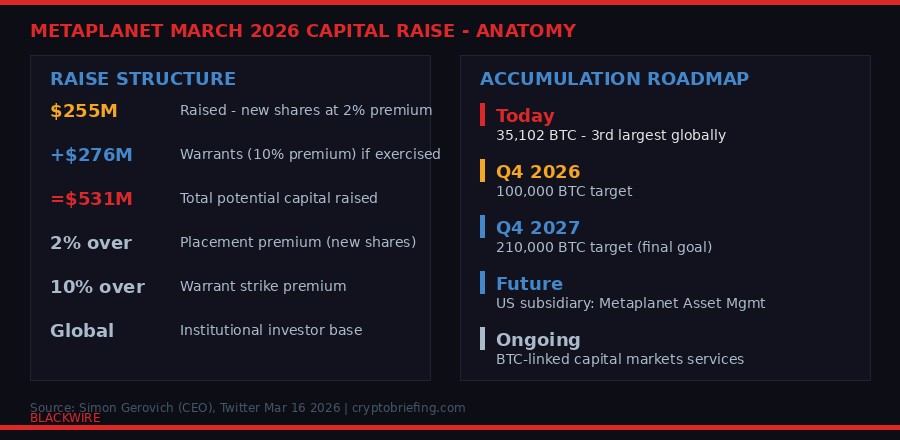
Metaplanet currently holds 35,102 BTC, valued at approximately $2.63 billion at current prices around $74,900. The company is targeting 100,000 BTC by end of 2026 and 210,000 BTC by end of 2027. That's nearly 6x their current holdings in 22 months. At today's prices, that's roughly $15.7 billion in Bitcoin they'd need to acquire. The $531 million raise is the starting gun, not the finish line.
Gerovich also announced plans to establish Metaplanet Asset Management, a US subsidiary focused on venture investments and digital asset financial services tied to Bitcoin capital markets. The company is not just buying Bitcoin - it's building infrastructure around Bitcoin treasury management, positioning to serve other corporations attempting the same strategy.
The Global Leaderboard: Who's Winning the Treasury War
The corporate Bitcoin treasury race has three clear tiers right now. At the top: Strategy (formerly MicroStrategy) and MARA Holdings, which together hold 792,553 BTC according to CryptoTreasuries data. Then there's everyone else, scrambling to close the gap before the price makes it impossible.
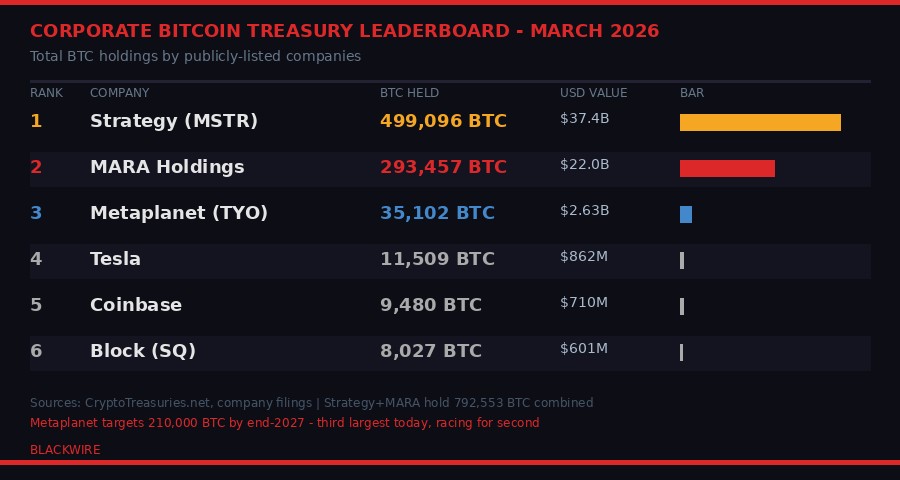
Strategy, led by Executive Chairman Michael Saylor, is expected to announce another Bitcoin acquisition this week following hints from Saylor on social media and last week's preferred share sale that raised additional capital. The company has been purchasing Bitcoin every week for months, using a combination of equity raises, convertible bonds, and preferred stock offerings. Its 499,096 BTC position is so large that at current prices it represents a $37+ billion bet - and every dollar of new capital goes straight into the market.
MARA Holdings, the mining company turned Bitcoin treasury vehicle, has been aggressively retaining mined coins instead of selling them. With 293,457 BTC, they're doing two things at once: mining new supply and hoarding it, while also buying in the open market.
Metaplanet at 35,102 BTC is a distant third - for now. But the growth trajectory is the story. They went from essentially zero to 35,000 BTC in roughly 18 months. The $531 million raise is designed to compress the timeline to 100,000 BTC dramatically. If they execute and the stock price cooperates, they could become the #2 corporate holder before Strategy's trajectory even accounts for the new entrant.
Below the top three, Tesla holds 11,509 BTC (kept since Elon Musk sold 75% of the position in 2022 and never fully re-entered), Coinbase sits at roughly 9,480 BTC in its treasury, and Block (formerly Square) holds around 8,027 BTC. The gap between the top three and the rest is enormous - and widening fast as the aggressive accumulators keep buying.
Why Geopolitics is Bitcoin's Unexpected Ally This Week
Here's the counterintuitive read on this week's market action: global equity markets opened Monday under pressure from the weekend's escalation in US-Iran tensions, yet Bitcoin held steady. Oil is up sharply - a classic risk-off signal. The S&P 500 futures pointed lower overnight. Asian markets bled. Yet Bitcoin didn't break down with them.
"I actually think it's quite positive that crypto and bitcoin held up quite well over the weekend... it looks like there aren't necessarily a lot of sellers left... most of the people holding now have much more long-term perspectives."
- Rob Hadick, General Partner at Dragonfly Capital (Unchained podcast, March 2026)
Hadick, who manages around $4 billion at Dragonfly, framed it plainly: the resilience of crypto during global equity downturns signals a structural shift in the investor base. The retail tourists who panic-sell at the first sign of macro stress have largely been flushed out. The holders remaining have multi-year time horizons. They're not watching oil headlines and dumping BTC.
The Iran conflict adds another dimension. Trump said last week he expects the conflict to last at least four weeks - and Hadick argues the real timeline is probably much longer. A sustained disruption to Iranian oil production raises stagflation risk: higher oil prices feeding into inflation just as central banks are trying to manage rates down. That's a horrible scenario for bonds and equities. It's potentially favorable for hard assets with a fixed supply - exactly what Bitcoin claims to be.
Chris Perkins, President of CoinFund and former Global Co-Head of Futures Clearing at Citi, added the oil market context: the Strait of Hormuz controls approximately 20% of global oil supply. Any sustained disruption there doesn't just raise prices - it creates cascading uncertainty across every commodity market, every logistics chain, every oil-dependent industry. Airlines, shipping, manufacturing. The knock-on effects are enormous.
"The volatility index being up while markets are flat is a bullish sign. Bitcoin is showing signs of strength and resilience, indicating a potential bottoming in the market."
- Chris Perkins, President of CoinFund (Unchained podcast, March 2026)
The VIX rising while spot equity prices stay flat suggests the market is buying protection against a downside that hasn't fully materialized yet. When the VIX spikes and prices fall together, you get capitulation. When VIX rises and prices hold, it often means the smart money is hedging rather than selling. Perkins reads that as a constructive setup for Bitcoin - the fear is being priced in through options markets, not through forced selling of crypto positions.
The Monetary Policy Confusion Feeding Bitcoin's Thesis
The macro backdrop for Bitcoin's treasury case has rarely been more compelling - or more confused. Ray Dalio, Founder of Bridgewater Associates and the man who invented global macro investing as a discipline, laid out the situation bluntly in a recent appearance: the US government is running a projected 40% deficit, with $7 trillion in spending against roughly $5 trillion in tax receipts. The national debt is approximately 600% of annual tax revenue.
More urgently: $9 trillion in US debt is maturing and needs to be rolled over. In a normal rate environment that's manageable. In the current environment - where foreign buyers are increasingly nervous about geopolitical exposure to dollar-denominated assets - it's a genuine stress point.
"We have to roll over $9,000,000,000,000 of debt. It's a riskier situation from their point of view."
- Ray Dalio, Founder of Bridgewater Associates (All-In Podcast, March 2026)
Dalio's framework identifies five forces shaping the economy: debt cycles, wealth and values gaps, internal political conflict, external geopolitical conflict, and technological disruption. Every single one of those forces is active right now, simultaneously. That's not a normal environment. It's the kind of environment where historical relationships between assets break down and new correlations form.
Bond yields moving up while the dollar softens is one of those broken correlations. Normally when geopolitical stress spikes, you'd expect a flight to dollars and Treasuries - safe haven flows. Instead, yields rose and bonds fell, while the dollar didn't get the safe haven bid. Hadick of Dragonfly called it "more confusion in the market than ever" with different market participants "coming to different conclusions in ways we haven't seen before."
This monetary chaos is precisely the environment where Bitcoin's fixed-supply argument resonates most powerfully with institutional treasurers. The Fed's credibility gap - torn between cutting rates to manage debt servicing costs and raising them to fight inflation from oil shocks - makes every fiat-denominated asset a second guess. Corporate CFOs watching this dynamic are increasingly open to the conversation that Strategy started in 2020: maybe some of the cash pile belongs in Bitcoin.
The Clarity Act: Regulatory Tailwind Building
Corporate Bitcoin treasury adoption doesn't happen in a vacuum. It needs regulatory scaffolding - clear rules about how to account for it, how to disclose it, and whether yield-bearing activities on top of BTC holdings are legally permissible. That scaffolding is getting built in Washington right now, and the trajectory is more favorable than at any prior point in crypto's history.
The GENIUS Act and broader crypto market structure legislation are moving through Congress with growing momentum. Chris Perkins, who sits on the CFTC's Global Markets Advisory Committee and its Digital Asset Markets Subcommittee, noted that "clarity legislation for crypto may soon pass" - and that both stablecoins and Bitcoin have now demonstrated clear product-market fit that even skeptical members of Congress can acknowledge.
The sticking point has been language around yield-bearing crypto products. New language in the Clarity Act around "yield" has raised significant concerns within the industry - specifically around whether DeFi yield mechanisms would be classified as securities. Perkins flagged this as a factor that could delay passage or require renegotiation of key provisions.
But the direction of travel is clear. The large asset managers are engaged. BlackRock's Bitcoin ETF has accumulated substantial inflows. Fidelity is in the game. State Street is building crypto custody infrastructure. Tushar Jain of Multicoin Capital, whose firm has been investing in crypto since the early days, made a sharp observation: "We have engagement with the largest asset managers, with the regulators, with the politicians, with the biggest tech companies. Everyone has underwritten this technology."
"There's basically a 0% chance that the industry is over. The involvement of large asset managers, regulators, and tech companies indicates a foundational shift in the adoption of blockchain technology."
- Tushar Jain, Co-Founder & Managing Partner at Multicoin Capital (Empire podcast, March 2026)
For Metaplanet's strategy to work long-term, this regulatory clarity matters enormously. A Japanese company acquiring Bitcoin for treasury purposes needs to be able to do so without creating accounting nightmares or triggering regulatory tripwires in the multiple jurisdictions where its institutional investors operate. The global push toward clearer crypto regulation - from MiCA in Europe to the US Clarity Act to Japan's own FSA framework - is reducing that friction systematically.
What This Arms Race Means for Bitcoin Supply and Price
Let's do the arithmetic that nobody wants to do because the implications are uncomfortable for anyone not already holding Bitcoin.
Metaplanet is targeting 210,000 BTC by end-2027. Strategy currently holds 499,096 BTC and keeps buying. MARA has 293,457 BTC and is mining plus purchasing. Those three entities together are targeting or holding over 1 million BTC within the next 18-24 months. Bitcoin's total supply is capped at 21 million, with roughly 19.8 million already mined. The amount of Bitcoin that will ever be mined in the future is shrinking - the halving in April 2024 cut new supply issuance in half, to approximately 450 BTC per day.
Three corporate entities targeting to hold 5% of Bitcoin's total supply between them is not a small demand shock. It's a structural supply constraint that plays out over years, not quarters. Every BTC that goes into a corporate treasury is, effectively, removed from circulation. These companies are not day traders. They have stated multi-year holding horizons. They are using equity markets to continuously fund additional purchases - an infinite money loop that only breaks if their stock prices collapse or regulators intervene.
The math nobody is saying out loud: Strategy + MARA + Metaplanet's combined targets would represent roughly 4.8% of Bitcoin's total capped supply of 21 million BTC - held by three companies, locked away from circulation. Combined with retail hodlers, ETF vaults (BlackRock alone holds ~$48B in BTC through its ETF), and nation-state reserves (US, El Salvador, Bhutan), available float shrinks dramatically with every passing quarter.
AI is also entering this equation. Nat Eliason, founder of OpenClaw - an AI-native company that has generated nearly $80,000 in revenue since February 2026 using AI agents for business operations - made the observation that crypto's most obvious near-term killer use case is payments infrastructure for AI agents. Autonomous agents transacting with each other need frictionless, permissionless payment rails. Bitcoin's Lightning Network and crypto-native stablecoins are the most credible candidates. Corporate treasuries holding BTC are, in this framing, positioned at the intersection of two of the most powerful trends in technology: AI-native business models and hard-money monetary policy.
Jain noted that "stablecoins are gonna continue to grow with very positive tailwinds from agentech commerce and cross-border payments." The AI economy runs on programmable money. Bitcoin and crypto broadly are the infrastructure layer that makes that possible. Metaplanet's aggressive accumulation makes more sense in that context - they're not just buying a store of value, they're buying a stake in the monetary infrastructure of the next decade's economy.
Japan's Bet: The Macro Context Behind Metaplanet's Strategy
To understand why a Japanese company is leading the corporate Bitcoin arms race in Asia, you need to understand what the Bank of Japan has been doing to Japanese savers for the last three decades. Japan pioneered zero interest rate policy. They pioneered quantitative easing. They pioneered yield curve control - an extreme intervention where the central bank caps 10-year bond yields at a target level by buying unlimited quantities of government bonds to enforce that price.
The result: Japanese savers have faced near-zero returns on domestic savings instruments for a generation. The yen has been in long-term structural decline against hard currencies. Holding yen is a slow bleed. The Bank of Japan's balance sheet is now larger than Japan's entire GDP - an extreme intervention that leaves little room for further policy normalization without triggering a fiscal crisis.
For a Japanese-listed company with institutional investors watching yen-denominated returns, Bitcoin isn't a speculative punt. It's an inflation-resistant, non-sovereign asset that has outperformed every major currency pair over any rolling 4-year period in its existence. Metaplanet is essentially what you build when you look at Japan's monetary situation and conclude that the correct response is maximum Bitcoin.
Gerovich's announcement that the company will establish a US subsidiary - Metaplanet Asset Management - to "support venture investments and develop digital asset financial services linked to Bitcoin capital markets" is also significant. This is not a company that bought Bitcoin and will sit on it. They're building a business around Bitcoin treasury management, positioning to offer Bitcoin-backed lending, Bitcoin-linked structured products, and advisory services to other Asian corporates considering the same playbook.
That's the Strategy playbook taken to its logical conclusion. Saylor didn't just buy Bitcoin - he turned MSTR into a Bitcoin holding company and then monetized that position through a perpetual fundraising machine. Gerovich is doing the same thing in Tokyo, with added ambitions to become the infrastructure provider for every other company in Asia that wants to run a similar strategy.
Timeline: The Corporate Bitcoin Treasury Race So Far
The Risks Nobody in the Boardroom Wants to Say Out Loud
The corporate Bitcoin treasury story has enormous momentum right now. But momentum is not a strategy, and the risks are real.
First, correlation risk. Rob Hadick of Dragonfly flagged that a 10-15% correction in the S&P 500 could still pressure Bitcoin. The institutional investors who bought Metaplanet shares to get levered Bitcoin exposure are the same investors who hold equities. If a genuine risk-off environment hits - not the current geopolitical jitters but a full-blown recession signal - forced selling across all liquid assets could take Bitcoin down with equities, at least temporarily. The "Bitcoin is a safe haven" narrative is still being tested.
Second, equity dilution risk. Every time Metaplanet raises capital by issuing new shares, existing shareholders are diluted. The strategy only works as long as Bitcoin's price appreciation exceeds the dilution effect. If Bitcoin enters a prolonged bear market while the company keeps issuing equity to buy more, shareholders get destroyed from two directions simultaneously.
Third, regulatory risk. The GENIUS Act and Clarity Act are not yet law. If Congress passes legislation that restricts corporate Bitcoin holdings, forces mark-to-market accounting treatment that creates earnings volatility, or limits the ability to issue warrants and convertible debt for crypto purchases, the fundraising machine breaks.
Fourth, concentration risk. The market is now pricing in that major corporate holders will keep buying. If one of them - especially Strategy with its massive position - ever signals distress or is forced to sell, the liquidity event would be severe. The bid/ask spread on liquidating 499,000 BTC is not a spreadsheet exercise anyone has successfully modeled.
Tushar Jain's point about market apathy is worth sitting with: the current environment, where a lot of market participants have "given up" on crypto and prices are range-bound, is historically a precursor to the next leg up. The people who leave are the weak hands. What's left is a more concentrated, more conviction-driven holder base. That's what makes the next move violent. Both directions.
What Comes Next: The 100k BTC Milestone and Market Implications
Metaplanet's near-term target is 100,000 BTC by end of 2026. That requires acquiring roughly 65,000 BTC in the next nine months - approximately 7,200 BTC per month, or 240 BTC per day. At today's prices around $74,900, that's approximately $18 million in daily purchases. The $531 million raise covers less than 30 days of buying at that pace, assuming they hit 100k by December. More capital raises will follow. Gerovich has made clear this is a continuous program, not a one-time event.
Strategy's expected announcement this week will add to the pressure. If Saylor follows his typical pattern - buying in tranches after each capital raise - another 1,000-3,000 BTC entering Strategy's vault in a single week is entirely plausible. Layer in MARA's ongoing mining retention program and Metaplanet's new capital deployment, and you're looking at potentially 4,000-8,000 BTC removed from liquid supply this week alone, across just three entities.
For context, the Bitcoin network currently mines approximately 450 BTC per day, or about 3,150 BTC per week. The demand from these three corporate buyers in a single week could exceed total weekly new supply by 2-3x. That's not a sustainable dynamic for a stable price. It's the setup for a supply shock.
Chris Perkins noted that "liquidity returning to markets is crucial for risk assets like Bitcoin." When the geopolitical fog clears - when Iran conflict resolution comes into view, when the Fed's next move becomes legible, when the bond market confusion resolves - capital on the sidelines will rotate back into risk assets. The corporate buyers aren't waiting for that catalyst. They're buying now, in the fog, at prices that institutional latecomers will view as cheap when hindsight clears.
Alpin Yukseloglu of Paradigm, which manages over $12.7 billion in crypto venture assets, offered a longer-horizon data point: AI models are now detecting over 70% of critical smart contract vulnerabilities, up from under 20% when he started tracking the metric. By end of year, he expects superhuman AI auditors to exist. That makes DeFi protocols - which have historically lost billions to exploits - dramatically safer and more institutionally accessible. Safer DeFi means more institutional capital flows. More institutional flows means more demand for the assets that underpin DeFi. Bitcoin sits at the base of that stack.
Bottom line: Metaplanet's $531M raise is a single data point in a trend that is now structural. Corporate Bitcoin treasuries are not a 2020-era experiment anymore. They are a mainstream capital allocation strategy adopted by companies across three continents. The supply math is getting tighter every quarter. The regulatory environment is moving toward clarity. Institutional infrastructure is maturing. The biggest risk to the bull case is a global recession that forces cross-asset liquidation. The biggest risk to the bear case is pretending this arms race has a natural ceiling when nobody who's winning it shows any sign of stopping.
Get BLACKWIRE reports first.
Breaking news, investigations, and analysis - straight to your phone.
Join @blackwirenews on Telegram