Meta's $14 Billion Bet: Zuckerberg Buys the AI Data King to Build Superintelligence
Mark Zuckerberg paid $14.3 billion for 49% of Scale AI and hired its 28-year-old CEO to lead a secret superintelligence lab. It is the largest AI talent acquisition in history - and a public confession that Meta's AI program was falling apart.

The race to build artificial general intelligence just got a $14 billion injection. Photo: Pexels
Three things happened to Meta's AI program in the months before this deal. Llama 4 underperformed expectations badly enough that Meta was caught gaming public leaderboards to make it look competitive. Meta Avocado, the company's next flagship model, got delayed from March until at least May because it still can't match Google. And Meta AI - the company's consumer chatbot - claimed a billion monthly users, a number that relies heavily on the fact that Meta forces the button onto Instagram and WhatsApp whether you want it there or not.
So on Thursday, March 13, 2026, Mark Zuckerberg announced he was acquiring 49% of Scale AI for $14.3 billion - implying a total valuation of roughly $29 billion - and simultaneously hiring Scale's founder and CEO, Alexandr Wang, to lead a new internal lab tasked with building superintelligence.
The announcement was covered as a triumph. The second-order read is more interesting: this is what it looks like when the richest social media company in the world realizes it is structurally losing a technology war.
Who Is Alexandr Wang, and Why Does Zuckerberg Want Him
At 28 years old, Alexandr Wang is the youngest self-made billionaire in modern tech history - a record he set when he was 25 on the back of Scale AI's explosive growth. He did not come from a founding team at a famous lab. He did not have a PhD from MIT or Stanford. He built Scale in 2016 as a 19-year-old by solving a problem that almost no one was talking about publicly but that every major AI company was quietly panicking about: clean, labeled training data at industrial scale.
The core insight behind Scale was brutally simple. Machine learning models are only as good as the data they train on. And getting that data labeled accurately - identifying objects in images, transcribing audio, verifying text outputs, annotating spatial coordinates for autonomous vehicles - required massive amounts of careful human labor. Scale built the pipeline to do that at industrial volume, using a globally distributed workforce of human annotators managed through sophisticated quality-control software.
By 2026, Scale was the trusted data partner for OpenAI, Anthropic, Google DeepMind, and dozens of other AI developers. It had also secured government contracts with the US Department of Defense for military AI planning systems, and had signed a five-year deal to provide AI tools to Qatar. The company had become - without most people outside the AI industry fully realizing it - the essential infrastructure layer between raw compute power and useful AI capability.
Wang was not just running Scale's operations. He was inside the training pipelines of every major frontier AI lab simultaneously. He understood what it actually took to build competitive models at the data layer - which is the layer that increasingly determines who wins the AI race at the frontier. That knowledge, along with the talent and infrastructure that surrounds him, is what Zuckerberg is paying $14.3 billion for.
"We've grown to over 1,500 people and become the trusted partner for model builders, enterprises, and governments building and deploying the smartest AI tools and applications." - Alexandr Wang, memo to Scale AI employees, March 2026
The Deal Structure - and What It Obscures
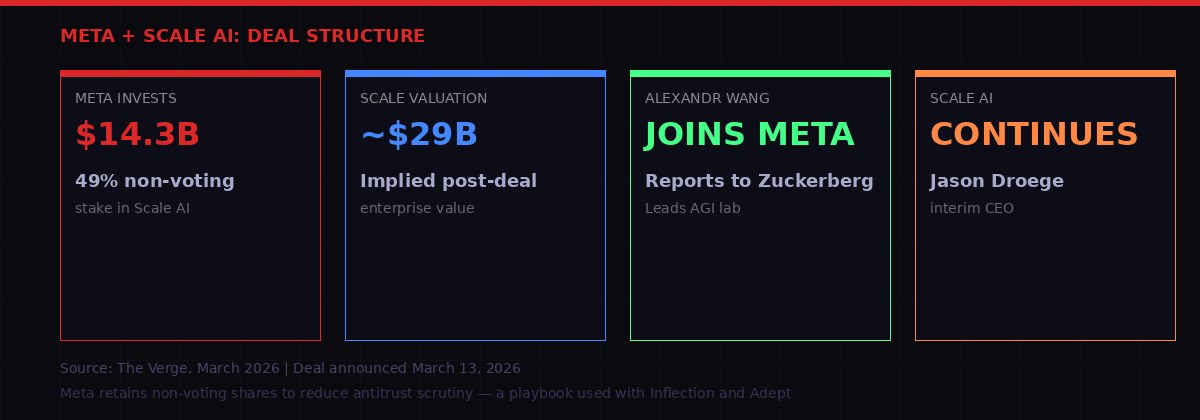
The deal's structure mirrors earlier Big Tech acqui-hires - non-voting shares, talent extraction, minimal regulatory exposure.
Meta is acquiring 49% of Scale AI as non-voting shares, paying $14.3 billion for the stake. Wang will join Meta reporting directly to Zuckerberg, while Scale AI will be led by Jason Droege - the company's former chief strategy officer - as interim CEO. Both companies announced this simultaneously, with Wang describing the arrangement in a memo to Scale staff as "a massive new investment from Meta" and "a powerful validation of the hard work you've all put into Scale's mission."
The non-voting structure is deliberate. It is the same playbook Meta used when it effectively acqui-hired talent from AI startup Inflection AI in 2024, and the same structure Amazon deployed when it acquired key personnel from Adept AI. By taking non-voting shares rather than full ownership, Meta reduces the threshold for regulatory review. The deal is still likely to face scrutiny from the FTC and the European Commission - particularly given that Meta is already on trial to defend itself against a government breakup case over its Instagram and WhatsApp acquisitions - but the structure makes it harder for regulators to treat this as a conventional merger.
Deal at a Glance
Wang will receive compensation reported to include eight-figure packages - a baseline that Zuckerberg has also offered to other researchers he has cold-emailed or WhatsApp-messaged directly as part of an aggressive recruitment campaign. The Wall Street Journal and New York Times have reported that Zuckerberg has personally reached out to leading AI researchers at Google, OpenAI, and other labs, dangling compensation packages that dwarf anything offered in the industry's previous recruiting cycles.
The distribution of proceeds from Meta's investment to Scale AI shareholders is also notable. Wang confirmed in his memo that the capital "will be distributed to those of you who are shareholders and vested equity holders, while maintaining the opportunity to continue participating in our future growth as ongoing equity holders." For Scale's employees and early investors, this is a liquidity event. For Zuckerberg, it is a talent retention tool - he has, in effect, made Scale's workforce rich enough to consider staying on under new leadership, while also giving Wang a financial cushion that insulates his decision to leave from looking like pure mercenary maneuvering.
What Broke Inside Meta's AI Program
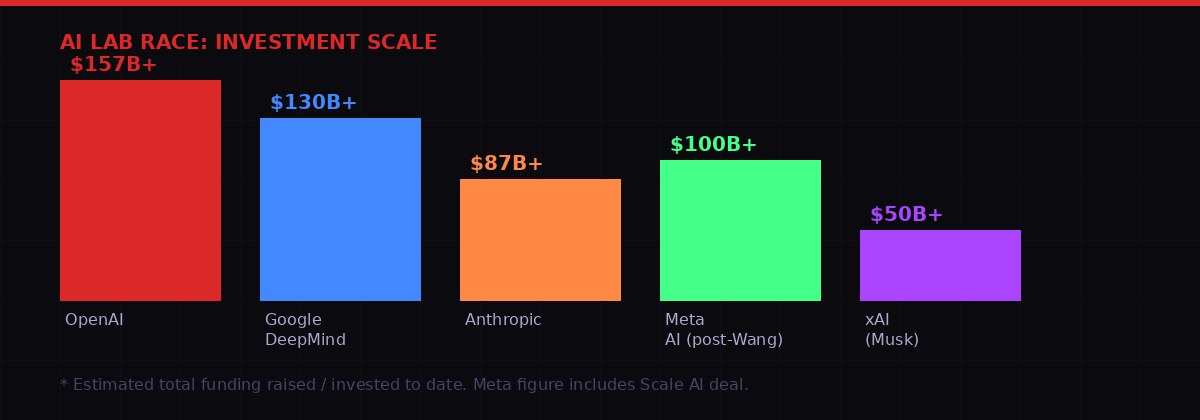
Meta's AI investment curve has been aggressive - but results at the model frontier have not matched the spend.
To understand why this deal happened, you need to understand what went wrong with Meta's AI program over the past 18 months.
Meta released Llama 4 in early 2026 to a reception that was worse than anticipated. The model was positioned as Meta's competitive response to OpenAI's GPT-5 family and Google's Gemini 2.0 series - open-weight, community-accessible, and powerful enough to run meaningful workloads at reduced cost. The release landed flat. Llama 4's benchmark performance was underwhelming against both closed and open competitors, and within days, investigators discovered that Meta had submitted a specially fine-tuned variant to the LMSYS Chatbot Arena leaderboard - a popular independent ranking - rather than the version being shipped to developers. The publicly ranked model and the publicly available model were not the same thing. The Verge reported the discrepancy, and it became a significant credibility problem for Meta's entire AI narrative.
Then Meta Avocado - the internal codename for what was supposed to be Meta's next major model release - got pushed. Originally targeted for March 2026, the model is now expected no earlier than May, according to reporting by the New York Times. The stated reason is that its performance still falls short of rival models from Google DeepMind and OpenAI. This is the second major public stumble in sequence for a company that has spent enormous capital positioning itself as an open-source alternative to the proprietary AI labs.
The deeper structural problem is one that Wang understood better than almost anyone in the industry: Meta's data pipeline was not good enough. Scale AI's commercial relationships with OpenAI and Anthropic meant that, in a real sense, Meta's competitors had access to better quality training data infrastructure than Meta itself. Every frontier model improvement is downstream of data quality - the human feedback loops, the annotation consistency, the coverage of edge cases in training sets. By acquiring Wang and his organization, Zuckerberg is attempting to close this gap at its source.
The Talent War Behind the Deal
The Scale AI acquisition is the largest single transaction in a broader talent campaign that Zuckerberg has been running personally since early 2025. According to multiple reporting sources, Zuckerberg has been reaching out directly to individual researchers at competing labs - using cold emails and WhatsApp messages - and offering compensation packages that people familiar with the matter describe as "seven- and eight-figure" amounts.
This is unusual even for Big Tech. CEOs of companies the size of Meta do not typically conduct individual researcher recruitment directly. The fact that Zuckerberg is doing so signals both the urgency he attaches to catching up in the AI race and the strategic importance he places on specific individuals rather than organization-wide capability acquisitions.
The targets have been concentrated at Google DeepMind, which has produced some of the most important foundational AI research of the past decade, and at OpenAI, where the talent base includes researchers who built the architecture and training methodology behind the GPT model family. Convincing those researchers to leave their current labs - where they have equity, established collaboration networks, and in many cases deep attachment to the research mission - requires compensation substantial enough to function as a one-time wealth event rather than merely a salary bump.
Meta has also moved to poach at the organizational level. The company recently hired several members of Google's Gemini team, and has been building what sources describe as a dedicated research group focused on "superintelligence" - the point at which AI systems surpass human-level performance across virtually all cognitive tasks. Wang's lab will sit at the center of this effort, with direct access to Meta's compute infrastructure, its consumer data at a scale no other AI lab in the world can match, and the data quality pipeline that Scale AI has spent a decade building.
The question that nobody is answering publicly is what Meta's research structure will look like once Wang's lab is fully staffed. Scale AI's existing contracts with OpenAI and Anthropic create an obvious conflict of interest: Wang will now be leading a competitor lab while his former company continues to serve those competitors' training needs. The official position - that Scale AI will operate independently under Droege - is designed to preserve that client relationship, but the technical knowledge Wang carries with him is not easily compartmentalized.
Scale AI's Position - and What Changes Now
Scale AI's value was never just in its labeled datasets. It was in the systematic understanding of what good training data looks like at frontier capability levels - the feedback loops, the human evaluation protocols, the techniques for identifying when model outputs are subtly wrong in ways that matter for safety and capability. That institutional knowledge now belongs, in a functional sense, to Meta.
Scale's government business adds another dimension. The company signed a deal with the US Department of Defense for a first-of-its-kind AI agent program for military planning. It has expanded government partnerships across Europe and Asia, including a five-year deal with Qatar. This positions Scale - and by extension, Meta's new lab - at the intersection of commercial AI infrastructure and national security-adjacent data work, a space that is increasingly attracting regulatory and public scrutiny.
The company's most sensitive contracts involve providing data annotation and evaluation services for AI systems that will be used in consequential decisions - military planning, intelligence analysis, and increasingly, autonomous systems. The acquisition of the company's functional leadership by Meta does not change Scale's legal obligations to those clients, but it does change who ultimately controls the institutional knowledge that governs how those systems are trained and evaluated.
Jason Droege, the incoming interim CEO, faces an unusual challenge: maintaining client trust across competing AI labs - OpenAI, Anthropic, Google - while the company's founder is now building a competitor at Meta. The "interim" label on his title is telling. Either Scale finds a permanent CEO who can credibly position the company as neutral infrastructure, or client defection becomes a real risk over the next 12-18 months.
The Second-Order Effects Nobody Is Talking About
This deal reconfigures the AI industry's data infrastructure layer in ways that will take time to become fully visible. Here are the non-obvious consequences worth tracking:
OpenAI and Anthropic lose their data partner's neutrality. Both companies relied on Scale AI as an arms-length, neutral contractor for training data quality work. That neutrality is now compromised in a structural sense, even if Scale AI's day-to-day operations continue unchanged. Expect both companies to accelerate their own internal data operations teams and to quietly begin diversifying away from Scale dependency over the next year.
The open-source AI narrative takes another hit. Meta has positioned Llama as a gift to the open-source community, a counterweight to the proprietary models from OpenAI and Google. But building and maintaining frontier-level open-weight models requires massive internal capability - which Meta clearly felt it was lacking. Paying $14.3 billion to buy that capability undermines the implicit message that open-source AI is an egalitarian alternative to the closed-lab approach. It turns out that winning at the frontier, even with open weights, still requires the same kinds of concentrated capital and talent advantages that characterize the proprietary labs.
Regulatory pressure on the acqui-hire playbook is building. The FTC under the current administration has been scrutinizing Big Tech's pattern of hiring talent and making investments structured to avoid merger review thresholds. The Meta-Scale deal joins a pattern that includes Amazon-Adept, Microsoft-Inflection, and Google-Character AI in using minority investment and talent acquisition to achieve effective consolidation without triggering standard merger review. The bipartisan concern about this practice in Congress is real, and this deal - the largest of its kind - could become the case that finally forces regulators to address the playbook directly.
China's AI labs are watching. Scale AI has been one of the principal data infrastructure providers for the US AI ecosystem. Wang's move to Meta means that whatever competitive intelligence he carries about the training pipeline practices and data quality methods of OpenAI, Anthropic, and Google now sits inside a commercial company rather than an ostensibly neutral contractor. For the Chinese AI ecosystem - which has been partly dependent on similar commercial data services - the lesson is that neutral data infrastructure companies are acquisition targets once they reach scale, and that dependency on them is a strategic vulnerability.
Timeline: How Meta Got Here
Can Zuckerberg Actually Win the AGI Race
The honest answer is that nobody knows - and that is itself remarkable given how much money is now riding on the outcome.
Meta's structural advantages are real. Compute: the company is spending over $60 billion on data center infrastructure in 2026 alone, according to its own forward guidance, and has committed to building some of the largest AI training clusters in the world. Data: Meta's consumer platforms generate behavioral data at a scale that no AI-native company can replicate - billions of users interacting across Instagram, WhatsApp, Facebook, and Threads, creating a training signal for social intelligence and multi-modal understanding that is unique in the industry. Distribution: any AI product Meta builds can be deployed instantly to billions of potential users at near-zero marginal cost.
The disadvantages are also structural. Meta is primarily an advertising company, and its organizational DNA is calibrated toward engagement optimization rather than frontier research. The culture of recruiting PhD researchers who want to publish foundational work is different from the culture of building products that maximize time-on-app. Zuckerberg has been trying to bridge this gap, but the departures from Meta's internal AI research team over the past two years - particularly from FAIR, the company's Fundamental AI Research division - suggest that the cultural gap is real and persistent.
Wang's task is to build something that does not currently exist inside Meta: a research organization capable of working at the frontier of capabilities while operating at the pace and scale that a company valued at over $1 trillion demands. He will be doing this while his former company navigates the delicate task of remaining a neutral contractor to Meta's competitors.
The superintelligence framing in the announcement is also worth examining carefully. When Zuckerberg says Wang will lead an effort to build "superintelligence," he is using language that carries an implicit claim about the timeline and trajectory of AI development. The labs that have used this framing most aggressively - OpenAI chief among them - have done so partly for research focus and partly for recruiting magnetism. Top researchers want to believe they are working on the most important problem in history. The superintelligence label is as much a talent acquisition tool as it is a technical roadmap.
What is not in doubt is that the deal changes the competitive dynamics of the AI industry in ways that will compound over time. Meta now has Wang's knowledge of what it actually takes to build competitive models at the data layer. That knowledge - accumulated over a decade of working inside every major lab's training pipeline - is more valuable than the $14.3 billion figure suggests. You cannot buy that knowledge off the shelf. You can only acquire the person who holds it.
What This Means for the Industry Going Forward
The Meta-Scale deal is one of several signals, taken together, that the AI industry is entering a consolidation phase that will look very different from the explosive startup proliferation of 2022-2024.
The number of organizations genuinely capable of competing at the frontier of AI capability is shrinking. The capital requirements for training frontier models - compute, data, and talent - have grown to the point where only a handful of well-capitalized entities can sustain the pace of investment required. OpenAI, Google DeepMind, Anthropic, xAI, and now a revamped Meta AGI lab are the realistic field of frontier competitors. The smaller labs that raised hundreds of millions during the funding boom are increasingly being absorbed into larger organizations or pivoting to narrower application domains.
The talent market is the clearest evidence of this consolidation. When Zuckerberg is personally cold-emailing researchers with eight-figure packages, when Scale AI's CEO is being extracted from a $29-billion company to run an internal lab, when every major tech company is spending billions to acquire or retain the people who can actually build these systems - this is what a winner-take-most market looks like in its talent formation phase.
The broader consequence is concentration of the technology that will, by the accounts of the people building it, be the most transformative in human history. Fewer organizations, with more power, making decisions with less accountability. Scale AI's government contracts mean that Wang walks into Meta with direct experience at the intersection of military AI and commercial infrastructure. Meta's scale means that whatever comes out of his lab will touch billions of people.
Whether that is a good thing or a dangerous one depends almost entirely on the judgment and values of a small number of people who, for the most part, have not been elected to anything and are not accountable to any democratic process. That has been true of Big Tech for two decades. With superintelligence as the stated goal, the stakes of that fact are higher than they have ever been.
Key Players in the Meta AGI Bet
The FTC's antitrust case against Meta is ongoing. The outcome of that case - which centers on the Instagram and WhatsApp acquisitions - could determine how much regulatory headroom Meta has to pursue further consolidation moves. If the FTC loses, or reaches a settlement that allows Meta's current structure to stand, the Scale AI deal signals what the next phase of Meta's growth strategy looks like: not organic research, not product innovation, but strategic acquisition of the talent and infrastructure that the company's internal development could not produce fast enough.
The AI race was always going to come down to who could sustain the investment, talent, and data pipeline quality required to stay at the frontier. Meta just made the most expensive single move in that race's history. Whether it was the right one - whether Wang can actually build what Zuckerberg needs, whether Scale's client neutrality survives the transition, whether the cultural gap between a social media company and an AGI lab can be bridged with money alone - these questions will take years to answer.
For now, the number that matters is $14.3 billion. That is what Zuckerberg thought it was worth to stop losing.
Get BLACKWIRE reports first.
Breaking news, investigations, and analysis - straight to your phone.
Join @blackwirenews on TelegramSources: The Verge (March 12-13, 2026), Futurism (March 12, 2026), Anthropic official statement on Department of War (March 2026), Scale AI company announcement (March 13, 2026), Meta spokesperson Ashley Zandy statement, Alexandr Wang memo to Scale AI employees via Threads. This article incorporates reporting on Meta's internal AI challenges, the Llama 4 leaderboard controversy, and the FTC v. Meta antitrust proceedings.