Meta Kills VR Horizon Worlds on June 15: The $46 Billion Obituary
Four years. Tens of billions of dollars. A company rename. And on June 15, 2026, the plug gets pulled on Meta's virtual reality metaverse - the most expensive corporate pivot in tech history that nobody asked for.
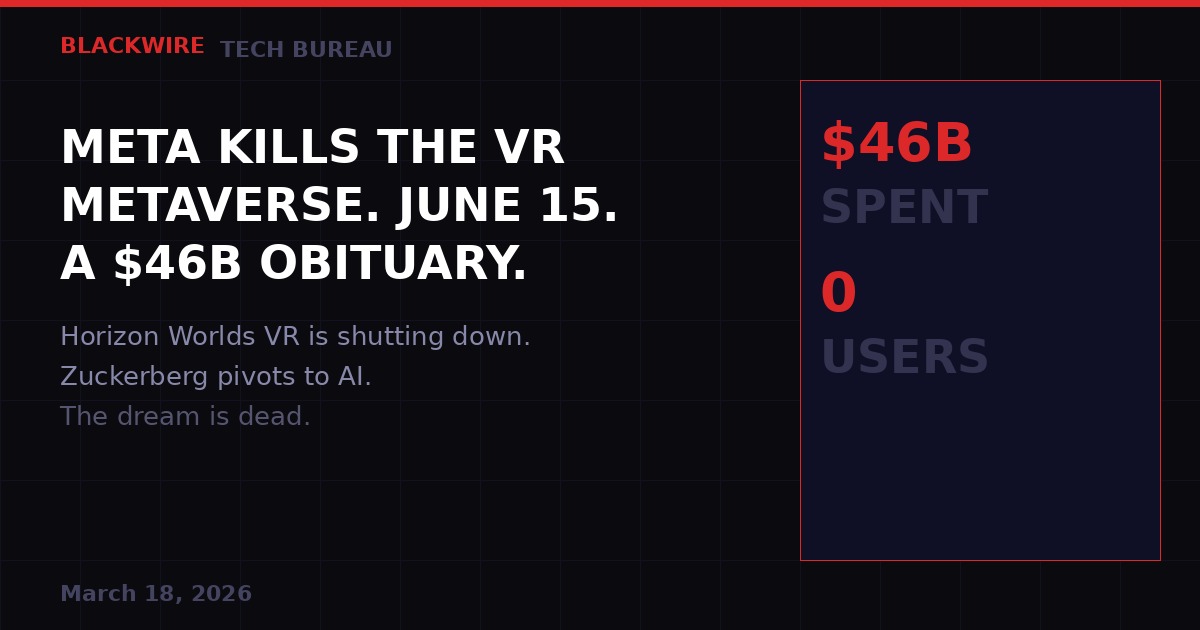
Mark Zuckerberg renamed his company after it. He put on a VR headset at congressional hearings. He built an avatar. He ran a virtual company meeting in virtual reality and talked about how we would all hold virtual meetings forever. On March 17, 2026, Meta confirmed what everyone outside Meta had known for two years: the virtual reality metaverse is dead.
Horizon Worlds, the consumer VR platform that was supposed to be Facebook's answer to the post-smartphone internet, will shut down its VR version on June 15, 2026. The shutdown was confirmed on Meta's official blog, citing a strategic shift to "go all-in on mobile." The announcement came weeks after Meta first signaled the pivot in February. Now there is a date.
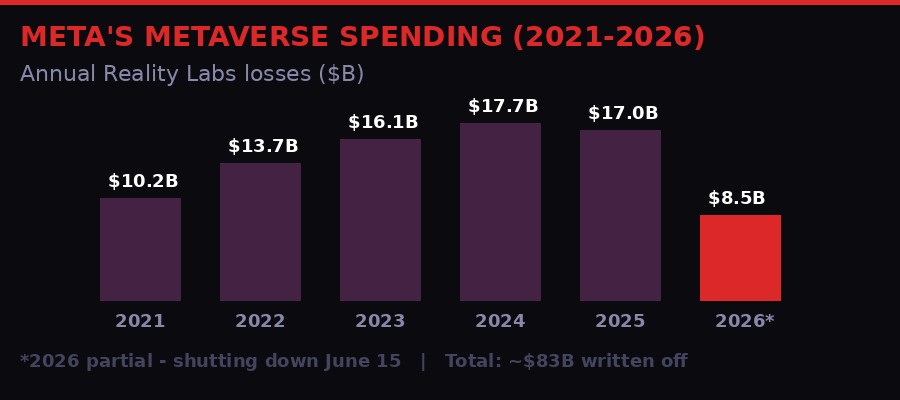
The math is brutal. From 2021 through 2025, Meta's Reality Labs division - the unit that built Horizon Worlds and the Quest headsets - burned through approximately $46 billion in operating losses, according to the company's own quarterly earnings reports. That number does not include the billions spent before 2021 in VR research and development. It does not include the cost of rebranding from Facebook to Meta in October 2021. It does not include the market cap hit Meta took as investors watched the losses pile up quarter after quarter before the stock staged its recovery.
The VR metaverse is over. What comes next is the question.
How Horizon Worlds Was Built to Fail
The story of Horizon Worlds begins not in 2019 when Project Horizon was announced, but years earlier in Zuckerberg's reading list. He had been consuming books about the metaverse concept since at least 2017 - Neal Stephenson's Snow Crash, Ernest Cline's Ready Player One, other works sketching a future where people live meaningful digital lives in shared virtual spaces. What Zuckerberg failed to reckon with was the difference between fiction and infrastructure.
Horizon Worlds launched in public beta in August 2020, during pandemic lockdowns when the idea of a virtual social world had unusual appeal. The early signal was misleading. People were stuck at home, curious about anything that simulated togetherness. Horizon Worlds got attention, some media buzz, a few enthusiastic early adopter pieces. Meta read this as validation.
The public launch came in December 2021, two months after Zuckerberg had renamed the entire company. That sequencing was a critical mistake in corporate strategy. The rebrand tied Meta's entire identity - its stock price, its executive credibility, its recruiting pitch - to a single product bet that had not yet been validated at scale. Every quarter that Horizon Worlds underperformed, the question was not just "is this product failing?" but "is Meta as a company wrong about the future?"
By late 2022, leaked internal memos revealed what leadership knew but would not say publicly: Horizon Worlds had approximately 200,000 monthly active users in North America - a fraction of a fraction of Meta's 3 billion total users across its apps. More damningly, most users who tried Horizon Worlds never came back. Retention was catastrophic. The metaverse was a leaky bucket.
"The platform doesn't feel alive," one internal Meta memo reportedly noted, referencing low user presence in most virtual spaces. "People show up, look around, and leave."
This is a technology adoption problem that goes deeper than execution. Virtual reality requires hardware that is expensive, physically uncomfortable for extended sessions, isolating (you cannot see your physical environment), and requires dedicated setup space. None of these problems were solved by the Quest 2 or the Quest 3. They are properties of the technology itself, not the product. The metaverse needed people to change their behavior radically. People did not.
The Forty-Six Billion Dollar Number: Where It Went
Let's audit the spending. Meta does not break down Reality Labs spending by product line in its earnings reports, but the broad strokes are public information.
The headset hardware program - Quest 2, Quest 3, and the ill-fated Quest Pro enterprise headset - represented significant capital. The Quest Pro launched in 2022 at $1,500, targeting knowledge workers who would supposedly hold virtual meetings. It was discontinued in 2023 after poor sales. Meta took write-downs. The Quest 3 launched in 2023 at a more competitive $499, but even at that price it could not manufacture mainstream consumer demand.
The software side was equally expensive. Building Horizon Worlds required a massive engineering team working on social VR infrastructure - networked physics, avatar rendering, spatial audio, content moderation for a three-dimensional space, creator tools. Meta hired thousands of engineers specifically for this product. Many have since been laid off in the company's repeated "year of efficiency" restructurings.
Then there was the research operation. Meta Reality Labs Research, headquartered in Redmond, Washington, was staffed with top academics working on the underlying science of VR displays, haptics, and neural interfaces. This research organization has done genuinely impressive work - publishing papers on varifocal displays, thin pancake optics, and eye-tracking technology. Much of it was foundational science that will outlive Horizon Worlds. But it also cost billions that went into scientific papers rather than products people used.
The most expensive single decision may have been the branding itself. The October 2021 company rename from Facebook to Meta was not just a logo swap. It required years of rebranding work across every surface - app stores, advertisements, office buildings, legal filings, domain purchases, employee onboarding materials. Independent analysts estimated the rebrand cost hundreds of millions of dollars in direct costs alone, before accounting for the confusion it created among users and the ongoing challenge of explaining to non-technical consumers what "Meta" means.
What did Meta get for $46 billion? A few hundred thousand regular VR users, a headset platform that is still viable for gaming and fitness applications, some genuinely impressive display technology, and a lesson in the difference between a CEO's vision and a consumer need.
The User Problem Nobody Would Admit
The fundamental challenge with Horizon Worlds was never the technology. It was the use case. Every successful consumer platform solves a problem people actually have. Facebook solved the problem of staying connected to your social network when distance or logistics made in-person contact difficult. Instagram solved the problem of sharing visual moments easily. WhatsApp solved the problem of cheap cross-border messaging.
What problem did Horizon Worlds solve? The initial pitch was "social interaction during COVID" - but COVID lockdowns ended. The second pitch was "remote work meetings" - but most workers found video calls adequate and most companies found fully remote work harder to sustain than they expected. The third pitch was "creator economy in 3D" - but creators found that the tools were limited, the audience was tiny, and monetization was non-existent by comparison with TikTok, YouTube, or Instagram.
Competitive dynamics also mattered. Horizon Worlds was trying to build a general-purpose social VR platform at the same moment that purpose-built VR applications were succeeding. VRChat, a social VR app with cult following, built a dedicated community by not trying to appeal to everyone. Beat Saber became one of the most successful VR games by doing one thing perfectly. Horizon Worlds tried to be everything for everyone and ended up being nothing for most people.
"We need to focus on making Horizon Worlds appealing to our employees first before we focus on the broader consumer market," Zuckerberg wrote in an internal memo in late 2022, as reported by The Verge. The admission was revealing: the product was not good enough for the people building it.
The legs problem was notorious. Horizon Worlds avatars did not have legs for years after launch. The internet noticed. Memes spread. The image of a corporate executive presenting a legless virtual avatar in a virtual conference room became shorthand for everything unconvincing about the metaverse pitch. Small detail, large symbol. Zuckerberg eventually added legs to his personal avatar in 2022 with considerable fanfare, but by then the damage to the product's image was done.
User retention data that leaked from inside Meta was damning. Internal metrics showed that the vast majority of people who tried Horizon Worlds did not return within 30 days. The platform had a funnel problem: it could acquire curious users, but it could not convert them into habituals. Social platforms live or die on daily active usage. Horizon Worlds never cracked that.
What Meta Is Doing Instead: The AI Pivot
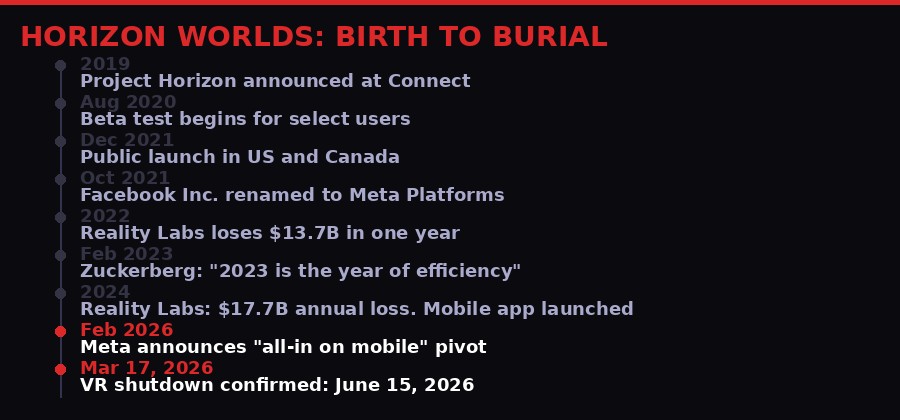
The June 15 shutdown is not an ending for Meta - it is a resource reallocation announcement with a date stamp. The money that was going into VR infrastructure is being redirected into artificial intelligence, and that pivot has been accelerating since 2023.
On the model side, Meta has built Llama into one of the most widely deployed open-source AI model families in existence. Llama 3 achieved significant adoption among developers who wanted capable, locally-runnable models without API costs or data sharing concerns. Llama 4 is expected to make major capability jumps. By open-sourcing its models, Meta has taken a different strategic bet than Google and OpenAI: rather than charging for model access, Meta embeds AI into its 3 billion-user platform to sell more advertising and create stickier user experiences.
The chip strategy has also shifted. Meta's Training and Inference Accelerator (MTIA) program, which produced its third-generation chip - the MTIA 300 - in early March 2026, is designed to reduce Meta's dependence on Nvidia GPUs for its recommendation systems and generative AI inference. The MTIA 400, 450, and 500 chips are already in development, with Meta stating they will eventually handle all AI workloads. This is a multi-year, multi-billion dollar silicon independence play.
The hardware that is surviving from the Reality Labs era is not the VR headset - it is the Ray-Ban smart glasses, developed in partnership with EssilorLuxottica. Ray-Ban Meta smart glasses have found a genuine user base, selling to people who want wearable cameras and speakers without the bulk of a full VR headset. The glasses do not put you inside a virtual world. They augment the physical one. It is exactly the kind of non-intrusive entry point into wearable computing that Horizon Worlds's full-headset immersion never was.
Then there is the Meta AI assistant, embedded across WhatsApp, Instagram, Messenger, and Facebook. This is where Zuckerberg's AI bet gets interesting. Meta has distributed its AI assistant to a potential audience of three billion people. Even a small fraction of engaged users creates a feedback loop of training data, usage patterns, and product iteration that rivals like OpenAI - with their much smaller direct user base - cannot easily match. If the AI assistant war is won by scale of real-world deployment, Meta is in a better position than its current reputation in AI would suggest.
Horizon Worlds itself is not dying completely - just the VR version. Meta confirmed it is continuing with a mobile version of Horizon Worlds, accessible through phones and tablets without requiring a headset. This is, functionally, the admission that VR-first social interaction was the wrong architecture. The mobile version is a conventional social game platform, not a metaverse. Whether Meta can rebuild any community around it after four years of bad press remains unclear.
The Zuckerberg Pattern: Pivot, Survive, Win
It is tempting to read the metaverse failure as a terminal verdict on Zuckerberg's judgment. That reading would be wrong, and investors know it.
Zuckerberg has pivoted catastrophically and recovered before. In 2012, Facebook's mobile strategy was a disaster - the company launched a public IPO while its mobile apps were embarrassingly behind its desktop experience. The stock cratered from $38 to $18. Analysts questioned whether Facebook could survive the smartphone transition. Within two years, mobile advertising had become the overwhelming majority of the company's revenue, and the stock had recovered and then tripled.
The same pattern appeared with the news feed algorithm crisis of 2018, the Cambridge Analytica scandal, the repeated privacy controversies with European regulators. Each time, the company was written off. Each time, Zuckerberg made structural changes - some cosmetic, some real - and the business fundamentals held because the core social graph remained irreplaceable.
Meta's stock peaked above $700 in early 2025 before settling back into the $500s. The market has already processed the metaverse failure and moved on. The company's Q4 2025 earnings showed strong advertising revenue driven by AI-powered ad targeting and recommendation. The business did not need the metaverse to survive. What the metaverse needed was a business to fund it - and now it no longer has one.
"We've been focused on a set of big bets and most of them have borne fruit - advertising, AI, the glasses," a Meta spokesperson told press in February 2026 when the mobile pivot was first announced. "We're going all-in on the things that are working."
The pattern suggests Zuckerberg's AI bet is likely to survive even if it underperforms expectations, because the underlying business of selling advertising against a 3 billion user social graph is robust. The question is whether AI becomes a growth driver or just a cost center that maintains competitive parity.
Second-Order Effects: What the Metaverse's Death Means for the Industry
The Horizon Worlds shutdown will be written up as Zuckerberg's folly. But the second-order effects on the wider technology industry are more interesting than the postmortem on a single product.
First: enterprise VR is not dead even if consumer social VR is. The distinction matters. Horizon Workrooms - Meta's enterprise meeting product built on the same VR stack - was always a more plausible use case than social VR. Companies have genuine training use cases where immersive simulation beats video: manufacturing safety, surgery training, military and first responder scenarios. The Quest hardware that survives the Horizon Worlds shutdown will still serve these markets, likely through third-party enterprise software rather than Meta's own platform.
Second: the VR hardware market is not going away. Apple's Vision Pro launched in 2024 and found a small but genuinely committed high-end user base willing to pay $3,499 for what is essentially a personal IMAX theater plus productivity device. Sony's PlayStation VR2 has maintained a gaming-focused install base. The technology will continue improving. The processing power required for comfortable VR - high resolution, low latency rendering at 90+ frames per second - is still consuming billions in R&D across multiple companies. What failed was not VR as a technology but the specific bet that VR social platforms would replace 2D social networks in the near term.
Third: this episode will change how Silicon Valley funds paradigm shift bets. Meta's ability to self-fund a $46 billion experiment was possible only because of its dominant advertising business. Smaller companies that tried to build metaverse infrastructure on venture capital - Decentraland, The Sandbox, various Web3 virtual world projects - have seen valuations collapse by 95% or more from their 2021 peaks. The lesson the VC community appears to be drawing is to invest in the picks and shovels (the hardware components, the networking infrastructure, the display technology) rather than the destination platforms themselves, where the user adoption risk is binary.
Fourth: the AI pivot taking the place of the metaverse is creating similar overinvestment risks. The same narrative engine that drove metaverse spending to irrational heights in 2021 and 2022 - "this is the next platform shift, you have to be there" - is now operating in AI. The difference is that AI already has demonstrated practical use cases that users pay for. But the pace of investment - more than $300 billion globally projected for AI infrastructure in 2026 - is running well ahead of demonstrated revenue. The industry should remember that VR also had early believers, early revenue, and early use cases before the plateau became visible.
Fifth: Meta's exit from consumer VR gives Apple room. With Horizon Worlds gone and the Quest ecosystem in question, the Vision Pro becomes a less crowded high-end space. Apple has never needed to sell millions of Vision Pro headsets to make it strategically valuable - it needs enough to keep the developer ecosystem alive until the technology matures and prices fall to iPhone-comparable levels. Meta's retreat, paradoxically, makes that long-term Apple strategy more viable.
The People Who Got Left Behind
Postmortems on big corporate failures focus on dollars and decisions. The human dimension is equally significant.
Meta hired thousands of employees specifically to build the metaverse - VR engineers, social platform developers, 3D artists, spatial audio engineers, world-building designers. Many were recruited from gaming companies, film visual effects studios, and academic research labs with promises that they were working on the next computing platform. Some left stable positions at companies building things people used. After multiple rounds of layoffs in 2022 and 2023 - the "year of efficiency" that cut 21,000 jobs - many metaverse-focused employees found themselves out of work or reassigned to projects they had not signed up for.
The creator community that built inside Horizon Worlds is a smaller but still real casualty. Meta had courted virtual world creators with developer tools and promises of monetization infrastructure that never fully materialized. The Horizon Creator Fund, a Meta initiative to pay creators for building compelling content, was repeatedly modified and eventually scaled back. Creators who had invested time learning the proprietary building tools of Horizon Worlds now face the June 15 shutdown with no clear path to migrate their work.
This matters beyond the immediate personal impact. Every platform that attracts creators and then shuts down makes the next platform pitch harder. Web3 virtual worlds made the same promises about creator ownership and monetization - smart contracts would ensure creators kept their assets forever. Most of those promises were also not honored when the market collapsed. The metaverse era has taught a generation of digital creators that betting your livelihood on an early-stage platform is high variance, regardless of how large the company backing it is.
Timeline: From Announcement to Grave
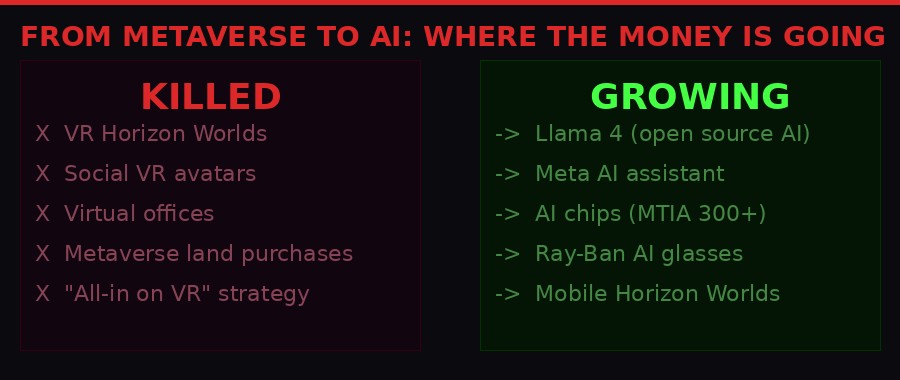
Project Horizon announced at Meta Connect. A shared social VR space where users build worlds together. Early demo video shows colorful cartoon environments. Press coverage is enthusiastic.
Closed beta launches during pandemic lockdowns. Initial user response is positive, boosted by COVID isolation driving interest in any virtual social alternative.
Facebook Inc. renames itself Meta Platforms. The rebrand is explicitly tied to the metaverse vision. Zuckerberg presents an extended keynote in VR describing the metaverse future. Stock initially rises on hype.
Horizon Worlds opens to the public in the United States and Canada. Press reviews note the empty virtual spaces and limited content.
Reality Labs reports $13.7 billion operating loss. Internal memos leak about low user retention. Meta sets a target of 500,000 monthly active users by year-end - a target it misses. Quest Pro launches at $1,500, targeting enterprise; struggles commercially. Broader Meta stock falls nearly 70% during the year.
Zuckerberg declares "year of efficiency." 21,000 employees laid off across two rounds. Reality Labs loss reaches $16.1B. Quest Pro discontinued. Quest 3 launches at $499, more competitive but still limited mainstream adoption.
Reality Labs loss: $17.7B. Meta AI assistant launches across all Meta apps. Ray-Ban smart glasses gain genuine traction. Horizon Worlds launches mobile app. The platform architecture shifts. Apple Vision Pro launches; the high-end VR market develops separately.
Meta announces it is "going all-in on mobile" for Horizon Worlds, pivoting away from VR-first strategy. No shutdown date given yet. VR community braces.
Meta confirms Horizon Worlds VR will shut down June 15, 2026. Official blog post links to Meta's updated Horizon support pages. No fanfare. A quiet end to a loud promise.
Horizon Worlds VR goes offline. The VR metaverse era is officially over. $46 billion spent. Lessons learned, mostly in retrospect.
What Comes Next: The Post-Metaverse Technology Landscape
Declaring the metaverse dead is easy. Figuring out what actually replaces it is harder, and the answer is almost certainly not what the critics of Meta are assuming.
The critics' narrative is that AI is the new hype cycle and will also fail to materialize into lasting value. This reading misses the fundamental difference between AI and VR adoption curves. AI assistants run on the devices people already own and already use, in the interfaces they already navigate. Asking ChatGPT a question looks exactly like a Google search and delivers an answer in the same format people already process information. The friction is near zero. VR asked people to strap hardware to their faces and navigate an entirely unfamiliar spatial interface. The adoption barriers were structurally different.
Spatial computing - the broader category that VR fits inside, alongside augmented reality and mixed reality - will likely find its footing through path-of-least-resistance applications rather than immersive social worlds. Navigation overlays in glasses. Instructions projected onto machinery during repairs. Medical imaging displayed in 3D space during surgical planning. These are high-value, time-limited uses where the friction of wearing hardware is justified by the professional outcome. Meta's bet was on entertainment and social use cases where the friction was always a harder sell.
The AI infrastructure buildout currently underway - NVIDIA's Vera Rubin chips, Amazon's expanding AWS capacity, Meta's MTIA silicon, Google's TPU roadmap - suggests that the technology industry's capital allocation has definitively shifted. AI is getting the investment that VR was getting in 2021. Whether that is different in kind or simply different in branding is a question the next five years will answer.
For now, June 15, 2026 is marked on the calendar. The day the metaverse closes for business. Not with a bang but with a support page update and a customer service FAQ.
Somewhere in a server farm, a handful of virtual worlds built by Horizon Worlds creators are still running. After June 15, they will not be.
Get BLACKWIRE reports first.
Breaking news, investigations, and analysis - straight to your phone.
Join @blackwirenews on TelegramSources: Meta official blog (March 17, 2026); The Verge reporting on Horizon Worlds shutdown; Meta quarterly earnings filings Q1 2021 - Q4 2025; Meta Reality Labs operating loss figures from SEC filings; WSJ and NYT reporting on internal Horizon Worlds metrics; Verge reporting on Meta Quest Pro discontinuation; Bloomberg reporting on Meta AI chip strategy; Meta Connect announcements 2019-2024; Meta AI blog posts on MTIA chip development; Apple Vision Pro launch coverage; NVIDIA GTC 2026 announcements.