65 Years Too Long: Belgium Orders Its First Criminal Trial for Complicity in Lumumba's Murder
A Brussels court has ordered Etienne Davignon - 93 years old, a former vice-president of the European Commission, and the last living Belgian accused in the assassination of Patrice Lumumba - to stand trial for war crimes. It took 65 years. Three generations of a family waiting. An entire continent holding its breath. And still, somehow, when the ruling came down, it felt like something shifting under the earth.
Key Facts
- Brussels court of first instance ruled March 17, 2026 that Davignon must stand trial for participation in war crimes
- Davignon, 93, was a 28-year-old Belgian diplomatic intern in Congo at independence in 1960
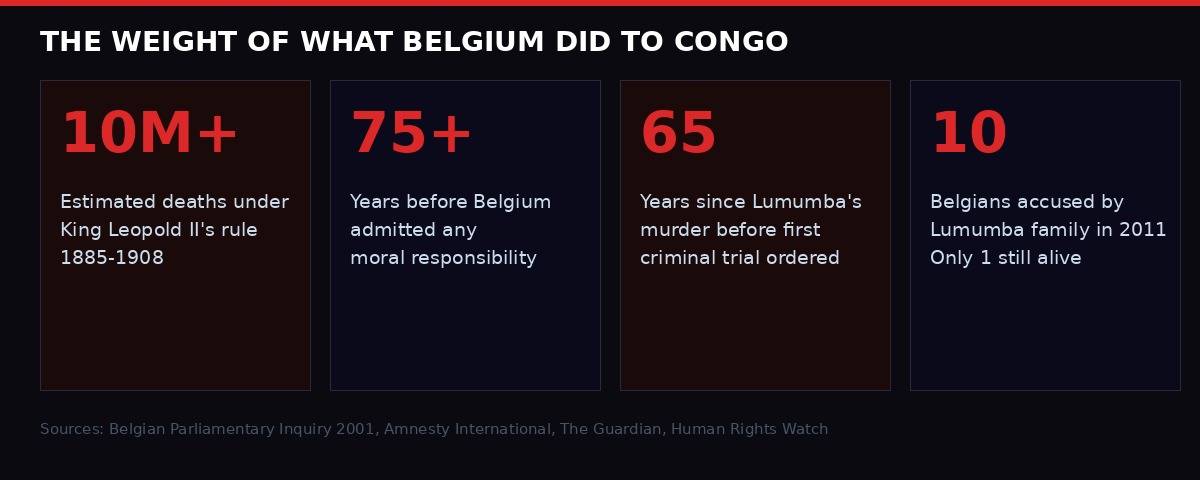
- He is the only one still alive among 10 Belgians accused by the Lumumba family in 2011
- Charges: illegal transfer of Lumumba to Katanga, humiliating treatment, denial of fair trial
- Trial could begin as early as January 2027 if no successful appeal is filed
- This would be the first-ever criminal trial of a Belgian official for a colonial political murder
The Man Who Was Erased
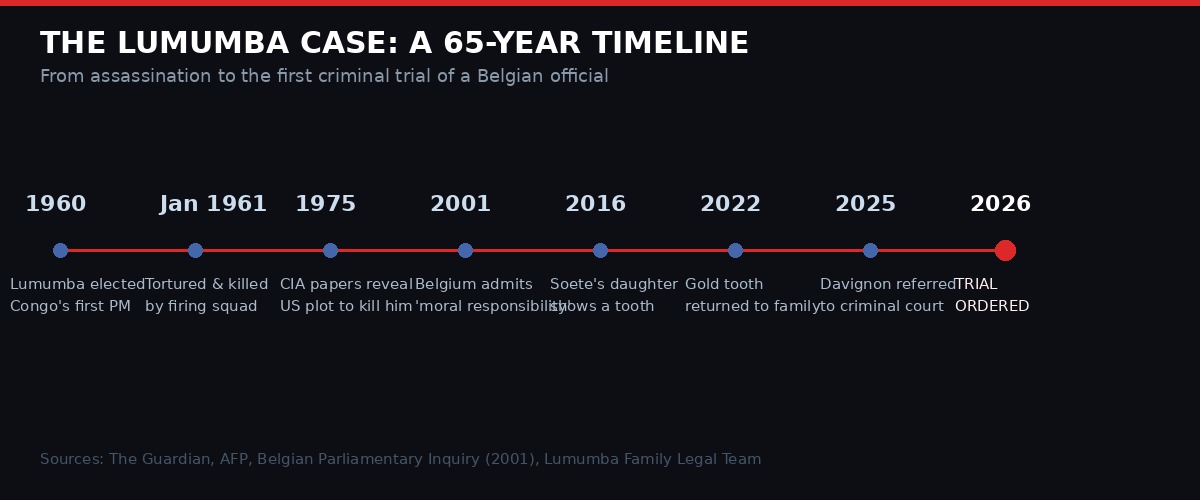
Patrice Emery Lumumba was 35 years old when they killed him. He had been prime minister of the newly independent Republic of the Congo for just 77 days before a coup backed by Western intelligence services removed him from power. What followed was a slow-motion atrocity dressed up as politics.
He was arrested in December 1960. Belgian and Congolese officials transferred him from Leopoldville - now Kinshasa - to the breakaway Katanga province, where Belgian mercenaries and Congolese separatists were fighting to keep the resource-rich region out of the new central government's hands. On January 17, 1961, Lumumba was taken into a jungle clearing near the mining town of Elisabethville with two of his associates, Maurice Mpolo and Joseph Okito. They were beaten throughout the day. That evening, they were executed by firing squad. [Guardian, 2026]
Then they disappeared. Belgian police commissioner Gerard Soete later confessed that he dismembered their bodies and dissolved the remains in acid to prevent any grave becoming a rallying point for resistance. He kept their teeth as souvenirs. He admitted this in a German documentary in 2000, apparently without remorse.
What was left of Patrice Lumumba - one gold-capped tooth - was returned to his family in a ceremony in Brussels in 2022. His son Roland said the return meant his family could "finish their mourning." Sixty-one years after their father was murdered. Sixty-one years to be allowed to grieve. [Guardian, 2022]
"A man was murdered for his political convictions, his words, his ideals." - Alexander De Croo, Belgian Prime Minister, at the tooth repatriation ceremony, June 2022
What Davignon Is Accused Of
The charges against Etienne Davignon are specific and deliberate. He is not accused of pulling the trigger. Belgian prosecutors and the Lumumba family's lawyers are more surgical than that.
Davignon arrived in the Belgian Congo as a 28-year-old diplomatic intern on the eve of independence in June 1960. Within months, as the new Congolese state fractured under the pressures of Cold War proxy politics, secessionist conflict, and the deliberate destabilization efforts of Belgium and the United States, he was in positions of real influence over what happened to the country's first democratically elected leader.
He is charged on three counts, according to the Brussels court of first instance: the illegal transfer of Lumumba and his associates from Leopoldville to Katanga - a transfer that all parties knew would result in death; the "humiliating and degrading treatment" of the three men during their captivity; and depriving them of any semblance of a fair trial. [Guardian, March 17, 2026]
The charge of intent to kill was dropped at an earlier stage. What remains is arguably more insidious - the bureaucratic machinery of murder. The paperwork, the transport arrangements, the official permissions. The men who never held guns but made sure the guns were in the right place.
Davignon has denied all involvement. His lawyer Johan Verbist told the Guardian the decision came too soon to comment fully, but that he would "analyse the possibilities for an appeal." Earlier, at a January 2026 closed hearing, Verbist had argued both that Davignon committed no war crimes and that too much time had passed for a fair trial. The court rejected both arguments.
The ruling went further than prosecutors had asked. The court extended the scope of the potential trial to cover Lumumba's two associates, Mpolo and Okito, who were murdered alongside him - adding depth and weight to what was already a historic decision. [Guardian, March 17, 2026]
"This is a historic decision. This decision confirms that the passage of time cannot erase the legal responsibility for the gravest crimes." - Christophe Marchand, lawyer for the Lumumba family
Three Generations Waiting
Yema Lumumba was born after her grandfather was killed. She has spent her adult life fighting for a reckoning that kept getting deferred - moral acknowledgments, parliamentary inquiries, symbolic returns of remains. But no criminal accountability.
Standing outside the Palais de Justice in Brussels on Tuesday, she chose her words carefully. "The fact that all this time has passed does not mean it is done and we will never get to know the truth," she told reporters. "It is also very important for the legal Belgian system to start confronting its own responsibilities regarding what happened during colonial times." [Guardian, March 17, 2026]
The Lumumba family filed their formal complaint accusing 10 Belgian officials in 2011 - fifteen years ago. By then most of the men named were already dead. The case worked through Belgium's slow legal machinery until last June, when Belgium's federal prosecutor took the extraordinary step of referring Davignon to the Brussels criminal court. In January 2026 a judge heard the case in closed session. On March 17, the ruling came: trial ordered.
The family's statement after the ruling was measured but carried the weight of decades: "For our family, this is not the end of a long fight, it is the beginning of a reckoning that history has long demanded." [Lumumba family statement, March 17, 2026]
In Kinshasa, on the other side of an ocean and 65 years of pain, people watched and waited. Social media in the DRC filled with images of Lumumba - the young man with the round glasses, the passionate speech at independence on June 30, 1960, that humiliated the Belgian king by calling out the truth of colonialism to his face. He is not a historical figure there. He is a wound that never closed.
The Architecture of a Colonial Murder
To understand why this trial matters - and why it took so long - you have to understand what Belgium did to Congo, and what it refused to say about it for most of a century.
King Leopold II acquired the Congo Free State as his personal property in 1885 at the Berlin Conference, where European powers carved up Africa among themselves like a property auction. What followed was one of history's most documented atrocities. Congolese people were enslaved to harvest rubber and ivory under a quota system enforced by mutilation. Workers who failed to meet quotas had their hands cut off - children's hands were severed to prove bullets hadn't been wasted. As many as 10 million people died from starvation, murder, and disease during the first 23 years of Leopold's personal rule. [Belgian Parliamentary Inquiry, 2001; Adam Hochschild, "King Leopold's Ghost"]
Belgium took formal control of the colony in 1908 after international outcry. The exploitation continued, if more bureaucratically. Congo provided Belgium with uranium - some of it used in the Manhattan Project's atomic bombs. It provided rubber, cobalt, coltan. Its people provided forced labor. Belgium built virtually nothing for them in return: on independence in 1960, there were 17 Congolese university graduates in a country of 15 million people.
Lumumba was elected in those extraordinary, chaotic months of 1960. He was charismatic, a pan-Africanist, inclined toward the Soviet Union as a counterweight to Western exploitation. That made him a target. The CIA drew up assassination plans. Belgium coordinated with Congolese opponents who wanted him gone. By the time he was transferred to Katanga, Western intelligence agencies were watching and doing nothing. Some were actively facilitating.
In 2001, a Belgian parliamentary inquiry concluded that Belgian ministers bore "moral responsibility" for the events that led to his death. Moral responsibility - not criminal. Not legal. Just moral. The phrase allowed Belgium to acknowledge something happened while ensuring nobody would ever be prosecuted for it. [Belgian Parliamentary Inquiry Report, 2001]
That calculation held for 25 more years. Until March 17, 2026.
Why This Precedent Terrifies Governments
Christophe Marchand, the Lumumba family's lawyer, has been building toward this moment for over a decade. He knows exactly what the ruling means beyond the Davignon case specifically.
"There are very few cases where a former colonial state accepts to address the colonial crimes and to consider that they have to be tried in that same colonial state, even if it's a very long time after," he said in a 2025 interview. "This decision confirms that the passage of time cannot erase the legal responsibility for the gravest crimes." [Guardian, 2025]
If the trial proceeds and results in conviction, it would be the first successful criminal prosecution of a Western European official for a crime committed as part of colonial rule. Not reparations, not apologies, not moral acknowledgments. A criminal verdict with actual legal weight.
The implications spread in every direction. Britain has faced calls for accountability over the Mau Mau uprising in Kenya - a 2013 settlement provided compensation to torture survivors but fell short of criminal prosecution. France has never faced serious legal accountability for the Algerian War's documented atrocities, including the use of torture as official policy. The Netherlands has fought reparations claims for colonial-era slavery in Suriname and the Dutch Antilles for years.
Every former colonial power is watching this case. Their governments' lawyers are watching this case. If Belgium sets the precedent that you can try a man for war crimes committed under colonial authority 65 years after the fact, the legal architecture of colonial impunity - which has held for well over a century - begins to crack. [Amnesty International commentary; Human Rights Watch analysis]
Davignon's defense team knows this too. The "too much time has passed" argument was not just about the fairness of this specific trial. It was about closing the door on the entire class of cases. The Brussels court's rejection of that argument is the part of this ruling that will reverberate far beyond Belgium.
"I want to trust that justice will do its work now." - Nancy Mariam Kawaya, Coordinator, Congolese Cultural Centre, Brussels, 2025
The Tooth, the Tooth, the Tooth
It is impossible to write about Lumumba without returning to the gold-capped tooth. It is the detail that sits in your chest.
Gerard Soete, the Belgian police commissioner who oversaw the disposal of the bodies, kept the teeth. He confessed this on German television in 2000, 39 years after the murder, apparently proud. His daughter later displayed one of them to a Belgian newspaper. A Belgian academic filed a criminal complaint after seeing the interview. Belgian authorities seized the tooth. It took sixteen more years of legal and diplomatic process before it was placed in a light blue case and handed to Lumumba's children at a ceremony in Brussels in June 2022.
Roland Lumumba said his family could finally finish their mourning. His father had been dead for 61 years. The family hadn't been able to bury him - hadn't been able to hold a funeral with a body or even remains - for six decades. Because a Belgian official had kept his teeth as a souvenir and felt no particular urgency about returning them.
This is the texture of what the Lumumba family has been living inside. Not abstract historical injustice. The specific, grinding, personal weight of a murder that was never fully acknowledged, never fully accounted for, never allowed to be mourned properly because there was nothing to mourn over except a tooth in a box on someone else's shelf.
Yema Lumumba stood outside the Palais de Justice on March 17 and said the fight was just beginning. She has spent her life on this. Her grandmother Pauline Opangu, Lumumba's widow, died in 2014 still waiting. Lumumba's son Patrice Jr. has spent his adult life carrying this case through courts and embassies. The family did not get swept up in the emotion of the moment. They have been too close to too many almost-moments over too many years for that.
What they got was a ruling. A formal order that a man must answer for what he did. They called it "the beginning of a reckoning that history has long demanded." Not the end. Not justice served. The beginning.
The Man Being Tried - And What He Represents
Etienne Davignon at 93 is not some fringe figure. He is Belgian establishment aristocracy. A former vice-president of the European Commission. A man whose career has woven through the highest levels of Belgian and European political and business life for seven decades. He served in the cabinet of the Belgian foreign ministry during the Congo crisis. He went on to shape European industrial policy in the 1970s and 1980s as EU industry commissioner. His business connections span blue-chip Belgian industry.
He was 28 when he arrived in Congo. Young enough that you might feel a complicated mix of things about who he was then versus who he became. But he was not a naive intern who stumbled into events beyond his understanding. He was a diplomat dispatched by Belgium to help manage its most valuable colonial possession during a crisis of its own making. The decisions made during those months - about Lumumba's transfer, about what Belgian officers did and did not prevent, about the paperwork and permissions that enabled a man's murder - were made by people who understood exactly what they were doing.
Davignon called the prosecution "absurd." He told Belgian media in 2025 that a parliamentary inquiry had already cleared him of direct or indirect responsibility. The Brussels court on Tuesday found sufficient grounds to say otherwise and let a criminal jury decide.
His lawyer will almost certainly appeal. Belgian procedure allows it. The case might not reach trial until 2027 if appeals are pursued. Davignon is 93. There are real questions about whether a trial will conclude before nature takes the decision out of the justice system's hands. The Lumumba family's lawyer Marchand acknowledged this candidly: "The idea is to have a judicial trial and to have the truth." Not necessarily a conviction against a frail nonagenarian. The truth - on the record, under oath, in a criminal court.
That itself would be unprecedented. A Belgian official, under oath, required to account for what he did in Congo in 1960 and 1961. Required to say what he knew, when he knew it, what he did or didn't do to prevent what happened. For the first time in 65 years, a Belgian court saying: you will answer for this.
The Diaspora Reaction: Grief That Doesn't Have Words for Relief
In Brussels, home to one of Europe's largest Congolese diaspora communities, the response to Tuesday's ruling was something harder to describe than celebration. People have been living inside this story too long for pure joy. What you see in the diaspora is a complicated unfolding - relief that something finally moved, grief that it took this long, anger that most of the men responsible died in their beds without ever being questioned, and a sharp awareness that a trial ordered is not a trial completed and certainly not justice delivered.
Nancy Mariam Kawaya, who coordinates the Congolese Cultural Centre in Brussels - opened in 2023 as part of Belgium's efforts to reckon with its colonial history - had been waiting for this ruling for months. Her center hosted a centenary exhibition for Lumumba in 2025, on what would have been his 100th birthday. "I want to trust that justice will do its work now," she said then.
The exhibition itself - titled "Lumumba Sans Temps," a French pun meaning both "without time" and "everlasting" (the French "cent ans," one hundred years, sounds like "sans" in casual speech) - captured something essential about why this matters beyond the legal case. One painting showed an imagined 100-year-old Lumumba, grey-haired, gazing into a distance he never reached. Another depicted modern Kinshasa as an unpopulated metropolis of skyscrapers drowning in plastic waste. In another, Lumumba sits on a plastic chair in a rubbish dump wearing a halo, as two barefoot boys reach toward him - one with blood-dripping hands holding a smartphone, a brutal reference to the minerals that power the world's devices and have fueled decades of conflict in eastern Congo.
These are not historical paintings. They are the ongoing story. The minerals Lumumba was killed partly to control are still being extracted. The conflict in eastern Congo that began in the power vacuum after his murder and the chaos of the Mobutu years has never fully stopped. Children are still dying in mines that feed supply chains ending in the phones in everyone's pocket. The art makes the connection explicit because Belgium has spent 65 years trying to keep those connections obscure.
Dady Mbumba, the exhibition's curator who was born in Congo and lives in Brussels, said he wants Lumumba's life and ideas to be as known as his death. "Lumumba fought for liberty, for equality, for unity," he said. In a country fractured for decades along exactly those fault lines - liberty denied, equality systematically destroyed, unity never achieved because Cold War powers preferred a compliant dictator to an independent leader - his ideas remain as contested and urgent as they were in 1960.
"It is a history that we share... although difficult and painful." - Dady Mbumba, curator, "Lumumba Sans Temps" exhibition, Brussels 2025
What Happens Next - And What This Cannot Fix
If Davignon does not successfully appeal, Belgian lawyers for the Lumumba family estimate a trial could begin in January 2027. It would be the first criminal proceeding against a Belgian official for a colonial political murder. The world will watch.
But honesty requires acknowledging what a trial of a 93-year-old man - even if it results in conviction - cannot accomplish.
It cannot bring back Patrice Lumumba, Maurice Mpolo, or Joseph Okito. It cannot restore the 65 years during which the Congolese state was looted first by Belgian-backed secessionists, then by the kleptocratic dictatorship of Mobutu Sese Seko, who was installed with Western support partly because of his willingness to suppress the nationalists Lumumba represented. It cannot address the systematic underdevelopment of a country that should, by its natural wealth alone, be among Africa's most prosperous.
It cannot give Roland Lumumba back his father. Cannot give Yema Lumumba back her grandfather. Cannot compensate the family for decades of grief deferred because there was no body to bury, no grave to visit, no official acknowledgment that what happened was criminal until years of pressure finally forced Belgium's hand.
What it can do - if it proceeds, and if it results in a criminal record rather than acquittal - is establish a legal fact. That what happened in Katanga in January 1961 was a war crime. That people who participated in it bear criminal responsibility. That the argument "this was too long ago to be tried" has limits, and those limits do not protect officials who arranged the murder of a democratically elected leader.
Christophe Marchand put it carefully when asked about the realistic outcome: "The idea is to have a judicial trial and to have the truth about what happened." Truth on the record. Under oath. In a court of law. After 65 years of official Belgium managing the narrative of what it did, a criminal trial would mean that story must be told again, this time without Belgium controlling the telling. [Guardian, March 17, 2026]
Belgium returned a tooth in 2022. In 2026, it has been ordered to return something harder to hold in a light blue case: a full accounting of what it did, and what it made possible, to the man its king had refused to look in the eye when he gave his independence speech 66 years ago.
Patrice Lumumba was 35 when they killed him. He would have been 100 last July. A granddaughter stood outside a courthouse in Brussels on Tuesday, 65 years after his murder, and said: this is the beginning.
That is a sentence that should never have needed saying. But it needed saying, and she said it, and now a court has agreed. The reckoning history demanded is, improbably and incompletely and far too late, beginning.
Get BLACKWIRE reports first.
Breaking news, investigations, and analysis - straight to your phone.
Join @blackwirenews on Telegram