The champagne flowed freely in May 2018. Surrounded by beauty queens, the Hsu brothers - Hsu Ming-chao and Hsu Ming-hsien - toasted the groundbreaking of a 33-story luxury development in Phnom Penh, Cambodia's capital. It was a big moment for their Lixin Group of companies, a Taiwanese real estate and entertainment outfit that had recently planted its flag in Southeast Asia's booming property market.
Seven years later, a confidential United Nations report would quietly describe a "major Mekong-based criminal enterprise" as being behind one of the region's most sophisticated webs of cyber fraud, online gambling, drug trafficking, and human trafficking - an enterprise so embedded in Cambodia's economy that authorities struggled to touch it.
The report called it "Business Group 2." Multiple sources who helped compile it have now confirmed to OCCRP that Business Group 2 is Lixin Group.
What emerged from a months-long joint investigation is a picture of a conglomerate that built its brand on luxury towers, celebrity appearances, and government connections - while allegedly running a parallel infrastructure that funneled billions from fraud victims into real estate "to legitimize proceeds of crime," as a Chinese court filing put it.
KEY FACTS
- UN UNODC 2025 report names "Business Group 2" (=Lixin Group) for scams, drug trafficking, gambling, and forced labor
- Chinese court records describe "Lixin 3rd Building" Sihanoukville as a fraud ring headquarters
- 35 trafficked workers found in 2022 Sihanoukville police raid on Lixin compound
- Southeast Asia scam industry: $37 billion in annual victim losses (UNODC)
- Lixin's "New City" project co-directed by Hun To, cousin of current Cambodian PM
- WM Casino app found still operating in 11 languages despite 2019 gambling ban
The Report That Named No Names
In April 2025, the United Nations Office on Drugs and Crime published a landmark assessment of organized crime in Southeast Asia. The 200-page document mapped networks responsible for scam call centers, drug trafficking corridors, and human trafficking operations that had turned parts of Myanmar, Cambodia, and Laos into lawless crime zones.
Buried inside was a case study on "Business Group 2" - a "major Mekong-based criminal enterprise" with what the report described as an "expansive portfolio of interests in land-based and online gambling, cyber-enabled fraud operations, and large-scale drug trafficking." The group, the UN wrote, had invested criminal proceeds into real estate on a massive scale.
The report named no names. Criminal enterprise designations at the UN level are carefully lawyered, and the deliberate anonymization gave the conglomerate - and its government connections - cover to continue operating. The report noted that "BG2" had raided premises, found trafficked workers, and yet faced no sustained legal consequences.
OCCRP's investigation changed the calculus. Multiple sources involved in preparing the report, speaking on condition of anonymity, confirmed that "Business Group 2" referred specifically to Lixin Group. The identification, cross-referenced against Chinese court filings, corporate records, and on-the-ground reporting from Sihanoukville, connects years of documented fraud activity to the glossy towers and government handshakes of Lixin's public brand.
Lixin Group representative Grant Tao denied all wrongdoing when contacted by OCCRP. "The client will contact the relevant U.N. departments and submit relevant evidence to explain the situation and clarify the facts," he said. The company denied involvement in illegal gambling, cyber fraud, or drug trafficking.
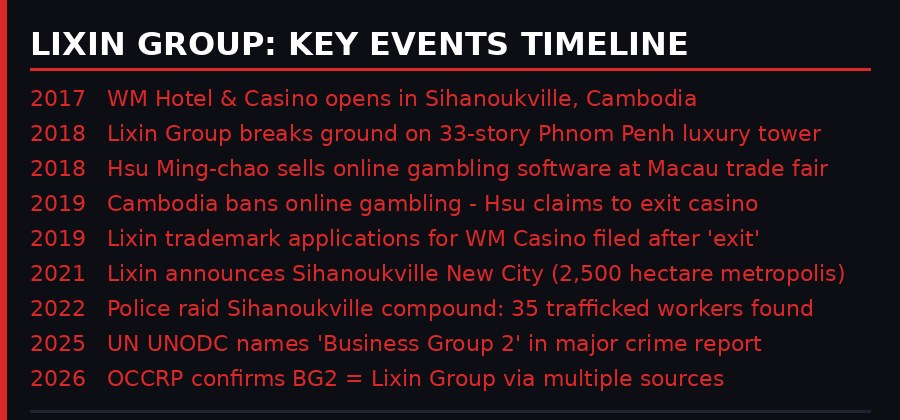
Lixin Group timeline: from casino groundbreakings to UN criminal designation - a decade of expansion alongside escalating allegations.
Built on Gambling, Sustained by Fraud
When the sleepy coastal city of Sihanoukville began transforming into a Chinese gambling mecca in the mid-2010s, Lixin was there early. In 2017, the group launched the WM Hotel and Casino, one of the first major gambling venues to cater specifically to Chinese tourists streaming in from the mainland.
From the outset, WM offered a format that would become emblematic of Cambodia's gray gambling economy: physical tables inside for in-person gamblers, and live-streamed dealer studios for online players watching on phones and computers from China, where gambling is illegal. By 2018, Hsu Ming-chao was selling the online gambling software at a trade fair in Macau - a Taiwanese tech entrepreneur pitching the infrastructure for what would become a massive shadow industry.
In 2019, Cambodian leader Hun Sen bowed to pressure from Beijing and announced a ban on online gambling. Hsu's lawyers told OCCRP he exited the WM casino investment in December of that year because it was loss-making. But the paper trail tells a different story.
In July 2020 - seven months after his claimed exit - Lixin Construction Co. Ltd, with Hsu Ming-chao as its sole shareholder and director, filed trademark applications with the Cambodian Ministry of Commerce for WM Casino, WM Hotel, and Lixin Casino. The applications were granted. Trademark holders can license their brand to others and collect fees, or block unauthorized use. Lixin's lawyers described the filings as part of "our client's overall business plan" but offered no further explanation for why a man who had divested from a casino was simultaneously trademarking casino brands.
When OCCRP reporters visited Sihanoukville in 2024 and again in late 2025, they found women in distinctive black-and-white dresses arriving at the former WM building via shuttle buses. Hours later, the same dealers appeared on live gambling apps carrying WM's branding. The building now has "FODUNA CASINO" on its facade but no public entrance. Nearby vendors confirmed it was still operational as an online casino.
At least nine online gambling websites and apps using WM's branding or linking to WM-branded platforms were found still operating as of November 2025 - more than six years after the official ban.
The Fraud Ring in Lixin's Buildings
Two Chinese court judgments obtained by OCCRP provide the most direct evidence linking Lixin buildings to systematic fraud operations.
In both cases, Chinese courts convicted employees - all Chinese nationals - who described in testimony how they had worked in "Lixin 3rd Building" in Sihanoukville running what the courts called "telecommunications network fraud." The defendants' confessions and witness testimony described a detailed corporate structure inside the building: a business department that divided workers into "sub-groups," a logistics department that procured fraud tools, and a property department that funneled the profits into Cambodian real estate investments.
"It was an attempt to legitimize the proceeds of crime." - Chinese court judgment, citing defendant testimony about Lixin's Sihanoukville operation
The fraud methods described were textbook Southeast Asia scam compound methodology. Workers would contact victims through social media, befriend them, and then lure them into chat groups where other fraudsters posed as successful investors. Targets were steered toward fake cryptocurrency trading platforms or bogus stock investment schemes. Those who deposited money either had it directly siphoned off or found their funds frozen on fabricated pretexts.
Others were drawn into rigged online gambling platforms - rigged, witnesses said, to give an initial winning streak before draining the victim's deposits. The same WM gambling infrastructure appears throughout both court cases.
Lixin's lawyers denied the Chinese court cases had any connection to Lixin Group, saying that "individuals, scam methods, fund flows, and site references in these cases have no connection whatsoever to Lixin Group." This is notable because most defendants and witnesses in both cases specifically named "Lixin" as the organization they worked for, and named the building by its Lixin designation.
China has no jurisdiction to prosecute Lixin itself, which is based in Cambodia. The 16 former employees convicted had committed fraud on Chinese citizens from Cambodian soil - a gap in international law enforcement that scam compound operators across Southeast Asia have systematically exploited.
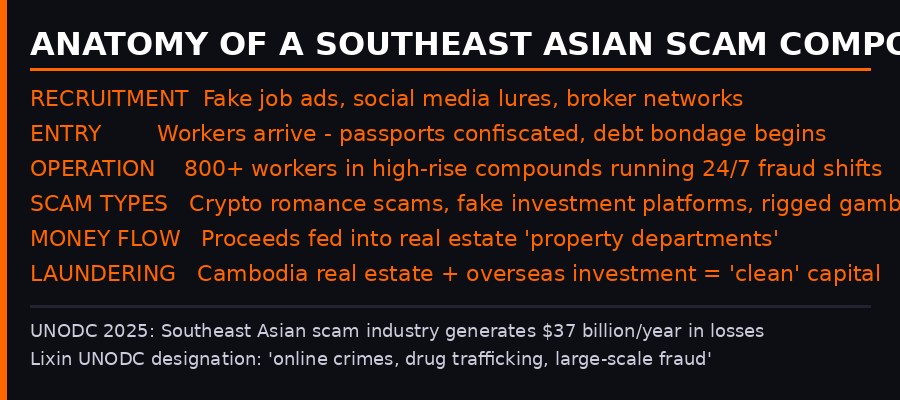
How Southeast Asia's scam compound industry operates - from victim recruitment through money laundering into real estate. UNODC estimates $37 billion in annual losses.
The 2022 Raid - and the Non-Prosecution
In August 2022, Cambodian police raided a compound in Sihanoukville and found 35 trafficked workers. Local media reported the address as belonging to Lixin Group's Harbour City development. A manager working in one of Lixin Group's buildings was arrested.
The raid made international headlines briefly. Cambodia's scam compound crisis was becoming impossible to ignore - neighboring Myanmar had already become the dominant destination for forced-labor fraud operations, and Sihanoukville was the Cambodian node of the same network.
But no formal prosecution of Lixin Group followed. OCCRP could find no court record indicating the arrested manager faced sustained charges, and Cambodian government officials did not respond to queries. The compound continued operating.
Lixin Group representative Tao denied the Harbour City compound had ever been raided at all.
The UN UNODC report, citing law enforcement sources, described "BG2" - which sources confirm is Lixin - as having premises in Sihanoukville where "multiple raids have resulted in rescues of people claiming to be detained there and forced to engage in online crimes." The report used the plural: multiple raids, multiple rescues. The 2022 incident was apparently not the only one.
This pattern - raids without prosecutions, rescue without accountability - is characteristic of how scam compound operators in Cambodia have maintained operations with apparent impunity. The UNODC report documented this failure across the region: "Law enforcement actions in specific jurisdictions have sometimes displaced operations rather than dismantling them."
The City That Hun To Is Building
Cambodia's current prime minister is Hun Manet - the son of former long-ruling leader Hun Sen, who handed power to his son in 2023. Hun Sen's family has maintained an iron grip on Cambodian politics, business, and land for decades.
Into this political ecosystem, Lixin has woven itself carefully. Corporate and government records reviewed by OCCRP show that Hun To - the cousin of Prime Minister Hun Manet and nephew of former PM Hun Sen - is co-director of Lixin Development, one of the major partners in Lixin's most ambitious project: Sihanoukville New City.
The project is extraordinary in scale. Lixin is planning a 2,500-hectare metropolis on the coast of southwest Cambodia, built from scratch. Promotional materials describe it as "a Cambodian version of Shenzhen" - a reference to the Chinese megacity that exploded from a small fishing town to a 17-million-person tech hub in four decades.
The planned city includes a business district with a signature skyscraper, luxury hotels, a logistics hub, a technology park, expansive residential zones, an eco-resort, a golf course, a theme park, and a horse racing track. And, of course, casinos - presented as world-class integrated resorts.
As of OCCRP's 2025 site visit, vast tracts of land had been cleared and new roads and roundabouts constructed. An integrated resort - two accommodation towers plus a casino - had opened in the precinct and was already taking hotel bookings. The new city was not a paper dream. It was under construction.
Speaking at a 2019 event, Hsu Ming-chao was effusive about the opportunity Cambodia's government had provided. "Lixin Group would like to thank Prime Minister Hun Sen and the Cambodian government for giving our group such a good opportunity," he said. The timing of that statement - after Cambodia's online gambling ban, while the trademark applications were being filed, and while Chinese court cases were building - gives it an uncomfortable resonance.
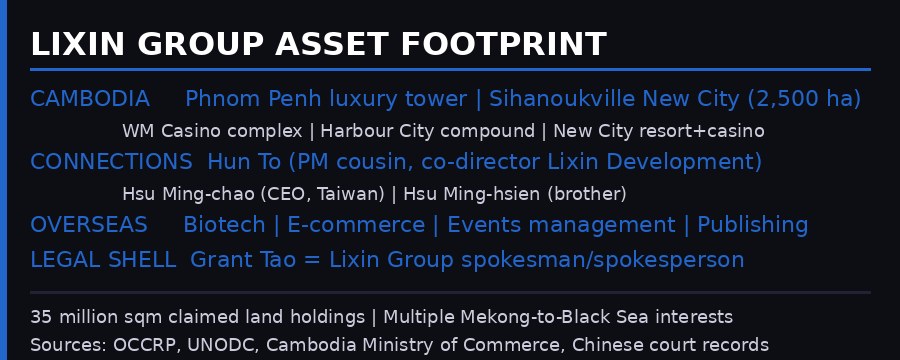
Lixin Group's footprint: from Phnom Penh luxury towers to the 2,500-hectare "New City" project, with Cambodia's ruling family embedded in the corporate structure.
The Scale of the Industry - and Why Cambodia Matters
To understand what Lixin Group allegedly represents, it helps to understand what Southeast Asia's scam compound industry has become.
A separate 2024 UNODC report estimated that scam operations in East and Southeast Asia - call center fraud, romance scams, crypto fraud, and fake investment platforms - generated between $18 billion and $37 billion in losses for victims in 2023 alone. The range is wide because the industry is deliberately opaque, but even the lower bound makes it one of the world's largest criminal enterprises by revenue.
The workforce is largely coerced. Scam compounds recruit workers through fake job advertisements - typically promising hospitality, tech, or customer service roles in Southeast Asia. Workers arrive to find their passports confiscated and a quota imposed: generate a certain amount of fraud revenue per day, or face violence, debt bondage, or sale to another compound. Human rights organizations have documented these practices extensively across Myanmar's Kokang region, Laos's Golden Triangle Special Economic Zone, and Cambodia's coastal cities.
The money, once extracted from victims, needs to be laundered. Real estate is the primary mechanism. A compound takes in cash from fraud, converts it through cryptocurrency or informal money transfers, and routes it into construction and land investment. The resulting assets - towers, resorts, hotel complexes - are then valued at legitimate market rates, creating a clean capital base that bears no obvious trace of its origins.
This is precisely what Chinese court testimony described in connection with Lixin: a "property department" whose explicit role was investing illicit earnings into real estate. Whether or not every element of Lixin's conglomerate was aware of or complicit in this process, the structural description matches the classic scam-to-real-estate laundering pipeline that UNODC has identified as the industry's backbone.
The UNODC report on "Business Group 2" noted the enterprise had an "expansive portfolio" of interests including large-scale drug trafficking - going beyond fraud alone. OCCRP's investigation focused primarily on the gambling and scam fraud components, but the drug trafficking allegation, attributed to law enforcement sources by the UN, represents a separate and serious dimension of the alleged criminal enterprise.
The Accountability Gap
The most striking aspect of the Lixin story is not the scale of the alleged activity - it is the near-total absence of legal consequence.
Cambodia is formally a signatory to numerous international anti-corruption and anti-trafficking frameworks. The country has a Financial Intelligence Unit. It has laws against money laundering and human trafficking. And yet Lixin Group continued expanding, receiving government approval for a 2,500-hectare city project, obtaining trademark protections, and attracting co-investment from members of the ruling family - all while a UN report was describing its alleged criminal empire and Chinese courts were convicting its former employees.
Part of the explanation is structural. Cambodia's courts and regulatory agencies operate with limited independence from the ruling CPP party and the Hun family network. Foreign investors willing to bring capital and align with politically connected partners have historically faced minimal scrutiny of how that capital was generated.
Part of the explanation is jurisdictional. The primary victims of Lixin's alleged scam operations are Chinese citizens, scammed via Cambodian-based platforms. China has pressed Cambodia on the issue - the online gambling ban in 2019 was partly a response to Chinese pressure - but Chinese legal jurisdiction stops at the border. The Cambodian courts have shown no appetite for prosecution.
And part of the explanation is deliberate design. Scam compound operators structure their enterprises specifically to maximize legal distance between the criminal operations and the legitimate-appearing corporate entities. Workers are employed by sub-contractors. Buildings are owned by one Lixin entity and operated by another. The casino software company is registered separately from the hotel. The trademark holder is not the property developer. Layer upon layer of corporate structure creates exploitable ambiguity at every level.
"Law enforcement actions in specific jurisdictions have sometimes displaced operations rather than dismantling them." - UNODC 2025 report on Southeast Asian organized crime
This is why the UNODC report's naming - even in the anonymous form of "Business Group 2" - was significant. International bodies rarely put criminal enterprise designations into formal documents without extensive documentation. The confirmation that BG2 is Lixin Group, now on the record with multiple sources, represents the first time the conglomerate's alleged criminal dimensions have been publicly linked to its real-world corporate identity.
What Happens Next
As of March 2026, Lixin Group is still building. The Sihanoukville New City project continues. The integrated resort is accepting bookings. Hsu Ming-chao remains the principal shareholder. Hun To remains a co-director of Lixin Development.
The UN designation has not triggered sanctions. No Western government has moved to block access to international financial systems for Lixin or its principals. The group's lawyers deny everything and have threatened to submit "relevant evidence" to the UN - a PR posture that costs nothing and resolves nothing.
The 35 trafficked workers rescued in 2022 had their moment of media attention, then vanished from the news cycle. The Chinese nationals convicted of fraud in the "Lixin 3rd Building" cases served their sentences and returned to their lives. The workers forced to run live dealer shifts in the repurposed WM Casino building are still arriving by bus every afternoon.
OCCRP's investigation did not find evidence that any government is currently building a legal case against Lixin Group itself. Cambodia's ruling family retains significant financial and political interests that align with the conglomerate's continued expansion. There are no obvious domestic incentives for prosecution.
The accountability, if it comes, will likely be forced from outside. International financial regulators, foreign investors in Lixin's projects, and banks processing transactions connected to the New City development are now on notice. The UN has provided the framework. OCCRP has connected the dots. Whether any institution with the power to act will do so is the question.
In the meantime, the Cambodian version of Shenzhen is under construction. Bulldozers are clearing the land. Hotel bookings are live. And the buses keep bringing workers to the building with no public entrance.
Get BLACKWIRE reports first.
Breaking news, investigations, and analysis - straight to your phone.
Join @blackwirenews on Telegram