Made in the USA, Fired on Mexico: How the U.S. Army's Ammunition Plant Became a Cartel Armory
For more than a decade, .50-caliber rounds stamped with "L.C." - Lake City, a U.S. government-owned plant in Missouri - have turned up at Mexican cartel massacre sites. Court records, federal seizure data, and millions of pages of documents show how a loophole in the Army's commercial sales contracts kept the pipeline flowing - and still does.
U.S. government-manufactured .50-caliber ammunition has been traced to cartel attacks across Mexico. PIL visualization: BLACKWIRE
The casings tell the story. After a cartel convoy stormed the Mexican border town of Villa Union on November 30, 2019, and shot it apart with heavy machine guns and .50-caliber rifles, investigators combing the streets found 45 spent shell casings stamped with two letters: "L.C."
Lake City. As in the Lake City Army Ammunition Plant, a sprawling federal facility just outside Kansas City, Missouri. As in the largest manufacturer of rifle ammunition for the United States military. As in a factory owned by American taxpayers.
That morning in Villa Union, four police officers and two civilians died in the firefight. By the time the shooting stopped, the casings on the ground connected a cartel massacre to the arsenal of the world's most powerful military - through a supply chain that the U.S. Army knowingly opened to the public and has never fully closed.
A joint investigation by the International Consortium of Investigative Journalists (ICIJ) and The New York Times, drawing on millions of pages of court records, federal seizure data, congressional files, and internal Army documents, has documented the full scope of this pipeline. What they found is not a story of weapons stolen or diverted. It is a story of official policy - one that saved the Army roughly $50 million a year and armed some of the most violent criminal organizations on the planet.
The findings now collide with two recent developments that make the contradiction impossible to ignore. In February 2025, the Trump administration formally designated six Mexican cartels as foreign terrorist organizations. And on March 12, 2026, the Inter-American Court of Human Rights issued a landmark advisory opinion declaring that states have a legal duty of due diligence to prevent arms trafficking - including monitoring manufacturers to ensure their products do not enable human rights violations.
Both declarations ring hollow against the documented evidence. The U.S. Army owns the plant arming the terrorists it has declared. International courts rule on state obligations that American law explicitly forbids enforcement of. The ground trembles in Villa Union, and the casings keep falling.
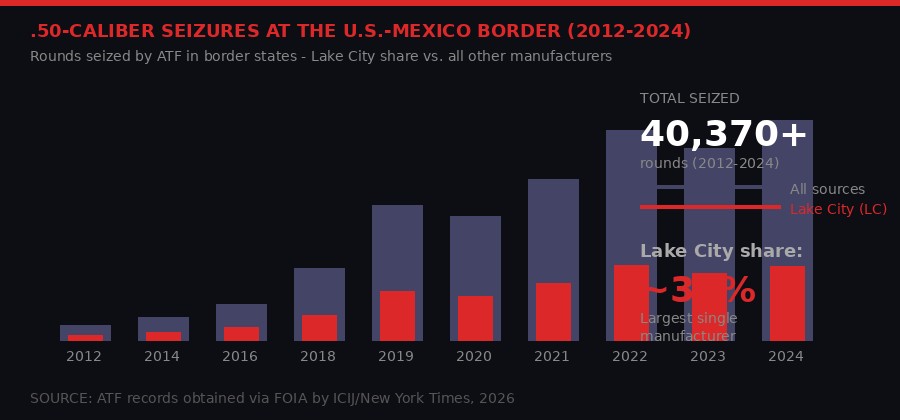
ATF data from 2012-2024 shows Lake City as the single largest identified source of .50-cal ammunition seized in U.S. border states. Visualization: BLACKWIRE
The Plant Behind the Casings
Lake City Army Ammunition Plant sits in Independence, Missouri, on 3,900 acres. It was built in 1941 to supply World War II. Today it is the primary source of small-caliber rifle ammunition for U.S. troops - a production capacity of more than 1.6 billion rounds per year under its current contract with Olin Winchester.
The facility is technically federal property. It is owned and funded by the U.S. Army. The contractor that operates it - first ATK, then Northrop Grumman beginning in 2012, then Olin Winchester from 2019 onward - runs day-to-day operations under a government contract that runs into the billions of dollars.
That contract contains a clause that transformed the plant's role in American gun culture. To justify the cost of maintaining enormous production capacity that sits largely idle in peacetime, Army planners authorized the operating contractor to sell surplus ammunition commercially. The revenue helps cover operating costs and has - according to the Army - saved taxpayers around $50 million annually.
The problem is that among the ammunition authorized for commercial sale are .50-caliber BMG cartridges. These are not deer rifle rounds. The .50 BMG was developed in the early 20th century for use in a heavy machine gun designed to destroy tanks and shoot down aircraft. A single round is roughly the size of a medium cigar. It can penetrate armor plating at several hundred meters. It can, as ammunition dealers once advertised to undercover federal investigators, "shoot down a helicopter or penetrate an armored limousine."
From 2008 onward, as ATK ramped up commercial sales under the Army's authorization, these rounds became widely available through civilian retailers. By 2013, 10-round boxes of Lake City .50-caliber "ball" ammunition had made their way onto Walmart shelves. Online retailers extolled their power. One popular website advertised: "If you're looking to stop a Jeep dead in its tracks, then you're looking at the right round."
In Mexico, cartels were reading the same advertisements - and placing bulk orders.
Armor-Piercing, Available Online: The Law Congress Forgot to Enforce
Congress has been aware of this problem, in a broad sense, for more than two decades. In the late 1990s, federal auditors found that Talon Manufacturing Co., a Defense Department contractor hired to demilitarize unneeded ammunition, had instead broken down the rounds, reconstructed cartridges from their components, and sold more than 100,000 armor-piercing incendiary .50-caliber rounds to civilian retailers. Ammunition dealers told undercover government investigators those rounds could "shoot down a helicopter or penetrate an armored limousine."
Congress responded in 2000 with legislation prohibiting the Pentagon from selling armor-piercing ammunition to the public. It required anyone receiving such ammunition or components from the Defense Department to pledge not to transfer the materials to any non-governmental purchaser in the United States.
The legislation did not, however, restrict the manufacture and commercial sale of armor-piercing .50-caliber ammunition by private contractors operating government-owned plants. Talon stopped operations in 2007 due to environmental concerns. But under the Army's expanded commercial sales authorization for Lake City, a new supply emerged.
SGAmmo, a small ammunition distributor, negotiated the purchase of armor-piercing incendiary .50-caliber rounds directly from Northrop Grumman as it transitioned out of the Lake City contract in 2019. The company's owner posted a newsletter urging customers to "get some before this stuff gets banned," adding that the haul resulted from "a government contract that ended up being canceled due to COVID-19 and left the factory hanging with the inventory."
Another retailer, American Marksman, marketed its own line of armor-piercing incendiary rounds made with Lake City components, describing on its website how it obtained them through a "recycling" arrangement with Northrop Grumman. Pallets of armor-piercing incendiary ammunition labeled with Olin Winchester's Lake City manufacturing code were still being sold by at least one online retailer as recently as March 2023. American Marksman continued selling these rounds as of the ICIJ/NYT investigation's publication.
Under U.S. law, virtually any American citizen or legal resident over 18 can purchase armor-piercing .50-caliber ammunition in any quantity. There is no licensing requirement, no quantity limit, no flagging system for bulk purchases. The only restriction is on taking the rounds across the border without a permit - a rule that, as decades of cartel procurement demonstrate, is enforced lightly at best.
Key Findings: Lake City and Mexican Cartel Violence
- 40,370+ rounds of .50-cal ammo seized by ATF in border states from 2012-2024
- ~33% of seized .50-cal rounds traced to Lake City - the largest single source
- 2,850 armor-piercing incendiary rounds seized by CBP during the same period
- 10,210 Lake City AP incendiary rounds seized in a single 2022 trafficking ring bust
- $50 million/year Army savings from commercial sales - its stated justification
- 500,000 firearms trafficked annually from the U.S. into Mexico (Mexico government estimate)
- 80% of guns recovered at Mexican crime scenes traced to the United States
- 16+ online retailers identified selling Lake City AP rounds to the public
Follow the Casings: From Kansas City to Cartel Battlefields
The ICIJ/NYT investigation documents four specific incidents in which .50-caliber ammunition traced to Lake City was used in cartel attacks on Mexican police and civilians.
The October 2019 ambush in Michoacan is perhaps the most devastating in human terms. Edder Paul Negrete Trejo was a police officer. He was a father of three. His widow, Brenda Aparicio Villegas, told ICIJ that he and his fellow officers "often had to purchase their own bullets" - a telling detail about the resource gap they faced. On October 14, 2019, cartel members of the New Generation Jalisco Cartel (CJNG) ambushed his convoy. Thirteen police officers died. One burned to death. Investigators found .50-caliber casings from Lake City at the scene.
Three weeks later came Villa Union. The Cartel del Noreste convoy drove brazenly through the town. Former mayor Sergio Cardenas, who watched from behind a freezer in his butcher shop, described the sound of the .50-caliber guns: "You could hear the .50-caliber rounds. Every now and then, a bullet or two would whiz by overhead. They ripped the air apart because they're so big." The chicharrones he had been frying burned. The town went into lockdown. Authorities traced one of the .50-cal rifles to a Texas gun store whose owner had sold nearly 500 weapons to CDN, including multiple .50-caliber rifles. A federal court sentenced him to 10 years.
The escalation continued. In 2024, CJNG gunmen used .50-caliber armor-piercing incendiary rounds - the kind made with Lake City components and sold commercially online - to attack a Mexican police convoy. The round pierced an armored vehicle. One crew member was killed. Three more were wounded. Then-Defense Secretary Luis Cresencio Sandoval said publicly: "The armor that we have cannot protect our personnel from this kind of penetration."
The ATF has known the scope of the problem for years. Since 2019, agents in border states seized more than 36,000 rounds of .50-caliber ammunition. About a third were Lake City products. Former ATF agent Chris Demlein, who spent years on gun trafficking, put it plainly: "The impact that one .50-cal has in a firefight is outrageous. They really, really tip the scale." The weapons can engage targets at distances exceeding a mile - capabilities that overwhelm the lighter-armed forces typically deployed by Mexican state police.
"Our mantra became, follow the ammo and you'll get to the guns. We were tracking shipments from all over the country."
- Jason Red, former Department of Homeland Security investigator in Arizona
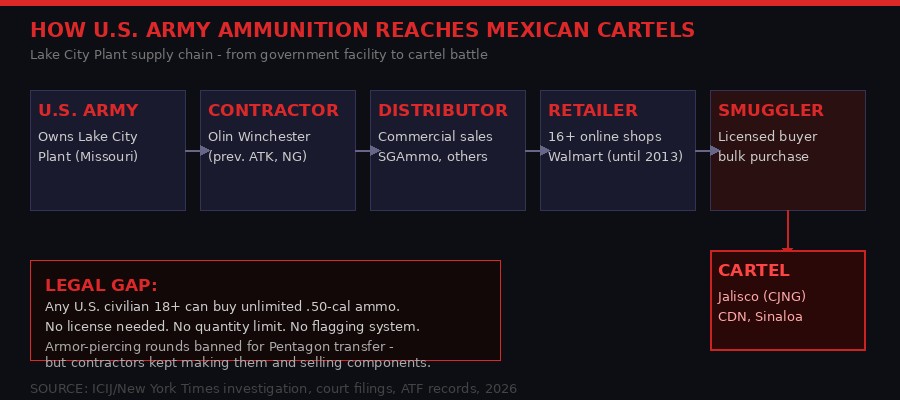
The pipeline from U.S. Army-owned plant to cartel battlefield runs through a web of contractors, distributors, and retailers - each technically compliant with federal law. Visualization: BLACKWIRE
The Liability Shield and the Mexican Lawsuit That Went Nowhere
Mexico has not been passive. In 2021, the Mexican government filed a lawsuit in U.S. federal court against seven American firearms manufacturers, accusing them of negligent business practices that helped arm cartels. The suit was a major legal undertaking - Mexico estimated it had standing to claim billions in damages.
In 2024, the U.S. Supreme Court threw the case out. The reason: a 2005 U.S. federal law called the Protection of Lawful Commerce in Arms Act (PLCAA) shields gun manufacturers from most civil liability for crimes committed with their products. The court ruled that PLCAA protected the manufacturers from legal liability for the criminal actions of third parties.
The Lake City case sits in a parallel but arguably more damning legal territory. This is not a private manufacturer protected by PLCAA. This is the U.S. Army - a branch of the federal government - whose facility is producing the ammunition, whose contract explicitly authorizes commercial civilian sales, and whose Pentagon spokesperson confirmed the $50 million annual savings rationale.
The Army's response to ICIJ/NYT's detailed questionnaire was brief. A spokesperson said Lake City's contractors "are required to comply with all federal and state regulations governing the sale of commercial ammunition" and that the operating contractor does not sell directly to the public. That statement is technically accurate and entirely beside the point. The contractors sell to distributors who sell to retailers who sell to civilians who sell or smuggle to cartels. The Army is five steps removed from the massacre in Villa Union. It is also the facility owner that set the entire chain in motion.
Olin Winchester, the current operator, did not respond to detailed questions. Neither did SGAmmo. American Marksman declined to comment. Northrop Grumman said it "fully complied with government contract obligations in its sales of ammunition" during its tenure.
The pattern is familiar to students of American gun policy: when accountability is diffused across enough links in a supply chain, no single actor bears full responsibility for the body count at the end of it.
Armed Enemies, Declared Enemies: The Trump Contradiction
In February 2025, the Trump administration formally designated six Mexican drug cartels as foreign terrorist organizations (FTOs). The designated groups included the Jalisco New Generation Cartel (CJNG) - the organization whose members ambushed and killed Edder Paul Negrete Trejo and 12 fellow officers in October 2019 with weapons that included Lake City-marked casings.
Under U.S. counterterrorism law, providing material support to a designated foreign terrorist organization is a federal crime. The Arms Export Control Act and export regulations govern the transfer of munitions to foreign terrorist groups.
But these laws apply to knowing, direct transfers. They do not reach a system where the U.S. Army opens a government-owned plant to commercial sales, the contractor sells ammunition to distributors, distributors sell to retailers, retailers sell to civilians who can buy 100-round military-style cans online without any license, and those civilians or their intermediaries smuggle the ammunition across a border that processes roughly 500,000 illegally trafficked firearms per year going south.
Secretary of State Marco Rubio announced a new U.S.-Mexico initiative to stop gun trafficking in September 2025 - a diplomatic gesture that has not been accompanied by any changes to Lake City's commercial sales arrangements. The Army continues to authorize those sales. Olin Winchester's Lake City facility continues to operate. American Marksman's website continues to list armor-piercing incendiary .50-caliber rounds. The same ammunition that can pierce armored police vehicles, at $3-4 per round, is available for purchase by anyone with a credit card and an American address.
The bureaucratic distance between the declaration of cartels as terrorists and the continued supply of military-grade ammunition to their black-market procurement networks is not a gap. It is a policy.
March 2026: International Courts Rule, American Law Stays Silent
On March 12, 2026, the Inter-American Court of Human Rights issued an advisory opinion responding to a 2022 request from the Mexican government. The court, based in Costa Rica and exercising jurisdiction over members of the Organization of American States, ruled that national governments have a "duty of due diligence regarding activities that may result in illicit trafficking of firearms."
That duty, the court found, includes monitoring and supervising firearms manufacturers to ensure their products are not enabling human rights violations. The opinion also calls for effective judicial remedies for victims whose rights have been violated by illicit arms trafficking.
"States must undertake risk assessments to anticipate the possibility that imports or exports of arms may lead to negative consequences such as undermining peace and security, as well as the commission or facilitation of serious violations of international humanitarian law or international human rights law, particularly when affecting vulnerable populations."
- Inter-American Court of Human Rights Advisory Opinion, March 2026
Jonathan Lowy, the president of Global Action on Gun Violence who represented Mexico in its lawsuit against U.S. manufacturers, called the opinion significant: it "makes clear that the United States's gun industry shield law, the PLCAA, is contrary to basic principles of international human rights law, and the United States is obligated to ensure gun manufacturers do not violate human rights by enabling gun trafficking to criminal markets."
The opinion could theoretically apply to the Brazilian firearms giant Taurus, one of the world's largest handgun manufacturers, which has also seen its products turn up in Mexican crime scenes. And its moral force extends clearly to the Lake City situation - where the "manufacturer" in question is not a private company but the U.S. government itself.
The U.S., however, is a member of the OAS but has not ratified the American Convention on Human Rights. The Inter-American Court's findings are not legally binding on Washington. American law - the PLCAA, the Army's procurement rules, the ATF's licensing regime - remains unchanged. The court's opinion joins a pile of recommendations, reports, and condemnations that have not moved the policy needle by a single degree.
Mexico estimates that as many as half a million firearms are smuggled from the United States into Mexico every year. Of guns recovered at Mexican crime scenes in recent years, roughly 80% have been traced to American sources. The country has seen a steep rise in homicides since the U.S. assault weapons ban expired in 2004. These numbers are not disputed. They appear in U.S. government reports, Mexican defense ministry briefings, and international court filings. They have not produced a change in Lake City's commercial sales policy.
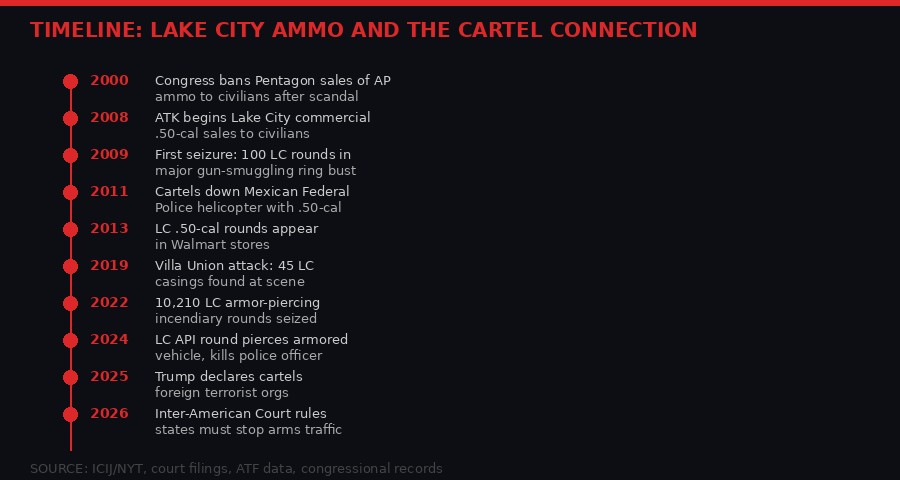
A decade-plus trail of carnage traces directly back to a single U.S. government-owned facility. Visualization: BLACKWIRE
The Accountability Gap: What Hasn't Changed
The ICIJ/NYT investigation did produce one concrete result: Congress moved. In December 2025, lawmakers passed legislation banning the Army from selling .50-caliber ball ammunition from Lake City to civilians - the standard, non-armor-piercing "ball" round that has been the primary product flowing to cartels for more than 15 years. The provision was attached to the National Defense Authorization Act.
The restriction is significant but incomplete. It applies only to ball rounds. It does not address armor-piercing incendiary ammunition, which continues to be manufactured with Lake City components and sold commercially by private contractors and retailers. It does not address the backlog of Lake City ammunition already in the civilian supply chain. It does not address the other manufacturers - primarily in Brazil and South Korea - whose .50-caliber rounds have also turned up at Mexican crime scenes.
More fundamentally, the new restriction addresses a single caliber at a single plant. The broader architecture of American gun law remains intact. Any adult can still purchase virtually unlimited quantities of most rifle ammunition without a license. The PLCAA still shields manufacturers from civil liability. The ATF operates with limited resources and no real-time transaction monitoring. The border remains porous to southbound contraband in ways that northbound enforcement has not remedied.
Vasily Campbell, the owner of one online retailer that had sold Lake City armor-piercing ammunition, said he stopped doing so "about two years ago once we found out where it was going and how it was getting there." He became suspicious when buyers began ordering 100-round military-style ammo cans delivered to residential addresses. "That's not a normal purchase," he said. "There's several orders I straight-up canceled."
The fact that a private retailer exercised more discretion than the U.S. Army's contractual framework required is not a compliment to either party. It is a summary of the state of American arms trafficking policy: reactive, fragmented, and dependent on individual judgment in a system designed to require none.
"Sadly, many of us pay the price."
- Brenda Aparicio Villegas, widow of police officer Edder Paul Negrete Trejo, killed in October 2019 cartel ambush in Michoacan. .50-caliber casings with Lake City markings were found at the scene.
Who Profits, Who Pays
The economic logic of the Lake City commercial sales program is not complicated. Maintaining a production facility capable of surging to 1.6 billion rounds per year costs money even when it is running at peacetime levels. Selling surplus ammunition to civilian markets offsets those costs. The Army has cited the $50 million annual savings figure as its primary justification for the arrangement.
That $50 million figure has never been set against the cost of the violence it helps enable. Mexico estimates that cartel-driven violence costs the country roughly 1-2% of annual GDP in lost productivity, healthcare, security spending, and economic displacement. At Mexico's 2024 GDP of approximately $1.5 trillion, that is $15-30 billion per year - conservative estimates that do not capture the full cascading economic damage of a sustained war between armed criminal organizations and an outgunned state.
The U.S. government saves $50 million. The Mexican economy absorbs losses measured in tens of billions. Mexican police officers buy their own bullets. Widows raise their children alone. Town mayors hide behind freezers listening to the ground shake.
The contractors profit. ATK, which ran Lake City until 2012, is now part of Northrop Grumman, one of the largest defense contractors in the world. Olin Winchester, the current operator, is a division of Olin Corporation, a publicly traded specialty chemicals and ammunition company. Both companies have benefited from the Lake City commercial sales arrangement - which effectively subsidizes their production capacity and civilian market presence through a government contract.
Neither company has faced legal accountability for the downstream use of their products. Under the PLCAA, no civil lawsuit can reach them. Under the Army's contractual framework, their obligation is compliance with federal and state sales regulations - regulations that permit the sale to anyone over 18, in any quantity, of rounds designed to pierce armor and destroy aircraft.
The Jalisco New Generation Cartel - now a federally designated foreign terrorist organization - continues to operate. In 2024, a CJNG gunman loaded a .50-caliber rifle with an armor-piercing incendiary round, fired it at a Mexican police armored vehicle, and killed the officer inside. The round had Lake City components.
Brenda Aparicio Villegas is still waiting for someone to be held accountable. "Not enough has been done," she said. "Sadly, many of us pay the price."
What Comes Next
The December 2025 legislative restriction on ball ammunition is a starting point, not a solution. The next battleground is likely to be the armor-piercing incendiary segment - the rounds that can pierce armored vehicles - which remain commercially available despite being the most lethal variant in cartel hands.
The Inter-American Court's March 2026 advisory opinion will be cited in future litigation and diplomatic negotiations. Mexico has made clear it intends to keep pressing the issue through every available legal channel. The government of President Claudia Sheinbaum has continued to highlight the firearms pipeline in bilateral talks with the U.S. and in international forums. The $13 billion lawsuit against gun manufacturers - tossed by the Supreme Court - will likely serve as a template for future legal strategies that attempt to navigate around the PLCAA's protections.
In the U.S. Congress, the Lake City ball ammunition ban has demonstrated that some restrictions are politically achievable. Follow-on legislation addressing armor-piercing variants and bulk purchase monitoring is expected to be introduced in 2026. Whether it passes depends on the same gun-politics calculus that has blocked meaningful reform for decades.
In the meantime, cartels continue to purchase, smuggle, and deploy .50-caliber weapons. Mexican police continue to be outgunned by the organizations they are tasked with fighting. And somewhere in a warehouse in Texas or Arizona or California, there are pallets of .50-caliber ammunition waiting to be loaded into trucks headed south - some of it made at a government facility outside Kansas City, some of it marked with two letters that investigators have learned to look for in the dirt of crime scenes.
"L.C." The ground trembles. The casings fall.
Get BLACKWIRE reports first.
Breaking news, investigations, and analysis - straight to your phone.
Join @blackwirenews on TelegramSources: ICIJ / New York Times joint investigation, February 2026; ATF records obtained via FOIA; U.S. federal court filings; Inter-American Court of Human Rights Advisory Opinion, March 2026; Mexico Defense Ministry press briefings; U.S. Army public statements; Bureau of Alcohol, Tobacco, Firearms and Explosives seizure data; CBP records; congressional testimony and committee reports.