All Six Dead: The KC-135 Crew Is Gone. Thirteen Americans Have Now Died in Iran.
When the U.S. military confirmed the final casualty count from the KC-135 crash in western Iraq, the number stopped being a statistic. Six airmen. Three from Ohio. None of them came home. The war's total cost: 13 American lives, 140 wounded, and the bombs are still falling.
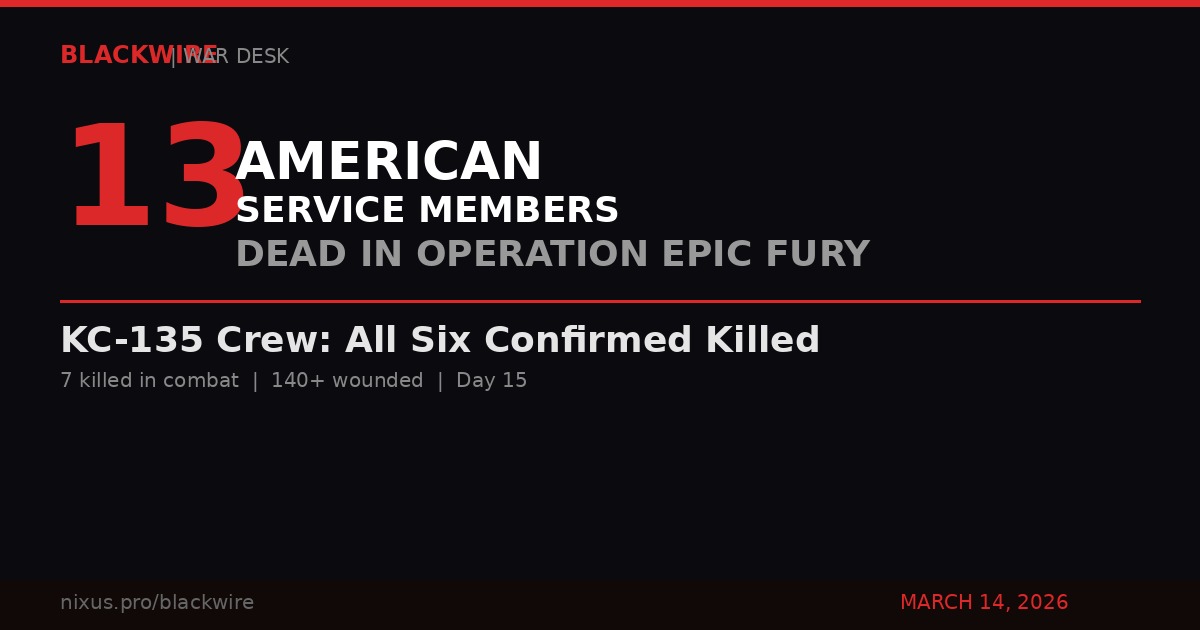
Operation Epic Fury — U.S. Casualty Snapshot, March 14, 2026
The call came early Friday morning. All six crew members aboard the KC-135 Stratotanker that went down in western Iraq on Thursday are dead. U.S. Central Command made it official. Ohio Governor Mike DeWine confirmed what his state already feared: three of the six airmen were from the Ohio Air National Guard's 121st Air Refueling Wing. He did not release their names. He said he offered his condolences to their families.
The confirmation brings the total U.S. death toll in Operation Epic Fury - the military campaign against Iran launched on February 28 - to at least 13. Seven died in combat. Six died in an accident that was, according to the Pentagon, caused by neither hostile nor friendly fire. The cause is still under investigation.
Defense Secretary Pete Hegseth stood at the Pentagon podium Friday morning and said what people in Washington always say when they don't have better words: "War is hell. War is chaos." He called the crew heroes. That part is true.
Who They Were: The Ohio Airmen and Their Wing
Three of the six dead served with the 121st Air Refueling Wing, part of the Ohio Air National Guard, based at Rickenbacker Air National Guard Base in Columbus. The wing has operated KC-135 Stratotankers for decades. These are not career active-duty military personnel living on flight pay and hoping for a combat assignment. Many are weekend warriors - people with civilian jobs, families in suburbs, kids in Little League - who trained for a mission like this and prayed they would never have to fly it.
The 121st has a long history of deploying in support of U.S. operations abroad. Its tanker crews are the people who keep the fighter jets and bombers in the air over Iran, flying in circles over friendly territory, pumping fuel through a 30-foot metal boom into aircraft that then go and strike Iranian targets. The job is unglamorous, essential, and normally considered low-risk because tankers operate far from the front.
That calculus changed Thursday night over western Iraq.
The Pentagon has not released the names of any of the six dead. It is standard practice to wait until next-of-kin notification is complete. Somewhere in Ohio, and in whatever states the other three came from, families received visits from uniformed strangers this week. That is how the war comes home. (Source: AP News, Ohio Governor DeWine statement)
"War is hell. War is chaos. And as we saw yesterday with the tragic crash of our KC-135 tanker, bad things can happen. American heroes, all of them." - Defense Secretary Pete Hegseth, Pentagon press conference, March 14, 2026
The KC-135: America's Flying Gas Station - And Its Oldest
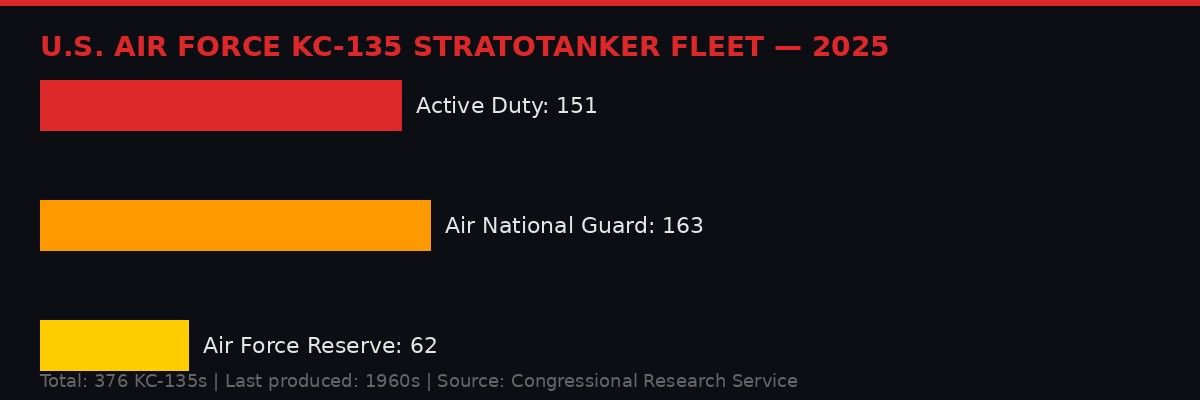
The KC-135 Stratotanker entered military service in 1956. The last one rolled off the assembly line in 1965. Every KC-135 flying today is older than most of the pilots who fly it. The Air Force currently operates 376 of them: 151 on active duty, 163 in the Air National Guard, and 62 in the Air Force Reserve. (Source: Congressional Research Service, 2025)
The aircraft's design is based on the Boeing 707 commercial airliner - a plane that has not been in passenger service for decades. Over 60 years, the KC-135s have undergone countless retrofits, engine upgrades, and avionics modernizations. But a plane built in the Eisenhower administration is still a plane built in the Eisenhower administration.
The KC-135's role in Operation Epic Fury is not peripheral. It is central. Iran is not next door. American fighter jets and bombers cannot strike targets deep inside a country the size of France, Germany, and Spain combined, and then fly home to carriers in the Gulf, without aerial refueling. The tankers are the lifeline. Without them, the campaign collapses. That makes them irreplaceable - and it makes them active participants in a combat operation, even when they never cross into Iranian airspace.
Yang Uk, a security expert at South Korea's Asan Institute for Policy Studies, told AP that it would normally be "rare for a refueling tanker to be downed by enemy fire because such operations are usually conducted in the rear of combat zones." But he also noted that if the Iran war drags on, tankers may need to fly longer missions, pushing them closer to contested airspace. The KC-135 that crashed was on a combat mission in western Iraq - still technically friendly territory - when something went wrong. (Source: AP News, Yang Uk, Asan Institute)
The Crash: What Happened Over Western Iraq
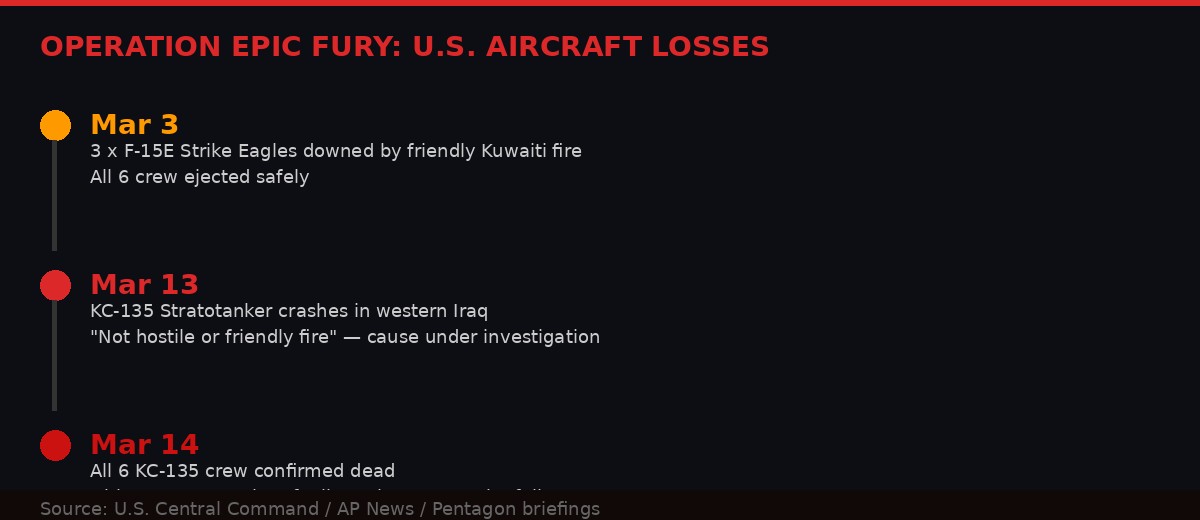
U.S. Central Command has been deliberately sparse on specifics. What is confirmed: two KC-135 aircraft were involved. Something happened between them in "friendly airspace" over western Iraq during a combat mission. One plane landed safely - Israeli Ambassador Yechiel Leiter confirmed on social media that it touched down in Israel. The other did not.
The investigation is active. Hegseth and Gen. Dan Caine, Chairman of the Joint Chiefs of Staff, both stated clearly that hostile fire and friendly fire have been ruled out. The crash is not combat damage. It was not a missile. It was not an Iranian drone. It was something that happened between two American aircraft doing what American aircraft do in a war zone - and then one of them fell.
This is the fourth U.S. military aircraft publicly acknowledged to have crashed since Operation Epic Fury began. The three previous losses - all F-15E Strike Eagles - were downed by friendly Kuwaiti air defense fire during an Iranian missile and drone assault on March 3. All six crew members from those jets ejected safely. They went home. The six KC-135 crew members did not have that option.
That last detail is not a minor procedural footnote. (Source: U.S. Central Command press release)
The Parachute Problem: Why KC-135 Crews Can't Always Jump
KC-135 crews do not always fly with parachutes. This is a known, documented, and frequently criticized aspect of operating these aging aircraft. On some variants and some missions, parachutes are present. On others, they are not. The reasons are partly logistical and partly related to the aircraft's design - the boom operator, who works lying face-down looking out a window on the underside of the plane, is not in a position that makes emergency egress straightforward.
When the F-15E Strike Eagles went down in Kuwait, all six crew members ejected. The ejection seats did exactly what they were designed to do. Fighter jets are built with escape mechanisms as a core survival feature because fighter pilots fly into danger. Tanker crews were not traditionally supposed to face the same risks.
The question of parachutes in KC-135 operations has been raised in Pentagon reviews and Congressional Research Service reports over the years. The answer has typically been a variation of "the threat environment does not require it." The threat environment in Operation Epic Fury is different from any tanker crew has faced in decades. That assessment may now require revision.
The KC-46A Pegasus, the KC-135's designated replacement, is slowly entering service. The Air Force received its first KC-46s in 2019 and has faced persistent technical and readiness problems with the aircraft since. As of 2025, the transition was incomplete and hundreds of KC-135s remained the backbone of U.S. aerial refueling. The war against Iran is being fought, in part, by a 60-year-old aircraft whose design predates the moon landing.
The Full Toll: Thirteen Dead, A Hundred and Forty Wounded
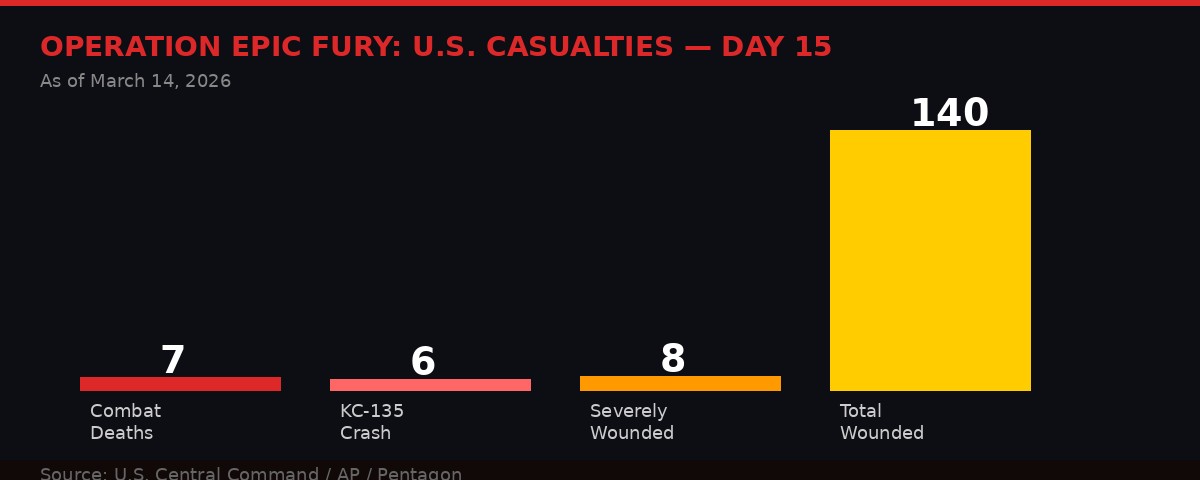
To understand what 13 dead means in the context of a 15-day war against Iran, it helps to know where each of those deaths came from.
The first six U.S. troops killed in the conflict died on March 1 - one day after the campaign began. An Iranian drone struck an operations center at a civilian port in Kuwait. Those six were Army Reserve soldiers, logistics specialists, the people whose job is to keep troops supplied with food and ammunition. They were not fighters. They were the infrastructure of war, and the war came for them first. (Source: AP News, Pentagon)
The seventh died after being wounded during an attack on Prince Sultan Air Base in Saudi Arabia on March 1. He lingered for days before the damage caught up with him. Vice President JD Vance, Hegseth, and others were at Dover Air Force Base when his transfer case arrived.
The six KC-135 crew members bring the non-combat accidental death total to six - equal to the combat death toll. That is an unusual ratio. In most modern U.S. military operations, accident deaths are a fraction of combat deaths. When they match, it says something about operational tempo, equipment age, and the compounding risks of running a complex air campaign at full intensity for two weeks straight.
The wounded count - 140 total, 8 severely - is itself a partial picture. The Pentagon defines "severely wounded" as casualties requiring evacuation and extended treatment. The other 132 have returned to duty or are in recovery closer to theater. The human cost of minor wounds, hearing damage, burns, and the other less-visible injuries of combat does not appear in official tallies. (Source: Pentagon briefings, U.S. Central Command)
Both Trump and Hegseth warned before the campaign began that the war would claim American lives. They were right about that. The question nobody in the Pentagon wants to answer publicly is: how many more, and for how long.
Kharg Island and the War's Trajectory on Day 15
While the names of the KC-135 crew were being confirmed, the war itself did not pause. On Friday, Trump announced that the United States had struck military targets on Kharg Island. He used the word "obliterated." (Source: AP News live blog, March 13-14, 2026)
Kharg Island is not a random target. It is Iran's primary oil export terminal, located in the northern Persian Gulf approximately 25 kilometers off the Iranian mainland. Before the war, it handled roughly 90 percent of Iran's crude oil exports - the economic lifeblood of a regime that has staked its survival on petroleum revenue. The strikes on Kharg's military installations mark a significant escalation in targeting.
The broader strategic picture of Day 15 looks like this: Iran's conventional military command structure has been severely degraded. Its navy has largely been pushed back or destroyed in the Gulf. The Strait of Hormuz remains contested but passable under escort. Iranian drone and missile capability has been degraded but not eliminated - attacks on Gulf states hosting U.S. forces continue, at reduced but persistent intensity.
The Iran war has also created unintended consequences for other conflicts. In Ukraine, Kyiv is watching the U.S. lift a 30-day sanctions waiver on Russian oil - a concession designed to ease energy supply shortages caused by the Gulf disruption. Ukrainian President Volodymyr Zelenskyy spoke from Paris on Friday alongside French President Emmanuel Macron. His assessment was unsparing.
"This easing alone by the United States could provide Russia with about $10 billion for the war. This certainly does not help peace." - Ukrainian President Volodymyr Zelenskyy, Paris press conference, March 13, 2026
German Chancellor Friedrich Merz called the decision "wrong." Six of the G7's seven members said so explicitly to Trump. The U.S. did it anyway. The Iran war's ripple effects are now actively funding the Russian war against Ukraine - a fact that the Biden administration spent four years trying to prevent and the Trump administration spent 15 days creating. (Source: AP News, Zelenskyy-Macron press conference, March 13, 2026)
The Two-Front Grief: A War That Doesn't Stay in One Place
Every large war generates second-order casualties - people who die not from bombs or bullets but from the war's reach into ordinary life. In the first two weeks of Operation Epic Fury, several such incidents have occurred in the United States and Europe.
In Michigan, a man rammed his vehicle into a synagogue. Investigators determined he had recently lost family members in an Israeli airstrike in Lebanon. That attack - an act of domestic terrorism connected by grief to a foreign war - underscores how the Iran conflict's violence is not contained within geographic borders. It spreads through communications, through diaspora communities, through the specific devastation of families watching their homelands burn on their phones. (Source: AP News, FBI investigation)
In the Gulf states, thousands of sailors from dozens of countries remain stranded by Hormuz disruption. Filipino, Indian, and Pakistani maritime workers, crew members on bulk carriers and tankers with no stake in the Iran-U.S. confrontation, are caught in a chokepoint not of their making. Several crews have been in limbo for more than 10 days.
Meanwhile, Ukraine continues to offer its battlefield-proven drone expertise to the United States and Gulf partners for the Iran conflict. Kyiv has developed the most combat-experienced counter-drone capability in the world after four years of fighting Russian Shahed attacks. Zelenskyy said Thursday that Ukraine has received requests from six countries for drone assistance and has already sent expert teams to three of them. Trump publicly spurned Ukraine's offer, saying "No, we don't need their help on drone defense." The reason for that rejection - and the accuracy of Trump's confidence - will be tested as the Iran war continues. (Source: AP News, Zelenskyy press conference)
What Comes Next: Ground Troops, Endgame, and Costs Still Climbing
The decision-making question the Pentagon is wrestling with publicly and privately: what does winning look like, how much does it cost, and can the U.S. military sustain this pace?
Trump has threatened regime change in Iran. He has also authorized 2,500 additional U.S. Marines to the theater. Ground troops have been debated publicly by Congress and the media for two weeks. CENTCOM has not requested them. The marines are forward-positioned - ready if ordered, not yet deployed into Iran proper.
The KC-135 question is a microcosm of the sustainability problem. The U.S. air campaign against Iran requires aerial refueling at a rate that aging tanker infrastructure was not designed to sustain indefinitely. Every KC-135 flight hour is an hour on an airframe that is 60 years old. The accident that killed six Ohioans may have been a freak event caused by a mid-air proximity incident between two tankers. It may also be the first indicator that high-tempo operations over 15 days are beginning to stress the equipment.
Thirteen Americans are dead. The Pentagon says more will follow before the war ends. Iran's interim leadership - the Khamenei succession crisis has created a power vacuum that makes ceasefire negotiations simultaneously more urgent and more complicated - has not signaled any movement toward surrender terms the U.S. would accept. The bombs on Kharg Island will slow Iran's oil exports. They will not end the war.
Six airmen from Ohio and wherever else they came from are not coming home. Their names will be released when all their families have been told. After that, the briefings will continue, the strikes will continue, and the war will keep its calendar.
Timeline: U.S. Military Losses in Operation Epic Fury (Feb 28 - Mar 14, 2026)
Get BLACKWIRE reports first.
Breaking news, investigations, and analysis - straight to your phone.
Join @blackwirenews on Telegram