Travis Kalanick Is Back - And He Brought Levandowski
The disgraced Uber founder just launched Atoms, swallowed his ghost kitchen empire into it, and is about to acquire Pronto - an autonomous mining startup run by a man Trump pardoned for stealing Google's self-driving secrets. Uber is backing him. Again.
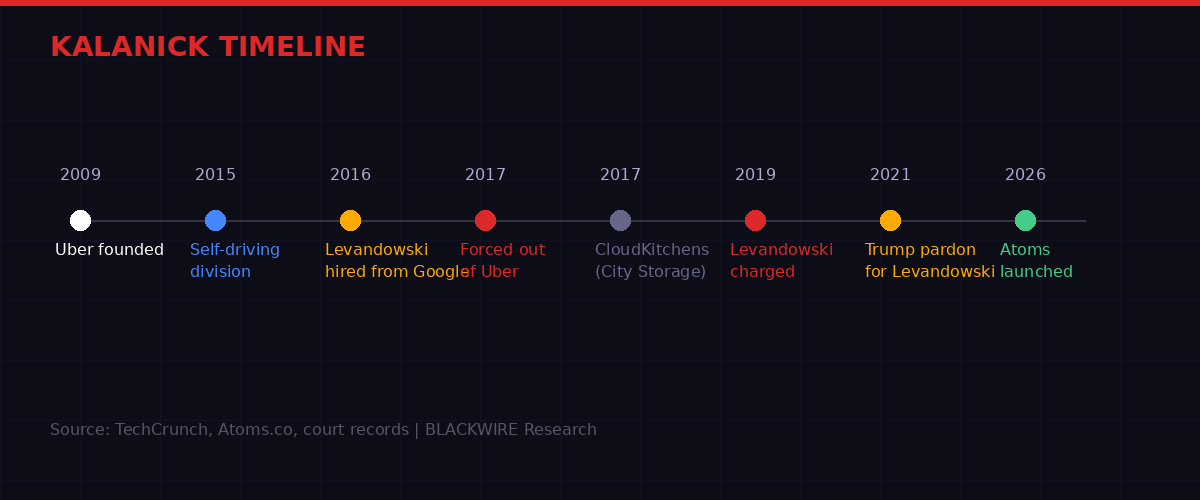
The Kalanick arc - from Uber founder to ghost kitchen entrepreneur to would-be industrial robotics magnate. BLACKWIRE Research.
Travis Kalanick got forced out of Uber on June 21, 2017, days after his mother died in a boating accident. An investor - Benchmark's Bill Gurley - organized the boardroom coup while Kalanick was still grieving. He's been nursing that wound publicly ever since, and now he wants you to know he's back.
This week, Kalanick officially launched Atoms, a physical-world automation company that folds in his eight-year-old ghost kitchen business CloudKitchens and expands into mining and industrial transport. The company's vision statement on atoms.co reads like a manifesto crossed with a philosophy dissertation - "In the battle against entropy, humans optimize for finding valuable unknown truths" - but beneath the rhetoric is a concrete and somewhat alarming strategy.
He is about to acquire Pronto, an autonomous vehicle startup built for industrial mining sites. Pronto was founded by Anthony Levandowski. The same Anthony Levandowski who was criminally charged with 33 counts of trade secret theft from Google, convicted, sentenced to 18 months in prison, then pardoned by Donald Trump on the last day of his first term. The same Anthony Levandowski who was the central figure in one of the most damaging corporate espionage cases in Silicon Valley history.
And behind Atoms sits Uber, reportedly providing "major backing" for the venture, according to The Information. A company Kalanick built, destroyed, and was removed from is now financing his attempt to build the next one.
Key Facts
- Atoms launched March 2026, folding in CloudKitchens (ghost kitchens) and adding Mining and Transport divisions
- Kalanick is the "largest investor" in Pronto and on the "precipice" of acquiring it, per his own public statements (TBPN interview, March 14)
- Pronto was founded by Anthony Levandowski, pardoned 2021 for 33-count trade secret conviction
- Uber is reportedly providing "major backing" per The Information; Atoms' site makes no mention of Uber
- Atoms' Transport division will build a "wheelbase for robots" - specialized industrial machines, not humanoids
- Kalanick explicitly says he wants to be "more aggressive than Waymo" in rolling out self-driving
The Atoms Thesis: Digitize the Physical World
Kalanick's pitch at Atoms is not about building better robots in the narrow engineering sense. It is a sweeping ideological claim about what the next economic revolution looks like. His framing - "AI for atoms vs. AI for bits" - positions everything from ChatGPT to Grok as interesting but incomplete: software that handles language and math while the physical world remains largely untouched by autonomous systems.
He is not wrong about the gap. Despite billions poured into humanoid robotics by Tesla, Figure, Agility, and others, industrial automation in the real world - particularly in mining, food manufacturing, and materials transport - remains strikingly manual. The gold mine in Nevada still runs on diesel trucks with human drivers. The ghost kitchen warehouse still needs people to stock shelves. The quarry still runs on human judgment for most high-stakes decisions.
Atoms is structured across three divisions. Atoms Food absorbs CloudKitchens, the sprawling ghost kitchen real estate operation Kalanick built after leaving Uber. Atoms Mining is where Pronto - and Levandowski - come in. Atoms Transport will develop what Kalanick calls a "wheelbase for robots": a standardized mobility platform for specialized machines, not humanoids, across industrial environments.
The bet is on specialized robots over general humanoids. "Humanoids have their place," Kalanick told TBPN in a live interview on March 14, "but there's a lot of room for specialized robots that do things in an efficient, sort of industrial-scale kind of way, which is sort of where we play." That is a deliberate counter-positioning to the Tesla Optimus / Figure hype cycle - a bet that the market for purpose-built machines will arrive faster and generate more durable economics than the race to build general-purpose human-shaped robots that can do everything.
He may be right. Every major advance in automation history has been domain-specific first: robotic arms for automotive assembly lines, then CNC machines for precision machining, then drones for logistics. General-purpose physical AI remains decades away from useful deployment. Industrial-specific automation, with a narrower task space and clearer economic ROI, is achievable now.
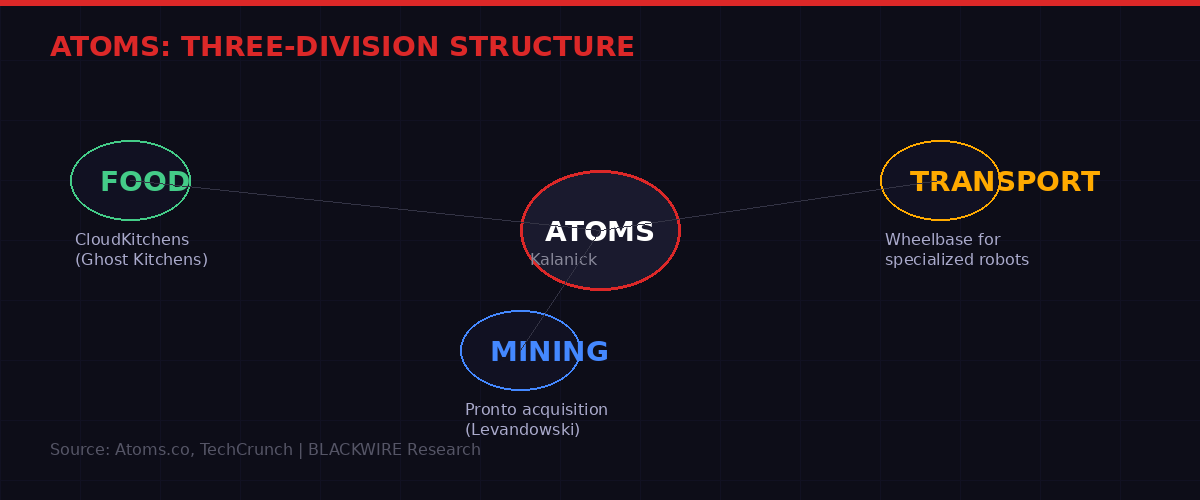
Atoms' three-division structure - Food (CloudKitchens), Mining (Pronto acquisition), and Transport (specialized robot wheelbase). BLACKWIRE Research.
Anthony Levandowski: The Pardon That Keeps Giving
No figure in the Atoms story is more complicated than Anthony Levandowski. His involvement is either a genius hire of an underutilized talent - or a catastrophic reputational bet that could derail Atoms before it gets started. Probably both, depending on who you ask.
Levandowski was one of the earliest and most technically gifted self-driving engineers in Silicon Valley. He was building autonomous vehicles at Google in the early 2010s when most people thought the technology was science fiction. His project, Chauffeur, became the foundation of what is now Waymo - the most advanced autonomous driving operation in the world by most technical measures.
In January 2016, Kalanick lured Levandowski away from Google to build Uber's self-driving division. Within months, Google filed a lawsuit alleging that Levandowski had downloaded approximately 14,000 confidential files from Google's servers before leaving - files containing the proprietary designs for LIDAR systems at the core of autonomous vehicle technology.
The lawsuit became one of the most high-profile corporate espionage cases in history. Uber and Waymo ultimately settled in February 2018, with Uber handing over roughly $245 million in Uber stock to Google's parent company Alphabet. Levandowski himself was later criminally charged by the Department of Justice in August 2019 with 33 counts of trade secret theft.
He pleaded guilty to one count. In August 2020, he was sentenced to 18 months in federal prison - the largest sentence ever handed down in a trade secrets case at that time. He had served only a few months when Donald Trump, on January 20, 2021 - his final day in office during his first term - pardoned Levandowski. According to TechCrunch, Levandowski was among the list of last-minute pardons granted before the Biden inauguration.
"Once you crack movement in the physical world, there's lots of people who want access to that." - Travis Kalanick, TBPN interview, March 14, 2026
After his pardon, Levandowski founded Pronto, an autonomous vehicle startup focused specifically on industrial and mining site applications. It is a clever narrowing of scope - rather than trying to solve full public-road autonomy, which remains extraordinarily complex, Pronto targets environments that are more controlled: mine sites, quarries, construction zones, industrial parks. These environments have fewer pedestrians, more predictable obstacles, lower speed requirements, and massive economic incentive for automation given the cost of human operators in remote locations.
Kalanick told TBPN that he is already the "largest investor" in Pronto and is on the verge of acquiring it outright. That acquisition would give Atoms a functioning autonomous vehicle operation with real field deployments - not a research project, but a company that has actually put machines to work in industrial environments.
The question the market will inevitably ask: does Levandowski's involvement create legal or reputational exposure for Atoms? The technical answer is no - he received a full pardon, he is legally clear, and Pronto's intellectual property was built from scratch after leaving both Google and Uber. The practical answer is more complex. Investors considering Atoms will have to decide whether backing a company that prominently features Levandowski signals something about Kalanick's judgment, his risk appetite, or his disregard for the kind of reputational optics that made Uber's 2017 crisis spiral out of control.
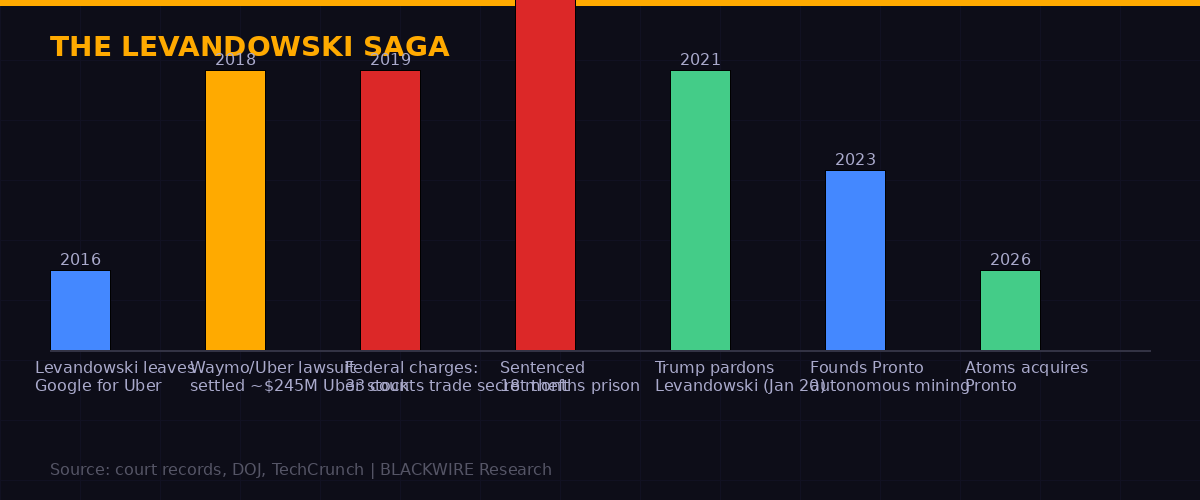
The Levandowski arc - one of the most dramatic legal sagas in Silicon Valley history, ending with a Trump pardon and a fresh start in autonomous mining. BLACKWIRE Research.
Uber's Strange Bet: Backing the Man It Ousted
The most structurally bizarre element of the Atoms story is not Levandowski. It is Uber.
According to reporting from TechCrunch and The Information, Uber is providing "major backing" for Kalanick's new venture and is reportedly supportive of Kalanick being "more aggressive than Waymo" in rolling out self-driving technology. Atoms' own website makes no mention of Uber. Uber did not immediately respond to requests for comment from either outlet.
The relationship is hard to interpret cleanly. Uber famously sold its self-driving division - the Advanced Technologies Group, or ATG - to autonomous trucking startup Aurora in December 2020. That sale was widely read as an admission that Uber lacked the technical depth and capital to win the AV race on its own. Uber's current CEO Dara Khosrowshahi has focused the company on its core ride-hail and delivery businesses and has generally avoided the capital-intensive hardware bets that defined the Kalanick era.
So why back Kalanick now? The most plausible theory: Uber needs autonomous vehicle technology to survive long-term, but it cannot build it internally. If Atoms succeeds in developing a viable specialized robotics and autonomous vehicle platform - even one focused initially on mining, not ride-hail - Uber gains a potential pathway back to AV capability without having to own the development risk. A "major backing" stake in Atoms could give Uber preferred access to whatever Kalanick and Levandowski build, at a fraction of the cost of running an in-house program.
For Kalanick, Uber's money means legitimacy, capital, and a potential exit or integration path. He gets to rebuild what he lost, with backing from the company that took it from him. There is something almost operatically recursive about it - the founder, backed by the company that ousted him, trying to rebuild the future that slipped away.
Kalanick has also said he wants Atoms to be more aggressive than Waymo on deployment timelines. Waymo currently runs ~1,000 fully autonomous robotaxis in Phoenix, San Francisco, and Los Angeles, logging millions of miles per month with no safety drivers. Any claim to be "more aggressive" than Waymo is a significant boast - Waymo has spent over a decade and somewhere north of $10 billion reaching its current scale. But Kalanick has always operated at the edge of what is legally and technically permissible, and Pronto's industrial focus means his aggressiveness may manifest in mining sites and logistics hubs before it reaches public roads.
CloudKitchens: The Ignored Piece Nobody Talks About
The mining and transport story is getting all the attention, but CloudKitchens deserves a closer look. It is the foundation on which Atoms is built, it has reportedly raised over $1 billion in funding, and it has been almost completely opaque about its financials and trajectory since Kalanick built it.
CloudKitchens operates a real estate portfolio of commercial kitchen spaces that it rents to restaurants and food entrepreneurs to fulfill delivery orders. It is the physical infrastructure layer for the ghost kitchen economy - the model where restaurants exist purely as delivery-only operations with no physical dining room, cooked in shared facilities and dispatched through Uber Eats, DoorDash, and other platforms.
At the Abundance Summit in Los Angeles in March 2025, Kalanick sketched out a grander vision: "cooking-as-a-service," where AI-optimized meal planning and automated food production eventually make cooking something you pay for rather than do yourself - in the same way that personal transport became a service through Uber rather than something most urban dwellers do in their own cars. He drew parallels to Zynga's fatal dependency on Facebook's platform, positioning CloudKitchens as the anti-platform: the infrastructure layer that restaurants depend on rather than a middleman that can squeeze them.
Now rolled into Atoms Food, the ghost kitchen operation becomes one pillar of a larger physical-world automation play. The pattern Kalanick is establishing - own the infrastructure, build the automation layer on top, extract value from the compounding of real estate with software - is familiar from his Uber playbook. Uber did not own cars; it owned coordination. Atoms does not intend to just own kitchens; it intends to eventually automate what happens inside them.
The risk is that CloudKitchens has never been independently validated at the unit economics level. The company has been tighter-lipped than almost any other billion-dollar startup about its actual financial performance. Folding it into Atoms obscures rather than clarifies its trajectory. If the ghost kitchen economics are poor - and there is significant market evidence that delivery-only food businesses face brutal margins - Atoms is built on a shaky foundation.
The Levandowski Effect: What Does It Signal About Atoms' Risk Culture?
People who have watched Silicon Valley for a long time will notice a pattern in Kalanick's choices. He hired Levandowski once, when everyone in the industry knew Levandowski was in a legal grey zone with Google. That bet contributed to the Waymo lawsuit that cost Uber nearly $250 million. Now he is doing it again, with a man who was not in a grey zone but was convicted by a federal jury.
The counterargument is straightforward: Levandowski received a presidential pardon. He founded Pronto legally, built IP from scratch, and has been operating cleanly for five years. The pardon was not a legal technicality - it was a full executive clemency that eliminated his conviction from the record. Whatever one thinks of the politics surrounding Trump's pardon decisions, the legal reality is that Levandowski is no more legally encumbered than any other founder.
But there is a subtler signal here. Kalanick is choosing to work with someone who demonstrated, under oath in a federal prosecution, the willingness to take proprietary technology from an employer for competitive advantage. In an industry where intellectual property is the primary asset, and where Atoms' entire mission involves building technical moats around physical automation, the founder's approach to IP ethics matters. Institutional investors - pension funds, sovereign wealth funds, corporate strategic investors - will scrutinize this hard.
The Atoms hiring decision also reveals something about how Kalanick processes lessons from Uber's collapse. The 2017 crisis at Uber was not primarily about self-driving technology. It was about a cultural willingness to push past ethical and legal limits: the "move fast and break things" ethos applied to sexual harassment investigations, regulatory evasion, and competitor intelligence. The Levandowski hire in 2016 was one instance of that culture. Rehiring the most famous figure from that chapter sends a signal about whether Kalanick has genuinely recalibrated or whether he has simply found a new arena in which to apply the same approach.
"The industrial thing is sort of like, probably, our main jam." - Travis Kalanick, TBPN interview, March 14, 2026
The Competitive Landscape: Who Does Atoms Threaten?
Atoms is entering a market that is already crowded with well-funded players, but Kalanick's specific combination of focuses is more differentiated than it first appears.
In the humanoid robot space, Tesla (Optimus), Figure, Agility Robotics (backed by Amazon), and 1X Technologies are all racing to build general-purpose machines. Atoms is explicitly not competing here. Kalanick has publicly dismissed humanoids as interesting but not his market. This is a sharp positioning choice - he is targeting the parts of industrial automation that humanoids cannot efficiently serve: high-throughput, domain-specific tasks where a specialized machine is economically superior to a general-purpose robot.
In autonomous mining specifically, the existing players include Caterpillar's Cat Automation portfolio, Komatsu's FrontRunner system, and various startups. The incumbents have deep relationships with the major mining companies but tend to move slowly and sell expensive, integrated solutions. Levandowski's Pronto approach - building software-layer autonomy for existing vehicle platforms rather than building proprietary hardware - could undercut incumbents on price and deployment speed.
The transport "wheelbase" concept puts Atoms in competition with a different set of players: Waymo (public roads), Nuro (delivery), and various logistics robotics companies. The key differentiator would be whether Atoms' platform is genuinely universal - able to underpin multiple applications - or whether it is effectively another purpose-built system dressed up as a platform play.
The second-order threat Atoms poses is to Waymo specifically. If Kalanick succeeds in being "more aggressive" on AV deployment timelines - even in industrial contexts initially - he builds the operational experience, regulatory relationships, and technology stack that could eventually translate to consumer applications. Waymo's current moat is its decade-plus of public road data. Atoms would start without that moat. But in industrial environments with cleaner data and less regulatory complexity, Atoms could compress the learning curve significantly.
Timeline: From Uber's Founding to Atoms' Launch
Kalanick cofounds what becomes the defining gig economy platform. Builds the ride-hail industry from scratch.
Kalanick opens Uber ATG (Advanced Technologies Group) in Pittsburgh. Begins the autonomous vehicle push that will define his downfall.
Kalanick poaches the leading AV engineer in Silicon Valley. Google files suit months later, alleging trade secret theft.
Board coup amid multiple crises - harassment scandals, regulatory fights, the Waymo lawsuit. Kalanick exits grief-stricken.
Uber pays approximately $245 million in stock to Alphabet. Levandowski is separately referred for criminal prosecution.
Kalanick starts City Storage Systems, later rebranded CloudKitchens. Builds ghost kitchen real estate empire quietly. Raises ~$1B.
33 federal counts of trade secret theft. Levandowski eventually pleads guilty to one count.
18 months in prison. Uber simultaneously sells its self-driving division to Aurora, exiting AV hardware permanently.
Among last-minute pardons on Trump's final day in office. Conviction expunged. Levandowski exits prison.
Autonomous vehicle tech for industrial and mining sites. Kalanick invests, becomes largest shareholder.
Kalanick announces Atoms publicly, folds CloudKitchens in, discloses pending Pronto acquisition. Uber provides backing.
What Happens Next: Three Scenarios
The Atoms story is still in its opening chapter. The Pronto acquisition has not closed. The Atoms Transport "wheelbase" is a concept, not a product. The Uber backing is unconfirmed by either party. What we know now is the thesis and the team. The execution - and the exposure of every bet Kalanick is making - comes later. Here is how this plays out across three scenarios.
Scenario 1: Atoms works, industrial robotics picks up, Uber gets its AV back door. Pronto's mining autonomy proves commercially viable. Kalanick's ghost kitchen empire generates reliable cash flow that funds the R&D for Transport. The robot wheelbase platform attracts industrial clients who do not need humanoids - they need reliable, purpose-built machines. Uber, sitting on a strategic stake, eventually gets preferential access to whatever autonomous driving capability Atoms builds. Kalanick gets to say he built the post-Uber future he always envisioned. Levandowski rehabilitates his reputation as the technical genius everyone knew he was before the legal chaos.
Scenario 2: The Levandowski problem resurfaces. A major institutional investor - a pension fund, a sovereign wealth fund, a large enterprise client - declines to participate because of Levandowski's involvement. Atoms raises money but at a discount to what Kalanick expects. The ghost kitchen economics underperform, reducing internal cash flow. The Transport division never generates a product because the mining acquisition absorbs all available capital. Atoms does useful industrial work but never becomes the physical-world automation company Kalanick is pitching. It ends up as a moderately successful industrial software business - not the Golden Age manifesto.
Scenario 3: Regulatory blowback from the Uber-Atoms relationship. The question of whether Uber is using Atoms to circumvent regulatory constraints on autonomous vehicles - by backing an "independent" company that it will eventually absorb or partner with - draws scrutiny from the FTC or state regulators. If Uber's involvement is deeper than a financial stake, if there are exclusivity agreements or acquisition options hidden in the structure, regulators could treat the arrangement as a de facto merger of Uber's network with Atoms' AV technology, triggering review under antitrust law. This would not kill Atoms, but it would significantly slow deployment and increase legal costs at a critical phase.
The most likely outcome is a combination of all three - partial success in industrial robotics, persistent reputational friction around Levandowski, and regulatory attention that Kalanick will treat as a nuisance rather than a serious constraint, because that is how Kalanick has always treated regulatory attention.
What is not in doubt: the physical-world automation market is real, the money is large, and the window between "concept" and "commercially deployed" is shorter now than at any previous point in robotics history. Kalanick has raised massive capital before, built infrastructure businesses at scale before, and navigated adversarial regulatory environments before. The question is whether he has added enough judgment to his toolkit to avoid creating the same chaos that destroyed Uber's potential and cost him the company he built.
The answer to that question is probably not visible yet. But given that his first major hire for Atoms is the man who helped blow up Uber's self-driving program the first time around, early indicators are mixed at best.
Get BLACKWIRE reports first.
Breaking news, investigations, and analysis - straight to your phone.
Join @blackwirenews on Telegram