Israel Invades Lebanon: Five Divisions Enter, One Million Displaced, 850 Dead - Day 17
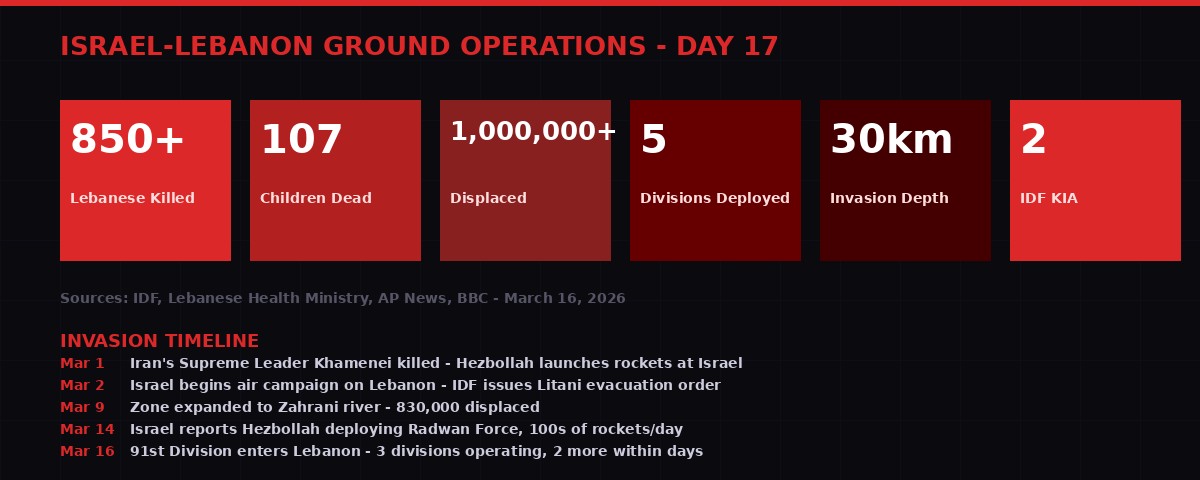
Lebanon casualty and displacement data through Day 17. Source: Lebanese Health Ministry, AP News, BBC.
IDF 91st Division enters Lebanon Monday morning - three full divisions now operating south of the Litani river, Israeli media reports two more divisions joining within days. Baghdad Green Zone hit with explosions near US Embassy. UAE ADNOC Shah oil field drone-struck. UN conducting "discreet" talks on Hormuz. Germany: "This is not our war."
The Ground Invasion Begins in Earnest
Monday morning, the Israel Defense Forces announced its 91st Division had begun "limited and targeted ground operations" against Hezbollah in southern Lebanon. By the afternoon it was clear the word "limited" was doing heavy diplomatic lifting - Israeli media reported three full divisions already operating inside the country, with two additional divisions prepared to join within days.
The IDF framed the operation as defensive - aimed at establishing a "forward defensive posture" along the northern border by dismantling Hezbollah infrastructure and eliminating fighters. But the operational scale, scope, and declared objectives told a different story. Axios reported Saturday that Israel was "aiming to seize the entire area south of the Litani river" - a stretch of Lebanese territory roughly 30 kilometers deep from the Israeli border.
"This activity is part of broader defensive efforts to establish and strengthen a forward defensive posture, which includes the dismantling of terrorist infrastructure and the elimination of terrorists operating in the area, in order to remove threats and create an additional layer of security for residents of northern Israel."
- IDF official statement, March 16, 2026 (AP)
IDF spokesman Lt. Col. Nadav Shoshani warned that Hezbollah was "intending to expand their operations" - pointing to the deployment of hundreds of fighters from the elite Radwan Force and sustained rocket fire at rates of hundreds of rounds per day as justification for the ground campaign. Israeli jets have maintained near-continuous air strikes across towns and villages in southern Lebanon, with state media reporting seven killed on Monday alone, including two paramedics.
Israeli Defense Minister Israel Katz made the objectives explicit. At a meeting with military commanders Monday, Katz warned that displaced Lebanese Shia residents "will not return to their homes south of the Litani area until the safety of residents in the north of Israel is guaranteed." That is not a defensive buffer statement - that is an annexation precondition written in plain language.
Two Israeli soldiers have been killed in southern Lebanon since operations began, according to IDF records. Lebanese authorities report 850 killed on their side, with 107 of those deaths confirmed as children. The Lebanese army, which has largely stayed out of the conflict, reports at least 1 million people displaced - the third mass displacement of Lebanon's Shia population in less than two years.
The Casualty Mathematics and Who Is Dying
Lebanon invasion data - Day 17 breakdown. Source: Lebanese Health Ministry via AP.
The 850 dead in Lebanon represent 15 days of sustained aerial bombardment before Monday's ground entry. That figure translates to roughly 56 Lebanese deaths per day over a conflict that erupted when Hezbollah launched rockets and drones into Israel after the assassination of Iran's Supreme Leader Ali Khamenei on March 1 and repeated Israeli strikes since a 2024 ceasefire ended.
Among the dead: a family of five from the village of Tammun in the occupied West Bank - not Lebanon, but indicative of the regional spread. Twelve-year-old Khaled Bani Odeh described to BBC reporters how Israeli forces shot dead his parents and two youngest brothers through their car windscreen as they returned from a family shopping trip. His brother, six-year-old Othman, was blind, disabled, and sitting on his mother's lap when he was killed.
"My mother cried out one last time before going quiet. My father recited the Shahada as he died."
- Khaled Bani Odeh, 12, to BBC Middle East correspondent, March 15, 2026
The Israeli army said its soldiers "sensed danger" when the family car "accelerated toward the forces." A nearby witness told BBC correspondents the car had come to a complete halt before any shots were fired. A New York Times account described the mother searching her bag when the shooting began. The incident is under investigation, a phrase that has appeared in IDF statements with increasing frequency as civilian deaths mount.
In Lebanon specifically, the evacuation zone has been expanded twice since the war began. On Day 3, Israel ordered all residents south of the Litani river to leave immediately. By Day 12, the zone had nearly doubled, pushing north to the Zahrani river - 40 kilometers from the Israeli border. Turkish authorities reported "approximately one million" Lebanese displaced, calling Israel's actions a threat to "Lebanon's territorial integrity and sovereignty." Turkey's embassy in London published a formal condemnation on Monday.
Hezbollah has maintained fire throughout, launching missiles and drones at the Israeli border town of Kiryat Shmona on Monday, shelling an IDF position in Lebanese Aitaroun, and firing rockets at Israeli troop concentrations in Margaliot and Yuval. Lebanese media reported direct ground clashes between Hezbollah fighters and Israeli troops around Khiam, Aadaysit Marjayoun, and Taybeh. The IDF says its troops found and dismantled weapons caches and "incitement materials" in evacuated civilian areas - a claim Hezbollah denies.
Baghdad Green Zone Hit - Explosions Near US Embassy
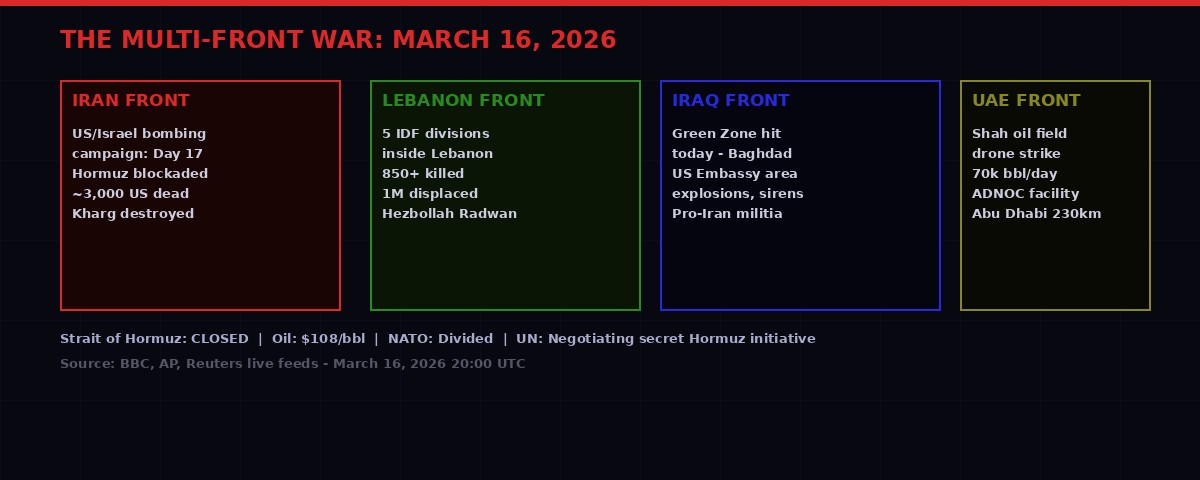
The four active fronts of the wider war as of March 16, 2026. Sources: AP, BBC, Reuters.
At the same moment Israeli divisions were moving into southern Lebanon, AFP journalists in Baghdad reported explosions in the Green Zone - the heavily fortified section of the Iraqi capital housing the US Embassy, international organizations, and Iraqi government buildings. Reuters correspondents confirmed explosions and sirens near the US Embassy compound.
The Green Zone has been targeted repeatedly since the US-Israeli campaign against Iran began on March 1. Pro-Iranian militia groups operating in Iraq, many of them affiliated with the Popular Mobilization Forces, have claimed responsibility for multiple prior attacks. Monday's explosions were not immediately attributed or claimed.
The Baghdad front is the war's most diplomatically complicated dimension. Iraqi Prime Minister Mohammed al-Sudani has condemned the US strikes on Iran while being politically unable to expel American forces under the existing Status of Forces agreement - and militarily unable to stop the pro-Iranian factions who operate with near-impunity in the areas he ostensibly controls. Iraq has become a pressure point where Iranian leverage is applied daily against US personnel and infrastructure.
American Central Command has kept details of Iraq-based incidents closely held. The KC-135 Stratotanker crash that killed six US service members last week - confirmed over the weekend when the Air Force released names including Tech Sgt. Ashley B. Pruitt, 34, of Bardstown, Kentucky - occurred in "friendly airspace" with the cause still under investigation. Six families are now in that particular category of grief reserved for those whose loved ones died in a war Congress never declared and the White House has not yet formally asked it to authorize.
UAE Oil Field Drone Strike - Energy War Escalates
In Abu Dhabi, officials confirmed a drone strike had caused a fire at the Shah oil field, located approximately 230 kilometers south of the Emirati capital. The Shah field is operated by the Abu Dhabi National Oil Company (ADNOC) and carries a production capacity of 70,000 barrels per day. No injuries were reported in early statements from the Abu Dhabi media office, and firefighting operations were underway.
The Shah field strike represents a qualitative shift in Iranian-aligned targeting. Previous drone attacks had focused on Saudi and US facilities, military installations, and shipping infrastructure. Hitting an ADNOC asset inside UAE territory - a country that has maintained careful neutrality in the Iran conflict and hosts a large Iranian-American community - sends a message to every Gulf state that is watching the war without declaring sides: there are no safe positions.
The UAE has the world's fifth-largest proven oil reserves and is a critical hub for global logistics, finance, and trade. Dubai's Jebel Ali is the busiest port in the Middle East. A sustained campaign targeting UAE energy and port infrastructure would have economic consequences that dwarf the Hormuz closure itself. Iran's message appears to be: if the Strait stays contested, nowhere in the Gulf is neutral.
The Shah oil field, located 230km south of Abu Dhabi, is a large oil project operated by ADNOC with a production capacity of 70,000 barrels of oil per day.
- Abu Dhabi Media Office statement, March 16, 2026 (BBC)
Oil markets moved sharply on the news, with Brent crude briefly exceeding $108 per barrel before settling back slightly as traders assessed whether the strike represented isolated escalation or the opening of a systematic UAE campaign. AP reported Monday that falling oil prices had sent Wall Street toward its "best day since the Iran war began" - a brief reversal that the Shah field attack complicated by end of day.
NATO Fractures Over Hormuz - "This Is Not Our War"
Trump's demand that NATO allies send warships to reopen the Strait of Hormuz has collided with a wall of European resistance so unified and blunt that it amounts to a formal rebuke from the alliance. The president indicated Monday he had asked "roughly a half-dozen countries" to contribute naval forces. Not one has committed.
Germany's Defense Minister Boris Pistorius delivered the sharpest rejection: "Germany will not participate with its military in securing the Strait of Hormuz. This is not our war. We have not started it." A government spokesman added that the Iran war "has nothing to do with NATO" - a pointed constitutional objection to Trump's framing that failure to help would be "very bad for the future of NATO."
"Nato was created as a defensive alliance. It was not an alliance that was designed for one of the allies to go on a war of choice and then oblige everybody else to follow."
- General Sir Nick Carter, former UK Chief of the Defence Staff, to BBC, March 16, 2026
The UK position is more nuanced but arrives at roughly the same place. UK Defence Secretary John Healey told the House of Commons that the Royal Air Force has conducted over 550 hours of defensive operations across five countries since the war began, shooting down drones "nearly daily." Britain now has "more jets flying in the region than at any time in the last 15 years." But Healey repeatedly used the word "multilateral" as a pre-condition for any Hormuz escort operation - meaning the UK will not act under US orders and will not act alone.
Prime Minister Keir Starmer confirmed in his Monday press conference that discussions about a "viable plan" for the strait were "ongoing" with US, European, and Gulf partners but that Britain was "not at the point of decisions yet." Trump responded by saying he was "not happy" with the UK, a formulation that has now been applied to Germany, France, Spain, and Japan in the past week.
Starmer's position is particularly delicate. Britain has HMS Middleton, its primary mine countermeasures vessel, docked in Portsmouth for major maintenance - meaning there is no British mine-clearing ship currently in the Gulf region, the first such gap in decades. The Royal Navy is instead preparing to offer newly developed seaborne drone systems designed to detect and neutralize mines without risking crews. Former Royal Navy commander Tom Sharpe told the BBC those systems have "yet to be tested in combat." The next few weeks may provide that test involuntarily.
France is described as "a maybe" on ship escorts when "circumstances permit" - diplomatic language that translates to no concrete commitment. China has been "noncommittal" despite Trump's suggestion he would pressure Beijing directly during his planned trip there. Trump's Treasury Secretary later downplayed the China-Hormuz framing, a rare moment of administration message discipline on a day with few others.
Iran's New Supreme Leader - "We Will Not Surrender to Bullies"
Mojtaba Khamenei, chosen as Iran's new Supreme Leader on March 8 following his father's assassination, has yet to appear publicly since his appointment. No photographs, no video footage, no in-person appearance of any kind. A message read by an anchor on state television on March 12 was his first communication. On Monday, he published a statement addressed to French President Emmanuel Macron.
"Iran did not begin this atrocious war. Defending against invasion is a natural right, in which we are good at. Using the American bases against Iran in the region, with the purpose of disturbing our relations with our neighbours, should be stopped. Iran will not surrender to bullies."
- Mojtaba Khamenei, statement published on social media, March 16, 2026 (BBC)
The statement's audience is not Macron. It is the Iranian domestic public, the Revolutionary Guard commanders whose institutional loyalty Mojtaba cannot fully assume without demonstrating it, and the regional proxy network that includes Hezbollah, the Iraqi PMF factions, and the Houthi forces in Yemen. Mojtaba's invisibility has raised real questions within Iran about who is actually governing. His Monday statement - published, not broadcast - is part of an ongoing legitimacy construction project conducted under conditions of active warfare and US-Israeli bombing.
The UN confirmed Monday it is conducting talks "discreetly" aimed at finding a diplomatic solution to reopen the Strait. UN Secretary General Antonio Guterres' spokesman invoked the 2022 Black Sea Grain Initiative - the deal brokered between Ukraine, Russia, and Turkey that allowed food exports to resume from Ukrainian ports - as a model. "The stakes are too high" for public speculation, the spokesperson said. EU foreign policy chief Kaja Kallas confirmed she had spoken with Guterres about a "possible UN-backed initiative." Details remain classified under operational security.
Iran has continued to permit the passage of selected vessels - primarily those carrying its own oil to allies India and China. India's Foreign Minister S. Jaishankar told the Financial Times on Monday there was "no blanket arrangement" for Indian ships to pass through the strait, suggesting even those channels require active negotiation rather than standing permission. With oil at $108 a barrel and the global economy absorbing the fourth consecutive week of restricted Gulf shipping, the pressure on all parties to find a formula is acute - but none of the available formulas are politically acceptable to all sides simultaneously.
The West Bank Dimension and Iranian Women's Soccer
The war's reach extends beyond the active conflict zones in ways that get less coverage but matter for longer-term trajectories. In the occupied West Bank, Israeli military operations have intensified under the cover of the Lebanon conflict. The Bani Odeh family killing in Tammun is not an isolated incident - it represents a sustained pattern of IDF and Border Police operations in Palestinian towns that have claimed civilian lives throughout the 17-day war period.
Simultaneously, an AP report published Monday captured the human cost on the Iranian side at a different register: a fifth member of the Iranian women's soccer team, who had been seeking asylum in Australia after defecting during an international tournament, gave up her asylum claim and agreed to return to Iran. The report did not specify the circumstances that led to the reversal. It followed reports that family members remaining in Iran had faced government pressure. Four other members of the squad remain in asylum proceedings.
The Iranian women's soccer team story is a small window into the machinery of coercion that the Islamic Republic has deployed throughout this conflict period - even as its territory is under sustained bombardment and its new Supreme Leader remains hidden from public view. The regime's capacity to pressure families of people who leave is not diminished by the war; if anything, wartime emergency conditions increase the state's license to act against perceived threats to loyalty.
What Comes Next - The War's Trajectory
The ground invasion of Lebanon is the most significant strategic escalation of the 17-day conflict. Air campaigns can be calibrated, halted, and reversed without territorial commitments. Ground operations create facts. Five IDF divisions inside Lebanese territory, with declared intent to hold the area south of the Litani until "the safety of residents in the north of Israel is guaranteed," represents an open-ended occupation of a sovereign country's southern territory.
The last time Israel attempted this - during the 2006 war with Hezbollah - a 33-day campaign killed 1,200 Lebanese and 165 Israelis and ended without decisively degrading Hezbollah. The group reconstituted and rearmed over the following 18 years. Israeli commanders argue the situation is different now - Iran's air defense capacity is degraded from US-Israeli strikes, Hezbollah's supply lines from Tehran are disrupted, and the group's long-range missile stocks are being depleted in sustained fire. Whether those advantages translate into a military outcome that justifies a second Lebanese occupation is the central question of the coming weeks.
For the Hormuz front, the timeline is brutal. Every additional week of blockade costs the global economy tens of billions in rerouted shipping, insurance premiums, and oil price effects. The UN's "discreet" diplomacy is the only visible off-ramp, but it requires Iranian concessions that the new Supreme Leader has publicly ruled out. Trump's demand that allies help reopen the strait has failed to produce commitments from any NATO member. The US Navy, powerful as it is, has no answer to a systematic mine-laying campaign combined with shore-based missile batteries and swarms of suicide drones - a combination Iran has been preparing for years.
The Baghdad Green Zone explosions add a third front where American personnel are at daily risk, in a country whose government cannot stop the attacks and will not expel the forces conducting them. The UAE drone strike adds a fourth - and potentially opens the Gulf Cooperation Council states to a systematic targeting campaign that would fracture whatever support they have quietly provided to the US-Israeli operation.
The 17th day of this war looks less like a conflict with a trajectory toward resolution and more like one that is actively widening on each of its dimensions. The Lebanese invasion, the Baghdad bombings, the UAE strike, and NATO's refusal to help with Hormuz are not separate events - they are the multiple outputs of a single escalation logic that has found no ceiling yet.
Timeline - Key Events
Get BLACKWIRE reports first.
Breaking news, investigations, and analysis - straight to your phone.
Join @blackwirenews on Telegram