Israel Strikes Central Beirut, Orders Widest South Lebanon Evacuation Since 2006
A building in the heart of Beirut is destroyed, killing at least 10 and injuring 27. Tyre city - including three Palestinian refugee camps - is ordered to evacuate. The Bekaa Valley is hit. Israel is no longer containing its Lebanon campaign to the south.

Destruction in a Lebanese urban center. The March 18 Beirut strike hit a residential building near downtown. (Pexels / illustrative)
The center of Beirut took a direct hit Wednesday. At least 10 people were killed and 27 injured when Israeli aircraft struck and destroyed a building near downtown - a neighborhood long considered outside the direct combat zone of the Israel-Hezbollah conflict in the south. Lebanon's state-run National News Agency confirmed the casualties. Israel said it targeted a building "affiliated with Hezbollah."
That justification has become a constant refrain. Every building struck is affiliated. Every neighborhood cleared is a Hezbollah stronghold. But the geography of Wednesday's strike is unmistakable: this was the heart of the Lebanese capital, not the frontline villages of the south that Israeli ground forces have been grinding through since mid-March.
The same morning, Israeli military loudspeakers and digital alerts ordered residents of Tyre - a coastal city of roughly 60,000 people and home to three Palestinian refugee camps - to leave immediately and move north of the Zahrani River. Lebanese civil defense officials described it as the broadest forced evacuation order issued in southern Lebanon since Israel's month-long war in 2006. Four additional villages were also ordered emptied.
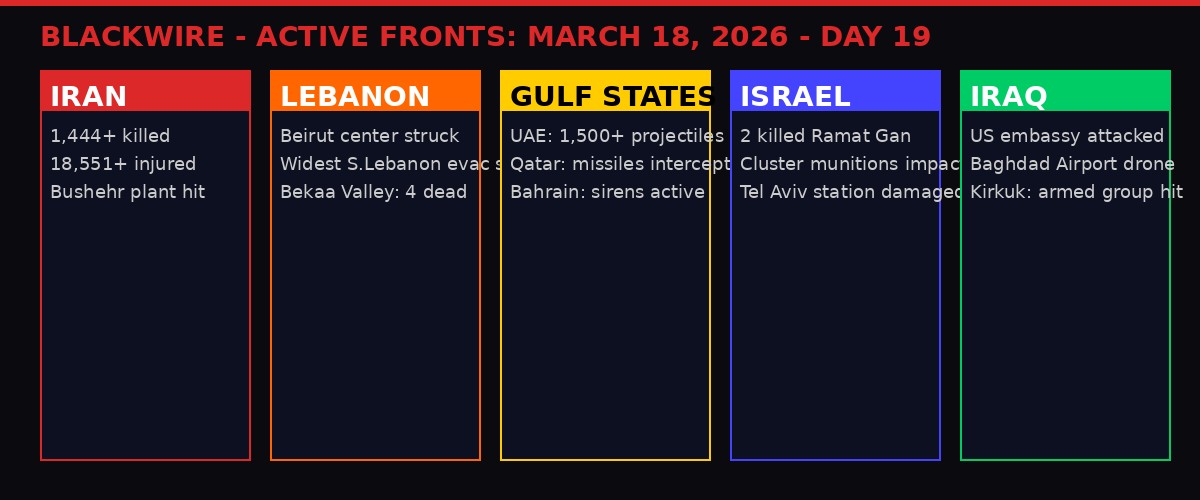
Active conflict fronts on Day 19, March 18, 2026. (BLACKWIRE infographic)
The Beirut Strike: What Happened

Urban warfare has reached central Beirut. (Pexels / illustrative)
Israeli aircraft struck a building in the Bachoura district, less than a kilometer from Beirut's commercial center and the parliament building. The strike happened in the early hours of Wednesday. By dawn, rescue crews were pulling survivors from the rubble while the death toll climbed to at least 10 with 27 injured, according to Lebanon's National News Agency.
Israel's military said the building housed "Hezbollah infrastructure." Israel's Defense Minister Israel Katz called it a precision operation. No details were released on what intelligence led to the target or whether warnings were issued before the strike.
For Beirut residents, the attack carried specific psychological weight. The 2006 war devastated the southern suburb of Dahiyeh - Hezbollah's stronghold - but largely spared the historic city center. When the November 2024 ceasefire collapsed and Hezbollah re-engaged in mid-March 2026, Israeli strikes initially concentrated on the south. Wednesday's strike changed that calculus.
"At least 10 people were killed and 27 injured, according to Lebanon's state-run National News Agency." - National News Agency Lebanon, via BBC, March 18, 2026
A parallel strike hours earlier destroyed a building in Ras Beirut - another central district. Israel described that target as Hezbollah-affiliated as well. The pattern suggests a deliberate expansion of Israel's target set inside Beirut proper, beyond the Dahiyeh and the southern belt.
Within hours, Hezbollah confirmed it had no personnel in either of the struck buildings. That claim cannot be independently verified - but it is not new. Hezbollah made the same denial during the 2006 war as Israeli strikes hit Beirut's neighborhoods. The Lebanese army, which has maintained a precarious neutrality, was not consulted on either strike according to Lebanese security officials who spoke to local media on condition of anonymity.
South Lebanon: The Widest Evacuation in Two Decades

Mass civilian displacement in Lebanese south. Over a million people have been forced from homes since fighting resumed. (Pexels / illustrative)
At dawn on Wednesday, the Israeli military issued evacuation orders for the city of Tyre and surrounding areas, instructing all residents to move north of the Zahrani River. The Zahrani lies approximately 35 kilometers south of Beirut. Everything south of it - including Tyre, the coastal villages, the Litani River zone, and the inland approaches to Nabatieh - is now being treated as a free-fire corridor by Israeli forces.
Tyre has a population of approximately 60,000 permanent residents, though the ongoing war has already displaced tens of thousands. The city also hosts three major Palestinian refugee camps: Rachidieh, El-Buss, and Burj el-Shamali. The combined population of these camps was approximately 40,000 before the war began. Those residents have nowhere simple to go - they are stateless, without passports, and many lack the means or connections to relocate north.
Lebanese civil defense officials told Al Jazeera the scope of Wednesday's order was unprecedented in the current conflict and the most sweeping since the summer 2006 war, when Israel demanded mass evacuation of the south before launching a ground assault. That war killed 1,191 Lebanese, the majority of them civilians, and displaced around one million people within the country's borders.
"The Israeli military on Wednesday ordered residents of four Lebanese villages in the country's south to leave their homes immediately and move north of the Zahrani River." - Al Jazeera correspondent, March 18, 2026
For the residents who remain in Tyre - some by choice, many by inability to leave - Israeli evacuation orders carry a specific meaning. They typically precede either intensive air bombardment or a ground advance. Given that Israeli ground forces are already operating with five divisions south of the Litani, the Wednesday order is widely interpreted as a signal that Israel intends to push further toward Tyre itself.
The UN Interim Force in Lebanon (UNIFIL) has approximately 10,500 peacekeeping troops stationed in the south under a mandate that dates back to 1978. Several UNIFIL positions have been struck by Israeli fire in the current conflict - incidents that Israel described as accidents but that drew formal protests from the contributing nations, including France, Italy, and Spain. UNIFIL has not been able to prevent the ground advance. Its mandate does not permit it to engage Israeli forces.
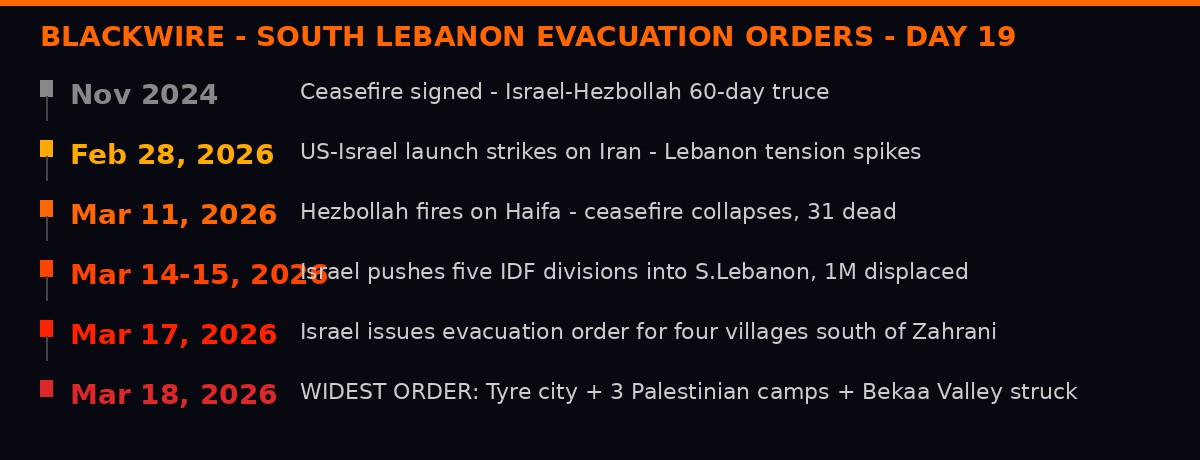
Escalation of Israeli evacuation orders in Lebanon, November 2024 to March 18, 2026. (BLACKWIRE infographic)
The Bekaa Valley: A Second Axis Opens

The Bekaa Valley is agricultural, densely populated in parts, and historically a Hezbollah stronghold. (Pexels / illustrative)
While attention focused on the Beirut strike and the Tyre evacuation, Israeli airstrikes also hit the Bekaa Valley in eastern Lebanon. Four people were killed in an attack on four houses in the town of Sahmar, according to Lebanon's National News Agency. The Bekaa Valley, a broad agricultural plain running along the Syrian border, has long served as Hezbollah's logistical backbone - an artery for weapons transfers from Syria and a base for training and arms storage.
Strikes in the Bekaa are not new. Israel has targeted the valley periodically since October 2023 when the current cycle of confrontation began. But the scope and frequency of Wednesday's Bekaa strikes - hitting four houses simultaneously in Sahmar - suggests Israel is applying pressure across multiple Lebanese axes at once rather than sequentially.
The military logic is coherent: if Israeli ground forces are advancing toward Tyre from the south while air power hammers Beirut from above and the Bekaa Valley from the east, Hezbollah's ability to regroup, resupply, and reinforce its positions is compressed simultaneously on three vectors. Whether that logic is producing the intended military result is less clear. Hezbollah has continued to fire on Israeli positions despite 19 days of sustained bombardment and the loss of key commanders.
The human cost in the Bekaa continues to mount. Local hospitals in Zahleh - the valley's largest city - have been operating beyond capacity since fighting resumed in March. The Lebanese Red Cross has warned that blood supplies are critically low. International aid organizations have been largely unable to reach parts of the Bekaa due to the security situation and destroyed road infrastructure.
The Tyre Refugee Camps: Nowhere to Go

Palestinian refugee camps in southern Lebanon have existed since 1948. They now face Israeli evacuation orders with no legal status to relocate. (Pexels / illustrative)
The three Palestinian refugee camps in Tyre - Rachidieh, El-Buss, and Burj el-Shamali - present a specific humanitarian problem that Israel's evacuation order does not address.
The residents of these camps are Palestinian refugees and their descendants, mostly from families displaced in 1948 and 1967. They hold UNRWA registration documents, not Lebanese identity papers. Lebanon has systematically denied Palestinian refugees the right to obtain Lebanese citizenship, own property outside the camps, or work in most professions - a policy successive Lebanese governments have maintained, arguing that integration would damage their claim to eventual return to historical Palestine.
In practical terms, this means that when Israel tells Tyre's Palestinian camp residents to "move north of the Zahrani River," those people have no legal status in the territory to the north, no property to move to, and often no resources to rent accommodation. UNRWA - the UN agency for Palestinian refugees - has already had its operations severely curtailed after Israel passed legislation in late 2024 restricting UNRWA's ability to operate within Israel and in Israeli-controlled areas.
UNRWA's director has appealed repeatedly to the Security Council. The response has been condolences and procedural expressions of concern. No binding resolution has been adopted because the United States has vetoed every draft that would impose restrictions on Israeli military operations.
"The Israeli military issued its widest forced evacuation order in southern Lebanon since the 2006 war. Earlier, the military told residents of the city of Tyre, including three Palestinian refugee camps, to evacuate their homes." - Al Jazeera, March 18, 2026
Human rights organizations including Amnesty International and Human Rights Watch have called the issuance of blanket evacuation orders without providing safe corridors, transport, or destination housing a violation of international humanitarian law. Israel disputes this characterization, arguing that warnings constitute legal compliance with the requirement to distinguish between combatants and civilians.
Day 19: The Full Picture - Five Fronts Burning

The Iran war has expanded far beyond its initial theater in 19 days. (Pexels / illustrative)
Lebanon is one of five active fronts burning simultaneously on Day 19 of the US-Israel war on Iran, which began on February 28, 2026. To understand why Lebanon matters, it is necessary to understand the war's full architecture.
In Iran itself, at least 1,444 people have been killed and 18,551 injured since US and Israeli strikes began, according to Iran's Ministry of Health. The Bushehr nuclear power plant was struck by a projectile on Tuesday - Iran informed the International Atomic Energy Agency there was no damage to the facility, but the strike on nuclear infrastructure is a new threshold. Israel separately confirmed it killed Iran's security chief Ali Larijani and Basij commander Gholamreza Soleimani in Tuesday strikes - and now claims to have killed intelligence minister Esmail Khatib overnight. If confirmed, Khatib's death represents a systematic decapitation of Iran's intelligence and security apparatus at a pace unprecedented in the history of covert operations.
In the Gulf, Iran has fired what Al Jazeera's correspondent in Dubai estimated at more than 3,000 projectiles - missiles and drones - at Gulf Cooperation Council states since February 28. The UAE has been hardest hit, with over half of all projectiles targeting Emirati territory. Dubai's night skies have become nightly spectacles of air defense intercept flares. Qatar has intercepted missiles. Bahrain - home to the US Fifth Fleet and British forces - has had sirens blaring. Kuwait's national guard shot down an unmanned aircraft at dawn Wednesday.
Middle Eastern oil output has fallen from 21 million barrels per day before the war to approximately 14 million barrels per day, according to Rystad Energy. The Strait of Hormuz closure - which Iran maintained for the first two weeks - has partially eased, with data suggesting Iran is allowing a growing number of commercial ships through. But the economic damage is already systemic: international insurers have suspended coverage for tankers in the Gulf, British Airways has suspended Doha flights through April 30, and the oil price shock is driving political pressure on Trump across the United States.
In Iraq, the US embassy in Baghdad has been repeatedly attacked by drone. An Iraqi armed group called Saraya Awliya al-Dam claimed responsibility for a multi-front wave of strikes against US targets. Baghdad has also moved to restart oil exports via the Kurdish pipeline to Turkey's Ceyhan port - an emergency rerouting caused by the Hormuz disruption.
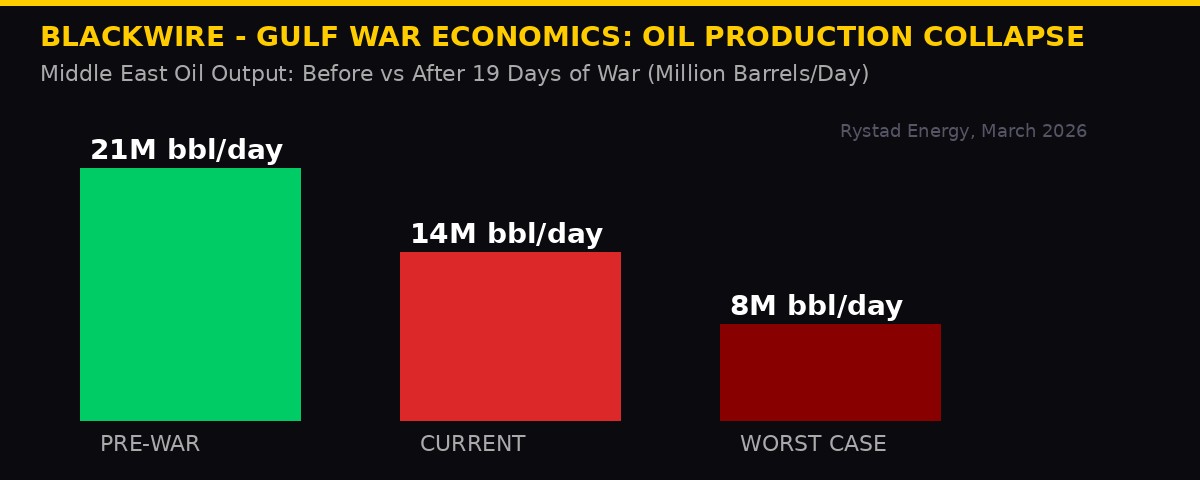
Middle East oil output before and after 19 days of war. The economic shock is spreading globally. (BLACKWIRE / Rystad Energy data)
And in Lebanon, on the war's far western edge, Israel is expanding. Central Beirut hit. Tyre ordered empty. The Bekaa Valley struck. The trajectory is unmistakable.
Timeline: Lebanon from Ceasefire to Evacuation Orders
The Diplomatic Collapse: Kent Resigns, Trump Fumes at NATO

The Trump administration's Iran war has fractured US relationships with allies. (Pexels / illustrative)
On the same day that Beirut's city center was struck and Tyre was ordered emptied, the political architecture holding the US war effort together showed new cracks.
Joe Kent, the Trump administration's top counterterrorism official, resigned. His resignation letter, portions of which circulated on social media before being confirmed by multiple US outlets, stated that "we started this war due to pressure from Israel and its powerful American lobby" and that Iran "is not a threat" to the United States. The statement from a sitting senior official was extraordinary - and politically explosive. Kent had been a close Trump ally and congressional candidate, making his break particularly significant.
Trump simultaneously lashed out at NATO allies - as well as Japan, Australia, and South Korea - for refusing to contribute military forces to the Strait of Hormuz operation. US warships have been maintaining a presence in the Gulf without the allied support Washington expected when the war began. The Hormuz situation has produced the most acute strain in transatlantic relations since the 2003 Iraq war. European leaders have declined to commit forces, arguing they were not consulted before the February 28 strikes and that the war lacks a legitimate UN mandate.
"Tensions with NATO allies: President Trump has lashed out at NATO allies, as well as Japan, Australia and South Korea, over their reluctance to offer military support in the conflict." - Al Jazeera Day 19 briefing, March 18, 2026
Canada's foreign minister said Ottawa was not consulted on the Iran war and would not join "offensive action." Saudi Arabia is hosting an emergency meeting of foreign ministers from Arab and Muslim countries in Riyadh to discuss the attacks - a gathering that reflects the profound unease among US regional partners who are simultaneously sheltering US forces, absorbing Iranian missile fire, and trying to avoid being seen as co-belligerents.
More than 200 Ukrainian military experts are now deployed across several Middle Eastern countries helping train and advise Gulf forces on counter-drone operations. President Zelenskyy confirmed the deployment on Wednesday, describing Iran and Russia as "brothers in hatred" and claiming that Iranian drones used in the Gulf contain Russian components. Ukraine's motivation is transparent: it is trying to demonstrate value to the United States at a moment when US attention and resources are concentrated on the Middle East rather than Kyiv.
What Comes Next: The Tyre Calculation

Israeli ground forces have advanced rapidly in southern Lebanon. The Tyre evacuation order suggests further advance is imminent. (Pexels / illustrative)
Military analysts following the Lebanon campaign read Wednesday's evacuaton order as a precursor to either a direct ground assault on Tyre or a sustained air campaign targeting the city's infrastructure and Hezbollah's remaining southern command nodes.
Tyre is symbolic as well as strategic. It is Lebanon's fourth largest city, an ancient Phoenician port that UNESCO designated a World Heritage Site. Its old city is built on a promontory into the Mediterranean and connected to the mainland by a narrow isthmus. The terrain makes ground assault difficult and defense viable - lessons Hezbollah's military planners have had decades to study.
But Hezbollah's southern command structure has taken severe punishment over 19 days. Key field commanders have been killed. Supply lines from Syria through the Bekaa have been repeatedly struck. And the organization is simultaneously trying to support Iran's missile operations against the Gulf states, absorb Israeli ground pressure in the south, and manage the political fallout from Lebanon's civilian government - which has broken from Hezbollah's strategy openly and pointedly.
The broader question is whether Israel's Lebanon campaign can be separated from the Iran war or whether it is inexorably linked. Israel's stated objective when it re-engaged in Lebanon was to "permanently remove the Hezbollah threat from Israel's northern border." That objective has not changed since 2006. Whether 19 days of war - and whatever comes after - can achieve what decades of occupation and two previous wars could not is the question Israel's defense establishment is not publicly answering.
What is visible on the ground: Central Beirut is burning. Tyre has been ordered empty. The Bekaa Valley is under bombs. On Day 19, the Lebanon front has expanded to dimensions unseen since 2006. Where it stops - if it stops - nobody in the region knows.
Get BLACKWIRE reports first.
Breaking news, investigations, and analysis - straight to your phone.
Join @blackwirenews on TelegramSources: Al Jazeera Day 19 explainer (March 18, 2026); Al Jazeera Iran missile-drones Gulf coverage (March 18, 2026); Al Jazeera Iran cluster missile strike Israel (March 18, 2026); BBC Middle East live updates (March 18, 2026); AP News Iran war front page (March 18, 2026); Lebanon National News Agency (via BBC); Rystad Energy oil output data (via Al Jazeera); Israel Defense Ministry statements (via Al Jazeera); IRGC statement on Larijani revenge attack.