IS's Africa Command: Inside Somalia's Forgotten War
While the world tracks the Iran war and Gulf missile strikes, another conflict has been grinding forward in silence. In the jagged mountains of northeast Somalia, Islamic State has spent a decade converting a remote corner of the Horn of Africa into the logistical spine of its global network - and a US-backed campaign to dismantle it is finally showing results, at a cost measured in blood and atrocity.

Remote mountain terrain typical of Puntland's al-Miskad range, where IS-Somalia maintains cave positions and forward bases. - Image: Unsplash
In the al-Miskad mountains of Puntland, northeast Somalia, soldiers from the Puntland Defence Forces cluster around a small screen watching a drone feed. A figure moves through a valley, crosses toward a cave. Intelligence suggests 50 to 60 Islamic State fighters are sheltered inside. This is what the end of the IS caliphate looks like in 2026 - not the shattered cities of Raqqa or Mosul, but a barren African mountain range, manned by recruits from Ethiopia, Morocco, Syria, Turkey, and Pakistan, fighting under a flag born in the deserts of Iraq.
The story of IS-Somalia is the story of IS's survival strategy after its territorial collapse in the Middle East. When the caliphate crumbled between 2017 and 2019, the organization did not die. It dispersed. And nowhere did it take deeper root than in the semi-autonomous region of Puntland, where a British-Somali national named Abdulqadir Mumin had already spent years building a foundation away from al-Shabab's shadow. (BBC, March 2026)
By April 2025, the picture had grown alarming enough that US Army General Michael Langley, then commander of United States Africa Command (Africom), told the US Congress directly: "ISIS controls their global network from Somalia." (AP, Africom congressional testimony, April 2025)
That statement - delivered to lawmakers in Washington while the public debated Gaza, Ukraine, and tariff wars - defines the stakes. The mountains of northeast Somalia are not a sideshow. They are, according to the top American commander for the African continent, the operational headquarters of the world's most persistent jihadist organization.
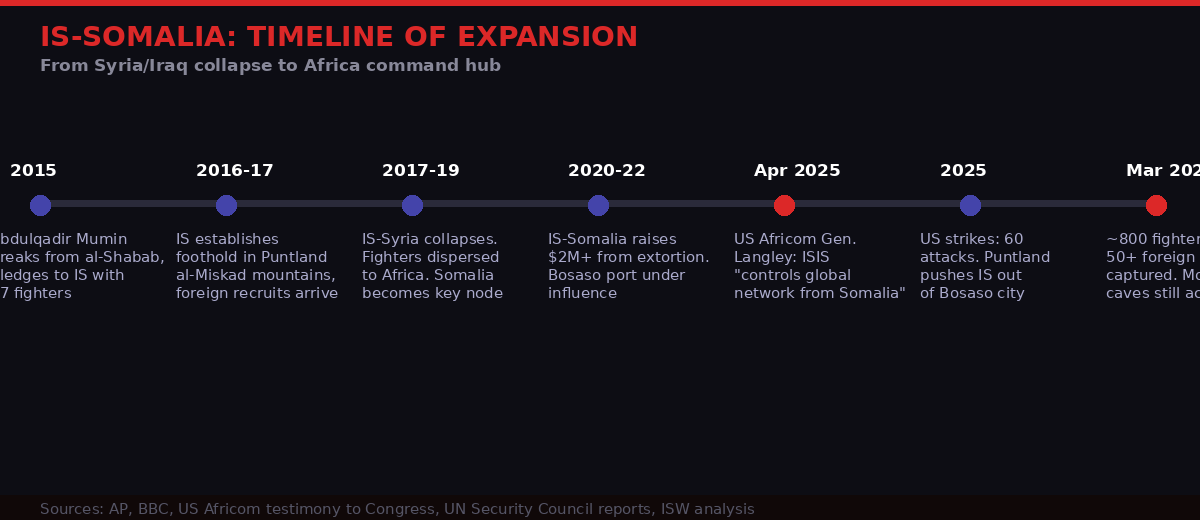
IS-Somalia: Timeline of expansion from 2015 to the present day. Sources: AP, BBC, Africom, UN Security Council.
From Sweden to the Caliphate: The Making of IS-Somalia
Abdulqadir Mumin is not the profile anyone expected. Before he became the founder of IS in Somalia, he lived in Sweden and the United Kingdom, held British citizenship, and operated within European Islamist networks. His trajectory from European resident to African jihadist commander mirrors that of dozens of foreign fighters who cycled through Western countries before heading to conflict zones - but Mumin went further than most.
In 2015, he appeared in a video alongside 17 other men, publicly pledging allegiance to Abu Bakr al-Baghdadi and the Islamic State. He had previously been a member of al-Shabab, the al-Qaeda affiliate that has been fighting Somalia's government for two decades. Mumin's break from al-Shabab was not ideological softening - it was a power play. He believed IS, then at the peak of its global expansion, represented the more potent brand. (BBC reporting on IS-Somalia, March 2026)
Mumin and his initial group of fighters moved into Puntland's mountainous northeast, establishing a presence in the al-Miskad range. The terrain is ideal for insurgency: barren, remote, inhospitable, with cave systems that provide natural shelter and hiding places that are difficult to surveil. The population is sparse, consisting mostly of nomadic communities who had little political capital to push back against armed groups.
Over the following years, Mumin's organization did something the IS franchise in Syria and Iraq could not sustain - it built a revenue base that did not depend on territorial control alone. According to a US Treasury report from 2022, IS-Somalia "raised $2 million from extortion payments from local businesses, imports, livestock, and agriculture" in that year alone. The group also gained influence in the port city of Bosaso, leveraging its position at the junction between land trade routes and the Gulf of Aden shipping lane. (US Treasury Department, 2022; BBC, March 2026)
"IS-Somalia still plays a critical role in terms of providing resources, support, and facilitation for other Islamic State affiliates, both in Africa and further afield, like Afghanistan." - Tricia Bacon, Director, Policy Anti-Terrorism Hub, American University (BBC, March 2026)
The recruitment pipeline proved particularly robust. As IS lost ground in Syria and Iraq, fighters dispersed globally, and the Horn of Africa offered a destination that was difficult to monitor, had permeable borders, and lacked the kind of intelligence infrastructure present in the Middle East. By June 2025, UN estimates put IS-Somalia's total strength at up to 800 fighters - more than half of them foreign nationals. (UN Security Council report, June 2025)
How a Terrorist Hub Works: Extortion, Ports, and Mountains
To understand why IS chose Somalia, you need to understand what a jihadist organization needs to survive beyond its territorial peak. It needs money, recruits, logistics, and a place to operate without constant state suppression. Puntland, the semi-autonomous region in Somalia's northeast, offered all four.
Money flowed through Bosaso, the region's main port city. IS imposed informal taxes on businesses operating in and around areas under its influence. Import merchants, livestock traders, farmers selling to markets - all faced demands. Compliance was enforced with violence. Refusal meant kidnapping, death, or the destruction of property. The $2 million annual figure from the 2022 Treasury report is almost certainly an underestimate, given the difficulty of tracking informal extortion in a region with limited financial infrastructure.
Recruits came through multiple channels. Some were radicalized online and made their way to Somalia via Kenya, Ethiopia, or by sea from Yemen. Others came from within East Africa's Somali diaspora communities. The foreign fighter contingent - confirmed nationalities including Ethiopian, Moroccan, Syrian, Turkish - suggests IS-Somalia maintained active recruitment networks across North and East Africa and the broader Islamic world. The Puntland Defence Forces have released images of more than 50 captured foreign fighters since sustained operations began in 2024. (BBC on-ground reporting, March 2026; Puntland Defence Forces statements)
The mountains provided the base. In the al-Miskad range, IS fighters live in and around cave systems. They move on foot, use camels to transport weapons and supplies, and rely on a network of local informants and intimidated villagers for early warning of military operations. The terrain makes vehicle-mounted operations nearly impossible and limits the effectiveness of ground-based intelligence collection.
This is precisely why American drone support became central to the counter-IS campaign. In 2025, the Pentagon carried out 60 airstrikes targeting IS-Somalia positions - an operational tempo equivalent to one strike every six days. The US does not publicize most of these operations, and they receive virtually no media coverage compared to operations in the Middle East or Ukraine. (BBC, citing Pentagon data, March 2026)
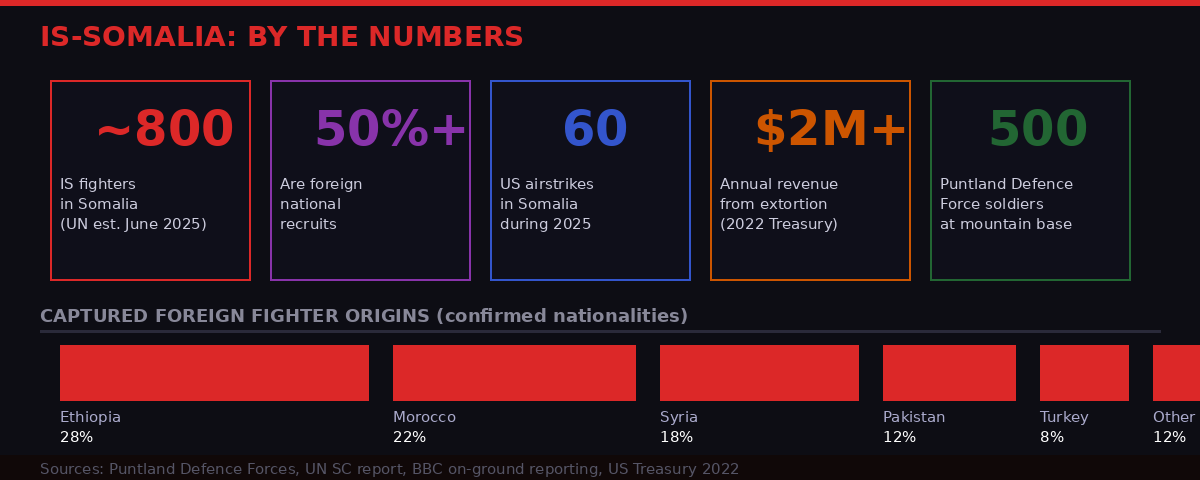
IS-Somalia by the numbers: estimated fighters, revenue, US strikes, and confirmed foreign fighter nationalities. Sources: UN SC, US Treasury, Puntland Defence Forces, BBC.
What IS Did to the Villages
Numbers and geopolitics exist at a remove from what it meant to live under IS rule in Puntland's small communities. The village of Dardar, home to about 600 people, spent years under IS control before the Puntland Defence Force retook it in February 2025. What happened there is documented through survivor testimony, and it is not exceptional - it is the standard model of IS governance wherever the group has established control, applied in an African context.
Rules were written on a blackboard in a nearby village. Men could not wear long trousers below their ankles. Stylish haircuts were prohibited. Men and women could not mix in public spaces. Women had to wear a specific type of hijab, along with gloves and socks covering their hands and ankles. Music was forbidden entirely. The local imam, Said Mohamud Ibrahim, was expelled from his own mosque. "They said: 'We are the imam now. And if you do not follow our instructions and leave the mosque right now, you will get what you deserve.' I understood that to mean they would either behead me or kidnap me," he told the BBC. (BBC, March 2026)
People disappeared. Mahad Jama, a resident of Dardar, lost his niece Shukri two years ago. She was pregnant when IS fighters came to her home. She was killed. Her seven-year-old son, Said - who was deaf and rarely left his mother's side - was with her that night. He was killed too. Jama lowered his head when he described it to the BBC's team on the ground. "You can't imagine what it feels like to lose your niece... and not even know why she was killed."
These are not exceptional cases. They are the documented pattern of IS rule in every territory the organization has controlled - Raqqa, Mosul, Sinjar, now Dardar. The brand of violence is consistent across continents and decades. What changes is the geography and the people on the receiving end of it.
"Life became very difficult. People were afraid. Some were kidnapped and are still missing." - Said Mohamud Ibrahim, local imam, Dardar village, Puntland (BBC, March 2026)
The psychic damage runs alongside the physical. Communities that spent years under IS governance carry trauma that doesn't disappear when the group is pushed back into the mountains. Rebuilding civil society - re-establishing education, restoring gender mixing in public life, allowing music - takes years after IS leaves. In some villages, it hasn't started yet, because IS hasn't left.
The Ground Campaign: Puntland Forces, US Drones, and What's Been Taken Back
The campaign against IS-Somalia is a coalition of necessity. On the ground, the Puntland Defence Forces - roughly 500 soldiers deployed to the mountain base documented by the BBC - carry the weight of close-quarters fighting. They use drones for intelligence gathering, camels for logistics in terrain where trucks cannot go, and infantry for the final assaults on IS positions. The fighting is dangerous and the pace is grinding.
The US role is primarily aerial. Africom's 60 strikes in 2025 targeted specific IS positions, commanders, and logistics nodes. American intelligence assets provide the Puntland forces with surveillance data that their own drone capacity cannot match. The partnership is not publicly acknowledged in detail by either party, and the operational specifics - which strikes were conducted by whom, under what authorities - are largely classified.
In May 2024, US strikes killed three IS militants in the area near Dardar, contributing to conditions that allowed the Puntland forces to retake the village several months later in February 2025. The broader push against IS's presence in Bosaso succeeded in the first months of 2025: the group was pushed out of the port city, a significant setback for its revenue base and logistics. (BBC, March 2026; Puntland Defence Forces statements)
But the mountains remain IS territory. The cave positions in the al-Miskad range have not been cleared. Soldiers at the mountain base described an imminent clash as the BBC team visited - machine guns were loaded, heavy weapons and supplies secured to camels, and infantry streamed out of the base in small groups toward IS positions. The fighting is ongoing. It is not on the news. It is happening anyway.
Puntland authorities say captured IS fighters face trial and, in some cases, the death penalty. Human Rights Watch has previously raised concerns about due process for detainees accused of membership in Islamist armed groups. A UN report from 2022 noted Somalia was working on "ensuring those held in custody for questioning was done in a coordinated manner so that the rights of detainees were upheld" - bureaucratic language covering what are, in practice, improvised detention facilities in a region with minimal judicial infrastructure. (Human Rights Watch; UN Security Council, 2022)
Among the soldiers fighting IS are women. Muna Ali Dahir, 32, is one of a small number of female officers in the Puntland Defence Forces. She has fought in previous engagements. "We fought hard and won - because this is our land," she said. The contrast with the IS fighters they are pursuing - who enforced strict gender segregation and covered women head to toe - is total and deliberate. (BBC, March 2026)
IS's Global Network: Why Puntland Matters Beyond Africa
The question that matters most - beyond the immediate humanitarian tragedy in Puntland - is what IS-Somalia's survival means for global security. General Langley's congressional testimony was specific: the group does not just operate locally, it coordinates globally.
Tricia Bacon of American University's Policy Anti-Terrorism Hub explained the structure in detail to the BBC: IS-Somalia "plays a critical role in terms of providing resources, support, and facilitation for other Islamic State affiliates, both in Africa and further afield, like Afghanistan." This means money, communications, logistics, travel facilitation, and potentially planning support for operations conducted by IS affiliates across the African continent and into Central Asia.
The IS affiliate network in Africa is extensive. IS-West Africa Province operates across the Lake Chad Basin, spreading into Burkina Faso and beyond. IS-Mozambique has conducted attacks in northern Mozambique and has links to the broader East African network. IS-Democratic Republic of Congo - known as the Allied Democratic Forces - has conducted some of the most lethal attacks in the country's history. All of these groups exist within an organizational architecture that, according to US military commanders, routes through Somalia. (Africom; BBC analysis; ISW assessments)
The financial flows are particularly concerning. Puntland's IS organization demonstrated in 2022 that it could generate $2 million annually through relatively localized extortion. As IS lost revenue from oil fields and taxation in Syria and Iraq, the need for African affiliates to generate and transfer funds increased. Somalia, with its hawala money transfer networks that operate outside formal banking, its porous borders, and its established Somali diaspora globally, is near-ideal as a financial node.
There is also the question of external attack planning. The 2015-2017 period of IS territorial expansion produced a wave of external attack facilitation - Brussels, Paris, Manchester, Nice, Berlin - as the caliphate used its administrative structure to move people and resources into Europe. Analysts debate whether IS-Somalia has the same capacity, but the infrastructure - foreign fighters who know European cities, established travel routes through East Africa to the Horn, and online radicalization pipelines - exists in principle.
"He who controls Kharg Island, controls the destiny of this war." US Senator Lindsey Graham said that about Iran. Nobody has said the equivalent about Puntland and IS. They should. - BLACKWIRE editorial observation
The Wider Context: IS in Africa and the Attention Gap
The Somalia campaign exists within a larger and largely unnoticed war across the African continent. The Sahel - the vast band of semi-arid land stretching from Senegal to Sudan - has been engulfed by jihadist violence for over a decade. Burkina Faso, Mali, and Niger have all experienced military coups in recent years, partly driven by the failure of civilian governments to contain the violence. France withdrew its military presence from several of these countries after years of counterterrorism operations failed to produce stability. The US has maintained a smaller footprint across the region, centered on drone operations and special forces advising. (Reuters, multiple dates 2023-2025; Africom statements)
The coverage gap between the Iran war - which commands live blogs and front pages - and the Africa conflicts is stark and has consequences. Western publics have little context for understanding why these distant conflicts matter to their own security. The political pressure to maintain the expensive, casualty-accepting operations required to degrade IS-Somalia is weak when no one is watching.
The 60 American airstrikes against IS in Somalia during 2025 cost money, require ongoing ISR (intelligence, surveillance, and reconnaissance) assets, and create legal and diplomatic obligations. Every strike requires legal authorization under the 2001 Authorization for Use of Military Force - a post-9/11 document that US courts have repeatedly stretched to cover operations its original authors never contemplated. These are not trivial legal questions, but they are discussed almost entirely within specialist policy circles invisible to the general public.
Meanwhile, the Puntland Defence Force soldiers carrying machine guns into mountain valleys earn modest wages and face injuries that will not be treated in world-class medical facilities. 24-year-old Abdikhair Abdiriza Jama, who showed the BBC reporters a photo of himself helping capture a Turkish IS fighter, was 14 when IS first arrived in his region. He did not believe the stories at first. "When I held one of them, I realized that foreign fighters were attacking our country," he said. "We won't stop until the last fighter is captured." (BBC, March 2026)
That resolve is genuine. Whether it is sufficient - without sustained international support, without continued US drone operations, without the political will in Mogadishu to invest in Puntland's security - remains the open question.
Timeline: IS-Somalia's Decade of Expansion
Key Events
What Comes Next: Degraded But Not Defeated
The current assessment from US and independent analysts is precise in its language: IS-Somalia's ability to "stage attacks in Somalia has been degraded" and it "does not pose a significant threat to Puntland or Somalia today." (Tricia Bacon, American University, BBC, March 2026) The distinction matters. Locally degraded does not mean globally neutralized.
The group retains its mountain positions. It retains some portion of its revenue networks, even after losing Bosaso. It retains its foreign fighter recruitment channels. And critically, it retains whatever role it plays in the IS global network's financial flows and communications - the functions that, per Africom's testimony, are being run from Somalia.
The path to genuine defeat requires several things that are not guaranteed. It requires sustained Puntland Defence Force operations that can clear the mountain cave positions - something that will take months more of dangerous, slow-moving infantry combat. It requires continued US drone and intelligence support, which depends on political will in Washington that is currently absorbed almost entirely by the Iran war and Hormuz crisis. It requires development assistance to give communities like Dardar economic alternatives to whatever residual IS influence remains.
It also requires something harder to manufacture: attention. The Iran war is real and consequential and demands coverage. But so is this. The IS global network ran on attention deficit for years before the Raqqa caliphate made it impossible to ignore. By the time Western governments mobilized seriously against it, the organization had planted roots across Africa that are now, a decade later, still being dug out one cave at a time.
The soldiers at the Puntland mountain base watching that drone feed - tracking a single IS fighter carrying water back to his friends in a cave - are doing the kind of patient, anonymous, dangerous work that defines most real counterterrorism. There are no headlines for it. The war goes on.
Sources: BBC News (Sahnun Ahmed and Scarlett Barter, March 2026, embedded with Puntland Defence Forces); AP News (Africom, Pentagon data); US Treasury Department (2022 IS-Somalia report); UN Security Council (June 2025 IS Somalia estimate); Human Rights Watch (Puntland detention concerns); Africom congressional testimony, Gen. Michael Langley, April 2025; Institute for the Study of War (ISW) Africa assessments; Tricia Bacon, Policy Anti-Terrorism Hub, American University.
Get BLACKWIRE reports first.
Breaking news, investigations, and analysis - straight to your phone.
Join @blackwirenews on Telegram