Baghdad Burning: U.S. Embassy Hit, Military Plane Down as Iran War Cascades Into Iraq
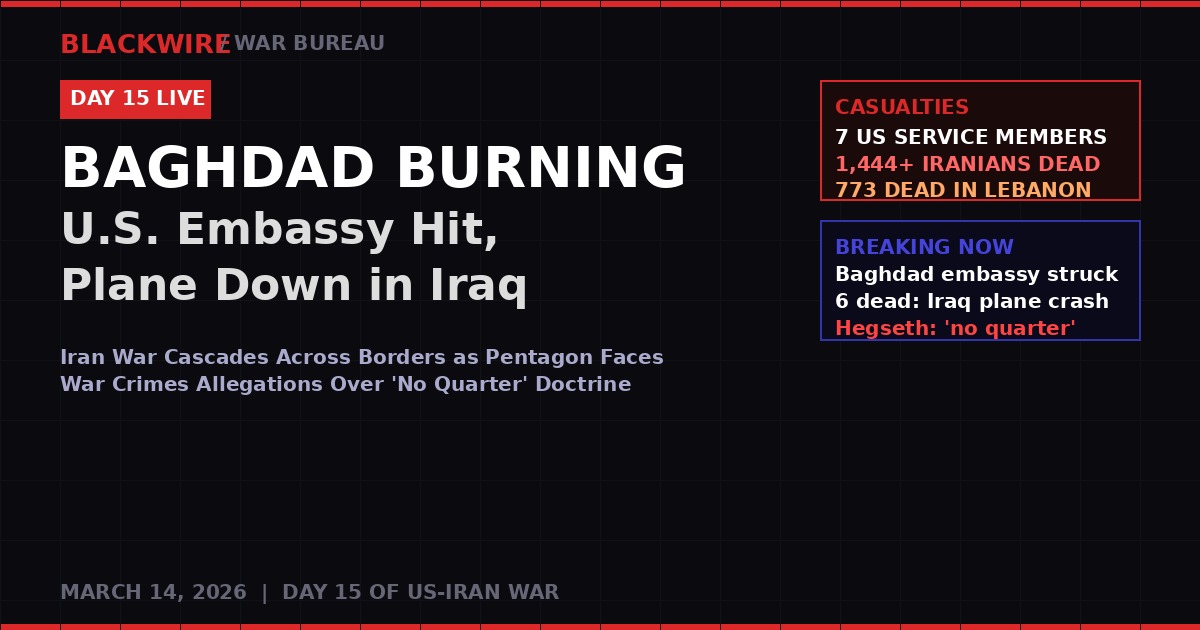
U.S. Embassy in Baghdad struck by Iranian-linked militia forces. Six U.S. military crew members confirmed dead after aircraft crash in Iraq. Pentagon Secretary Pete Hegseth's "no quarter, no mercy" declaration drawing formal war crimes accusations from international law experts. All developing simultaneously on the morning of March 14.
The war just got wider. In the space of a few hours on Saturday morning, the U.S.-Iran conflict - already bleeding into Lebanon, Qatar, Norway, and the Arabian Gulf - punched through a new threshold. The U.S. Embassy in Baghdad, sitting behind blast walls and checkpoints in the most hardened diplomatic compound in the world, was struck. A U.S. military aircraft went down in Iraq. The Pentagon's death toll climbed to at least seven service members. And before any of that had happened, Defense Secretary Pete Hegseth had publicly declared that the United States would give Iran "no quarter, no mercy" - language that international law scholars say constitutes a war crime in itself.
Day 15 of what the Trump administration calls "Operation Epic Fury" has crossed lines that the previous fourteen days, for all their brutality, had not. Iraq - a country the U.S. spent two decades and $2 trillion trying to stabilize - is now a live theater. The war's geometry is no longer manageable. It's fracturing.
The Baghdad Strike: America's Diplomatic Fortress Under Fire
The U.S. Embassy in Baghdad is not just a building. It is the largest American embassy on earth - a 104-acre compound constructed after the fall of Saddam Hussein at a cost of over $700 million, specifically designed to be impervious to the kind of attacks that had plagued U.S. facilities across the region for decades. Blast walls, anti-rocket systems, its own power generators, its own water supply. It was built to survive. On Saturday morning, it was hit anyway.
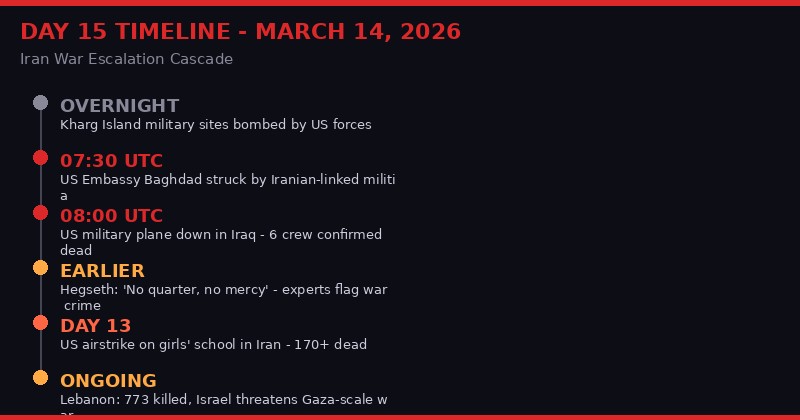
According to reports confirmed by BBC and Al Jazeera, a strike - attributed to Iranian-backed militia groups operating in Iraq - hit the embassy compound in the early hours of March 14. The exact nature of the strike, casualty figures inside the compound, and which specific group claimed responsibility were still being confirmed as of publication. The Iraqi government, caught in an impossible position between its treaty obligations to Washington and its deep political ties to Tehran, had not issued a formal statement by the time this report was filed.
The significance of the Baghdad strike extends far beyond the physical damage. Since the U.S. launched its campaign against Iran on February 28, Iraq's powerful Iran-aligned militias - the Popular Mobilization Forces, including groups like Kataib Hezbollah and Kataib Sayyid al-Shuhada - had issued mounting threats but largely held back from direct action on U.S. soil. That calculus appears to have changed overnight.
The Green Zone, where the embassy sits, was the symbolic center of U.S. authority in post-invasion Iraq. Attacking it sends a message that cannot be spun as anything less than deliberate escalation. Pro-Iranian forces in Iraq are not drawing down. They are mobilizing.
For the Iraqi government of Prime Minister Mohammed Shia al-Sudani, the situation is acutely dangerous. Iraq has deep economic, political, and security ties to both Washington and Tehran. Any formal identification of the attackers as Iraqi-based militia forces will force Baghdad into a corner: condemn and risk civil unrest from PMF-aligned political factions, or equivocate and risk U.S. retaliation. Neither option is survivable in the traditional political sense. Iraq is, once again, the ground on which other powers fight.
Six Dead: The Military Plane Crash That Silence Cannot Explain
Before dawn over Iraq, a U.S. military aircraft went down. All six crew members aboard were confirmed dead, according to a report from The Guardian citing U.S. military sources. The details - aircraft type, precise location, whether the crash was the result of hostile fire or mechanical failure - were withheld pending notification of next of kin and an ongoing military investigation.
But the context makes silence on the cause untenable. This is the same Iraqi airspace where Iranian-backed forces have been steadily increasing surface-to-air capabilities since the war began. The same corridors where U.S. assets have been operating in close coordination with the broader campaign against Iran. The same region where, as of this writing, the U.S. Embassy had just been struck. A coincidence of timing? Possibly. But that explanation demands an extraordinary amount of credulity.
The Pentagon's official death toll now stands at seven confirmed U.S. service members killed since the war began on February 28 - though independent analysts monitoring military casualty disclosures suggest the real figure may be significantly higher, particularly given the pace and intensity of operations over the past week. The AP reported Friday that the seventh casualty had been identified, and the six from the Iraq crash would bring the acknowledged total to thirteen if confirmed as war-related.
The human cost to the U.S. military, however grim, is dwarfed by what is happening on the other side. Iran has lost at least 1,444 people killed since the war began, according to Iranian health ministry figures reported by Al Jazeera - a figure that international observers believe is substantially underreported given the communication blackouts in struck regions. Among the dead: the more than 170 children killed when a U.S. airstrike hit a girls' school in southern Iran, a strike that Hegseth's Pentagon defended as targeting a "dual-use military facility" despite mounting evidence and international outcry to the contrary.
The families of the six dead crew members in Iraq will receive the visit every military family dreads. They died in a war that, as of Friday, even senior Republican senators were questioning the legal basis for. Their deaths are not an abstraction. They are the receipt for choices made in Washington.
'No Quarter, No Mercy': The War Crime at the Podium
On Friday, Pete Hegseth stood before cameras and said something that international law has prohibited for more than a century.
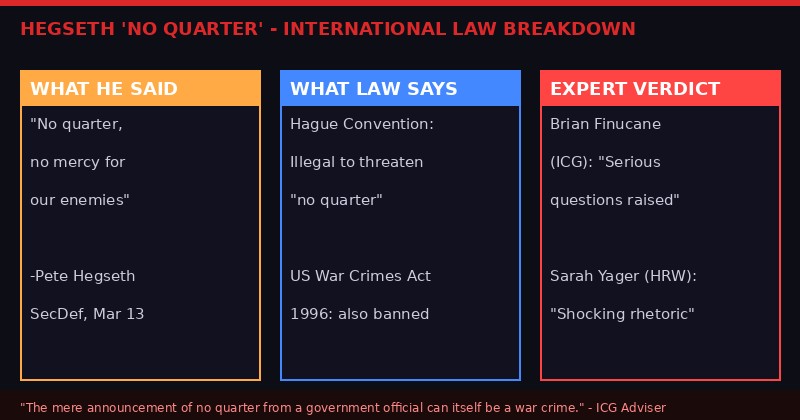
"We will keep pressing. We will keep pushing, keep advancing. No quarter, no mercy for our enemies."
- Pete Hegseth, U.S. Secretary of Defense, March 13, 2026
The legal problem with this statement is not a matter of interpretation. The prohibition against declaring "no quarter" - meaning no surrender will be accepted, no prisoners taken - is codified in the Hague Convention, in the Geneva Conventions, in the U.S. military's own field manuals, and in the 1996 War Crimes Act passed by a Republican-led Congress. The Nuremberg tribunal prosecuted Nazi officials specifically for this offense. It is not a gray area.
Brian Finucane, a senior adviser at the International Crisis Group who previously served in the U.S. State Department's Bureau of Political-Military Affairs, told Al Jazeera the implications were stark.
"These comments are very striking. It raises questions about whether this belligerent, lawless rhetoric is being translated into how the war is being conducted on the battlefield."
- Brian Finucane, International Crisis Group
Finucane went further, noting that "the mere announcement of 'no quarter' from a government official can itself be a war crime" under existing treaty obligations and domestic U.S. law. The prohibition exists precisely because history demonstrated what happens when soldiers are told in advance that taking prisoners is not the goal: civilians die, wounded combatants are executed, and the spiral of atrocity accelerates until it consumes everything.
Sarah Yager, Washington director at Human Rights Watch, said the rhetoric was unlike anything she had encountered in two decades of engaging with the U.S. military establishment.
"I've been engaging with the U.S. military for two decades, and I'm shocked by this language. Rhetoric from senior leaders matters because it helps shape the command environment in which U.S. forces operate. From an atrocity-prevention perspective, language that dismisses legal restraints is a serious red flag."
- Sarah Yager, Human Rights Watch Washington Director
Hegseth's response to such criticism has been consistent and publicly combative. He has said he will abide no "stupid rules of engagement" and no "politically correct wars." On March 4, he told a Pentagon briefing: "Death and destruction from the sky all day long. We're playing for keeps. Our warfighters have maximum authorities granted personally by the president and yours truly." The president himself has amplified this posture, calling Iranian leaders "deranged scumbags" in public statements and repeatedly framing the campaign as one of maximum lethality rather than calibrated deterrence.
The pattern extends beyond rhetoric. The sinking of the IRIS Dena - an Iranian naval vessel returning from a ceremonial exercise in India, carrying at least 84 sailors, reportedly not fully armed - prompted questions from legal experts about whether interdiction rather than destruction was feasible. Hegseth's description of the sinking as a "quiet death" did not ease those concerns. The failure of U.S. forces to assist in rescuing shipwrecked sailors, a requirement under the Geneva Convention, has been flagged by multiple human rights organizations as a potential violation.
The cumulative picture being assembled by organizations including Human Rights Watch, Amnesty International, and the International Crisis Group is one of systematic disregard for the laws of armed conflict - not the isolated failures that occur in every war, but a top-down permissive culture emanating from the Secretary of Defense himself. That picture is going to follow this administration into every court, every international forum, and every future negotiation for years.
Day 15 Battlefield: Kharg Island, Tehran, Lebanon, the Strait
Zoom out from the Baghdad embassy and the Iraq crash, and the broader battlefield picture on Day 15 is no less grim.
The dominant military action overnight was the U.S. strike on Kharg Island - Iran's primary oil export hub, sitting in the northern Persian Gulf. According to Trump's own statements, "military targets" on the island were "obliterated." The White House and Pentagon were careful to specify that oil infrastructure itself was not the primary target - a distinction that carries enormous weight given that approximately 90 percent of Iran's oil exports pass through Kharg. Striking the island's military facilities while warning that the oil terminal itself could be next is a form of coercive signaling: we can turn off your revenue entirely if you don't stand down.
Iran's response was immediate and direct. Iranian officials threatened to reduce "U.S.-linked oil facilities to a pile of ashes" if the oil structures on Kharg are attacked. This is not empty rhetoric from a defeated adversary. Iran retains significant capacity to disrupt Gulf shipping, to attack regional oil infrastructure in Saudi Arabia and the UAE, and to threaten the Strait of Hormuz - through which roughly 20 percent of the world's oil supply transits daily. Oil markets have already absorbed the early shock of this war. A direct attack on Gulf energy infrastructure would send prices to levels not seen since the 1970s.
Meanwhile, intense strikes continued targeting central Tehran overnight, according to Al Jazeera's live war updates. The character of the strikes - sustained, targeting military and government infrastructure across the capital - suggests the campaign has moved beyond the initial decapitation and deterrence phase into something closer to systemic dismantlement of Iranian state capacity. Tehran's air defenses, degraded substantially in the first week of the war, are no longer providing the coverage they once did.
Lebanon is deteriorating rapidly. According to Al Jazeera reporting through Friday, Israel's military campaign there has killed 773 people since early March and displaced hundreds of thousands more. Israeli military spokespersons have begun using language about Lebanon that they previously reserved for Gaza - including warnings that civilian areas sheltering Hezbollah infrastructure face "Gaza-level" consequences. Hezbollah has publicly vowed what it calls an "existential" fight, meaning the organization views the current campaign as an attempt to permanently destroy it. That framing leads to different tactical and strategic choices than a conventional deterrence calculation.
Iran's New Leadership: The Khamenei Problem
Since the death of Ali Khamenei and the installation of his son Mojtaba Khamenei as Iran's new Supreme Leader, the regime's communications have become notably strange. When Mojtaba made his first formal address after assuming the position, it arrived not as a direct broadcast but through a presenter reading his words on state television. BBC reporting from inside Iran found ordinary Iranians questioning whether the statement was even authentically his - "I don't even think it was his message," one Iranian told BBC reporters.
The peculiarity of that communication is significant. A supreme leader whose first major statement comes through a television presenter rather than in person, under conditions of sustained bombardment and questioned legitimacy, is a leader navigating a very narrow corridor between appearing strong enough to maintain authority and being visible enough to become a target. Hegseth himself claimed on March 13 that the new supreme leader had been injured in a U.S. or Israeli strike - a claim Iran denied but that injected further uncertainty into the succession picture.
Iran's president, meanwhile, has been considerably more vocal. He has publicly rejected any notion of unconditional surrender - "they should take that dream to their grave," he said in remarks reported by AP - and has set specific terms for ending the war: reparations and a guarantee against future attacks. Those terms are non-starters for Washington. The Trump administration has shown no interest in a negotiated settlement that leaves the Iranian government intact.
What this creates is a dynamic in which neither side has a visible off-ramp. Iran cannot accept terms that amount to capitulation without triggering a domestic political collapse. The U.S. cannot accept terms that leave the Islamic Republic standing without admitting the campaign failed. The war continues because stopping it is politically harder than fighting it, for both parties.
Iraq: The Third Front That Changes Everything
The United States has approximately 2,500 troops currently stationed in Iraq under existing counterterrorism agreements with the Baghdad government. They are there under a framework designed for a very different threat environment - small-scale counterterrorism operations against residual ISIS elements, not operations in the midst of a regional war in which Iraq's most powerful militia groups are aligned with the country being bombed.
Those 2,500 troops are now extremely exposed. The Baghdad embassy strike and the military plane crash mark the beginning, not the apex, of Iraqi militia activity if the war continues on its current trajectory. The Popular Mobilization Forces have hundreds of thousands of fighters across Iraq. They have sophisticated drone capabilities - many supplied by Iran directly. They have surface-to-air missiles, artillery, and established networks of tunnels and safe houses that years of U.S. intelligence gathering have never fully mapped.
For Washington, the strategic calculus in Iraq is stark: reinforce and risk a direct confrontation that turns the Iraqi government against the U.S. presence entirely, or draw down and cede ground that took years and enormous American lives to establish. Neither option is clean. Both carry catastrophic risk.
The Iraqi government's position is equally impossible. Prime Minister al-Sudani's coalition depends on political parties with direct PMF ties. If his government is seen as facilitating or tolerating U.S. military operations that are killing Iranians and now drawing retaliation onto Iraqi soil, that coalition collapses. If he moves against the militias, he triggers potential civil violence. Iraq has spent the better part of a decade building fragile political institutions precisely to avoid this choice. The war just forced it anyway.
Al Jazeera also reported that Iran's military conducted preemptive strikes against Kurdish positions in northern Iraq earlier in the war - a signal that Tehran is already treating Iraq as a legitimate operational space. The Baghdad embassy strike, if confirmed as Iranian-directed rather than purely autonomous militia action, would mark a significant further escalation of that posture.
The Global Fallout: Oil, Sport, Alliances Fracturing
The reverberations of this war are no longer contained to the Middle East.
Oil prices have surged to levels that economists say are beginning to feed through into everyday consumer costs worldwide. AP video reporting from earlier this week showed analysts warning of a potential global energy crisis if the Strait of Hormuz is closed or if Gulf oil infrastructure comes under direct attack. Iran's threats to respond to any Kharg oil facility strike with action against "U.S.-linked" oil facilities in the region are being taken seriously by energy markets - Saudi Aramco's infrastructure, UAE export terminals, and Kuwaiti oil fields are all within range of Iranian missile and drone capabilities.
The sporting world has taken note. Al Jazeera reported Friday that the Formula 1 Bahrain and Saudi Arabian Grands Prix are set to be cancelled due to the ongoing Middle East conflict - a symbolic blow to two Gulf states that have invested heavily in sportswashing their international image, and a concrete measure of how thoroughly the war has disrupted regional normalcy.
South Korea is watching with growing alarm as reports emerged that the U.S. may be redeploying parts of its THAAD missile defense system from the Korean Peninsula to the Middle East. Seoul, which faces a very different missile threat from North Korea, has explicitly opposed any drawdown of the THAAD coverage that protects it. The BBC noted this is "sparking unease" in South Korea - diplomatic understatement for what is, in practice, a U.S. ally being told that its air defense coverage is being reduced to fight a war it did not ask for.
Within the U.S. political system, the Republican coalition is showing fractures. BBC reported on "cracks in Trump's Republican coalition" over the war - significant numbers of Republican senators and representatives have "serious doubts" even as the president's core base remains supportive. Several senior Republican senators demanded an investigation into the girls' school strike. The legal basis for the war - launched without a congressional declaration of war or even a formal Authorization for Use of Military Force - faces mounting challenges from both parties.
Among U.S. allies in Europe, frustration is hardening into something closer to open opposition. Ukraine's President Zelensky and EU allies condemned a U.S. decision to roll back sanctions on Russian oil as "not helping peace" and directly linked to the energy market chaos generated by the Iran war. Yvette Cooper, the UK Foreign Secretary, told reporters that "making decisions based on what the US do or say doesn't feel like sensible foreign policy" - one of the most direct public distancing gestures from a senior British minister toward Washington in decades.
What Comes Next: The Narrowing Path
Fifteen days into a war that was described by Trump as a "short-term excursion," the situation looks nothing like an excursion. It looks like a regional conflagration with no visible exit, expanding casualty lists, and a legal framework for limiting civilian harm that is being publicly dismantled by the Secretary of Defense.
The attack on the Baghdad embassy is a threshold event regardless of who specifically ordered it. It means that the security architecture the United States has maintained in Iraq - at tremendous cost in lives and dollars - is no longer sufficient to protect U.S. personnel from actors responding to a war Washington started. The U.S. will either reinforce and risk open conflict with Iraqi militia groups, or it will accept a diminished and increasingly vulnerable presence in a country it spent two decades trying to stabilize.
The Hegseth "no quarter" doctrine has already made the legal aftermath of this war more complicated than it needed to be. International courts do not forget on-the-record declarations from a sitting Secretary of Defense. Human rights organizations are documenting everything. The immediate tactical advantage of "maximum lethality" framing comes with a long-term cost in international legitimacy that will constrain U.S. foreign policy for a generation.
Iran's capacity to absorb punishment is being tested, but it has not collapsed. The new Supreme Leader, whether injured or intact, has not sued for peace. The Iranian military continues to conduct strikes on U.S. targets and allies. The Strait of Hormuz remains open - but the threats against it are real, they are credible, and the economic consequences of closing it even temporarily would be catastrophic for a global economy already strained by 15 days of elevated energy prices.
The path out of this war - if one exists - runs through negotiation, and negotiation requires both sides to save face. Right now, neither side is building the architecture for that. Washington is offering unconditional surrender or continued bombing. Tehran is threatening existential resistance. The Baghdad embassy is burning. Six American soldiers are dead in an Iraqi desert. And the Pentagon chief is standing at a podium telling the world there will be no quarter.
Day 16 begins tomorrow.
Get BLACKWIRE reports first.
Breaking news, investigations, and analysis - straight to your phone.
Join @blackwirenews on Telegram