Week Three of the Iran War: Tourist Threats, Kuwait in Flames, and Trump's Break With Netanyahu
As Iranians marked Nowruz and Muslims celebrated Eid al-Fitr, the conflict entered its most dangerous phase yet - Iran threatening cultural sites worldwide, NATO retreating from Iraq, and the two men who started this war showing the first serious cracks in their alliance.

Fires visible across the Gulf as Iranian drone strikes hit major energy infrastructure. Kuwait's Mina Al-Ahmadi refinery - the Middle East's largest - was struck by two waves of Iranian drones on Friday. (File/Pixabay)
FAST FACTS - DAY 21
- War began February 28, 2026 - US and Israel launched simultaneous strikes on Iran
- Brent crude oil: $110/barrel, up from $70 before the war (57% increase)
- Kuwait's Mina Al-Ahmadi refinery - 730,000 bbl/day capacity - hit by Iranian drones
- US deploying 3 additional warships and ~2,500 more Marines to the region
- NATO pulling several hundred personnel out of Iraq after Iranian attacks on allied bases
- Trump publicly said he told Netanyahu "don't do that" on South Pars strike
- Iran's top military spokesman killed in airstrike hours after threatening tourist sites
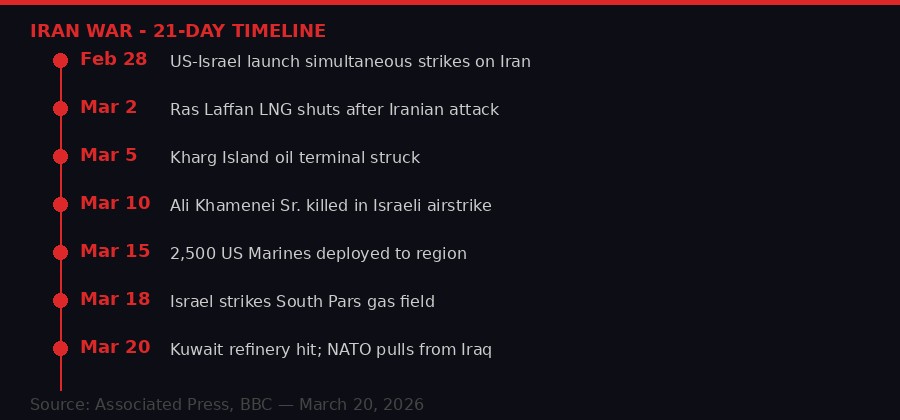
Key events in the first 21 days of the US-Israeli war on Iran. (BLACKWIRE/Infographic)
The Holiday That Became a Battlefield
Friday, March 20 should have been a double celebration across the Islamic world and Iran. Eid al-Fitr - the end of Ramadan - and Nowruz, the Persian New Year, coinciding for the first time in years. Instead, heavy explosions shook Dubai as air defenses intercepted incoming fire over a city where millions were gathering for prayers. In Iran, Nowruz arrived without the smell of hyacinths and the sound of firecrackers that Iranians described to the BBC as the ache of an absence.
Iranian Supreme Leader Ayatollah Mojtaba Khamenei - who has not been seen in public since assuming the role after his father was killed in Israeli strikes at the start of the war - marked the occasion with a written statement read on Iranian state television. He praised Iranians' "steadfastness" and claimed US and Israeli attacks were built on the "illusion that killing Iran's top leaders could cause the overthrow of the government." (AP, March 20)
"The enemy fell into contradictions and irrational statements." - Ayatollah Mojtaba Khamenei, statement on Nowruz, March 20, 2026 (via Iranian state television)
US and Israeli officials suspect the younger Khamenei was himself wounded in earlier strikes. The absence of any public appearance since taking power has fed competing theories - is he hiding, incapacitated, or already dead and being impersonated by recorded statements? On Friday, Iran's government provided no answers. What it did provide was a threat that alarmed counterterrorism agencies across three continents.
Iran Threatens the World's Tourist Sites

Iran's military threatened "parks, recreational areas and tourist destinations" worldwide on Friday - a signal that the conflict could extend to soft targets far from the battlefield. (File/Pixabay)
Iran's top military spokesman, Gen. Abolfazl Shekarchi, went on record Friday with a statement that set off immediate alarm in Western intelligence services: "parks, recreational areas and tourist destinations" worldwide will not be safe for Tehran's enemies.
The threat was a deliberate signal. For weeks, Iran has fought primarily in and around the Persian Gulf and Middle East - attacking military bases, energy infrastructure, and shipping lanes. Threatening tourist sites is a different category. It evokes the playbook of earlier Iranian-backed operations: assassinations in Europe, bombings of Jewish community centers in South America, proxy attacks that have no formal military fingerprint.
Within hours of the statement, Iranian state television reported that Gen. Shekarchi had been killed in an airstrike. Whether the threat died with him, or whether the order had already been passed down the chain, remains the central question being worked in Western intelligence capitals on Friday evening. (AP, March 20)
The pattern of Iran using international proxies and sleeper cells for asymmetric retaliation is well-documented. After the 2020 killing of Gen. Qasem Soleimani, US embassies and military personnel globally went on heightened alert for months. This threat comes from a country that has now been at war with the United States for three weeks - not from a one-off targeted killing, but from a sustained, existential conflict. The threat calculus is different. The motivation is different. The capacity remains debated, but Western governments are not dismissing it.
In Paris, London, Berlin, and New York, security services heightened protection at major tourist destinations and cultural landmarks on Friday, though no governments issued formal public advisories by the time of filing. (Reuters, March 20)
Kuwait's Refinery Burns: Another Gulf Domino Falls
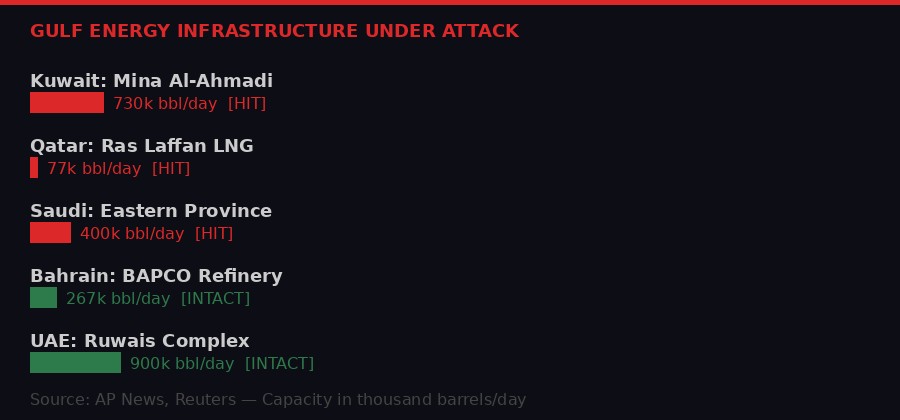
Gulf energy infrastructure targeted in the Iran war. Kuwait's Mina Al-Ahmadi refinery is among the Middle East's largest. (BLACKWIRE/Infographic)
The largest single event on the ground Friday was not a military clash between uniformed forces - it was an attack on money. Two waves of Iranian drones struck Kuwait's Mina Al-Ahmadi refinery early Friday, sparking a fire at one of the most critical petroleum processing facilities in the world.
Mina Al-Ahmadi processes approximately 730,000 barrels of oil per day. It is one of the largest refineries in the Middle East and a cornerstone of Kuwait's petroleum export economy. A sustained outage does not just hurt Kuwait - it removes refined product from the global market at a moment when the entire Gulf energy system is already under stress. (AP, March 20)
Kuwait was not a participant in the US-Israeli war on Iran. It has no military alliance with either country in the context of this conflict. Its refinery was not a military target in any conventional sense. Iran's decision to strike it anyway - alongside similar attacks on Saudi Arabia's oil-rich Eastern Province and a fire from intercepted shrapnel in Bahrain - signals a deliberate strategy: punish every country in the Gulf for not opposing the US-Israeli campaign loudly enough.
"Iran's attacks on energy infrastructure in the Gulf combined with its stranglehold on shipping in the Strait of Hormuz has raised concerns of a global energy crisis." - Associated Press, March 20, 2026
Saudi Arabia reported shooting down multiple drones targeting its oil-rich Eastern Province on the same day. Bahrain confirmed a fire broke out after shrapnel from an intercepted projectile landed on a warehouse. The map of attacks Friday - Kuwait, Saudi Arabia, Bahrain, plus explosions intercepted over Dubai - forms a near-complete ring of fire around the Persian Gulf's producing heartland. (AP, Reuters, March 20)
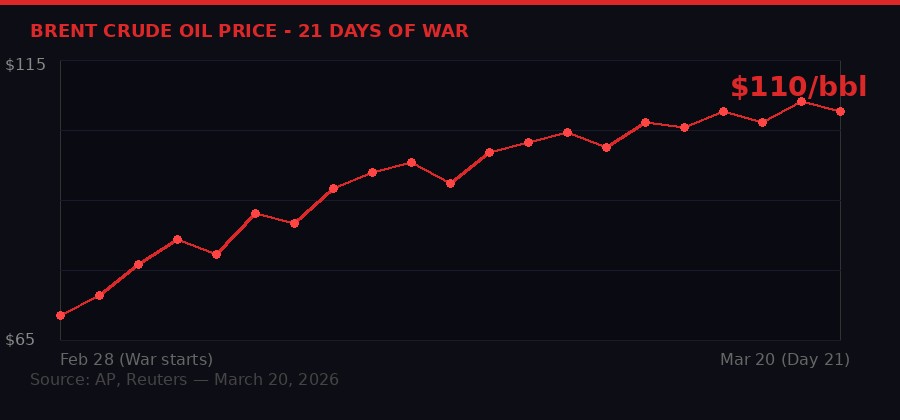
Brent crude oil has surged 57% since the war began February 28. The Kuwaiti refinery attack and continued Strait of Hormuz disruptions pushed it above $110/barrel Friday. (BLACKWIRE/Infographic)
The Trump-Netanyahu Crack: What It Means for the War
The most consequential development of the week was not military. It was political - and it happened in the Oval Office.
On Thursday, during a meeting with Japanese Prime Minister Sanae Takaichi, President Donald Trump told reporters he neither agreed with nor approved of Israel's decision to strike Iran's South Pars gas field - the world's largest - earlier in the week. His words were uncharacteristically direct for an ally he has publicly championed since the war's launch.
"I told him, 'Don't do that.' We get along great. It's coordinated, but on occasion he'll do something. And if I don't like it - and so we're not doing that anymore." - President Donald Trump, Oval Office remarks, March 19, 2026 (AP)
Netanyahu's response was measured but revealing. He confirmed Israel "acted alone" on the South Pars strike, then pledged to honor Trump's request not to attack the gas field again. He framed himself not as a co-commander of this war, but as a subordinate: "He's the leader. I'm his ally. America is the leader." (AP, March 20)
Two people familiar with the matter, speaking to AP on condition of anonymity, said the US was made aware of Israel's plan before the attack on South Pars - contradicting Trump's earlier claim on social media that the US "knew nothing." The discrepancy matters. If the US was briefed and Trump chose to express public displeasure anyway, it suggests either diplomatic theater for Gulf allies, or genuine alarm at the escalatory consequences of the strike. Possibly both.
The South Pars attack was genuinely destabilizing. Unlike earlier Israeli strikes on Iran's missile systems and nuclear sites - which serve the stated US objective of preventing a nuclear weapon - the South Pars field primarily supplies Iran's domestic energy needs. It doesn't hurt Iran's nuclear program. It hurts Iranian civilians. And it prompted immediate Iranian retaliation against Gulf Arab states, pushing oil prices higher, alienating Gulf allies, and drawing European and Japanese condemnation.
Director of National Intelligence Tulsi Gabbard confirmed on Thursday what AP had reported throughout the week: "The objectives that have been laid out by the president are different from the objectives that have been laid out by the Israeli government." Trump wants to end Iran's nuclear program. Netanyahu wants regime change. Those are not the same war. (AP, March 20)
NATO's Retreat From Iraq: A Quiet but Significant Withdrawal

NATO has pulled several hundred personnel from Iraq after a string of Iranian attacks on British, French, and Italian bases in the country. The alliance's security advisory mission - in place since 2018 - is now relocated to Europe. (File/Pixabay)
NATO's top commander, Gen. Alexus Grynkewich, confirmed Friday that the alliance has pulled several hundred personnel from Iraq and relocated them to Europe. The withdrawal ends - at least temporarily - NATO's security advisory mission that had operated in the country since 2018. (AP, March 20)
The mission's purpose was training and advising Iraqi defense and security forces. Its exit was not a military defeat in any conventional sense. It was a risk calculation: Iranian forces had attacked British, French, and Italian bases in Iraq repeatedly over the past three weeks. Keeping NATO advisors in Iraq was becoming an escalatory liability, drawing alliance members into a war they had not formally joined.
Iraq itself occupies an impossible position in this conflict. The Iraqi government has called for the US to stop using Iraqi territory for operations against Iran. Iranian-backed militias - some formally integrated into Iraqi security forces - operate openly inside the country. When NATO personnel are stationed there, they become proxies whether they intend to or not. Their departure removes the pretext for continued Iranian attacks on Iraqi-based Western personnel - and removes NATO from a potential tripwire escalation scenario.
For the United States, the NATO pullout presents a different concern. One of the key leveraged positions in any post-war regional order is Iraq. A country with a Shia-majority government that maintains relationships with both Tehran and Washington, it could either serve as a backchannel or become a proxy battleground. Removing NATO presence reduces Western institutional foothold in the country at a critical moment. (AP, Reuters, March 20)
The Global Economic Reckoning: Pumps, Prices, and Panic
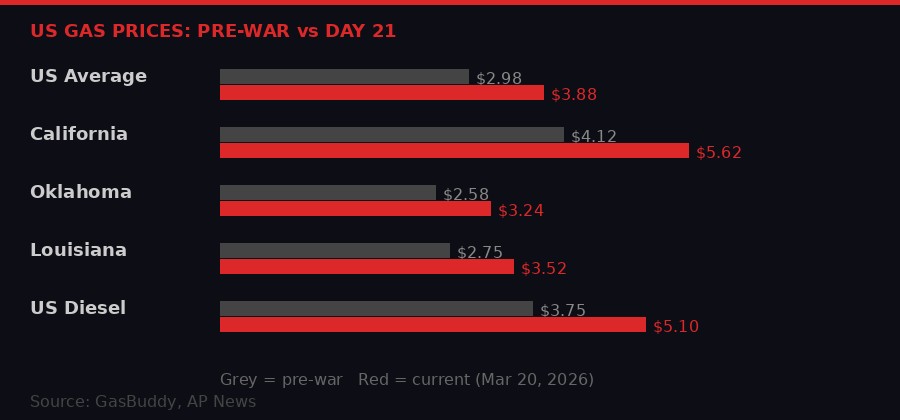
US gasoline prices have surged 30% since the war began. California drivers are paying $5.62/gallon. Diesel - which moves every product Americans buy - is up 36%. (BLACKWIRE/Infographic)
The Iran war has made everything more expensive. Not eventually. Now.
Brent crude oil closed above $110 per barrel Friday - up from roughly $70 before the war began on February 28. That 57% increase in three weeks is not an abstraction. It is already restructuring household budgets, airline pricing, food logistics, and central bank calculations in every developed economy. (AP, March 20)
In the United States, the average price of regular gasoline hit $3.88 per gallon on Thursday - up from $2.98 before the war, a 30% increase in less than a month. California drivers were paying $5.62. Diesel prices - which directly affect the cost of shipping every product that moves by truck - surged to $5.10 per gallon nationally, a 36% increase since war began. (AP, March 20)
"Higher gasoline and diesel prices are now costing the US economy half a billion dollars more every single day (and rising) versus three weeks ago. A staggering rise and near record-setting." - Patrick De Haan, petroleum analyst at GasBuddy, March 2026 (via AP)
Supply chain analyst Patrick Penfield of Syracuse University told AP that $4 per gallon is the historical tipping point where American consumer behavior visibly changes - people drive less, eat out less, reduce discretionary spending. With averages already at $3.88 and California already at $5.62, the tipping point is not coming. For tens of millions of Americans, it arrived this week.
The impact is more severe in Asia and Europe, which import a far higher share of their energy from the Middle East than the United States does. Qatar's Ras Laffan LNG terminal - one of the world's largest liquefied natural gas export facilities - shut down on March 2 after an Iranian attack and was struck again Thursday. Ras Laffan supplies roughly a fifth of the world's LNG. Natural gas prices in Europe and Asia have surged accordingly, feeding inflation in economies that are already under pressure from years of post-pandemic supply chain stress. (AP, Reuters, March 20)
The Strait of Hormuz - through which roughly 20% of the world's oil and critical goods pass - has been effectively choked by Iranian naval activity, mine threats, and drone attacks on commercial shipping since the war's first days. Every additional week it remains constrained adds cumulative pressure to global supply chains. The effects are not linear. Economists watching the data warn that if the strait remains this restricted for another three to four weeks, the economic consequences will begin appearing in Q2 GDP figures across the G7. (AP, BBC, March 20)
The Allies Question: Japan, Europe, and the Cowards Comment
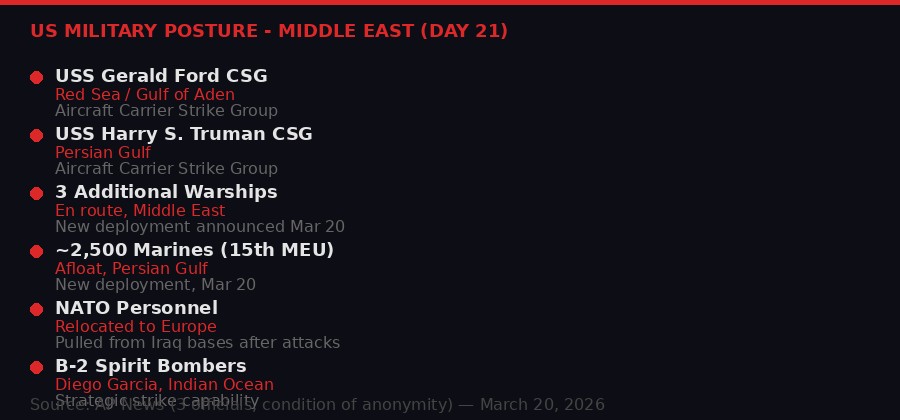
US military deployment as of Day 21. Three additional warships and 2,500 Marines were announced Friday. NATO advisory personnel have been withdrawn from Iraq to Europe. (BLACKWIRE/Infographic)
Trump called NATO allies "cowards" earlier this week for declining to quickly join his call to help protect the Strait of Hormuz. The remark set the table for a tense Thursday in Washington, when Japanese Prime Minister Sanae Takaichi arrived at the White House for what was billed as an alliance-affirming visit.
Japan depends heavily on Middle Eastern oil, and a large share of it passes through the Strait of Hormuz. The Takaichi visit was partly a damage-control exercise after Japan was among the nations that did not immediately endorse Trump's call for allied naval participation in securing the strait. (AP, March 20)
Trump's Oval Office remarks with Takaichi present were - diplomatically speaking - extraordinary. When asked why the US didn't notify allies like Japan before striking Iran, Trump invoked Pearl Harbor.
"We didn't tell anybody about it because we wanted surprise. Who knows better about surprise than Japan? Why didn't you tell me about Pearl Harbor, OK?" - President Donald Trump, Oval Office, March 19, 2026 (AP)
Takaichi's slight smile reportedly dropped. She raised her eyebrows. The moment was caught by pool cameras. By evening, the two leaders were all smiles over dinner and Trump called Takaichi "a spectacular woman." Takaichi, in English, declared "Japan is back" - but gave Trump a "detailed explanation" of what actions Japan can and cannot take under its pacifist constitutional constraints.
The leaders of five European nations and Japan issued a joint statement Thursday demanding Iran stop attacks on the Strait of Hormuz, expressing readiness to contribute to "appropriate efforts" to ensure safe passage - deliberately vague language that committed to nothing while providing political cover. France, meanwhile, generated its own crisis when French military newspaper Le Monde reported that a French officer had inadvertently revealed the location of an aircraft carrier by uploading a 35-minute Strava run aboard the vessel as it headed toward the Middle East. The officer reportedly leaked the carrier's position at a moment of heightened hostile surveillance. (BBC, March 20)
What Comes Next: Three Scenarios the Intelligence Community Is Running
Three weeks into a war that was sold to the American public as a short, sharp campaign to eliminate Iran's nuclear capability, the landscape has shifted substantially. Iran has not collapsed. Its leadership is wounded but broadcasting defiance through whatever means remain available. Its military is degraded but still operational - capable of striking Gulf refineries and threatening global tourism infrastructure on the same day. The war shows no end in sight.
Analysts working the Iran file in Washington, London, and Jerusalem are running three distinct scenarios for the coming weeks.
Scenario One: The Compression Strategy. The US and Israel continue degrading Iran's military, nuclear, and economic infrastructure until the regime fractures from within. Trump and Netanyahu have separately alluded to hoping for a popular uprising or a coup from within the Revolutionary Guards. There is no public evidence this is imminent - but both governments have an intelligence picture the public does not. If domestic pressure inside Iran reaches a critical point, a ceasefire negotiated with a successor government becomes possible.
Scenario Two: Escalation Through Proxies. Iran shifts from direct military engagement - where it is outgunned - to asymmetric global operations: proxy attacks on soft targets in Europe, cyberattacks on energy infrastructure, operations through Lebanese Hezbollah remnants, Houthi resurgence in Yemen, and activist networks in South America. This is Iran's historical playbook when faced with conventional military superiority. The threat to tourist sites Friday was a signal that this option is live.
Scenario Three: A Deal Through Backchannels. Trump has consistently said his objective is ensuring Iran "never has a nuclear weapon" - not regime change. Iran's backchannel communications through Oman and other Gulf intermediaries have reportedly remained open throughout the conflict, per sources cited by Reuters and AP. A deal that gives Trump a declared victory on nuclear disarmament - in exchange for a ceasefire and eventual sanction relief - is not impossible. Trump telegraphed his willingness to consider lifting some oil sanctions as recently as Thursday, with Treasury Secretary Scott Bessent broaching waiving sanctions on oil already at sea. (BBC, AP, March 20)
None of these scenarios play out quickly. In the meantime, oil stays above $100, Gulf refineries burn, and Iranian military spokesmen threaten to bring the war to wherever tourists gather. It is Day 21. The opening act just ended.
Get BLACKWIRE reports first.
Breaking news, investigations, and analysis - straight to your phone.
Join @blackwirenews on Telegram