Nowruz Under Fire: Israel Bombs Tehran, Kuwait's Largest Refinery Burns, IRGC Spokesman Killed Hours After Last Boast
Iran's 2,500-year-old celebration of the Persian New Year became a war zone Friday. Israeli airstrikes shook Tehran as Iranians lit their Nowruz bonfires. Explosions boomed over Dubai during Eid al-Fitr prayers. Kuwait's 730,000-barrel-a-day refinery caught fire for the second straight day. And the IRGC's own military spokesman - who told state media hours earlier that Iran was "producing missiles even during war conditions" - was killed in an airstrike before sunrise.

The twenty-fourth day of the Iran war opened with a convergence of symbolic and strategic catastrophe. For Iran, March 20 is Nowruz - the Persian New Year, the most sacred civic celebration in the Iranian calendar, marking the first moment of spring and a 3,000-year tradition that predates Islam. Families gather for the "haft-sin" table, children receive new clothes, and the country pauses for collective renewal. This year, they scrambled for shelters instead.
For the Gulf Arab states, Friday was Eid al-Fitr - the end of Ramadan, the biggest festival in the Islamic year. In Dubai, where skyscrapers light up and millions crowd the corniche, the day began not with fireworks but with air defense interceptors detonating over the city, shaking windows across the emirate.
Two holy days. Two civilizations. One war that has consumed both.
IRGC Spokesman: "We Are Producing Missiles Even During War Conditions"
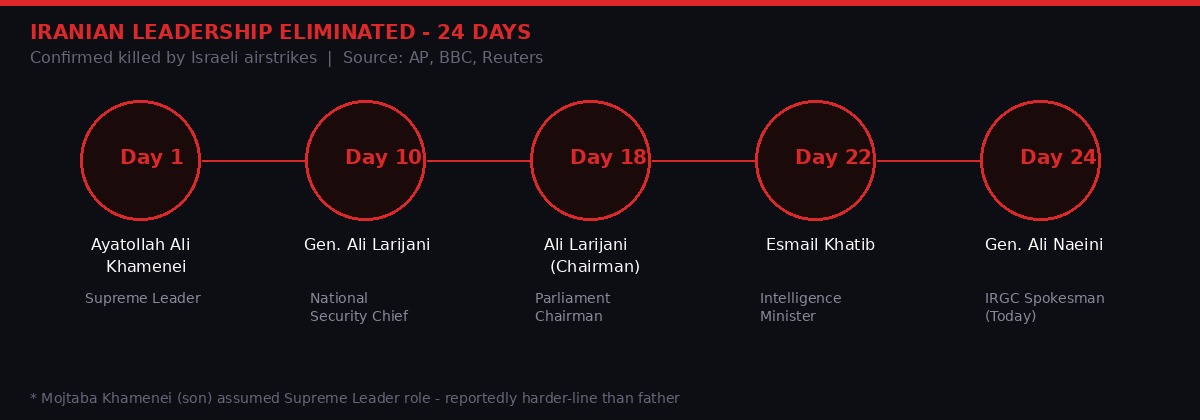
The most remarkable sequence of Friday began with a statement from IRGC military spokesman Gen. Ali Mohammad Naeini, published in Iran's state-run IRAN newspaper. Netanyahu had claimed on Thursday that Israel had destroyed Iran's capacity to produce ballistic missiles. Naeini pushed back, hard.
"We are producing missiles even during war conditions, which is amazing, and there is no particular problem in stockpiling. These people expect the war to continue until the enemy is completely exhausted. This war must end when the shadow of war is lifted from the country." - Gen. Ali Mohammad Naeini, IRGC Spokesman, IRAN newspaper (March 20, 2026 - his final statement)
Within hours, Iranian state television reported that Naeini had been killed in an Israeli airstrike. [AP, March 20]
The sequence had an almost cinematic brutality to it: a military spokesman publicly refuting claims of his country's degraded capacity, then eliminated before the day was through. It was the fifth senior Iranian figure killed in 24 days - following Supreme Leader Ayatollah Ali Khamenei himself, National Security Chief Gen. Ali Larijani, Parliament Chairman Ali Larijani, and Intelligence Minister Esmail Khatib.
Israel's strategy of systematic decapitation has been relentless, if not conclusively effective. Each kill generates headlines and tactical disruption. But the IRGC has continued to fire waves of missiles regardless - the apparatus, as analysts have noted, runs deeper than any single man.
Tehran Struck on the First Day of the New Year

Activists inside Iran reported hearing multiple explosions around the capital in the early morning hours. The attacks came the morning after Israel had pledged - at Trump's direct request - to halt further strikes on Iran's massive South Pars offshore gas field. That restraint apparently did not extend to Tehran itself.
Israeli Prime Minister Benjamin Netanyahu had told foreign journalists Thursday that Iran "no longer has the ability to enrich uranium or make ballistic missiles." The IRGC's response, before it fell silent with Naeini's death, was to flatly deny both claims. The IRGC insisted uranium enrichment was continuing, and that missile stockpiles were being replenished under wartime production conditions. [AP, March 20]
Whether Tehran strikes can translate to strategic victory remains the central question. Netanyahu's stated aim is to so degrade and humiliate the Islamic Republic that Iranians rise up and overthrow it. That outcome has not materialized. Iranian authorities crushed a mass protest movement in January - before the war even began - and there have been no signs of organized internal resistance since. The Supreme Leader was killed on Day 1. The Republic marches on.
Iran is now led by Ayatollah Mojtaba Khamenei - the son of the killed supreme leader, who has made a single recorded public statement since taking power. In that statement, issued Friday, he said Iran's enemies need to have their "security taken away." It was ominous, vague, and exactly the kind of thing his father would have said. The bloodline endures; the ideology, apparently, with it. [AP, March 20]
Kuwait's Mina Al-Ahmadi Refinery: Second Strike in 24 Hours

Kuwait had hoped to be spared. The tiny, oil-rich nation on the northern shore of the Persian Gulf maintains no military operations against Iran. It hosts US troops - which Iran considers a legitimate military target - but Kuwaiti civilians have no quarrel with Tehran. That calculus counts for nothing in Iran's stated strategy of exhaustion warfare.
Friday's drone strikes set Kuwait's Mina Al-Ahmadi oil refinery ablaze for the second straight day. [AP, March 20] The facility processes approximately 730,000 barrels of crude per day - making it one of the three largest oil refineries in a country whose economy is essentially built on petroleum. Firefighters were working to control the blaze as of Friday morning. Damage assessments were not yet available.
The Thursday strike had already damaged the refinery significantly. A second hit within 24 hours signals deliberate targeting - Iran is not missing Mina Al-Ahmadi by accident. The message is operational: Gulf states sheltering under the US umbrella will pay an energy price for that relationship.
Kuwait is one of three oil refineries hit in the first three weeks of the war. Saudi Arabia's Ras Tanura facility - attacked repeatedly - has been one of the most significant targets in the campaign. Saudi Arabia had attempted to route oil westward through the Red Sea to bypass the Strait of Hormuz entirely. Iran anticipated that move: an Iranian drone hit the Saudi SAMREF refinery in Yanbu, the Red Sea port city that was supposed to be the escape route. [AP, March 19-20]
The Gulf Energy Infrastructure: Mapping the Damage
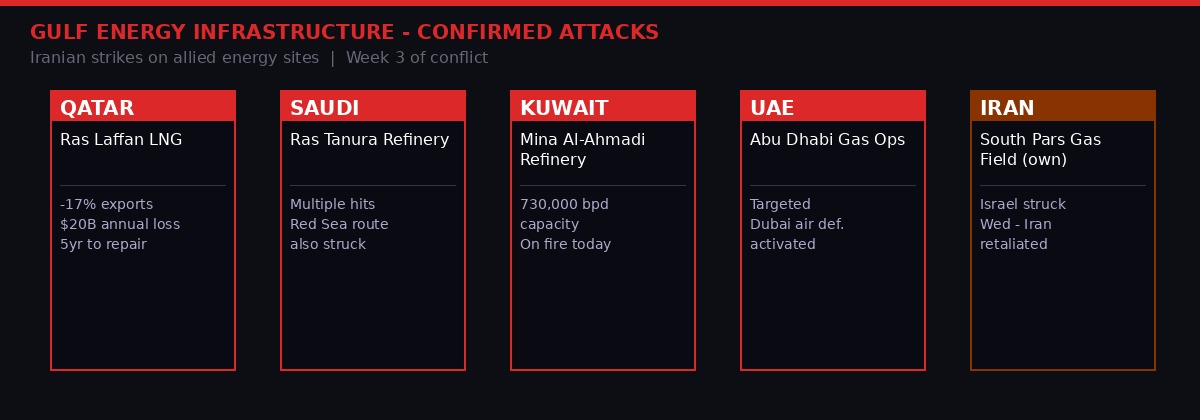
The scale of Iran's energy infrastructure offensive is only becoming clear in its entirety at the three-week mark. This is not a single-target campaign. Iran has methodically struck every major energy producer in its neighborhood.
In Qatar, Iranian missiles hit the Ras Laffan liquefied natural gas facility - the world's largest LNG complex, the source of roughly 30% of global LNG supply. Qatar says the damage reduced exports by 17%, will cost approximately $20 billion in annual revenue, and will take up to five years to fully repair. [AP, March 19] The plant's production had already been partially halted after earlier strikes. Qatar's government is privately furious. Publicly, it has been measured. It hosts Al Udeid Air Base, the largest US military facility in the Middle East, which complicates any diplomatic distance it might wish to maintain.
In Abu Dhabi, gas operations were targeted. In Kuwait, the Mina Al-Ahmadi refinery caught fire twice. In Saudi Arabia, the Ras Tanura and SAMREF refineries were both struck. The UAE's Fujairah port - one of the busiest oil loading terminals in the world - was attacked in Week 2.
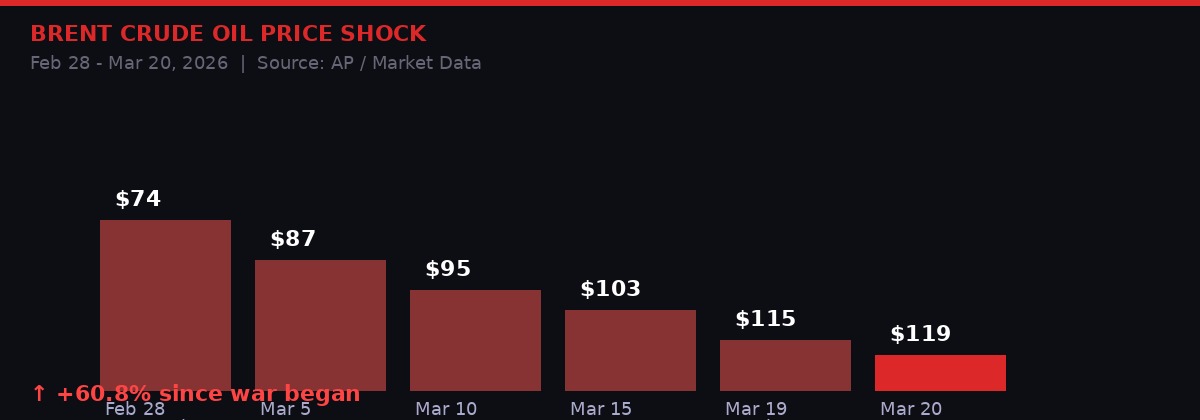
Brent crude surged above $119 a barrel Thursday before settling around $107 on Friday morning - still up more than 47% since the war began on February 28. [AP, March 20] European natural gas prices have roughly doubled in a month. The energy shock is global now, not merely regional.
The UN Security Council held an urgent closed-door session Thursday. Gulf states stressed the need for Iran to halt attacks on their infrastructure. Iran showed no signs of hearing them. [AP, March 19]
Dubai on Eid: Air Defenses Intercept Over the City

The timing was deliberate. Eid al-Fitr begins with the Fajr prayer - the first prayer of the day, before sunrise. Mosques across Dubai had just broadcast the call to prayer when the sounds of explosions began rippling across the city. The UAE's air defense interceptors engaged incoming fire overhead.
No casualties were immediately reported from the intercepts themselves. Shrapnel from a downed projectile landed on a warehouse in Bahrain and sparked a fire there. Saudi Arabia's Eastern Province - the oil heartland of the kingdom - reported shooting down multiple drones. [AP, March 20]
Dubai is one of the most internationally exposed cities on Earth. Over 90% of its population is foreign-born. It hosts the regional headquarters of thousands of global companies. Its airport is among the world's three busiest. The psychological toll of repeated air defense activations - even successful ones - on business confidence, tourism, and long-term investment is something no economic model has yet accounted for.
The UAE moved on Friday to arrest what it called a "terrorist network funded and operated by Lebanon's Hezbollah and Iran." Five men were detained on allegations of money laundering under a "fictitious commercial cover" intended to threaten the UAE's financial stability. Images of the five prisoners were released by state news agency WAM. None were publicly identified. [AP, March 20]
The arrests underscore what UAE security services have clearly been tracking for weeks: Iran has been running parallel operations inside Gulf states - overt drone and missile strikes from Iranian territory, covert financial and intelligence operations from inside UAE commercial infrastructure. The visible war and the invisible war are running simultaneously.
The Decapitation Strategy: Tactical Success, Strategic Uncertainty

Israel's systematic killing of Iran's senior leadership is historically unprecedented in its speed and reach. No country in the modern era has attempted to decapitate another state's leadership at this tempo - from a supreme leader to an intelligence minister to a military spokesman in three and a half weeks.
Analysts warn the strategy has limits that history documents clearly.
Jon Alterman, chair of Global Security and Geostrategy at the Center for Strategic and International Studies, put it directly: "Even dictators need to rely on entire networks that support them." Iran's government and military are built from overlapping institutions, parallel hierarchies, and layered command structures specifically designed to survive the loss of any single leader. [AP, March 20]
The IRGC has continued launching waves of ballistic missiles at Israel - millions of people have been forced to shelters dozens of times - even after multiple top commanders were killed or driven underground. Hezbollah, whose leader Hassan Nasrallah was killed by Israel in 2024, resumed attacks on Israel within days of the current war beginning. Hamas has pressed on for years after losing one leader after another.
Ellie Geranmayeh, deputy director of the Middle East and North Africa program at the European Council on Foreign Relations, described Iran's strategic logic: "Iran is upping the costs for this US military campaign and regionalizing it from the get-go, as they promised they would if America restarts the war again with Iran." [AP, March 20]
The Iranian bet is attrition. US and Israeli public support for the war is not unlimited. Polls suggest the American public is already wary of a prolonged conflict. Netanyahu faces domestic pressures. Trump, who demanded a pause in South Pars strikes, is clearly sensitive to the oil price consequences. "The Iranians are banking on basically out-stomaching him," Geranmayeh said.
Trump, meanwhile, has set four objectives: destroy Iran's missile capabilities, wipe out its navy, prevent a nuclear weapon, and end Iran's support for armed regional groups. On each measure, results are partial. Iran's navy has been substantially destroyed. Missile production continues, according to the IRGC's own - now dead - spokesman. Nuclear enrichment sites were hit, but the stockpile of 60%-enriched uranium remained inside Iran as of last week. [AP, March 19]
The Nowruz Calculation: Symbolic Strikes and Their Limits

Striking Tehran on Nowruz carries meaning beyond the military target list. For Iranians - secular and religious, diaspora and domestic, pro-regime and opposition - Nowruz is the one shared identity that transcends politics. It predates Islam by millennia. The Pahlavi shahs celebrated it. The Islamic Republic, with some ambivalence, has always maintained it.
Hitting Tehran on Nowruz morning sends a message that is simultaneously potent and double-edged. It signals Israeli contempt for Iranian cultural sovereignty. But it also risks exactly the kind of national solidarity effect that might harden civilian support for a government many Iranians otherwise despise.
Netanyahu's stated theory is that Israelis strikes will cause Iranians to "rise up against the Islamic Republic." Geranmayeh and other analysts are skeptical. Bombing a population on its most sacred holiday rarely generates gratitude. The January protests that preceded the war were crushed - internal opposition is not in a position to organize. And whatever political space might have existed for anti-regime sentiment has likely been compressed by the simple survival instinct of living under daily airstrikes. [AP, March 20]
There is a historical template for this failure. The US-led coalition's bombing of Iraq in 1991 and 2003 did not generate popular uprisings against Saddam Hussein in the expected timeframes. The 2006 Israeli bombing campaign against Lebanon strengthened Hezbollah domestically. Bombing rarely breaks civilian will - it more often redirects it toward the nearest external enemy.
Whether Iran's government will eventually collapse under the combined weight of military degradation, leadership losses, energy disruption, and economic isolation is a genuine question. The Islamic Republic was already under severe pressure before February 28. But "eventual collapse" is not "this week." And the war is only 24 days old.
The Timeline: How Day 24 Unfolded
Day 24 - March 20, 2026 - Nowruz / Eid al-Fitr
What Comes Next: The Attrition Endgame
The Iran war is now in what military analysts call the "attritional phase." The initial shock of the opening salvo - the Supreme Leader killed on Day 1, US and Israeli aircraft hitting dozens of targets simultaneously - has given way to grinding daily exchanges. Neither side has the ability to end this cleanly.
The United States and Israel cannot invade and occupy Iran. A country of 90 million people, the size of Western Europe combined, sitting in one of the world's most complex terrains - ground invasion was never seriously contemplated. The strategy was always air power plus economic strangulation plus targeted killing plus the hope of internal regime collapse. The first three are being executed. The fourth has not arrived.
Iran cannot defeat the United States militarily. Its conventional forces have been systematically destroyed. Netanyahu's claim that Iran's navy "lies at the bottom of the sea" is largely accurate - the surface fleet was neutralized in the first week. Its air defenses have been rendered largely ineffective by sustained attack. What remains is its missile inventory, its drone production capacity, and the IRGC's willingness to accept casualties and keep firing.
The Pentagon has asked Congress for $200 billion in supplemental war funding - a figure that reflects the scale of sustained operations, air asset deployment, missile defense expenditure, and the inevitable cost of supporting allies under energy stress. [AP, March 19] Congress has not approved it. The political clock is running.
Iran's energy offensive against Gulf states is the single most consequential strategic move of the war. By targeting not just its own energy infrastructure but the region's, Iran is making the war expensive for everyone. The global energy shock is now feeding inflation in India, power shortages in Europe, and political headaches for leaders who never wanted involvement in this conflict. That pressure ultimately lands on Washington, which started it.
Japan's Prime Minister Sanae Takaichi flew to Washington on Friday to meet Trump, seeking help securing the Strait of Hormuz. Japan imports roughly 90% of its oil through the strait. [AP, March 20] The conversation reflects what every major oil-importing economy is privately demanding: a path back to open waterways, and soon.
Treasury Secretary Scott Bessent has reportedly raised the idea of waiving sanctions on Iranian oil already at sea - a stunning reversal of longstanding American policy that would represent a significant concession to energy market realities. [BBC, March 20] Whether that trial balloon will survive the hawkish right wing of Trump's coalition is another matter entirely.
The war is 24 days old. The Hormuz Strait remains contested. Oil is at $107. Tehran is under bombs on New Year's morning. And the IRGC's spokesman, who said the missiles keep coming, is dead. But the missiles, for now, still keep coming.
Get BLACKWIRE reports first.
Breaking news, investigations, and analysis - straight to your phone.
Join @blackwirenews on TelegramSources: Associated Press (March 19-20, 2026); BBC News (March 20, 2026); AP strategic analysis piece on Iranian decapitation strategy (March 20, 2026). All casualty figures from AP wire reports as of 0800 UTC March 20, 2026.