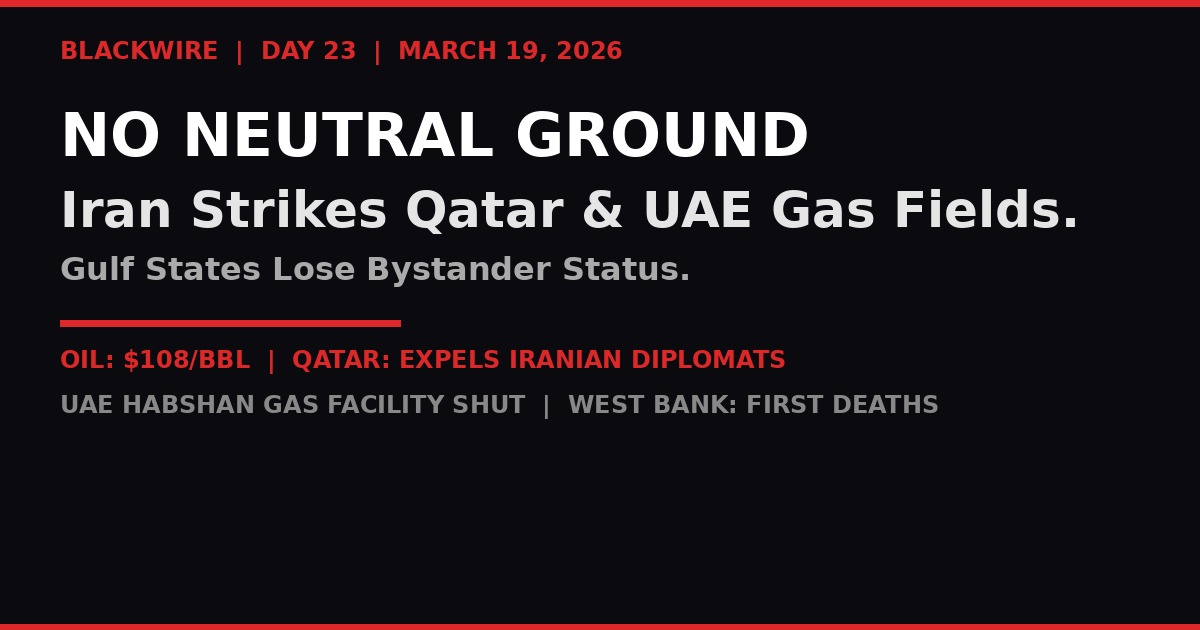
For three weeks, Qatar, the United Arab Emirates, Saudi Arabia, and the smaller Gulf states had walked a careful line. They were not in the war. They were not attacking Iran. Their ports handled goods. Their airspace stayed open. Their energy facilities kept operating under a tacit assumption: Iran would not be stupid enough to wreck the Gulf economy it depends on for regional legitimacy.
That assumption died on March 18, 2026.
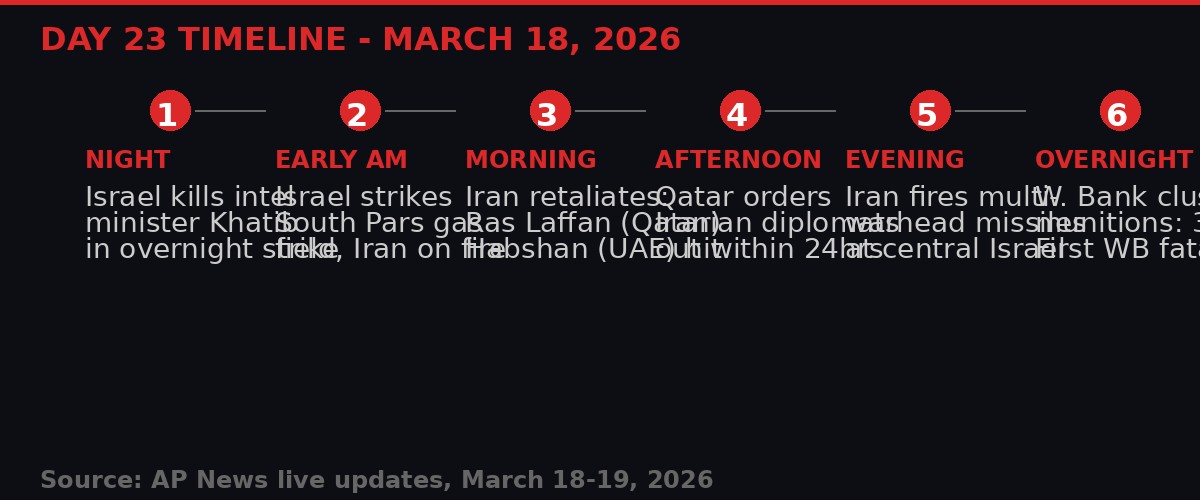
Tehran struck Qatar's Ras Laffan liquefied natural gas complex - the single largest LNG facility on Earth - sparking fires that caused what QatarEnergy described as "extensive" damage before crews contained it. Hours later, Iranian missiles hit the UAE's Habshan gas facility and Bab field, forcing Abu Dhabi to shut down operations entirely. Saudi Arabia's Eastern Province - home to the bulk of the kingdom's oil infrastructure - was targeted again. Bahrain and Kuwait were struck. And in a development that shocked even seasoned war watchers, an Iranian cluster munition landed in the occupied West Bank town of Beit Awa, killing at least three Palestinian civilians and wounding thirteen more.
Qatar's response was immediate: Iranian diplomatic staff were ordered to leave within 24 hours. The Gulf's last diplomatic link to Tehran was cut.
The South Pars Strike: Israel Hits Iran's Economic Heart
The cascade of Gulf strikes was Iran's response to a move that changed the war's energy calculus: Israel attacked South Pars. State media in Tehran confirmed it on the morning of March 18. Facilities near the port town of Asaluyeh, on Iran's Gulf coastline, were on fire. (AP News, March 18, 2026)
South Pars is not a typical oil field. It is the Iranian half of what geologists call the world's largest natural gas reservoir - a formation that stretches under the Persian Gulf and surfaces on the Qatari side as the North Field. The two countries have tapped the same underground resource from opposite directions for thirty years.
Iran uses gas differently than its neighbors. It is the world's fourth-largest natural gas consumer - behind only the United States, China, and Russia - despite having an economy a fraction of their size. The Columbia University Center on Global Energy Policy notes that Iran relies on subsidized domestic gas for everything: home heating in its cold interior provinces, cooking, electricity generation, and industrial feedstock. South Pars provides roughly 80 percent of that domestic supply. (Columbia University Center on Global Energy Policy)
Sanctions have blocked Tehran from commercializing the field as a revenue source. Three LNG export projects - including ventures with TotalEnergies and Shell before the nuclear program sanctions hit - were abandoned or stalled. A third site at Asaluyeh, near the area now on fire, had reportedly been under construction for nearly two decades and was approaching completion. All of that is now in jeopardy.
"The attack is a serious escalation which threatens retaliatory strikes on Gulf and Israeli production facilities." - Andres Cala, geopolitical analyst, Montel News energy intelligence firm
A source familiar with U.S. decision-making told the Associated Press that Washington was informed of Israel's plans to strike South Pars but did not participate in the attack. The source, who was not authorized to speak publicly, declined to say whether the Trump administration supported the decision. (AP News, anonymous official, March 18, 2026)
That detail matters. It suggests Israel made an independent calculation that disrupting Iran's domestic energy grid - forcing rolling blackouts, heating failures, and industrial shutdowns - would accelerate pressure on the Tehran government. The logic is similar to the strategy used against Russia's energy infrastructure in the 2022-era Ukraine conflict. Whether Iran's population turns against the government under such pressure, or hardens behind it, remains the central unknown of the entire war.
Qatar's Ras Laffan in Flames: The LNG Market's Worst Nightmare
Iran's retaliation for the South Pars attack was swift and directed at Tehran's most valuable regional neighbor: Qatar. (AP News, QatarEnergy statement, March 18, 2026)
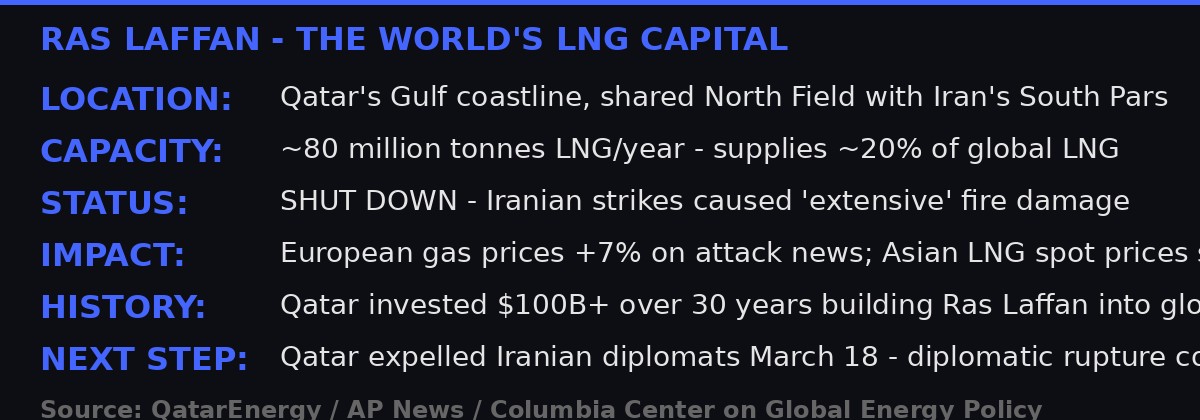
QatarEnergy confirmed on social media platform X that a missile struck Ras Laffan, the industrial city on Qatar's northern coast that has made the tiny emirate one of the most powerful energy exporters on the planet. The fire was described as causing "extensive" damage. Production at the facility had already been halted after earlier Iranian attacks; the March 18 strike dealt a deeper blow to the physical infrastructure itself.
Ras Laffan is not merely large. It is the node through which roughly one-fifth of the world's traded liquefied natural gas passes. Qatar exports more than 120 billion cubic meters of LNG per year, compared to Iran's paltry 9 billion cubic meters. Qatar's primary customers are in Asia - Japan, South Korea, China, and India - but because LNG is a global commodity whose price is set by available cargoes worldwide, the shutdown of Ras Laffan has been felt immediately in Europe, where nations were still rebuilding gas storage after the Russian pipeline cutoffs of 2022-2023. European gas prices jumped 7 percent on news of the March 18 attack. (AP News / Columbia University energy analysis)
"They are absolutely worried that they are the next in line. They are concerned about being hit by a drone and damage to their LNG facilities, because for them that would be really a disaster." - Anne-Sophie Corbeau, global research scholar, Columbia University Center on Global Energy Policy, speaking on Qatar's position
Qatar's diplomatic response was calibrated to its fury. The Foreign Ministry ordered all Iranian Embassy officials to leave within 24 hours. This is the language of complete diplomatic rupture - a step usually reserved for declared enemies. Qatar and Iran had shared the North Field/South Pars reservoir for decades. Trade, financial, and diplomatic ties had been maintained even as Qatar hosted the U.S. Al Udeid Air Base, home to CENTCOM's air operations command. Tehran had respected that ambiguity for years. No longer.
UAE: Habshan Shut, Abu Dhabi Calls It "Dangerous Escalation"
Iran did not stop at Qatar. Missiles also struck the Habshan gas facility and the Bab oil field in the United Arab Emirates. The UAE government confirmed both hits and described them as a "dangerous escalation." Authorities in Abu Dhabi said gas operations at the struck facilities had been shut down after interceptions over the sites - meaning some incoming weapons were stopped, but not all. (UAE government statement, via AP News, March 18, 2026)
Habshan is located in Abu Dhabi emirate and is part of the pipeline and processing network that handles gas from the UAE's onshore oil fields before it is either consumed domestically or exported via the Dolphin pipeline to Qatar and Oman. Shutting Habshan disrupts both domestic energy supply in the UAE and a key transit corridor for regional gas flows.
The strikes on the UAE follow a pattern that has evolved over Day 15-23 of the conflict. Iran initially concentrated attacks on shipping in the Strait of Hormuz and on Israeli and American targets. But as the war deepened and Gulf Arab states - despite loudly declaring their neutrality - continued to provide logistics, overflight corridors, and financial infrastructure to U.S. forces operating in the region, Tehran began recalibrating. The message is unmistakable: hosting U.S. air assets, allowing supply lines through your territory, and buying time for Washington to squeeze Iran carries a cost now.
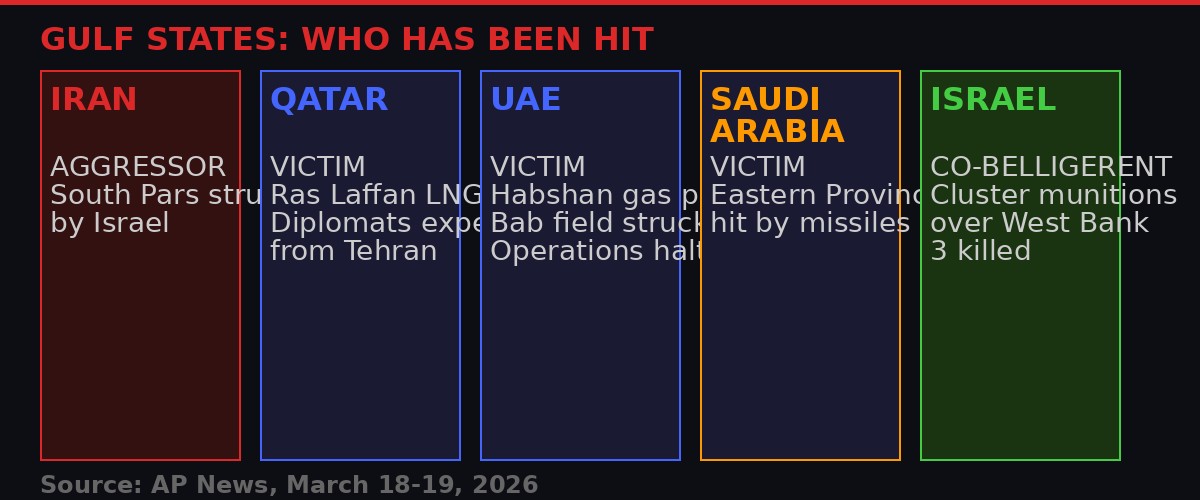
Saudi Arabia's Eastern Province was struck again on March 18. The Eastern Province is where Aramco's crown jewels sit - Abqaiq, Ras Tanura, and the bulk of the kingdom's 8-10 million barrels per day production capacity. Riyadh has intercepted most incoming drones and missiles, but each volley increases the probability of a catastrophic breakthrough. Saudi Arabia remains the one party that, if it entered the war on Washington's side, could dramatically change the military balance - and Iran seems determined to preemptively punish it anyway.
Bahrain and Kuwait were also struck on Day 23, though with less apparent infrastructure damage. Iran's targeting now appears to be both signaling and attrition - keeping every Gulf capital on a war footing, draining air defense inventories, and demonstrating that no address in the region is off limits.
West Bank Cluster Munitions: Three Dead, a New Red Line Crossed
The most legally and morally charged development of Day 23 was the cluster munition strike on Beit Awa, a small Palestinian town in the southern occupied West Bank, south of Hebron. The Palestinian Red Crescent confirmed at least three people killed and thirteen injured. The Israeli military told the Associated Press directly that the weapon was an Iranian missile - specifically, that it was a cluster munition that penetrated Israel's layered air defense system. It was not interception debris. It was a functioning weapon that released multiple submunitions over a populated civilian area. (IDF statement to AP News, March 18, 2026 / Palestinian Red Crescent)
"An Iranian missile - not shrapnel from an interception - hit in the West Bank." - Israeli military, statement to the Associated Press, March 18, 2026
Cluster munitions are banned under the Convention on Cluster Munitions, signed in Dublin in 2008 and ratified by more than 110 countries. Iran is not a signatory. Neither, for what it is worth, is the United States or Israel. The weapon used appears to be a variant of Iran's Khorramshahr-4 ballistic missile - the same system Iran unveiled earlier in March, designed to release a cluster of submunitions at high altitude to defeat point-defense systems. Footage filmed by AP journalists showed at least one missile releasing a cluster of warheads over Israeli airspace on March 18. (AP News footage, March 18, 2026)
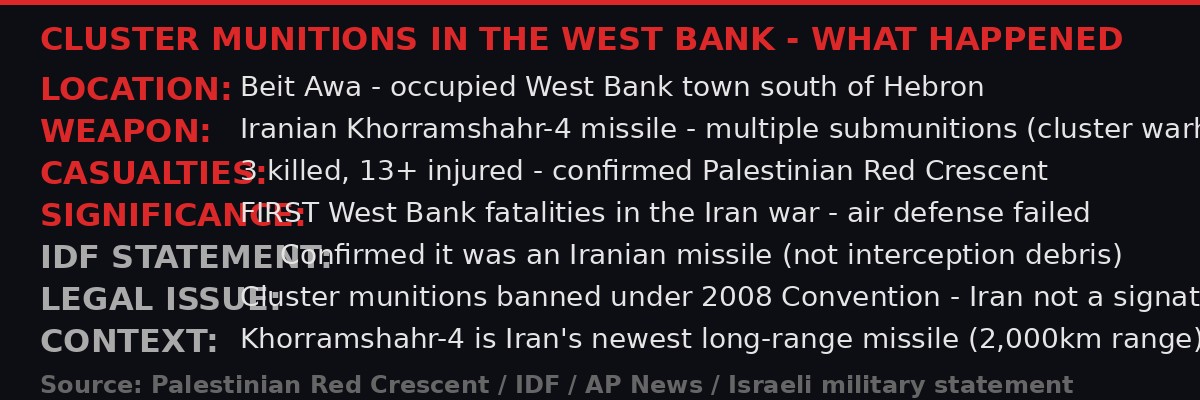
The significance is layered. First, it marks the first combat deaths in the occupied West Bank during the Iran-Israel war. The West Bank's 3 million Palestinian residents have been living under a separate but intertwined crisis - the war had been a source of anxiety but had not yet delivered direct casualties on their territory. That changed on the night of March 18.
Second, the use of cluster munitions over a civilian-populated area triggers international humanitarian law obligations that neither Iran, nor arguably the U.S. or Israel, want scrutinized. Human rights organizations have already documented previous Iranian cluster munition use in the conflict, and the West Bank deaths are likely to accelerate calls at the International Criminal Court for a broader investigation into all parties' conduct.
Third, and strategically most significant, the Iranian missile reached the West Bank despite Israel deploying its Iron Dome, David's Sling, and Arrow 3 systems in an interconnected defensive grid over the entire country. The fact that a cluster munition got through suggests Iran has found a combination of trajectory, flight path, and submunition deployment altitude that exploits seams in Israel's multi-layer defense. Israeli Defense Minister Israel Katz promised "significant surprises" in response. (AP News, March 18, 2026)
Trump's Desperation Pivot: Venezuela Unlocked, Allies Still Refusing
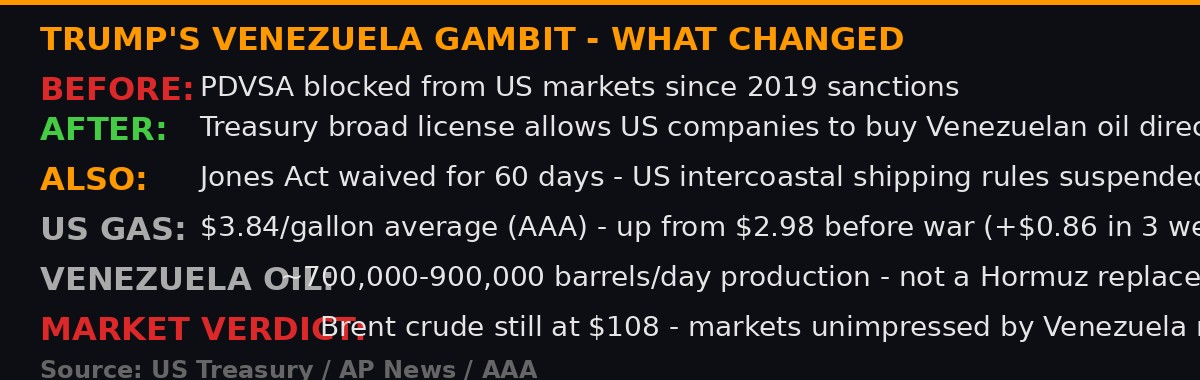
Washington's response to Day 23's energy catastrophe was to reach for a political tool that would have been unthinkable a month ago: lifting sanctions on Venezuela's state oil company PDVSA. (US Treasury Department announcement, March 18, 2026)
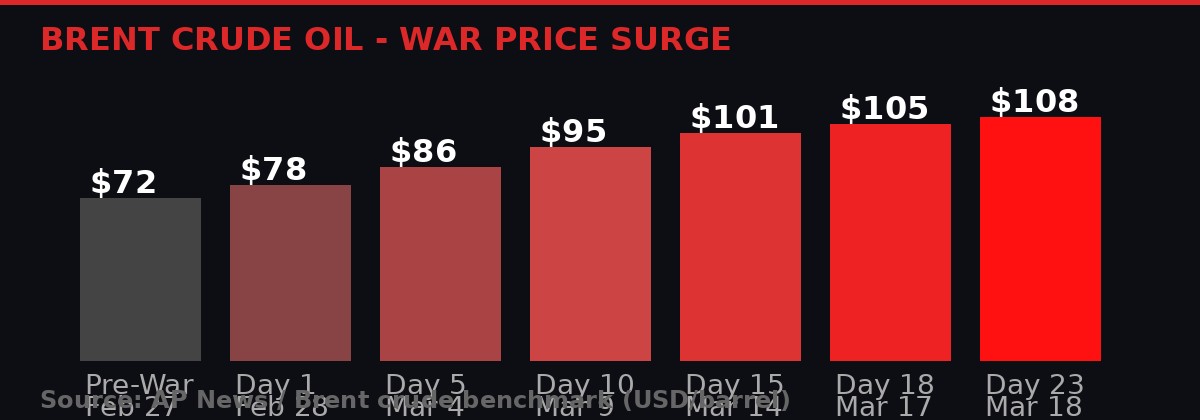
Treasury Secretary Scott Bessent issued a broad license on March 18 allowing U.S. companies to purchase Venezuelan oil directly from PDVSA and on global markets. For context: PDVSA had been effectively frozen out of U.S. markets since 2019, when the Trump administration - during Trump's first term - imposed maximum-pressure sanctions against Maduro's government. That same Trump is now reversing his own policy under pressure from $108 oil and a national average gas price of $3.84 per gallon, up from $2.98 before the war. (AAA fuel price data, as of March 18, 2026)
The White House also announced a 60-day waiver of Jones Act requirements - the 1920s-era law mandating that goods shipped between U.S. ports travel on U.S.-flagged vessels. The Jones Act regularly makes gas more expensive in coastal states that import fuel by sea. Suspending it is a meaningful but limited tool.
"Gas prices are up and we know they're up. And we know that people are hurting because of it. And we're doing everything that we can to ensure that they stay lower. This is a temporary blip." - Vice President JD Vance, event in Auburn Hills, Michigan, March 18, 2026
Markets received the Venezuela announcement with indifference. Brent crude climbed to $108 anyway. The problem is structural: Venezuela's oil production is currently estimated at 700,000 to 900,000 barrels per day under decades of mismanagement, disinvestment, and U.S. sanctions. Restoring it to the 3 million barrels per day it produced in the early 2000s would take years of capital investment and technical expertise that the country currently lacks. It cannot replace Hormuz, which in peacetime handled roughly 21 million barrels of oil and equivalent per day. (International Energy Agency pre-war data / Reuters energy analysis)
Meanwhile, Trump continued to receive rejection from every ally he asked for help reopening the Strait of Hormuz. The United Kingdom, which Trump called the "Rolls-Royce of allies," formally refused to commit warships. Prime Minister Keir Starmer said Britain requires "a proper thought-through plan" and that his forces would not be drawn into "the wider war." France's Emmanuel Macron said Paris might consider naval escorts only after the fighting stopped - which is another way of saying no. Germany's Defense Minister Boris Pistorius called for diplomatic solutions. EU foreign policy chief Kaja Kallas put it most directly: "This is not Europe's war. We didn't start the war. We were not consulted." (AP News, March 18, 2026 / multiple European government statements)
China, which was also asked by Trump to help reopen the strait, ignored the request. Analysts at the International Crisis Group noted the grim irony: an American show of force meant to intimidate Beijing had instead demonstrated that the U.S. could not manage the consequences of its own military campaign. China's state media called for all parties to stop military operations. (International Crisis Group analysis / AP News)
The Killing of Iran's Top Figures: Khatib, Larijani, Soleimani
Israel's intelligence war against Iran's leadership accelerated dramatically in the days surrounding Day 23. In an overnight strike preceding the South Pars attack, Israel killed Esmail Khatib, Iran's intelligence minister. This was not a fringe target: Khatib ran the Ministry of Intelligence and Security, the domestic and foreign intelligence apparatus that historically coordinated Iran's proxy network and penetrated foreign governments. (AP News, Israeli military confirmation, March 18, 2026)
The previous day, Israeli forces had also killed two other senior figures: Ali Larijani, senior strategic adviser to Supreme Leader Mojtaba Khamenei on nuclear negotiations with the Trump administration, and Gen. Gholam Reza Soleimani, head of the paramilitary Revolutionary Guard's Basij domestic force. Both men had been sanctioned by the U.S. Treasury - Larijani for his role in coordinating violent suppression of Iran's 2022 nationwide protests, Soleimani for years of leading the Basij's brutal internal crackdown operations. (U.S. Treasury sanctions records / AP News)
"Significant surprises" to come. - Israeli Defense Minister Israel Katz, statement following the killing of intelligence minister Khatib, March 18, 2026
Iran's response to Larijani's killing included deploying Khorramshahr-4 missiles with multiple-warhead payloads against central Israel. The Revolutionary Guard said explicitly that these missiles were designed to defeat air defense systems by releasing clusters of warheads at high altitude. AP journalists filmed at least one missile releasing its submunitions over Israeli airspace. It was one of these weapons - or a similar munition from the same barrage - that struck Beit Awa in the West Bank, killing three. (AP News footage and reporting, March 18, 2026)
Supreme Leader Mojtaba Khamenei - who took over after his father Ali Khamenei's death earlier in the war - publicly expressed condolences for the killing of Larijani. Iran's government remains, in the words of U.S. Director of National Intelligence Tulsi Gabbard speaking to Congress this week, "intact." She declined to provide details about any ongoing U.S. negotiations with Tehran. (AP News / Gabbard congressional testimony, March 18, 2026)
Strait of Hormuz: Iran's Stranglehold and the Shadow Tanker Trade
The Strait of Hormuz remains the war's central economic weapon, and the situation as of March 19 is more complex than either side's propaganda admits. (Lloyd's List Intelligence / Kpler trade analytics / AP News, March 18, 2026)
Most commercial shipping has stopped. Before the war, roughly 100 to 135 vessel passages moved through the strait per day. Between March 1 and March 15, that number fell to roughly 89 total transits over the entire two-week period - a collapse of more than 90 percent in daily throughput. Of those 89 vessels, Lloyd's List Intelligence says more than one-fifth were Iran-affiliated, transiting their own cargoes. The rest included Chinese-affiliated tankers, ships from Greece, India, and Pakistan - countries that have negotiated diplomatic arrangements with Tehran for safe passage. (Lloyd's List Intelligence, March 2026)
Iran has, despite the war, managed to export well above 16 million barrels of oil since the beginning of March, according to trade data platform Kpler. This is achieved through a combination of "dark" transits - ships that disable their AIS transponders and run close to the Iranian coast - and what maritime analysts call diplomatically negotiated safe corridors. India's Shipping Corporation vessels Shivalik and Nanda Devi transited the strait around March 13-14 following talks between New Delhi and Tehran. Pakistan's state-owned tanker Karachi made a confirmed passage. (Lloyd's List Intelligence / Kpler analyst Ana Subasic / AP News)
Treasury Secretary Bessent told reporters that Washington had deliberately allowed Iranian oil ships to cross the strait: "The Iranian ships have been getting out already, and we've let that happen to supply the rest of the world." This reveals the war's profound contradiction: the U.S. is simultaneously bombing Iran and allowing Iranian oil exports to prevent a complete global energy crisis that would crush U.S. domestic politics. (Bessent interview, via AP News)
Trump, posting on social media with visible frustration that no allies had offered military help to clear the strait, wrote: "WE DON'T NEED THE HELP OF ANYONE!" A senior British military official, Armed Forces Minister Al Carns, offered a colder assessment: reopening the strait is "a long way off" due to mines, attack boats, and drones that Iran has positioned throughout the waterway. (Trump social media post / AP News interview with Armed Forces Minister Carns)
What Comes Next: Escalation Without Exit
Day 23 crystallized a strategic reality that Washington, Jerusalem, and Tehran have been circling since February 28: this war has no clear off-ramp, and each escalation forecloses the ones before it. (AP News analysis / International Crisis Group / retired U.S. military officials)
Iran has now struck every major energy producer in the Gulf except Oman and Kuwait's offshore fields. Qatar has expelled its diplomats. The UAE has called the attacks a "dangerous escalation." Saudi Arabia is absorbing near-daily bombardment of its most critical province. None of these countries have entered the war offensively - but none can sustain indefinite bombardment without eventually being forced to choose sides.
The U.S. ally problem is not improving. Trump's America-first posture - going to war without NATO consultation, without a UN Security Council resolution, and without building the kind of coalition that enabled the 1990 Gulf War - has exhausted the goodwill Europeans spent three decades accumulating toward Washington. Retired Lt. Gen. Ben Hodges, former commanding general of U.S. Army Europe, put it plainly: "They are looking at the United States in a way that they never have before. And this is bad for the United States." (Hodges, quoted in AP News, March 18, 2026)
China's calculation is perhaps the most consequential. Beijing is buying Iranian oil at discounted prices, providing diplomatic cover for Tehran at the United Nations, and watching the United States exhaust its military credibility, its foreign relationships, and its domestic economic stability simultaneously. The International Crisis Group's Ali Wyne summarized the situation: "A show of U.S. force that was meant to intimidate Beijing has instead served to puncture the illusion of U.S. omnipotence." (Ali Wyne, International Crisis Group, AP News, March 18, 2026)
Oil at $108 is not the ceiling. Before the war, analysts had priced a Hormuz closure scenario at $130-$150. The difference between then and now is that markets still believe some negotiated resolution is possible. Every passing day of infrastructure destruction - South Pars, Ras Laffan, Habshan - tightens that window. At some point, the physical capacity to restart flows will itself be damaged beyond quick repair.
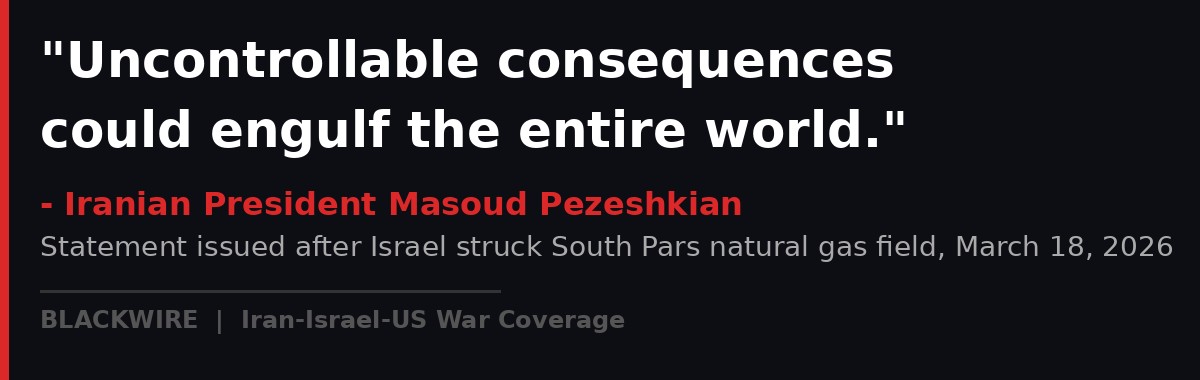
Iran's Pezeshkian warned after the South Pars strike of "uncontrollable consequences" that "could engulf the entire world." That language has been used before in Middle Eastern conflicts and rarely proved accurate. But the architecture of this particular crisis - simultaneous strikes on six countries' energy infrastructure, cluster munitions in the West Bank, Iranian oil getting through to China while U.S. allies refuse to help, a Fed holding rates while a war inflates every input cost - looks different from any previous Gulf confrontation. The parts are in motion. The mechanisms for stopping them are not visible yet.
Three Palestinian civilians in Beit Awa discovered on the night of March 18 that this war does not leave bystanders intact. The Gulf's energy infrastructure is learning the same lesson in real time.
Dispatches continue. Follow BLACKWIRE.
Get BLACKWIRE reports first.
Breaking news, investigations, and analysis - straight to your phone.
Join @blackwirenews on Telegram