Fujairah Burns: Iran Targets UAE's Last Open Oil Route
A drone strike on the UAE port of Fujairah signals a catastrophic expansion of Iran's war strategy. Hormuz is already sealed. Now the bypass is burning. As Kurdish Peshmerga mobilize on Iraq's border and the USS Tripoli heads south with 5,000 Marines, the conflict shows no ceiling.

File photo: Oil port infrastructure. On March 14, a drone strike triggered fires at Fujairah's oil storage complex - the UAE's only major terminal outside the Strait of Hormuz. Unsplash / illustrative
For the first two weeks of this war, the port of Fujairah had one strategic function: stay alive. It sits on the Gulf of Oman, east of the Strait of Hormuz, which means ships loading there don't have to navigate through Iran's de facto naval exclusion zone. When the IRGC announced on March 3 that all transit through the strait was suspended, Fujairah became the last functioning major oil terminal in the region.
On March 14, Iran took that option away too.
Shortly before noon local time, a drone struck the port complex, triggering fires at an oil storage facility. Bloomberg reported that oil loading operations were suspended immediately. Thick black smoke could be seen rising from the terminal, filmed by residents and posted across social media. BBC, Bloomberg, March 14
UAE authorities issued a statement saying civil defense teams were working to "contain the fire" and attributed it to "falling debris following the successful interception of a drone by air defenses." They reported no injuries. The phrasing was careful - the UAE has been trying to avoid explicitly calling Iranian attacks attacks.
The IRGC was less diplomatic. A statement issued through state media declared that "US interests in the UAE, including ports, docks and military locations," had become "legitimate targets" in response to American strikes on Kharg Island the previous day. Fujairah is home to US military support infrastructure and bunkering facilities used by the US Fifth Fleet supply chain. IRGC statement via Tasnim News Agency, March 14
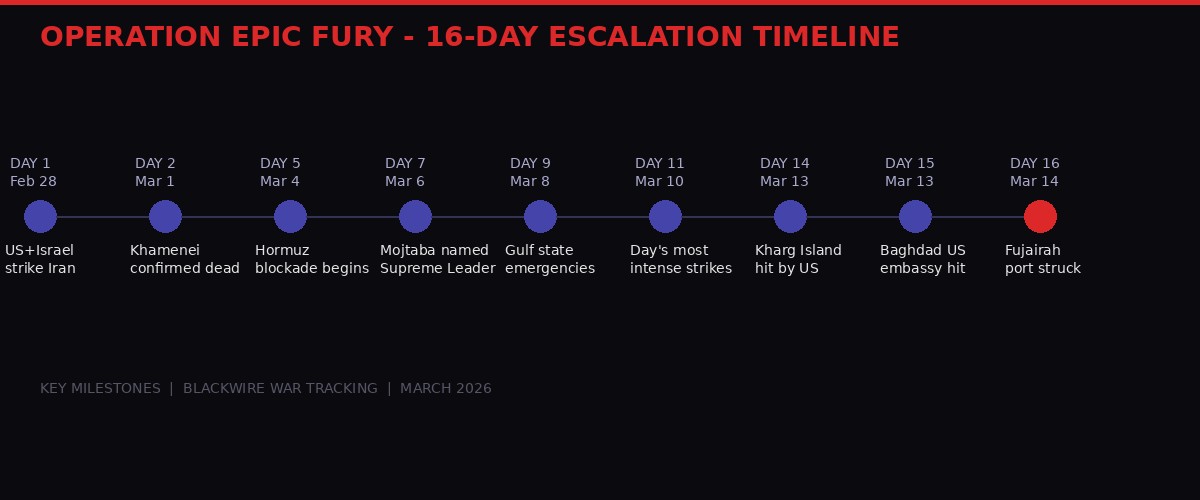
Sixteen days of escalation: from the first US-Israel strikes on February 28 to the Fujairah attack on March 14. Each step has outpaced the previous one. BLACKWIRE
Why Fujairah Is the Last Line
To understand why this matters, you need the geography. The Persian Gulf is shaped like a bottleneck. At the narrow end sits the Strait of Hormuz, a waterway roughly 33 kilometers wide at its narrowest point. Roughly 20 percent of the world's traded oil passes through it every day under normal conditions. US Energy Information Administration
The IRGC has been enforcing a blockade since Day 5 of the war. Iranian fast attack craft patrol the strait. Mines have reportedly been laid in contested shipping lanes. A Norwegian-flagged chemical tanker was boarded by IRGC naval commandos on Day 6 and released only after prolonged negotiations. The message was clear: the strait is closed until Tehran says otherwise.
Fujairah was designed as a Hormuz bypass. The UAE built it specifically so that tankers could load oil pumped overland from Abu Dhabi's Habshan fields, avoiding the strait entirely. During previous Gulf tensions, Fujairah was the pressure-release valve. It kept oil flowing when politics threatened to choke the strait.
Now the bypass itself is on fire.
The port handles roughly 1.3 million barrels per day of oil throughput under normal operations, and it bunkers up to 180 ships per month. Since the Hormuz blockade began, the pace had increased sharply as shipping companies desperately rerouted. Satellite tracking data from MarineTraffic.com showed an 40 percent surge in vessel traffic at Fujairah in the days following the closure of Hormuz. MarineTraffic analysis cited by Bloomberg
After this morning's strike, that traffic has no place to go. Brent crude crossed $107 per barrel by midday European trading. Bloomberg Markets
Kharg Island: The Provocation That Triggered Today
The Fujairah strike is a direct consequence of what happened 24 hours earlier. On March 13, US forces struck Kharg Island in the northern Persian Gulf - a small, militarized island that is the terminal for close to 90 percent of Iran's oil exports. The island's deep-water berths are the only facilities in Iran capable of loading Very Large Crude Carriers, the supertankers that move bulk oil across oceans.
President Trump announced the strike with characteristic bluntness: Iran's key oil island had been "totally obliterated." The Pentagon, per its usual posture, declined to confirm specific targeting details.
Iranian authorities, however, pushed back hard on the damage assessment. Ehsan Jahanian, political deputy to the governor of Bushehr province, said oil exports from Kharg were "fully under way" and facilities "remain intact." He acknowledged damage to "parts of the military facilities and Kharg Airport" but insisted no casualties had occurred among military personnel, oil company employees, or island residents. Tasnim News Agency via BBC Persian, March 14
The divergence between the American "obliterated" and the Iranian "fully under way" is a familiar propaganda gap. BBC Security Correspondent Frank Gardner, reporting from Riyadh, offered the most useful framing:
"Kharg is the terminal for close to 90% of Iran's oil exports because its waters are deep enough to load that oil onto tankers known as Very Large Crude Carriers. If President Trump decides to go one step further and destroy its actual oil facilities - as opposed to just the Iranian troops guarding them - then that is likely to drive oil prices even higher. More worrying is how hard Iran will hit back." Frank Gardner, BBC Security Correspondent, Riyadh, March 14
The Fujairah strike answers that question. Iran hit back within twelve hours, and it hit a neutral country's infrastructure to do so.
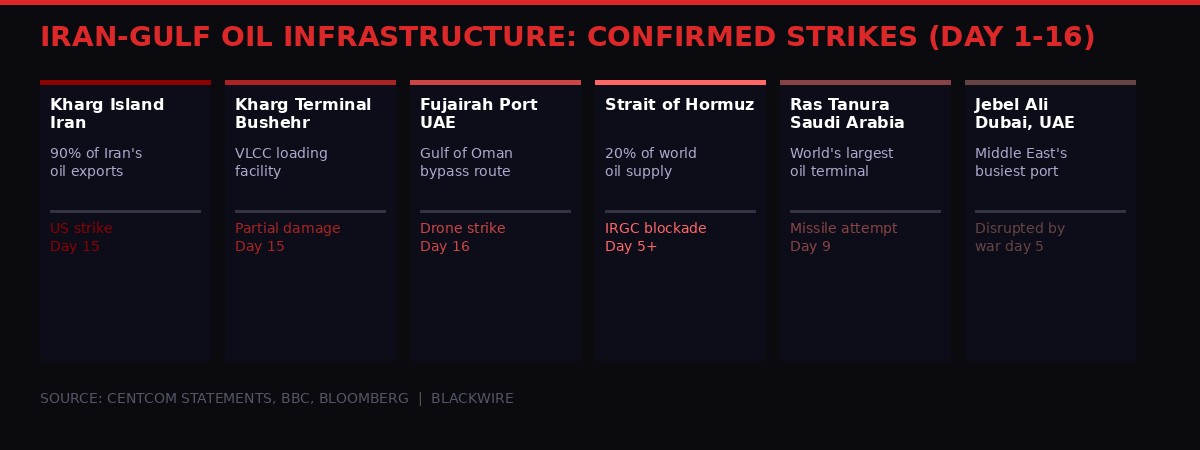
Sixteen days in, the strike pattern is clear: systematic targeting of every major oil node in the region, from Iran's own export terminal to UAE bypass routes to Saudi loading facilities. BLACKWIRE analysis, compiled from CENTCOM, BBC, Bloomberg
USS Tripoli: 5,000 More Americans Heading to the Fight
On the same day Fujairah burned, CBS News - citing two US officials - reported that an amphibious ready group led by the USS Tripoli had been ordered to the Middle East. The USS Tripoli is an amphibious assault ship, normally homeported in Japan, that typically operates with a Marine Expeditionary Unit embarked. That unit consists of roughly 5,000 sailors and Marines, distributed across several warships in the group. CBS News / BBC, March 14
The request for reinforcements was made by US Central Command and approved by Defense Secretary Pete Hegseth, according to the officials. The deployment brings the total US ground and naval presence in the theater to levels not seen since the 2003 Iraq War build-up.
What are those Marines for? Officially, no one is saying. But the force structure is revealing. Amphibious assault ships exist to project ground combat power onto hostile shores. The Marine Expeditionary Unit trained aboard USS Tripoli is equipped and doctored for amphibious landings, hostage rescue, non-combatant evacuation operations, and forced entry scenarios.
None of those missions suggest the war is winding down.
Trump, speaking to reporters on Friday, said US forces would hit Iran "very hard" over the coming week. When asked about timeline, he offered: "It will be over when I feel it in my bones." He added that escorting tankers through the Strait of Hormuz would begin "soon." White House pool report, March 13
Hegseth has been more direct. His stated position since Day 1: "no mercy for our enemies." The Tripoli deployment is consistent with that posture. It is not a defensive deployment. It is capacity for escalation.
Day 16 Situation Summary - March 14, 2026
- Fujairah port - Drone strike, fires active, oil loading suspended. UAE calls it intercepted debris. IRGC claims responsibility implicitly via target declaration.
- Kharg Island - US strike on Day 15. Iran claims operations continuing. Damage disputed. No confirmed casualties.
- Strait of Hormuz - Effectively closed since Day 5. IRGC naval patrols active. Mine reports unconfirmed by CENTCOM.
- Israel - IDF reports new wave of Iranian missiles launched at approximately 12:41 local time. Ongoing multi-wave pattern continues. IDF confirms strikes on approximately 110 Hezbollah command centres since war began.
- Iraq - Kurdish Peshmerga groups mobilizing in northern Iraq. Iran launching preemptive drone strikes on Komala party camps near Sulaymaniyah.
- USS Tripoli - Ordered to Middle East with amphibious ready group. Approximately 5,000 sailors and Marines. Request from CENTCOM, approved by Hegseth.
- Oil - Brent crude above $107 per barrel. IEA warns of supply disruption lasting months if Hormuz closure continues past 30 days.
- US casualties - 13 confirmed killed. Six were crew of KC-135 refueling aircraft that crashed in western Iraq on Day 14.
The Kurdish Front: 40,000 Fighters Watching the Border
In the mountains of northern Iraq, a different kind of war is taking shape - one that doesn't show up on satellite images of burning ports or missile impact craters, but one that could reshape the endgame entirely.
BBC correspondent Orla Guerin visited a training camp run by Komala of the Toilers of Kurdistan, a dissident group that is part of a recently formed alliance of Iranian Kurdish organizations. Commander Shaho Bloori, 53, told Guerin that thousands of fighters are "organised in the mountains and ready to go home" - and that "that will be soon." BBC, March 13
The Kurdish question is one of the most destabilizing variables in this war. Iran has an estimated 10-12 million Kurdish citizens, concentrated largely in the western provinces of Kurdistan, Kermanshah, and West Azerbaijan. The Iranian Kurdish political parties - Komala, KDPI, PJAK, and others - have been agitating for autonomy or independence for decades. The regime has suppressed them through executions, drone strikes on camps in Iraqi Kurdistan, and periodic military operations into the Kurdish-populated border zones.
Now, with the regime under unprecedented military pressure from the air and its senior leadership decimated, the Kurdish parties see a window. A senior Komala official, Amjad Hossein Panahi, was direct with Guerin: "Bombing is weakening the regime, but it's a big country and this is not enough. Ground forces must intervene, and the Kurds can play an important role in this." BBC, March 13
Iran's response has been preemptive. The IRGC launched drone strikes on Komala positions near Sulaymaniyah in recent days. The strikes caused injuries but no confirmed deaths. The message from Tehran: the Kurdish threat is registered, and the IRGC will kill Peshmerga on Iraqi soil regardless of the diplomatic consequences for Baghdad.
The Iraqi Kurdish Regional Government is caught in an impossible position. It shares a long border with Iran, hosts Iranian Kurdish dissident groups under a long-standing political arrangement, and has strong economic ties with both Tehran and Washington. The KRG has been trying to keep cameras away from the Peshmerga camps and keep journalists from confirming force levels. That effort is failing.
The alliance of Iranian Kurdish groups has not yet committed to crossing the border. Trump has "blown hot and cold" on the idea, according to BBC's Guerin, and the US publicly remains ambivalent. A no-fly zone over western Iran, which the Kurdish parties are requesting as a precondition for major ground operations, has not been established. But the fighters are trained, positioned, and waiting. If the regime shows signs of fracture - if Mojtaba Khamenei's contested authority weakens further, or if a major city rises in protest - the calculus changes overnight.
New Supreme Leader, Wounded and Silent
Mojtaba Khamenei, 56, delivered his first public address on Thursday, March 13 - the 14th day of the war. He did not appear on camera. His statement was read by a newsreader on Iranian state television.
The content was defiant: Tehran would continue the Hormuz blockade, would "avenge the blood" of Iranians killed in the conflict, and warned neighboring countries to stop hosting American military bases. The framing was that of a regime intact and in control. Iranian state television, March 13
The reality on the ground is different. US Defense Secretary Pete Hegseth has claimed Mojtaba is "wounded, and likely disfigured" - a claim Iran has not directly contradicted, given his continued absence from visual media. The Assembly of Experts, Iran's clerical body responsible for confirming a new Supreme Leader, convened an extraordinary session in Qom on Day 12. Reports from inside Iran, filtered through exile media, describe deep divisions within the clerical establishment over Mojtaba's suitability and the legitimacy of wartime succession. BBC Persian, Iran Wire, March 12-14
What is clear: Iran is functioning as a state and capable of launching coordinated military operations - the Fujairah drone strike required planning, logistics, and authorization. What is less clear is whether that capacity reflects a unified command structure or a fragmented IRGC acting on its own initiative. Several intelligence analysts, speaking anonymously to Reuters, have assessed that the IRGC's Aerospace Force has significant operational autonomy and can execute strikes without direct approval from the Supreme Leader's office.
If that is true, ending the war requires not just defeating Iran's political leadership but bringing the IRGC to heel - a problem of a different order of magnitude entirely.
The Road to Day 16: A Timeline of Escalation
Amsterdam Attack: The War Comes to Europe
While the Gulf burns, European security services are tracking a parallel front. In Amsterdam on Saturday morning, an explosion occurred at a Jewish school in what the city's mayor called "a deliberate attack." The blast came days after a separate incident in Rotterdam. BBC, March 14
Dutch authorities have not publicly attributed either incident to Iran. But the timing tracks with a documented pattern: in the weeks since the war began, European intelligence agencies have shared threat assessments warning of potential IRGC-linked or IRGC-inspired attacks against Jewish and Israeli-associated targets. Britain arrested multiple individuals in early March for alleged connections to an Iranian espionage and harassment network. UK Home Office, March 7
The Amsterdam attack has not produced confirmed casualties as of the time of writing. Dutch security services have been on elevated alert since before the war. The incident is under active investigation, and political pressure is mounting on the Dutch government to publicly name Iran as a state sponsor of the network responsible. That step - official attribution to a nation-state in a hot war - would trigger alliance obligations and a new set of consequences the EU is not prepared to handle.
For now, Europe watches. The war was supposed to be a "short-term excursion," in Trump's formulation. European capitals are quietly preparing for a longer reality.
What Happens Next: The Logic of Escalation
Sixteen days into this war, the pattern is set: every escalation by one side produces an escalatory response by the other, and each cycle raises the stakes for civilian infrastructure that has nothing to do with the military objectives stated at the outset.
Kharg Island was struck to pressure Iran's oil revenue and its capacity to fund the war. Iran responded by striking Fujairah to pressure the Gulf states hosting US bases and to signal that there is no "safe" infrastructure in the region. If the US now destroys Kharg Island's actual export terminals - rather than just the military installations on the island - Iran has already shown it will find something else to hit. The IRGC's declared target list for the UAE includes ports, docks, and military locations. That is the entire economic geography of the UAE.
The USS Tripoli deployment puts 5,000 additional Marines within reach of the theater. Their presence creates new options for CENTCOM - and new targets for Iranian military planners. A Marine Expeditionary Unit is a significant ground combat force. Its deployment, combined with Trump's language about the war lasting "until I feel it in my bones," suggests the White House has not established a clear military end state.
The Kurdish dimension represents either the war's most destabilizing variable or its most promising one, depending on perspective. If 40,000 Peshmerga fighters open a ground front in western Iran, they could accelerate regime collapse - the outcome the US nominally seeks. They could also trigger a humanitarian catastrophe, draw Turkey into conflict via PKK proxy dynamics, further destabilize an already fragile Iraq, and produce a post-regime vacuum that makes the 2003 Iraq aftermath look manageable.
The IEA has warned that if the Hormuz closure extends past 30 days, global oil markets will face a supply disruption without modern precedent. Emergency reserve releases from the US, IEA members, and Gulf producers can cover roughly 90 days of shortfall at current rates. After that, the math gets ugly.
Thirteen Americans are dead. Thousands of Iranians are dead - civilians and military alike - though the scale of civilian casualties in Iran remains impossible to verify independently given the information environment. Oil is above $107 and climbing. The Hormuz bypass is on fire. And the force being dispatched to resolve this is an amphibious assault group designed for landings.
Day 17 starts tomorrow.
Get BLACKWIRE reports first.
Breaking news, investigations, and analysis - straight to your phone.
Join @blackwirenews on Telegram