War Comes Home: $108 Oil, $3.84 Gas, a Frozen Fed, and a Venezuela Reversal Nobody Saw Coming
Americans woke up Wednesday to the highest gas prices in two and a half years. The Federal Reserve held interest rates and admitted it has no idea how bad things will get. And in one of the most startling policy pivots of the Trump era, the White House quietly lifted restrictions that for years blocked U.S. companies from doing business with Venezuela's state oil giant. All of this on the same day Israel struck the world's largest natural gas field, Iran fired cluster-warhead missiles at Tel Aviv, and Europe told Trump it would not send a single warship to help.

Global oil infrastructure is the central battlefield of the Iran war's economic dimension. (Unsplash)
Twenty-Three Days and Counting: The War's Economic Toll

Pump prices in the U.S. have jumped nearly 29% since the Iran war began. (Unsplash)
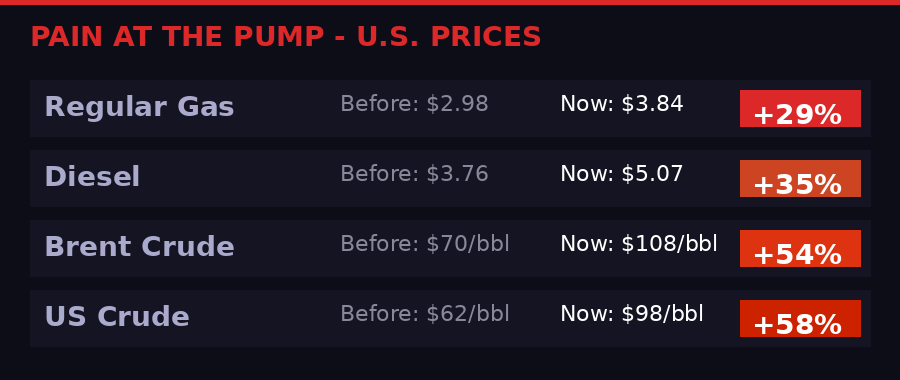
The U.S.-Israeli war against Iran entered its 23rd day on March 18 with no ceasefire in sight, no coalition partner willing to join the fight, and an economic shock that is now registering in the daily lives of ordinary Americans in ways that abstract oil barrel prices never quite captured. The price at the pump is the number that voters feel. And that number is now $3.84 per gallon on average, up from $2.98 the night before U.S. and Israeli bombers first struck Iranian territory on February 28. According to data from AAA, the American motoring club that tracks fuel prices across the country, that is the highest level since September 2023.
Diesel - the lifeblood of trucking, farming, and industrial logistics - is even worse. The U.S. average for diesel hit $5.07 per gallon on Wednesday, per AAA, its highest level since 2022 and up sharply from $3.76 before the war began. For a country that moves most of its goods by road and relies on just-in-time supply chains built around cheap fuel, these are not just statistics. They are cost inputs that ripple through every sector of the economy within weeks.
The international benchmark, Brent crude, broke above $108 a barrel on Wednesday - up roughly 54% since the war's first airstrikes. U.S. crude is trading at nearly $98. The trigger for Wednesday's jump was Israel's strike on Iran's South Pars natural gas field, the world's largest, combined with Iranian retaliation strikes on Qatar's Ras Laffan liquefied natural gas facility and attacks on Saudi Arabia's oil infrastructure in its Eastern Province. Each attack on energy infrastructure carries a premium because markets understand that any further escalation compounds supply uncertainty.
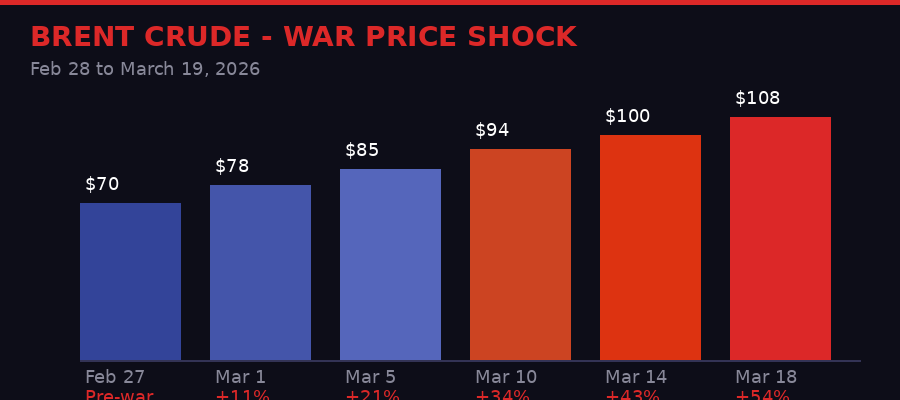
"Gas prices are up and we know they're up," Vice President JD Vance acknowledged at an event in Auburn Hills, Michigan on Wednesday. "And we know that people are hurting because of it." He called it "a temporary blip." Economists are less certain. The International Energy Agency's emergency reserve releases earlier in the war failed to move prices, and analysts at Rystad Energy's chief economist Claudio Galimberti told AP he expects the conflict to last at least two to three more weeks - with prices remaining "high and volatile" until traffic through the Strait of Hormuz resumes.
The South Pars Strike: Energy War Enters a New Phase

Iran's South Pars gas field, shared with Qatar's North Field, is the largest natural gas reservoir on Earth. (Unsplash)
Israel's reported strike on Iran's South Pars natural gas field on Wednesday represented a significant strategic shift. Previous Israeli and American strikes in this war have focused primarily on Iran's military command structure, missile stockpiles, Revolutionary Guard leadership, and nuclear infrastructure. Hitting South Pars is something different: it is an attack on Iran's domestic energy lifeline.
South Pars is not primarily an export asset. Iran exports relatively little natural gas - about 9 billion cubic meters annually, mostly to Turkey and Armenia, customers that have alternative supply options. The field's real strategic value is domestic. Iran is the fourth-largest consumer of natural gas in the world, ahead of countries with far larger economies, because it uses heavily subsidized gas for heating, cooking, and electricity generation. South Pars accounts for roughly 80% of that supply. According to analysis by the Center on Global Energy Policy at Columbia University, attacking it does not primarily hurt Iran's oil revenues - it threatens to knock out the power grid for Iranian cities, especially going into spring when demand shifts but infrastructure remains vulnerable.
Iranian President Masoud Pezeshkian responded with language suggesting the regime sees this as a potential turning point. He warned of "uncontrollable consequences" that "could engulf the entire world." Iranian state media reported fires at facilities near Asaluyeh on the Gulf coastline, where South Pars processing infrastructure sits. The Islamic Republic immediately threatened to retaliate against Gulf neighbors' energy assets - and followed through within hours, striking Qatar's Ras Laffan facility and attacking Saudi Arabia's Eastern Province.
European natural gas prices jumped 7% on news of the South Pars attack - even though South Pars' exports do not directly supply Europe. The jump reflects contagion fear: Iran attacking Qatar's LNG export terminal at Ras Laffan has already forced a shutdown there, reducing global LNG supply and forcing competition for available cargoes from other sources. Any further damage to Gulf gas infrastructure tightens a market that was already strained before the war began.
"The attack is a serious escalation which threatens retaliatory strikes on Gulf and Israeli production facilities." - Andres Cala, geopolitical analyst, Montel News
The Federal Reserve Sits on Its Hands - And Tells You Why

Federal Reserve Chair Jerome Powell held rates steady Wednesday and offered an unusually candid admission of uncertainty. (Unsplash)
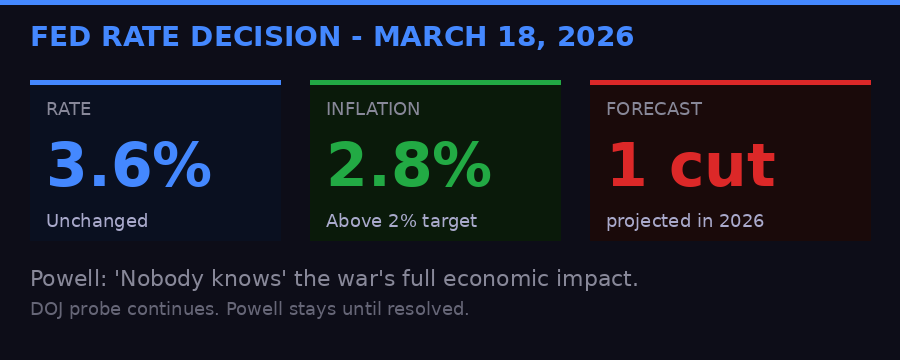
The Federal Reserve held its benchmark interest rate unchanged at 3.6% on Wednesday, and Chair Jerome Powell gave a press conference that was notable less for what he said and more for how honest he was about what he does not know. "The thing I really want to emphasize is, nobody knows," Powell said, referring to the economic impact of the Iran war. "The economic effects could be bigger, they could be smaller, they could be much smaller, they could be much bigger. We just don't know."
That is a remarkable admission from the head of the world's most powerful central bank. The Fed's mandate is price stability and full employment. Right now, both are under threat from a single exogenous shock: a war that nobody at the central bank was asked about before it began and that nobody there has the tools to end. The Fed can raise rates to fight inflation, but doing so when the economy is already absorbing a 54% oil price surge risks tipping into recession. It can cut rates to support growth, but that risks allowing inflation to run further above target in an environment where gas and diesel prices are feeding into every downstream cost.
The Fed's preferred inflation measure was already at 2.8% in January, before the war began - above the 2% target. Powell said the central bank needs to see "further progress in the price of goods declining as the impact of tariffs fades" before cutting rates. The Iran war makes that timeline completely unpredictable. Fed policymakers maintained their forecast for one additional rate cut in 2026, but Powell made clear that forecast is conditional on the war not significantly worsening - a condition that, on Day 23, looks precarious.
Investors read the room. The S&P 500 dropped 1.4% after the Fed decision. The central bank's message - we don't know, we're waiting, don't expect help anytime soon - was not what markets wanted to hear from the institution historically seen as the backstop against economic catastrophe.
Powell also addressed the ongoing DOJ investigation into his congressional testimony about a Fed building renovation - a politically charged investigation that critics see as Trump administration pressure to install a more compliant Fed chair. Powell was blunt: "I have no intention of leaving the central bank" until the investigation is dropped or resolved. Trump's nominee to replace him, former Fed official Kevin Warsh, has seen his Senate confirmation delayed because key Republican senators oppose the DOJ probe. The result is institutional limbo at the worst possible moment.
"Fed officials are aware they've missed their inflation target for five years, and they do not want to continue to miss it indefinitely." - Nathan Sheets, Chief Economist, Citi; former Fed economist
The Venezuela Reversal: Ideology Hits the Gas Pump

Venezuela's PDVSA can now sell oil directly to U.S. companies under an emergency Treasury waiver issued March 18. (Unsplash)
One of the most jarring moves of Wednesday came from Treasury, not the Pentagon. The Trump administration - which spent years imposing and reinforcing sanctions against Venezuela's government and its state oil company, Petroleos de Venezuela S.A., known as PDVSA - quietly issued a broad authorization allowing U.S. companies to buy Venezuelan oil and do business with PDVSA directly. For years, this kind of transaction was explicitly banned under U.S. sanctions as punishment for the Maduro government's authoritarianism and human rights record.
The political context is unusual even by the standards of this administration. In January, Trump oversaw a U.S. military operation that resulted in the ouster and arrest of former Venezuelan President Nicolas Maduro. Trump had said the U.S. would effectively "run" Venezuela and monetize its oil reserves. Wednesday's Treasury action is a partial step toward that vision - but taken at a moment of desperation, not triumph.
The immediate trigger is obvious: Brent crude is at $108, American drivers are furious, and the Republican Party faces a midterm election in November with energy prices as a central voter concern. The administration is throwing every available lever. In addition to the Venezuela sanctions easing, Trump also waived Jones Act requirements for 60 days - those are the 1920s-era shipping rules requiring goods moved between U.S. ports to travel on U.S.-flagged vessels. The waiver is designed to allow cheaper, more flexible routing of fuel supplies along the U.S. coast.
But energy analysts are tempering expectations. "We're talking about 12 to 18 months before we see dramatic changes in Venezuelan output," said Geoff Ramsey, an expert on Latin America at the Atlantic Council, speaking to AP. Venezuela's energy infrastructure has been degraded by years of mismanagement, sanctions, and underinvestment. Even with the sanctions lifted and U.S. companies allowed in, physical production cannot ramp up fast enough to meaningfully offset what is being choked off in the Persian Gulf.
Rystad Energy's Galimberti was equally blunt: "We are in the most abnormal market I can remember. As long as the strait remains shut, we're going to have a crisis." The Venezuela play may buy a few cents per gallon at the margin in certain markets over coming months. It will not fix a war.
The Global Raspberry: Every Ally Has Said No

NATO members have rejected Trump's demand for warships in the Strait of Hormuz. European leaders say the war is not theirs to fight. (Unsplash)
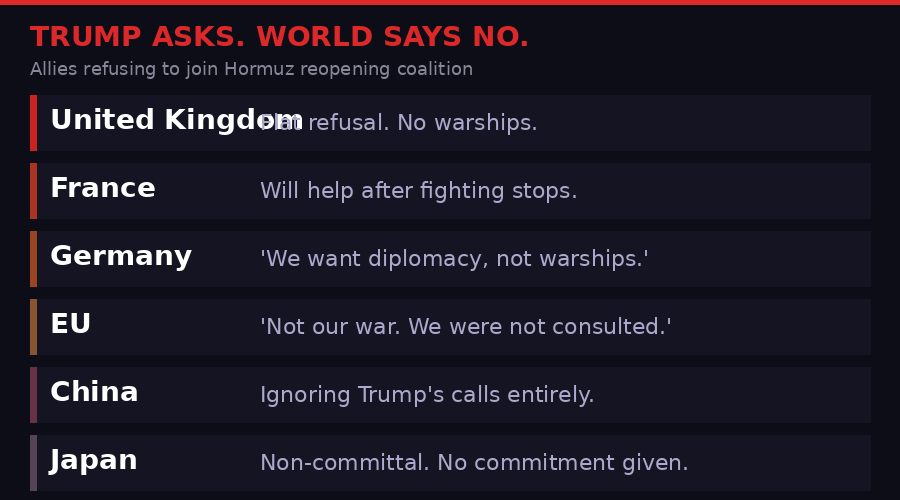
The Trump administration's inability to assemble a coalition to reopen the Strait of Hormuz is now being described by European defense analysts as "a global raspberry." The term - British slang for a contemptuous refusal - was coined by François Heisbourg, a veteran French defense strategist, and it has stuck because it captures the breadth of the rejection. No close American ally has agreed to send warships. Major neutral powers have ignored the request entirely.
Britain, historically the most reliable U.S. military partner, has refused point-blank. Prime Minister Keir Starmer, who cultivated relations with Trump carefully enough to secure an early trade deal, drew a firm line: "Britain will not be drawn into the wider war." Starmer told Parliament that British military action requires backing under international law and "a proper thought-through plan" - a pointed suggestion that neither exists. Trump was incandescent. He described Britain as "the Rolls-Royce of allies" and complained publicly that he had asked specifically for British minesweeping ships. "I was not happy with the U.K.," he said. "They should be involved enthusiastically. We've been protecting these countries for years."
France's Emmanuel Macron offered a conditional opening: France could envision naval escorts in the Strait of Hormuz, he said, but only once fighting has stopped. That is roughly equivalent to saying he might help once there is nothing to help with. "France didn't choose this war. We're not taking part," Macron said.
Germany's Defense Minister Boris Pistorius was even more direct. "We want diplomatic solutions and a swift end to the conflict. Sending more warships to the region will certainly not contribute to that." The EU's foreign policy chief Kaja Kallas framed it in terms that stung: "This is not Europe's war. We didn't start the war. We were not consulted."
China, not an ally but a major stakeholder in Hormuz given its dependence on Gulf oil, is simply ignoring Trump's calls. Beijing has its own strategic calculus: Iran has allowed Chinese-affiliated ships to transit the strait, giving China a functional workaround that makes joining a U.S.-led coalition actively counterproductive to Chinese interests. Trump's phone to President Xi has reportedly gone unanswered on the Hormuz question. A planned Trump visit to Beijing has slipped, with no new date set.
The deeper structural problem, as former Lt. Gen. Ben Hodges - the former commanding general of U.S. Army Europe - told AP, is that Trump spent his first year back in office bullying these same allies over tariffs, Greenland, defense spending, and NATO commitments. "Allies are looking at the United States in a way that they never have before. And this is bad for the United States," Hodges said. Some European leaders, having tried flattery and appeasement, "are starting to realize that there's no benefit or value in using flattery."
"My attitude is: We don't need anybody. We're the strongest nation in the world." - President Donald Trump, Monday March 16
The Strait of Hormuz: Closed in Theory, Leaking in Practice

Some 90 ships have slipped through the Strait of Hormuz since March 1, mostly on dark transits or with diplomatic clearance from Iran. (Unsplash)
The Strait of Hormuz is not fully sealed - but it might as well be for the purposes of normal global energy trade. According to data from Lloyd's List Intelligence, about 89 ships crossed the strait between March 1 and March 15. Before the war, the waterway handled roughly 100 to 135 vessel passages per day. That means traffic has dropped to approximately 6 ships per day from what was previously a steady stream of dozens. About 20 vessels have been attacked in the area since the war began.
The ships getting through are a revealing cross-section of who still has operational leverage. Iran-affiliated vessels make up more than a fifth of the transits - Iran has exempted its own exports from the blockade and is continuing to ship oil primarily to China, its biggest customer. Iran has exported more than 16 million barrels since March 1, according to trade analytics platform Kpler. China is absorbing these shipments, in some cases having vessels declare Chinese crew or use China-affiliated flags to reduce the risk of attack.
India and Pakistan have also managed limited transits through a combination of state-level negotiations with Tehran. India's LPG carriers Shivalik and Nanda Devi crossed around March 13-14 following diplomatic talks. India's foreign minister Subrahmanyam Jaishankar told the Financial Times the transit was enabled by conversations with Iran - an implicit acknowledgment that the strait has effectively become a toll road where Iran decides who passes.
Meanwhile, countries with no direct diplomatic channel to Iran are adapting. Saudi Arabia has rerouted some of its oil exports by pipeline across the country to Red Sea ports. Iraq has reached a deal with the Kurdish autonomous region to begin exporting 250,000 barrels per day through a pipeline to a Turkish port - bypassing the Gulf entirely. These workarounds add cost and time but confirm that the global energy system is beginning to route around the blockade in ways that will take months, not days, to fully substitute.
The British Armed Forces Minister Al Carns put the military reality plainly: "Any reopening of the strait is a long way off." The threat profile includes mines, attack boats, drones, and shore-based missiles. Clearing the strait militarily is not a single operation - it is a sustained campaign requiring significant naval presence. Without coalition support, the U.S. is doing it alone, and is choosing not to force the issue while attempting to manage oil prices through other means.
The Assassinations: Israel's Decapitation Campaign Continues

Israel has killed multiple senior Iranian officials in rapid succession since the war began, including the intelligence minister on March 18. (Unsplash)
On the military front, Israel's decapitation campaign continued without pause on Wednesday. Iran's intelligence minister, Esmail Khatib, was killed in an overnight strike - the latest in a series of senior Iranian officials targeted and eliminated since the war began. Israeli Defense Minister Israel Katz promised "significant surprises" to come and described the intelligence minister's killing as part of a continuing campaign against Iran's top leadership.
The day before, on March 17, Israel killed Ali Larijani - a figure of extraordinary significance in Iranian political life. Larijani was not a battlefield commander. He was a senior strategic adviser to the late Supreme Leader Ali Khamenei on nuclear negotiations with the Trump administration. His killing was sanctioned by the U.S. Treasury Department in January for his role in coordinating the violent suppression of nationwide protests, but his principal function had been as a sophisticated diplomatic operator. His death on March 17, along with the killing of Gen. Gholam Reza Soleimani - head of the Revolutionary Guard's Basij paramilitary force - drove Iran's retaliatory response on March 18.
Iran's retaliation was calibrated for maximum psychological impact. The Revolutionary Guard announced it used multiple-warhead missiles - weapons that release a cluster of munitions capable of saturating Israeli missile defenses - directed at central Israel. Footage filmed by the Associated Press showed at least one missile releasing a cluster of munitions over Israeli territory. Two people were killed near Tel Aviv. The multiple-warhead design is significant: it signals that Iran is actively trying to counter the sophisticated interceptor systems that have protected Israel from simpler ballistic attacks.
The West Bank sustained its first fatalities of the war on Wednesday, when Palestinian Red Crescent workers reported at least four people killed in the town of Beit Awa. It was not immediately clear whether they died from a direct strike or debris from a missile interception. The deaths expand the geographic footprint of the war's civilian toll in ways that will be politically significant for any future ceasefire negotiations.
Who Wins If This Continues: The Strategic Picture at Day 23
Three weeks and two days into a war that began on February 28, the strategic picture is clarifying in uncomfortable ways. The Trump administration launched this conflict with a declared goal of dismantling Iran's nuclear program and, many analysts believe, seeking regime change. Neither objective has been achieved. Iran's leadership, though it has suffered devastating losses, remains functional. The new Supreme Leader, Mojtaba Khamenei, has consolidated his position and continues to direct operations. Iran's nuclear scientists have dispersed. The program has been degraded, but not destroyed.
Meanwhile, the war's economic costs are flowing disproportionately to the countries that started it. The United States is paying $108 per barrel on global markets. American households are paying $3.84 a gallon at the pump. European allies - who were neither consulted nor involved - are paying elevated energy prices and watching their relationship with their most important security partner fray in real time. Iran, despite losing senior leaders and military hardware at a staggering rate, is still exporting 16 million barrels of oil via dark channels and still extracting economic leverage through Hormuz.
China is the clearest geopolitical beneficiary. Beijing has maintained its oil supply through Iran's selective enforcement of the blockade, is buying Iranian crude at discount prices unavailable to sanctioned competitors, and has watched the United States burn through international goodwill while fighting a war that had no UN mandate and no coalition. China's refusal to help reopen Hormuz is not passive disinterest - it is a deliberate strategic choice that costs Beijing nothing while making Washington look isolated.
The Federal Reserve's admission - "nobody knows" what comes next - is the honest answer to every question about this war right now. Nobody knows when it ends. Nobody knows what an acceptable Iranian surrender looks like. Nobody knows whether the U.S. public, currently absorbed by gas prices, will eventually demand an exit. And nobody knows what the Middle East's energy map looks like when the shooting finally stops.
What is known: at $108 a barrel, every week this war continues transfers roughly $2 billion in additional daily oil revenue to the global energy sector. American consumers are paying a hidden war tax every time they fill their tanks. The Jones Act waiver and Venezuela sanctions flip are tactical measures that acknowledge the pain without having a plan to end it.
War Price Timeline: February 28 to March 19
What Comes Next: The Pressure Points to Watch
The next 72 hours will test several variables that analysts are watching closely. Israel's Defense Minister Katz promised "significant surprises" - a phrase that in this war has often preceded a major strike. Whether those surprises target Iran's nuclear sites, remaining military leadership, or energy infrastructure will determine whether Wednesday's 5% oil price spike becomes a floor or a temporary peak.
On the diplomatic front, the collapse of Trump's coalition-building push forces a choice. The U.S. can escalate unilaterally to force open the Strait of Hormuz - a costly military operation with no guarantee of success - or it can accept the current partial blockade while managing prices through alternative supply. The Venezuela sanctions flip is evidence that the administration has chosen the latter approach, at least for now.
Iran's domestic situation is the wild card. South Pars supplies 80% of the country's natural gas. If the attack has meaningfully degraded its output, Iran faces potential power shortages at home that could intensify public pressure on the leadership from within. A regime that is being decapitated from above while its population faces blackouts and fuel shortages from below is operating in unfamiliar terrain. But history suggests that foreign attacks on domestic infrastructure often rally populations around their government, at least in the short term.
Powell's "nobody knows" is the defining phrase of the moment. The Iranian war has entered a phase where every major actor - the U.S. government, the Federal Reserve, European allies, energy markets, and Tehran itself - is operating with incomplete information and deteriorating confidence in their ability to predict what the next 24 hours will bring. That uncertainty is itself a cost, priced into every barrel of oil and every gallon of gas sold anywhere on Earth.
The war started with the stated objective of eliminating Iran's nuclear threat. It is now a war whose most visible daily battleground is a gas pump in Louisiana, a flatbed trucker in Pennsylvania, and a Federal Reserve chair in Washington who will tell you plainly: he doesn't know what happens next.
Get BLACKWIRE reports first.
Breaking news, investigations, and analysis - straight to your phone.
Join @blackwirenews on Telegram