South Pars Struck, Qatar Expels Iran, West Bank Mourns Its First Dead
Israel struck the world's largest natural gas field. Iran retaliated by hitting Qatar's LNG terminals, UAE gas plants, and killing civilians in the West Bank with a cluster munition. Qatar expelled Iranian diplomats. America's closest allies refused - again - to send ships. Oil crossed $108 a barrel. Day 23 of the Iran war produced more carnage, more diplomatic wreckage, and still no path to an exit.
BLACKWIRE War Desk graphics. Day 23 of Operation Epic Fury. March 19, 2026.
The South Pars Strike That Changed Everything
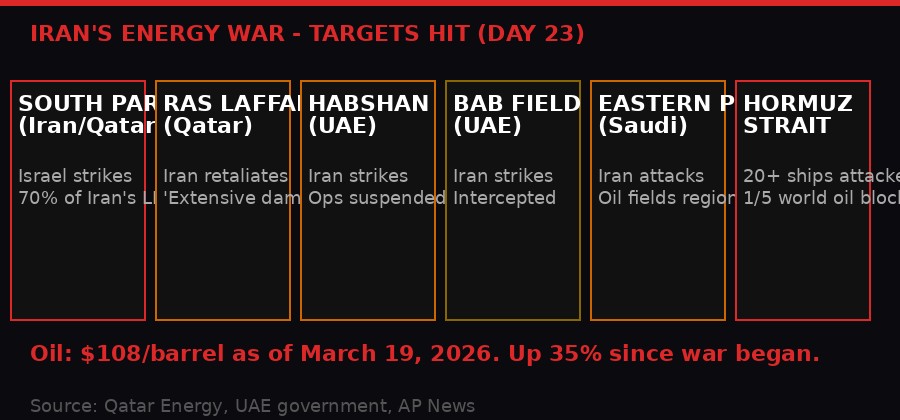
Every energy facility hit in the Iran war as of March 19, 2026. Source: AP News, Qatar Energy, UAE government statements.
South Pars is not just a gas field. It is the largest natural gas reservoir on the planet, a 3,700 square kilometer offshore structure straddling the maritime border between Iran and Qatar. Iran calls its section South Pars. Qatar calls its section the North Field. Together they hold roughly 51 trillion cubic meters of gas - enough to power the global economy for years.
Israel struck it on March 18. The attack was not claimed publicly. But Israeli Defense Minister Israel Katz made no effort to hide the intent, promising more "surprises" in the same statement that confirmed the killing of Iran's intelligence minister, Esmail Khatib. (Source: AP News, March 18, 2026)
A person familiar with the matter told AP that the United States was informed about Israel's plans to strike South Pars in advance - but did not participate. Whether the Trump administration agreed with the decision was not disclosed.
The strike was strategically unlike anything that came before it. Previous Israeli attacks targeted Iran's military infrastructure, its nuclear sites, its command figures. This was different. This was going for the economic jugular - the facility that funds Iran's war machine, that powers its civilian economy, that it shares with the richest natural gas state on earth.
Iranian President Masoud Pezeshkian responded with the bluntest warning yet, saying the attack could produce "uncontrollable consequences" that "could engulf the entire world." The statement was notable not for its belligerence but for its specificity - suggesting even Tehran understands what full regional economic collapse looks like.
"I do not want to authorize this level of violence and destruction because of the long term implications that it will have on the future of Iran." - President Donald Trump, social media post, March 18, 2026
Trump said Israel would not strike South Pars again. The same post warned that if Iran continued attacking Qatar's energy infrastructure, the U.S. would "massively blow up the entirety" of the field. The logic was convoluted: Iran had struck Qatar because Israel struck South Pars. Trump was threatening to finish what Israel started if Iran kept retaliating for what Israel started.
Qatar Expels Iranian Diplomats - A Breaking Point
Qatar's response to the South Pars attack on its shared field was swift and, for Gulf diplomacy, seismic. Doha ordered Iranian Embassy officials to leave the country within 24 hours. The expulsion is the starkest diplomatic rupture between the two countries in recent memory - and it marks the end of Qatar's long balancing act between the West and Tehran. (Source: AP News, March 18-19, 2026)
Qatar has historically maintained functional ties with Iran even as its Gulf neighbors viewed Tehran with deep suspicion. The two countries share the South Pars/North Field gas structure, and their economic relationship runs deep through that shared infrastructure. Qatar also maintained political channels with Hamas, which complicated its relationship with both Iran and the West. That complicated neutrality is now gone.
Qatar Energy confirmed in a statement posted to X that a missile struck its massive Ras Laffan liquefied natural gas facility, sparking a fire that caused "extensive" damage before being extinguished. The company said it had already halted production at Ras Laffan due to earlier Iranian attacks. Additional missile strikes late Wednesday caused "sizable fires and extensive further damage" at other LNG sites, with no reported injuries.
The Ras Laffan industrial city is not just Qatar's energy heartbeat - it is one of the most critical LNG export hubs on earth. European nations that pivoted away from Russian gas after 2022 built their energy security on Qatari LNG. The continued targeting of Ras Laffan by Iran is now threatening not just Gulf stability but European energy supply chains rebuilt at enormous cost over the past four years.
Saudi Arabia's top diplomat stated that Iranian attacks on the kingdom meant "what little trust there was before has completely been shattered." The phrasing - "what little trust" - was a remarkable admission of how thin Gulf-Iran relations had become even before the war began.
The West Bank Bleeds: Iran's Cluster Munition Crosses a New Line
The occupied West Bank was not supposed to be part of this war. It became one on March 18.
Iran fired a barrage of missiles toward Israel. One of them - not intercepted debris, but a full missile - hit the West Bank town of Beit Awa. The Palestinian Red Crescent initially said at least four people were killed, later revising the figure to three as crews assessed the scene. At least 13 others were injured. (Source: AP News, Palestinian Red Crescent, March 18, 2026)
The Israeli military confirmed to AP that the weapon was a cluster munition - a device that detonates into dozens of sub-munitions across a wide area, banned under international humanitarian law by the Convention on Cluster Munitions. The U.S. and Israel are not signatories to that convention. Iran is not either. But its use of cluster munitions against a densely populated civilian area marks a significant escalation in the brutality of the war's conduct.
Cluster munitions were already a flashpoint in this war. Iran fired the Khorramshahr-4 missile - capable of deploying cluster warheads - toward Tel Aviv in earlier exchanges. Human rights organizations had already raised alarms about the weapons' deployment in the conflict. The Beit Awa strike confirmed their fears were not hypothetical.
The timing is charged. The West Bank has been under Israeli military occupation for decades. Palestinian civilians there have lived through Israeli-Palestinian violence for generations. Now they are being killed by Iranian missiles fired at a war they had no part in starting - caught between an Israeli occupation above them and an Iranian missile barrage overhead.
"An Iranian missile - not shrapnel from an interception - hit in the West Bank. Officials described it as a cluster munition that got past Israel's air defense system." - The Associated Press, reporting Israeli military confirmation, March 18, 2026
America Alone: The Ally Collapse Deepens
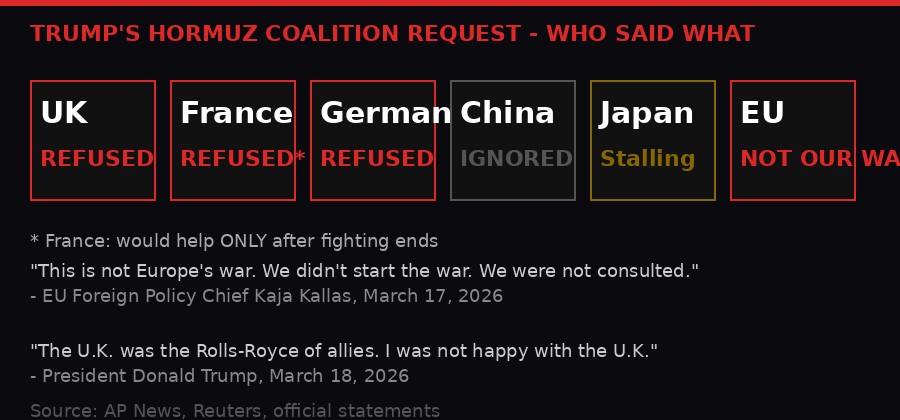
Every major ally Trump has approached to secure the Strait of Hormuz has refused. March 2026 - Sources: AP News, official statements.
Donald Trump went to war without telling his allies. Now he needs them and they are not coming.
The pattern has become one of the defining strategic failures of Operation Epic Fury. Trump launched strikes against Iran on February 28 without NATO consultation, without seeking UN authorization, without the broad coalition-building that preceded the Gulf War of 1991. He assumed force projection would be enough. He assumed allies would follow a fait accompli. He was wrong on both counts. (Source: AP News, multiple reports, March 15-19, 2026)
The United Kingdom is the starkest example. Prime Minister Keir Starmer spent months cultivating Trump, reached an early trade deal, and was described by Trump himself as having built real goodwill. Trump called Britain the "Rolls-Royce of allies." Yet when Trump asked for British minesweeping ships to help clear the Strait of Hormuz, Starmer refused. He said British troops require "the backing of international law and a proper thought-through plan" - a statement that implicitly accused the Trump administration of having neither.
Starmer initially blocked U.S. bombers from attacking Iran from British bases, before accepting their use for strikes on Iran's ballistic missile program. That limited cooperation was not reciprocated by Trump, who publicly attacked Starmer after the minesweeper refusal.
"He should be involved enthusiastically," Trump said of Starmer. "We've been protecting these countries for years."
France and Germany added their refusals. EU foreign policy chief Kaja Kallas put it plainly: "This is not Europe's war. We didn't start the war. We were not consulted." German Defense Minister Boris Pistorius said sending warships would "certainly not contribute" to diplomatic solutions. French President Emmanuel Macron expressed willingness to consider naval escorts in Hormuz - but only once the fighting stops. The fighting has not stopped.
Retired Lt. Gen. Ben Hodges, former commanding general of the U.S. Army in Europe, described the geopolitical fallout with unusual directness: allies are "looking at the United States in a way that they never have before. And this is bad for the United States." (Source: AP News, March 18, 2026)
The broader analysis from veteran French defense analyst Francois Heisbourg was more concise. He called the collective response a "global raspberry."
China Watches, Benefits, and Says Nothing Useful
Beijing was also asked for help reopening Hormuz. Beijing declined.
The Chinese Foreign Ministry offered its standard formula when asked whether China would send ships or mediate: it called for "parties to immediately stop military operations, avoid further escalation of the tense situation and prevent regional turmoil from further impacting the global economy." It did not offer anything concrete.
What China did do was deliver $200,000 in humanitarian aid through the Red Cross and Red Crescent to Iran, earmarked for families of children and teachers killed in the Shajarah Tayyebeh elementary school bombing in Minab. The Chinese ambassador to Iran publicly condemned the school attack. The optics were carefully calibrated: China as the humanitarian counterweight to American militarism. (Source: AP News, March 18, 2026)
Trump's highly anticipated state visit to Beijing - originally scheduled for March 31 - has now slipped. Both sides say they "remain in communication" and that the delay has nothing to do with the Hormuz request. Analysts are not convinced.
"President Trump's request to delay his long-awaited summit with President Xi Jinping underscores how significantly he underestimated the fallout from Operation Epic Fury. A show of U.S. force that was meant to intimidate Beijing has instead served to puncture the illusion of U.S. omnipotence." - Ali Wyne, International Crisis Group, via AP News, March 2026
China, which depends heavily on Gulf oil shipped through Hormuz, has a direct economic interest in keeping the strait open. It also has an equally powerful interest in watching the United States bleed credibility in a conflict of its own making. For now, Beijing is choosing the latter. Sun Yun, director of the China program at the Stimson Center, said plainly: "I think the Iran request is now going to be less pressing for China to fulfill."
Meanwhile, China's diplomatic engagement with Middle Eastern countries has intensified, with Beijing pledging a "constructive role" in easing tensions. It is positioning itself as the grown-up in the room while Washington burns the furniture.
Gabbard Dodges, Hormuz Suffocates, Venezuela Gets a Lifeline
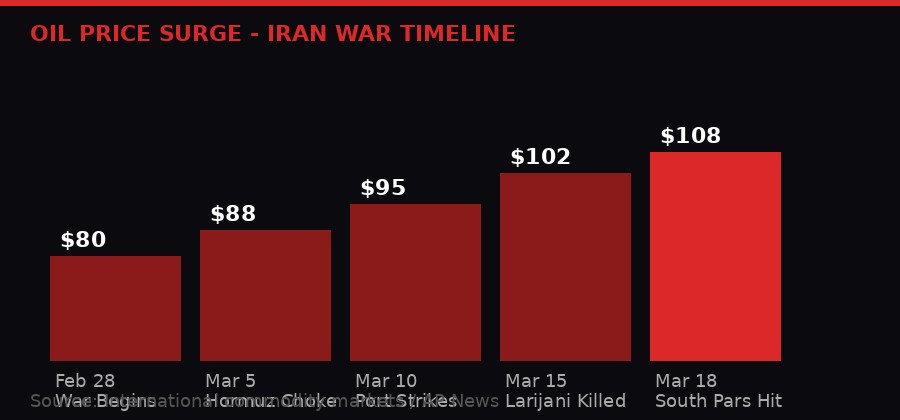
Brent crude oil prices since the start of Operation Epic Fury, February 28 through March 19, 2026. Source: International commodity markets / AP News.
Tulsi Gabbard appeared before the Senate Intelligence Committee on March 18 for the annual worldwide threat assessment hearing. Senators wanted answers about what intelligence the Trump administration had before launching the war. Gabbard gave them almost nothing.
She told senators that Iran's regime "appears to be intact but largely degraded." She confirmed that U.S. attacks had "obliterated" Iran's nuclear program and that Tehran had made no effort to rebuild it. This was, notably, a partial repudiation of the war's original justification: Trump had repeatedly said the war was necessary to head off an imminent Iranian nuclear threat. Gabbard would not confirm the intelligence community reached the same conclusion. (Source: AP News, Senate Intelligence Committee hearing, March 18, 2026)
"It is not the intelligence community's responsibility to determine what is and is not an imminent threat," Gabbard said at one point.
Democratic Senator Jon Ossoff of Georgia shot back: "It is precisely your responsibility to determine what constitutes a threat to the United States."
Gabbard's appearance came one day after the resignation of Joe Kent as director of the National Counterterrorism Center. Kent said he could not "in good conscience" back the war and did not agree that Iran posed an imminent threat. The resignation was a rare public break from a Trump appointee on core national security grounds.
The economic squeeze is becoming impossible to ignore. Oil surged another 5% on March 18 to over $108 a barrel as Iran continued choking the Strait of Hormuz - through which one-fifth of the world's traded oil moves. The Treasury Department responded by easing sanctions on Venezuela, allowing U.S. companies to do business with the country's state-owned oil firm. The move was a tacit admission that the administration needs alternative supply and has run out of easier options. (Source: AP News, March 18, 2026)
Iran's grip on Hormuz is not weakening. More than 20 vessels have been attacked since the war began. A ship was set ablaze early Thursday off the coast of the UAE, near the mouth of the strait. The UK Maritime Trade Operations center confirmed a vessel was hit by "an unknown projectile" off Khor Fakkan, UAE. The fire was brought under control but the message was clear: the waterway remains a kill zone.
The Leadership Decapitation: Iran Loses Its Intel Chief
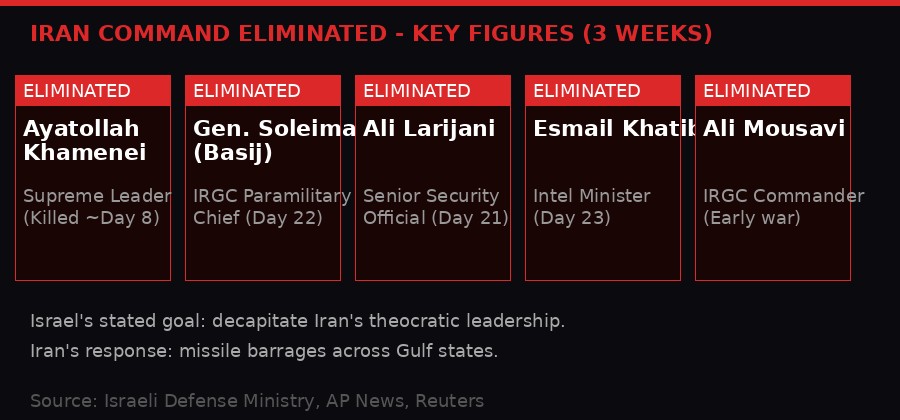
Senior Iranian officials and military commanders eliminated during three weeks of Operation Epic Fury. Source: Israeli Defense Ministry statements, AP News.
The killing of Intelligence Minister Esmail Khatib on March 18 represented another node in Israel's systematic effort to decapitate Iran's governing apparatus. Khatib ran Iran's Ministry of Intelligence - the civilian spy service responsible for counterintelligence, surveillance of domestic dissidents, and covert operations abroad. He was not a battlefield commander. He was the man who knew where the bodies were buried.
In the three weeks since the war began on February 28, Israel has killed a range of senior Iranian figures. Ali Larijani - long one of Iran's most powerful political figures, former speaker of parliament and a key back-channel diplomat - was killed on March 17. General Gholam Reza Soleimani, head of the IRGC's Basij paramilitary force, died in the same attack. An earlier strike killed Supreme Leader Ayatollah Khamenei, triggering a succession crisis. (Source: AP News, Israeli Defense Ministry statements, March 2026)
After each killing, Israel's Defense Minister promised more "surprises." The pattern suggests a methodical list - a targeting architecture built over years of intelligence collection now being systematically executed. The goal appears to be not just military degradation but political decapitation: eliminating the institutional knowledge and personal networks that hold the Islamic Republic's governance structure together.
Iran's response to Khatib's death was a barrage of missiles toward Israel - the attacks that killed Palestinian civilians in the West Bank. The cycle is now self-reinforcing: each Israeli kill triggers an Iranian salvo, which triggers more Israeli strikes, which kills more Iranian officials, which triggers more salvos. Neither side has shown any interest in breaking it.
War Timeline - Key Escalations
What Comes Next: Endgame Scenarios
The core strategic problem of the Iran war has not changed since day one: there is no articulated endgame. Trump launched Operation Epic Fury to eliminate Iran's nuclear capability and, implicitly, to force regime change. The nuclear sites have been hit. The regime has not changed. Iran's leadership is degraded but operational. The IRGC is conducting a distributed war across multiple fronts without centralized command - which makes it harder to decapitate, not easier. (Source: AP News analysis, Gabbard Senate testimony, March 18, 2026)
Three scenarios are now on the table in Washington, Riyadh, Doha, and every other capital watching this unfold.
The first is continued attrition: the war grinds on, Iran keeps attacking energy infrastructure, oil stays above $100, allies stay on the sideline, and the U.S. tries to win through exhaustion. This scenario favors Iran's strategy of pain distribution - making the economic cost of the war unbearable for everyone connected to Hormuz, including the U.S. economy. $4 gas in America was already a political problem before the war. $6 or $8 gas heading into midterm season is a different problem entirely.
The second is escalation: Trump authorizes the "massive" destruction of South Pars he threatened on social media, or strikes Iran's remaining oil production capacity. This collapses global oil markets, triggers a genuine energy catastrophe in Europe, and potentially draws China in as a defensive patron for what remains of Iran's economy. This scenario terrifies every energy economist and Gulf state alike.
The third is negotiation - but negotiation requires an interlocutor. Iran expelled Qatar's diplomats. Iran and the U.S. have no direct communication channel. Mojtaba Khamenei, who reportedly controls the IRGC's operational decisions after his father's death, has shown no interest in talks. The diplomatic architecture for a ceasefire does not currently exist. Building it would require someone - China, Oman, Switzerland, the UN - to broker a channel that neither side has shown willingness to open.
For now, the Strait of Hormuz remains choked. The energy war is widening. The West Bank is bleeding from a weapon it had nothing to do with. And America's allies have delivered a verdict on the war with their silence: not our problem, not our fight, not our war.
The Numbers Behind the Disaster
In three weeks, the Iran war has produced staggering economic and human costs. Oil has risen from roughly $80/barrel before the conflict to $108 as of March 19 - a 35% surge that is feeding through into fuel prices, shipping costs, and consumer goods globally. The Strait of Hormuz, through which approximately 20% of global oil trade moves, has been effectively closed as a safe shipping lane since early March. (Source: AP News, commodity market data, March 2026)
More than 20 commercial vessels have been attacked. Gulf port operations at Jebel Ali (UAE), Ras Laffan (Qatar), and Fujairah (UAE) have been disrupted. Kuwait, Bahrain, Saudi Arabia's Eastern Province, and the UAE have all absorbed Iranian missile strikes. Qatar's LNG export capacity - the critical source of gas for European markets since Russia's 2022 supply cutoff - has been partially shuttered.
The human toll inside Iran is harder to verify but significant. Israel has conducted sustained bombing campaigns against military, nuclear, and leadership targets. The strike on Shajarah Tayyebeh elementary school in Minab - which China used as a humanitarian pivot point - caused international outrage and remains unexplained by U.S. and Israeli officials. Iran's state media puts civilian casualties in the thousands. Western governments have not published independent assessments.
U.S. military casualties have been confirmed but not comprehensively disclosed. The deaths of personnel from the 103rd Sustainment Command in Kuwait were acknowledged. Additional casualties from the shoot-down of a KC-135 tanker aircraft were confirmed. The total American dead remains obscured by classification and a White House reluctant to discuss the human cost of a war it launched without congressional authorization.
The Treasury Department's decision to ease Venezuela sanctions - reversing years of maximum pressure policy - signals the administration understands oil supply is becoming a crisis-level problem. Venezuela's state oil company PDVSA can now work with U.S. firms. It will take months to materially affect supply. The markets are not waiting months.
Get BLACKWIRE reports first.
Breaking news, investigations, and analysis - straight to your phone.
Join @blackwirenews on TelegramSources: AP News live coverage of the Iran war (March 18-19, 2026); AP News reports: "Strikes hit world's largest natural gas field in Iran" (March 18); "Trump's failed strong-arming of allies on Iran" (March 18); "China ignores Trump's Hormuz request as the Iran war deepens" (March 18); "Gabbard deflects when asked about intel she offered Trump before Iran war" (March 18); Qatar Energy official X statements; Palestinian Red Crescent casualty reports; Israeli Defense Ministry public statements; U.S. Treasury Department press releases on Venezuela sanctions.