The numbers are out. They are worse than the Pentagon admitted.
A report from the Center for Strategic and International Studies, published Friday, estimates that Iranian retaliatory strikes have caused approximately $800 million in damage to US military assets in the Middle East over the first two weeks of the conflict. That figure - higher than any official accounting - reflects destroyed radar systems, demolished facilities, and infrastructure across at least seven bases in four countries.
The US Department of Defense, asked to comment, referred reporters to US Central Command. CENTCOM declined to respond.
On the same day that analysis dropped, President Trump posted to Truth Social that the United States was "considering winding down" military operations against Iran, listing out objectives he claimed were being met. Within hours, strikes were reported hitting Tehran. Beirut's southern suburbs received new IDF evacuation orders. And Israel struck government infrastructure inside Syria for the second time this month - this time citing attacks on Druze civilians as justification.
Three weeks in, the US-Iran war is simultaneously approaching a possible off-ramp and opening new fronts. The contradiction is not accidental. It is what this war has become.

Iranian strikes specifically targeted US radar and satellite communication systems - the sensory network of American operations. Illustrative / Pexels
The $800 Million Reckoning
The CSIS report, authored by senior adviser Mark Cancian and colleagues, represents the most detailed independent accounting of US military losses since the war began on February 28. The headline figure: $795 million in estimated damage, rounded up to $800 million in the analysis.
The single largest item is a destroyed AN/TPY-2 radar system at a US air base in Jordan. That radar - the core tracking component of the THAAD missile defense architecture - costs approximately $485 million according to Pentagon budget documents reviewed by CSIS. Satellite imagery obtained by BBC Verify confirms the system was struck and shows smoke rising from the site. Whether the radar itself was fully destroyed or merely the protective housing and support systems remains unclear, but CSIS judges the damage extensive.
"The damage to US bases in the region has been underreported. Although that appears to be extensive, the full amount won't be known until more information is available."
- Mark Cancian, CSIS Senior Adviser, co-author of the damage assessment report, March 2026
The remaining $310 million covers buildings, facilities, and infrastructure damage across multiple sites. Iran has struck the same bases more than once - satellite imagery confirmed repeat hits on Ali Al-Salim base in Kuwait, Al-Udeid in Qatar, and Prince Sultan Air Base in Saudi Arabia during different phases of the conflict.
Iran's targeting logic is legible: radar first, then facilities. Knock out the eyes, then grind down the infrastructure that sustains American power projection. Russia reportedly shared intelligence with Tehran on the location and vulnerability of US assets in the region. If accurate - and US officials have not denied it - that represents a direct contribution by Moscow to a conflict that has already killed 13 American service members.
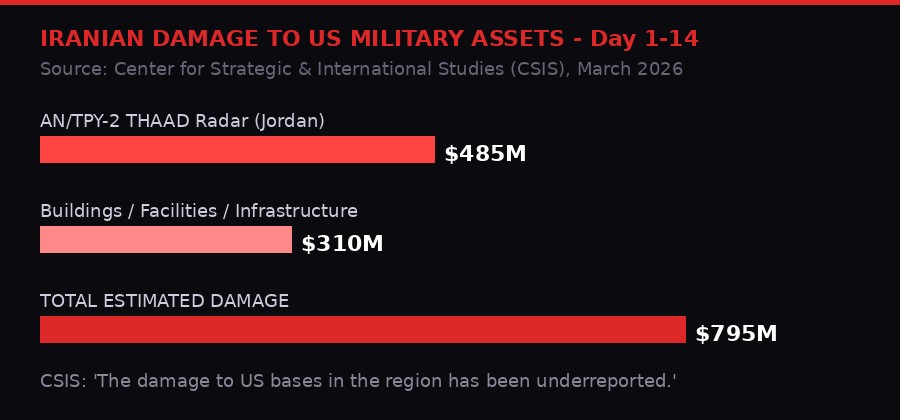
CSIS damage breakdown: $485M for the THAAD radar system, $310M in facilities and infrastructure. Total: approximately $800M. BLACKWIRE / CSIS data
$800M
ESTIMATED US MILITARY DAMAGE - FIRST 14 DAYS | SOURCE: CSIS / BBC VERIFY, MARCH 2026
The human cost remains contested. The US-based Human Rights Activists News Agency (Hrana) estimates the overall death toll has reached approximately 3,200, including 1,400 civilians and at least 207 children. Iran has not published casualty figures. The US confirmed 13 military deaths as of Friday. Iranian state media has not disclosed military losses.
Trump's Exit Signal - What It Means and What It Doesn't

Trump's Truth Social posts have functioned as de facto military signals throughout the conflict - allies and adversaries alike read them as policy. Illustrative / Pexels
Friday night, as Air Force One flew from Washington to West Palm Beach, White House staff handed press pool reporters printed copies of Trump's latest Truth Social post. The practice - printing social media posts and distributing them on the plane - is a signal Trump uses for messages he particularly wants amplified.
The post laid out a numbered list of US objectives in the Iran war: destroy Iran's nuclear program, degrade its conventional military, end its support for regional proxies. Trump claimed these objectives were being achieved and said the US was "considering winding down" operations.
The message was careful. It did not say the war was ending. It signaled that Trump wanted credit for progress and - critically - that the United States would not be the one holding the Strait of Hormuz open once the shooting slowed. That job, in Trump's framing, belongs to the nations that actually depend on it.
"Many countries, especially those who are affected, will be sending warships."
- President Donald Trump, March 14, 2026, on securing the Strait of Hormuz
"I criticized NATO countries that complain about the high oil prices but don't want to help open the Strait of Hormuz - a simple military manoeuvre."
- President Donald Trump, March 20, 2026
BBC North America correspondent Anthony Zurcher, traveling with Trump on Air Force One, noted that the message "may not be particularly well received by America's allies." That is an understatement. The US wind-down signal lands at the exact moment a fragile coalition of Hormuz-adjacent powers is trying to figure out who does what.
On Thursday, a joint statement from the UK, France, Germany, Italy, the Netherlands, Japan, and Canada condemned Iranian attacks on commercial vessels and pledged "readiness to contribute to appropriate efforts to ensure safe passage through the Strait." Bahrain joined Friday. The statement is explicit. What it commits any of those countries to doing, in concrete military terms, remains undefined.
The gap between the pledge and the action is where wars expand.
KEY FACT
The Strait of Hormuz carries approximately one-fifth of the world's oil and natural gas. Roughly 17 million barrels of crude oil pass through daily. South Korea sources 70% of its crude from the Middle East. India gets half its LNG through the strait. The de facto blockage since February 28 is the most consequential chokepoint closure in decades.
Hormuz: A Blockade in Everything But Name

Tanker movements through the Strait of Hormuz have been functionally paralyzed since late February. About 21 Indian ships remain stalled as of March 20. Illustrative / Pexels
Iran has not formally declared a blockade of the Strait of Hormuz. It doesn't need to. The combination of minelaying, drone and missile attacks on commercial vessels, strikes on Gulf energy infrastructure, and the credible threat of further action has effectively achieved the same result. Insurance rates for tankers attempting transit are prohibitive. Most are not trying.
As of March 20, approximately 21 Indian-flagged and Indian-bound vessels remain stalled in the Gulf region, according to reporting from Indian state media. Three vessels - two carrying LPG and one crude - reached the western Indian state of Gujarat this week after Indian Foreign Minister S. Jaishankar announced ongoing talks with Iran aimed at easing disruptions. It is a small number against a large backlog.
The global economic consequences are not theoretical. They are arriving in people's daily lives.
India, the world's second-largest LPG importer, sources roughly 60% of that fuel from the Middle East. With ships stalled and Hormuz effectively closed, the government has distributed an emergency quota of 48,000 kilolitres of kerosene to states for low-income households. India's environment ministry has temporarily allowed restaurants and hotels to switch to biomass, coal, and kerosene for cooking. Reports from multiple Indian states document spikes in firewood and cow dung cake sales - traditional cooking fuels that were being phased out by government LPG expansion programs.
"We see it as a very temporary situation and when supply of LPG becomes better, consumers will immediately move back."
- Nandikesh Sivalingam, Director, Center for Research on Energy and Clean Air, March 2026
Public health officials are less sanguine. A return to biomass and kerosene combustion - both linked to serious heart and lung disease through indoor air pollution - represents a secondary health cost of the war that will not appear in casualty counts.
Europe faces different but structurally similar pressure. Economists at Oxford Economics estimate that if oil prices stay near current levels, inflation in the UK and EU could increase by approximately 0.5 percentage points before year's end. For already-stretched government budgets and central banks still unwinding pandemic-era monetary expansion, that headroom is tight.
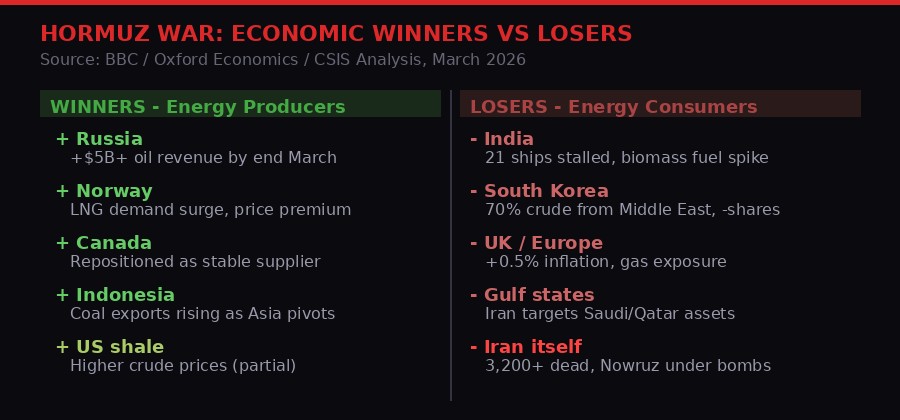
The Hormuz blockade is reshuffling the global energy deck. Russia gains; India, South Korea, and Europe pay. BLACKWIRE / BBC / Oxford Economics
Russia's Quiet Windfall
The war that Washington started is generating unexpected revenue for Moscow.
Some estimates suggest Russia could earn up to $5 billion more by the end of March 2026 compared to projections before the war - and could be on track for its biggest fuel-revenue year since 2022, when sanctions following the Ukraine invasion temporarily spiked prices before European buyers found alternatives.
The mechanism is straightforward: Gulf producers like Qatar and Saudi Arabia are under Iranian attack. Their output is disrupted. Customers seeking stable supply are turning to whoever is producing and not under threat. Russia qualifies on both counts. It is producing. It is not under military threat. And it reportedly provided Iran with intelligence on US base vulnerabilities - meaning Moscow helped ignite the disruption that is now enriching it.
Norwegian and Canadian energy producers are also benefiting. Norway ramped production after Russian gas was cut to Europe post-2022 and is doing so again. Canada's Energy Minister Tim Hodgson has been explicit about positioning his country as "a stable, reliable, predictable, values-based producer of energy." What Canada can actually produce and export at scale, given infrastructure constraints, is a different question.
The coal angle is less discussed but real. As Asia - particularly South Korea, Japan, and parts of India - scrambles for alternatives to Middle Eastern energy, coal prices are rising. Indonesia, a major coal exporter, stands to benefit substantially from sustained disruption.
Trump has argued that higher oil prices benefit American producers. That is partially true: US shale operators are booking windfall revenues at current price levels. But the US is also the world's largest per-capita consumer of fossil fuels, and American households and manufacturers are paying at the pump and through heating bills for a war the president launched. Oxford Economics notes that if crude were to reach and sustain $140 per barrel, the US economy risks contraction.
Syria: The Second Front Nobody Wanted

Israel struck Syrian government command centers and weapons storage sites overnight Thursday-Friday, citing attacks on Druze civilian communities in Suweida province. Illustrative / Pexels
Syria was supposed to stay out of this.
Syrian President Ahmed al-Sharaa said so explicitly, in the days after the US-Israel strike on Iran began February 28. "We are calculating our steps with extreme precision and working to keep Syria away from any conflict," he said after Eid al-Fitr prayers in Damascus.
Israel did not give him the choice.
Overnight Thursday into Friday, the Israeli military struck a command center and weapons storage facilities at Syrian army compounds in the south of the country. The justification: attacks on Druze civilians in Suweida province, a predominantly Druze area in southwestern Syria where clashes between government forces and local armed groups had escalated sharply.
"The IDF will not tolerate harm towards the Druze population in Syria and will continue to operate to defend them."
- Israeli Defense Forces statement, March 20, 2026
The Syrian foreign ministry called the strikes "an outrageous assault on Syria's sovereignty and territorial integrity" and rejected Israel's justification as "flimsy pretexts and fabricated excuses." Israeli Defense Minister Israel Katz warned that if Syria allowed its government to "exploit" the regional war to target Druze communities, Israel would strike "with even greater force."
The Druze are a religious minority community found in Syria, Lebanon, Israel, and the Israeli-occupied Golan Heights. Their faith is an offshoot of Shia Islam with distinct practices and a strong tradition of communal self-defense. Israel has a substantial Druze population and has previously framed intervention in Syria as protection of co-religionists across the border.
But the timing matters. Israel's strike on Syria comes as it simultaneously maintains operations against Hezbollah in Lebanon - new evacuation orders for southern Beirut neighborhoods were issued Friday - and continues to participate in the broader campaign against Iran. Each front feeds the others. Hezbollah's degradation in Lebanon reduces one Iranian proxy. Strikes in Syria signal that Damascus cannot provide sanctuary for weapons or fighters. Iran itself absorbs US and Israeli airstrikes daily.
The UK-based Syrian Observatory for Human Rights documented the Suweida fighting as beginning with mortar fire landing in Druze-controlled areas, followed by shelling of residential neighborhoods in Suweida city. Syrian government authorities described the same events as a law enforcement operation against an organized criminal network involved in car theft and drug trafficking - nine people arrested, they said.
Analysts consulted by multiple outlets suggest the Suweida escalation is more tied to internal Syrian dynamics than to deliberate regional expansion. But internal dynamics and regional dynamics are not cleanly separable when Israel is watching and willing to strike.
Nowruz Under Bombardment

Iranians marking Nowruz 2026 - the Persian New Year - are doing so under the sound of air defense systems and in the absence of the usual street celebrations. Illustrative / Pexels
March 20 is Nowruz. The Persian New Year. An ancient celebration of the spring equinox that predates Islam by millennia, observed by Iranians, Kurds, Azerbaijanis, Tajiks, and dozens of other communities across a wide geography.
This year, Nowruz arrived with air defense sirens.
BBC Persian reporting gathered accounts from multiple Iranians, their names changed for safety. A woman named Mina, in her fifties, living in Damavand northeast of Tehran after being displaced from the capital: "Every day feels so long. It's like I've lost track of time."
Her son Amir: "At this rate, there might not even be much left of Iran. I don't want this to be our last Nowruz."
A woman named Parmis, in her twenties in Tehran: "I was in the salon when a loud explosion went off, and no one even flinched."
The last time Iran celebrated Nowruz at war was in the 1980s, during the eight-year conflict with Iraq - a war that killed hundreds of thousands and reshaped the Iranian state. That comparison is not lost on Iranians. The BBC Persian service documented markets still partially open, some residents defiantly preparing the traditional Haft Sin table, but the scale of celebration nothing like previous years. Streets that should be dense with shoppers are quiet. Families that normally visit each other across Tehran are staying local or leaving the city entirely.
The Human Rights Activists in Iran (Hrana) group - US-based, with networks inside the country - reported as of Friday that 3,114 people had been killed in Iran, including 1,354 civilians, of which at least 207 were children. These figures cannot be independently verified. Iran has not released official casualty data. But multiple monitoring organizations with distinct methodologies are converging on similar orders of magnitude: several thousand dead, significant civilian component, substantial destruction of infrastructure.
Trump, at a White House event Friday, said: "We're doing extremely well in Iran."
"This year? Every day feels so long. It's like I've lost track of time."
- "Mina," displaced Tehrani resident, quoted by BBC Persian, March 2026
Timeline: February 28 - March 20, 2026
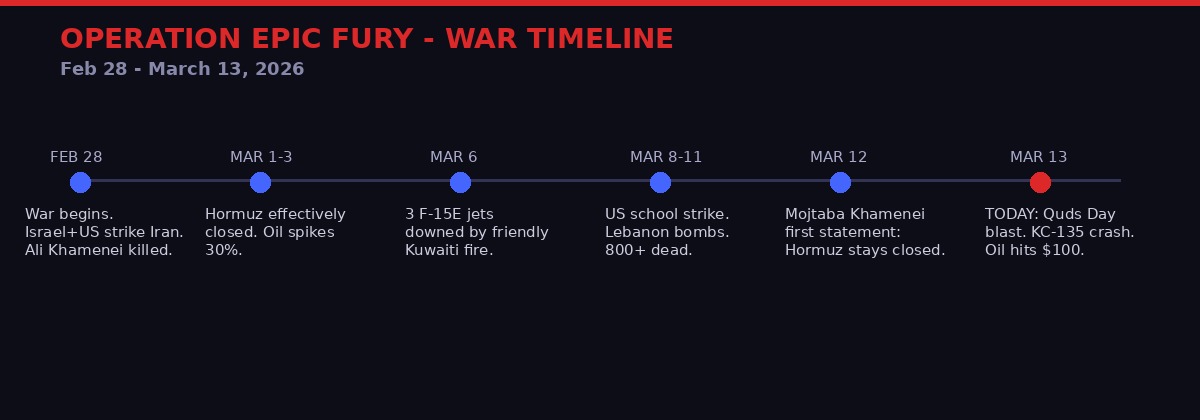
Key events in the first 20 days of the US-Iran-Israel conflict. BLACKWIRE
WAR TIMELINE - KEY EVENTS
FEB 28
United States and Israel launch coordinated missile and air strikes against Iranian nuclear and military infrastructure. The war begins without a formal declaration. Iran describes it as an act of aggression and pledges retaliation.
MAR 1-3
Iran launches retaliatory strikes against US military bases in Bahrain, Jordan, Kuwait, Qatar, and Saudi Arabia. Commercial shipping through the Strait of Hormuz halts as Iran begins minelaying operations and drone attacks on tankers. Global oil prices spike.
MAR 3
Trump says the US Navy will escort tankers through the Strait of Hormuz "if necessary." Iran threatens to "set fire" to any ships attempting passage. The standoff hardens.
MAR 6
CSIS later determines that Iranian strikes destroyed a THAAD AN/TPY-2 radar system at a US base in Jordan. Estimated replacement cost: $485 million. Radomes at multiple sites destroyed. The intelligence-gathering backbone of US missile defense in the region takes its worst hit of the war.
MAR 10
Trump escalates rhetoric, threatening to hit Iran "twenty times harder than they have been hit thus far" if Tehran does not allow oil to flow through Hormuz. Iran does not yield. Shipping remains paralyzed.
MAR 14
Trump signals that "many countries, especially those who are affected" by the Hormuz blockade will be "sending warships." The statement shifts implied responsibility for the strait from the US to its allies. Allied capitals receive it with alarm.
MAR 15-18
ExxonMobil reports "extensive damage" to its operations at Qatar's Ras Laffan industrial hub following Iranian missile strikes. Qatar's gas production - critical to European LNG markets - is disrupted. Global markets process the implications.
MAR 18
Trump floats publicly what analysts had speculated privately: what if the US "finished off" the Iranian regime and "let the countries that use it be responsible" for the strait? The remark is read by Gulf partners as preparation for a partial US withdrawal.
MAR 19
Israel strikes Syrian government infrastructure for the second time this month, citing Druze civilian attacks in Suweida. Syrian foreign ministry calls it "an outrageous assault." Hezbollah evacuation orders issued for southern Beirut. Lebanon remains on the edge of a full second front.
MAR 20
CSIS publishes $800 million damage estimate - higher than any official US figure. Trump posts wind-down signal on Truth Social. Fresh strikes reported hitting Tehran. Bahrain joins UK-led coalition pledging Hormuz safe-passage efforts. Nowruz begins in a country at war. The USS Gerald Ford carrier group remains active. 13 US service members dead. Death toll in Iran: approximately 3,200.
What Comes Next - and Why Nobody Has the Answer

A growing coalition of naval powers - UK, France, Germany, Italy, Netherlands, Japan, Canada, Bahrain - has pledged support for Hormuz safe-passage. What that means in practice remains undefined. Illustrative / Pexels
Trump's wind-down signal creates a specific problem: it is not a ceasefire offer. Iran has not been consulted. There are no defined terms. The signal tells US allies to prepare to take over Hormuz security, tells the American public the war is going well, and tells financial markets that the president is thinking about an off-ramp - but it does not actually stop any of the fighting.
Iran's calculus is different from what Washington appears to assume. Tehran has absorbed significant military damage over 20 days. Its nuclear program has been set back, possibly severely. Its conventional military has taken losses. But it has also demonstrated that it can inflict $800 million in damage on the world's most powerful military, shut down the global energy artery, and bring Russia closer into its orbit - all while surviving. The regime has not collapsed. The IRGC is still operational. Iranian air defenses are still activating over Tehran.
A war that does not end decisively - and does not end on Iran's terms either - is what actually produces the most dangerous endgame. A weakened but intact Tehran, a Hormuz that remains contested, and a coalition of Arab states that just watched the US suggest it might step back from policing the world's most important shipping lane.
The Druzhba pipeline dispute between Ukraine and Hungary - separately, 6,000 kilometers away - adds another layer. Budapest is withholding consent for an EU loan to Ukraine over a pipeline Russia bombed in January and Ukraine has been slow to repair. Zelensky has said publicly he would not restore Russian oil transit regardless. Hungary's Orban is running an election campaign against Ukraine. One dispute that should be technical is being weaponized politically, and it is blocking a $90 billion EU support package to a country still fighting a separate war with Russia.
Multiple active conflicts. Multiple blocked supply chains. Multiple diplomatic crises stacked on each other. The idea that any one of them can be resolved cleanly, in isolation, is the organizing fiction of great-power management. It has rarely survived contact with events.
Day 20. The damage is $800 million and rising. The strait is blocked. Nowruz came with airstrikes. Trump wants credit and an exit. Iran wants to survive. Israel is striking Syria. And the nations that pledged to help open Hormuz have not yet said what, concretely, they will do.
The field does not care about any of that. The field only counts the days.
Sources: BBC News (Iran war live coverage, March 20-21 2026); BBC Persian (Nowruz under war, March 2026); BBC Verify (satellite imagery analysis); Center for Strategic and International Studies (CSIS) damage assessment, March 2026; Human Rights Activists in Iran (Hrana), casualty reporting; Oxford Economics (oil price impact analysis); Syrian Observatory for Human Rights; UK joint statement on Hormuz, March 19 2026; Indian state media reporting on LPG shortages; Center for Research on Energy and Clean Air.
