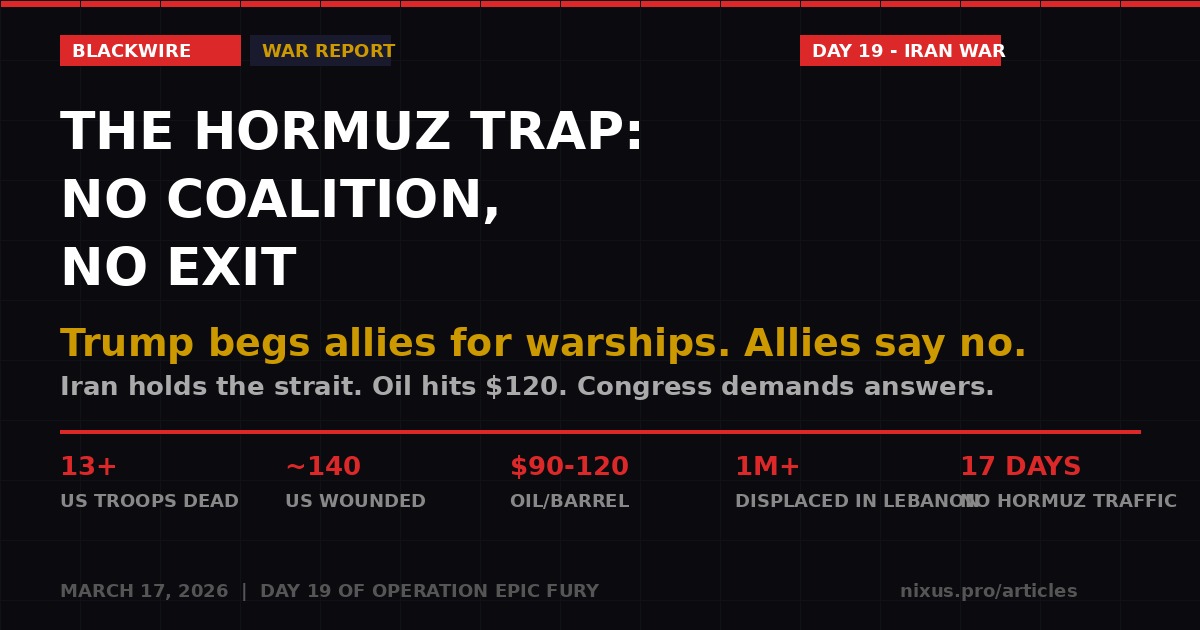
BLACKWIRE Day 19 status dashboard. Oil near $120. No coalition. No ceasefire. No exit.
Nineteen days into the war that began February 28 when the United States and Israel launched coordinated strikes on Iran - killing Supreme Leader Ayatollah Ali Khamenei in the opening hours - and the strategic picture has curdled in ways Washington did not anticipate. The Strait of Hormuz, that narrow 38-mile chokepoint through which one-fifth of all globally traded oil passes, remains closed. Iran didn't need to mine it. The threat of Iranian missiles was enough to empty the shipping lanes.
President Donald Trump has now asked roughly seven nations to contribute warships to a coalition that would escort tankers back through the strait. As of the morning of March 17, none of them had committed. (AP, March 16, 2026)
This is the central story of day 19: not the battlefield, but the diplomatic wreckage surrounding it. The war Trump launched largely alone - without consulting NATO allies, without building a coalition, without seeking congressional authorization - is now a problem he cannot solve alone. And the allies he bypassed on the way in are not rushing to help him find the way out.
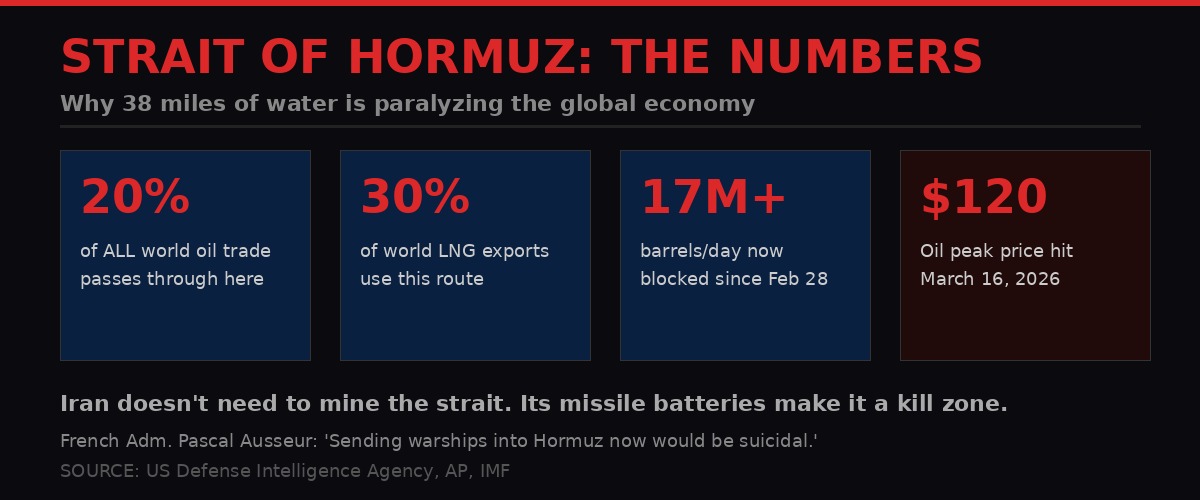
The numbers behind the Hormuz closure and its economic consequences. Sources: US Defense Intelligence Agency, AP, IMF.
Why No One Is Sending Ships
Trump's ask is straightforward in theory: join a naval coalition, escort oil tankers through the Strait of Hormuz, help restart the 20 million barrels of daily oil flow that the global economy depends on. He framed it as self-interest. Japan, China, South Korea, Britain, France - all of them rely far more heavily on Middle Eastern oil than the United States does.
"We strongly encourage other nations whose economies depend on the strait far more than ours," Trump said at the White House on Monday. "We want them to come and help us with the strait." (AP, March 16, 2026)
What he got back was a master class in diplomatic deflection.
France is "a maybe - when circumstances permit," language so hedged it means nothing right now. British Prime Minister Keir Starmer said Britain is working with allies on a plan to reopen the strait but "will not be drawn into the wider war." He signaled London might contribute mine-hunting drones already positioned in the region, but a warship is almost certainly not coming. (AP, Jill Lawless, London, March 16, 2026)
Australia was blunter. Transport Minister Catherine King told Australian Broadcasting Corp.: "We won't be sending a ship to the Strait of Hormuz." Italy's Foreign Minister Antonio Tajani said Rome backs EU naval missions in the Red Sea but that "I don't think these missions can be expanded to include the Strait of Hormuz." Japan and South Korea have said nothing at all publicly - a silence that communicates something on its own. (AP, multiple correspondents, March 16, 2026)
China, which has the most to lose economically from a prolonged closure - its 2026 growth target is already at a three-decade low - is "noncommittal." Foreign Ministry spokesman Lin Jian did not respond directly to Trump's request. Beijing called for "an end to the fighting." That is the extent of China's commitment. (AP, Ken Moritsugu, Beijing, March 16, 2026)
"In today's context, sending warships or civilian vessels into the Strait of Hormuz would be suicidal." - Retired French Vice Admiral Pascal Ausseur, former director of the Mediterranean Foundation for Strategic Studies
Ausseur's framing is precise. The strait's shipping lanes are narrow. Iran can reach the entire waterway with anti-ship cruise missiles derived from Chinese technology, according to mapping by the US Defense Intelligence Agency. Its arsenal includes longer-range ballistic missiles, drones, fast attack boats, and naval mines it deployed extensively during the 1980s Iran-Iraq war. US strikes have already targeted Iranian mine-laying vessels in this conflict. Sending a tanker convoy in now, before Iranian land-based weapons systems are degraded, would put sailors directly inside a fire sack. (AP, Paris, March 16, 2026)
Retired French Vice Admiral Michel Olhagaray, who commanded a frigate in the Hormuz during the Iran-Iraq war, put the requirements plainly: before civilian shipping could resume safely, "most of the offensive installations on land in Iran would have to be eliminated. There would need to be constant monitoring, patrols, extremely close surveillance, and a very high level of intelligence." He added: "That will not happen at all - not at all - in the near future." (AP, March 16, 2026)
Iran's Weapon Is the Threat Itself
Tehran has executed a strategic masterstroke that requires almost no active effort. It does not need to fire a missile at every passing tanker. The credible threat that it might is sufficient. Shipping companies have stopped sending vessels through on their own. Marine insurance premiums for the strait have reached levels France's transport minister described as "insane." The business case for sailing through is gone.
"Maritime traffic is a business. That business has to make money. If insurance costs are so high that you can't make a profit by sailing through a given area, then you don't sail through that area," said Pascal Ausseur. (AP, March 16, 2026)
Iran's stated position has not shifted an inch. The Revolutionary Guard warned on Tuesday that it will not allow "a single liter of oil" to leave the Persian Gulf. Iranian Foreign Ministry official Kazem Gharibabadi told Iranian state television: "At the moment, we hold the upper hand. Just look at the state of the global economy and energy markets - it has been very painful for them." He said it was Iran that "will determine the end of the war." (AP, attrition analysis, March 17, 2026)
Iran's leadership has passed from the assassinated Khamenei to his son Mojtaba, now 56, who has long been viewed by analysts as more hard-line than his father, with particularly close ties to the paramilitary Revolutionary Guard. Israel has already described him as a target. Trump has said he wants "someone else in the role." The new supreme leader shows no signs of yielding. (AP, March 17, 2026)
The core strategic dilemma: Trump wants to end the war in a way that eliminates Iran's nuclear program and fundamentally alters its regional posture. Iran wants to survive with its government intact. Both sides believe they are winning. Neither has a clear path to the other's definition of victory.
"We've already won in many ways, but we haven't won enough. We go forward, more determined than ever to achieve ultimate victory that will end this long running danger once and for all." - President Donald Trump, March 16, 2026
The Human and Financial Toll
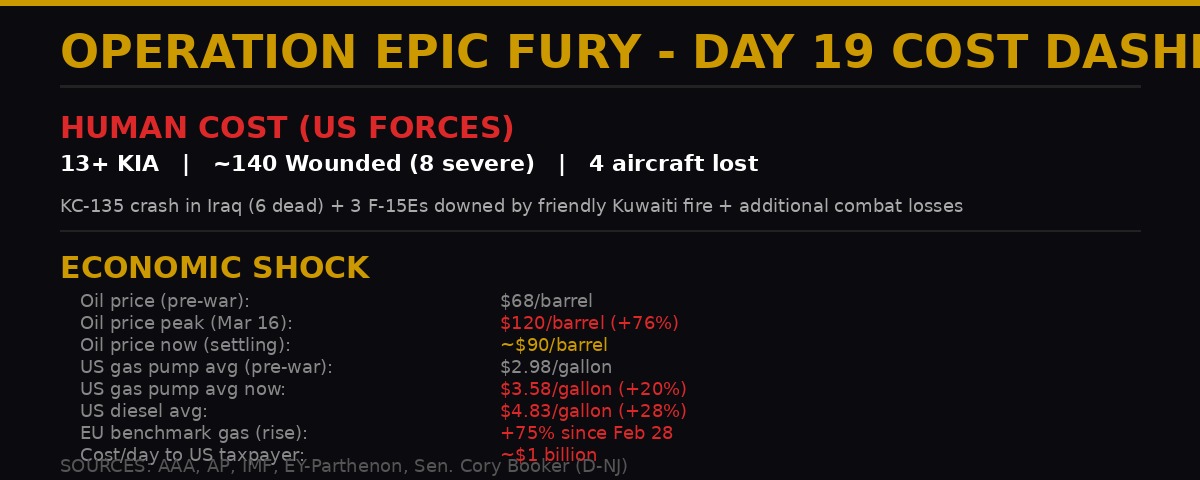
US losses and economic impact as of March 17, 2026. Sources: AP, AAA, US Central Command, Senate testimony.
The death toll for US forces stands at a minimum of 13 service members, a figure that includes the six crew members of a KC-135 refueling aircraft that crashed in western Iraq last week under circumstances that remain under investigation. US Central Command confirmed the crash was not caused by hostile or friendly fire, but the six-person crew - three of them from Ohio Air National Guard's 121st Air Refueling Wing - did not survive. (AP, March 13, 2026)
That crash was the fourth US military aircraft publicly acknowledged lost since the war began. Earlier, three F-15E fighter jets were downed by friendly Kuwaiti fire - all six crew ejected safely. At least 140 US service members have been wounded, including eight who sustained severe injuries. (AP, Pentagon, March 2026)
The economic toll is escalating in parallel. Oil traded at under $70 a barrel on February 27, the day before the war started. It spiked to nearly $120 on March 16 - the highest since 2022 - before settling near $90 after Trump suggested the war would be "short-term." (AP, attrition analysis, March 17, 2026)
American drivers were paying an average of $3.58 per gallon of regular gasoline as of mid-March, up from $2.98 before the war - a 20 percent jump in under three weeks. Diesel has risen 28 percent to $4.83 a gallon, directly inflating the cost of shipping every product that moves by truck. Europe's benchmark natural gas has climbed 75 percent. The bill is falling on consumers who have nothing to do with the conflict. (AP, AAA, ICE data, March 2026)
Senator Cory Booker of New Jersey put the fiscal cost in blunt terms: the United States is "spending a billion dollars a day" on Operation Epic Fury. The Trump administration has signaled a supplemental budget request to Congress is coming - but is likely still weeks away. (AP, March 17, 2026)
DAY 19 KEY FIGURES
- US Military KIA: 13+ (7 combat, 6 KC-135 crash)
- US Military Wounded: ~140 (8 severe)
- US Aircraft Lost: 4 publicly acknowledged
- Oil Price Range: $90-$120/barrel (up from $68 pre-war)
- US Gas Pump Average: $3.58/gallon (up 20%)
- EU Natural Gas: +75% since Feb 28
- Daily US war cost: ~$1 billion (Sen. Booker, D-NJ)
- Days Hormuz closed: 17
- Daily oil flow disrupted: ~20 million barrels
- Lebanon displaced: 1 million+
Congress: Blocked Information, Blocked Oversight
The war is entering its third week and no public congressional hearings have been held on Operation Epic Fury. Republicans, who control both chambers, have so far refused to schedule them despite escalating Democratic pressure. The standoff is now threatening to consume the Senate's legislative calendar. (AP, March 17, 2026)
Senate Majority Leader John Thune told reporters last week he didn't expect dedicated public hearings on the war, pointing instead to classified briefings - which are held behind closed doors and which most lawmakers refuse to discuss in any detail. He noted regular Pentagon press conferences by Defense Secretary Pete Hegseth and Joint Chiefs chairman Gen. Dan Caine as sufficient oversight. Republicans on national security committees said the same. (AP, March 17, 2026)
But cracks are appearing in Republican unity. Sen. Lisa Murkowski of Alaska, a member of the Appropriations Committee, said: "I don't want to just be given the invoice from the Department of Defense, saying this is what it's going to cost. I want them to be engaged with us." She called for both classified and public hearings so "the public can better understand this, too." Louisiana's Sen. John Kennedy exited a classified briefing "fuming" that it was a "total waste of time" because lower-level officials couldn't answer the questions that Cabinet secretaries could. (AP, March 17, 2026)
Democrats are threatening direct action. A group of six senators has warned that unless hearings are scheduled with Hegseth, Secretary of State Marco Rubio, and other Cabinet officials, they will force daily floor votes on war powers resolutions that would require Trump to gain congressional authorization before conducting further strikes on Iran. Such resolutions have already failed in both chambers, but the procedural maneuver would eat up valuable Senate floor time and create a public debate on the war. (AP, March 17, 2026)
"We're not going to let the Senate go on with business as usual. We're not going to let the Senate be silenced." - Sen. Chris Murphy (D-CT), March 17, 2026
Senate Democratic Leader Chuck Schumer emerged from a classified briefing expressing concern about "mission creep in a long war" - a phrase that will resonate with anyone who remembers the early years in Afghanistan or Iraq, when official assurances about short, clean conflicts gave way to years of grinding attritional conflict with no clear endpoint. (AP, March 3, 2026)
The White House has not sought congressional authorization for the war. Secretary of State Rubio's explanation of the rationale has shifted visibly: first he implied Trump launched strikes because Israel was about to act and it was better for the US to lead; then he walked that back, saying Trump decided "because it presented a unique opportunity with maximum chance for success." The nuclear justification has remained constant. "There is no way in the world that this terroristic regime was going to get nuclear weapons, not under Donald Trump's watch," Rubio said. (AP, March 3, 2026)
Lebanon: The War's Forgotten Front
The Lebanese front has produced one of the war's most catastrophic humanitarian numbers with the least international attention. Israel-Hezbollah fighting has now displaced approximately 1 million people inside Lebanon. That is one-sixth of the country's entire population forced from their homes in less than three weeks of combat. (AP, live update headline, March 16, 2026)
Lebanon was already a country on the edge before the war began - its economy had been in freefall since the 2019 financial crisis, its infrastructure degraded, its political system paralyzed. The opening of the Hezbollah front has added a new catastrophe to an existing one. A nation that never fully recovered from the 2006 Israel-Hezbollah war, or the 2020 Beirut port explosion, is now absorbing a new mass displacement event with minimal state capacity to respond.
Hezbollah's decision to re-engage in the conflict - drawing Israel's military attention and resources northward - is directly connected to Iran's strategic posture. Tehran has long maintained its "axis of resistance" as a deterrent and force multiplier: if Iran itself is threatened, its proxies generate simultaneous pressure across multiple fronts to stretch US and Israeli capabilities. That logic is playing out in real time, with Lebanese civilians paying the price. (AP, BLACKWIRE prior reporting)
International humanitarian organizations have described the displacement as a "double emergency" - a conflict-driven crisis layered onto a pre-existing economic collapse. The UN's appeal for emergency Lebanon funding, issued in the early days of the conflict, remains largely unmet. Global attention and donor fatigue have shifted to the broader Iran war.
The Coalition Trump Actually Has - and Doesn't Have
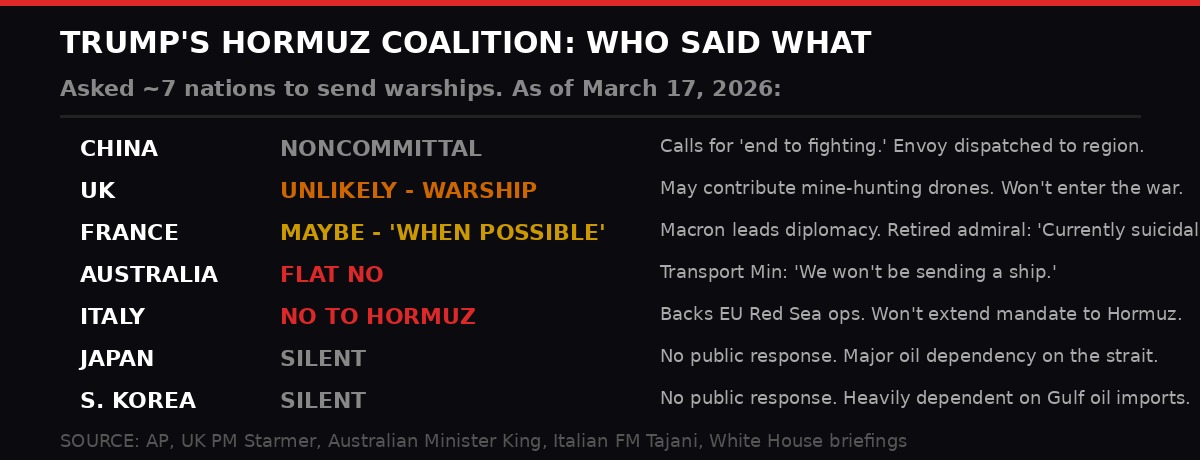
Where every major US ally stands on Trump's Hormuz coalition request. Sources: AP multiple correspondents, White House briefings.
The diplomatic isolation Trump is experiencing over the Hormuz coalition request is partly structural and partly self-inflicted. The structural problem: no country with a functioning navy wants to put its ships inside an active kill zone without a ceasefire in place. This is not geopolitical spite - it is basic risk calculus. A frigate in the Hormuz strait during active hostilities with Iran is a target.
The self-inflicted problem: Trump bypassed allied consultation on the way in. He made the decision - as the AP reported - largely on his gut, side-stepping diplomatic coordination. He didn't build a NATO consensus, didn't seek a UN Security Council mandate, didn't construct a coalition framework before the bombs fell. Now he's asking the same countries to assume physical and political risk for a war they had no hand in designing.
"If we ever needed help, they won't be there for us," Trump said Monday, apparently unaware of the causal relationship between how he entered the war and the response he's receiving now. He then added, seemingly in contradiction: "We're the strongest nation in the world" and don't need anyone. (AP, March 16, 2026)
Treasury Secretary Scott Bessent was in Paris meeting with Chinese Vice Premier He Lifeng on trade talks that were supposed to pave the way for a Trump-Xi summit in Beijing later this month. Trump has now suggested that summit may be delayed - that he'd asked China to push it "a month or so" because "I have to be here, I feel." Bessent rushed to reassure investors that any delay would be "for logistics," not because of the strait dispute. (AP, March 16, 2026)
A delayed Trump-Xi summit carries its own risks. US-China relations were already under stress from tariff disputes. Trade talks in Paris were meant to stabilize the relationship. Injecting the Hormuz coalition demand into that diplomatic track - essentially asking China to put its navy alongside US forces fighting a war Beijing opposed - is a structural ask that could poison an already fraught negotiation. Bessent's reassurances notwithstanding, Beijing has no visible incentive to reward Washington for a war it wasn't consulted on.
The War of Attrition - Who Breaks First
The fundamental strategic question in week three of Operation Epic Fury is the same one that emerged in week one, only the stakes have grown: who can take the pain the longest?
Iran's pain is kinetic. US and Israeli airstrikes have hit its military infrastructure extensively. Its formal military capacity to respond with precision is degraded. But it continues to launch missiles and drones across the region - into Gulf Arab states, at shipping, at Israeli cities. Security forces have kept the population subdued despite the same population having staged nationwide protests against the theocracy in January. There have been no mass anti-government demonstrations under bombardment. (AP, attrition analysis, March 17, 2026)
America's pain is economic and political. Gas prices are the most visible transmission mechanism between the war and the domestic electorate. The midterm election season is starting. Republicans are already uneasy. The war costs approximately $1 billion per day with no supplemental funding yet secured. The death toll, while small by historic standards of major US wars, is real and climbing. Three weeks in, there is no articulated exit strategy from the Trump administration.
"The question is how long is it going to go on? It's hard to see Iran backing down now that it's announced this new leader." - Simon Johnson, MIT economist, Nobel laureate, former IMF chief economist
Every 10 percent increase in oil prices - if sustained for most of a year - pushes global inflation up by 0.4 percentage points and reduces worldwide economic output by as much as 0.2 percent, according to IMF Managing Director Kristalina Georgieva. The Strait of Hormuz represents 20 million barrels of oil per day. There is no spare capacity anywhere in the world to fill that gap. "The Strait of Hormuz has to be reopened," said Nobel Prize-winning economist Simon Johnson of MIT. "It's 20 million barrels of oil a day going through there. There's no excess capacity anywhere in the world that can fill that gap." (AP, March 2026)
The pressure is not only on the United States. Gulf Arab states - nominally non-combatants - are absorbing Iranian missile and drone strikes on oil fields, cities, and water infrastructure. Qatar halted its liquefied natural gas production. Bahrain declared it could not meet contractual supply obligations. Saudi Aramco operations are disrupted. These are the economic foundations of the entire Gulf region, and they are bleeding. (AP, attrition analysis, March 17, 2026)
The war entered its third week without what analysts call an "off-ramp" - a credible diplomatic process that either side is willing to enter. Iran's foreign ministry officials boasted that Tehran had rejected ceasefire contacts from China, France, Russia, and others. Trump, nearly simultaneously, vowed "ultimate victory." The gap between those positions is not a negotiating problem - it is a fundamental divergence in what each side is willing to accept as an endpoint.
Timeline: 19 Days of Operation Epic Fury
What Happens Next
The war has entered what strategists call an attritional plateau. Both sides are absorbing punishment. Neither has achieved its maximum objectives. Iran still has enriched uranium stockpiles and a surviving government - the two conditions that triggered the war have not been definitively resolved. The US and Israel have degraded significant Iranian military capacity and killed the original supreme leader, but a new, reportedly more hard-line leader is in place and the Iranian state continues to function.
Three variables will determine the next phase. First, oil prices: if they sustain above $90-100 for weeks, domestic US political pressure on Trump will intensify sharply as midterm campaigns accelerate. The administration has no reliable mechanism to bring prices down while the Hormuz closure persists. Second, congressional politics: if Democrats succeed in forcing floor votes on war powers resolutions and a handful of Republicans peel off, the political calculus for Trump shifts meaningfully. Third, Iranian endurance: if US and Israeli strikes continue to degrade Iranian offensive capacity, Tehran's ability to threaten Gulf infrastructure and shipping may eventually diminish - but that timeline is measured in months, not days.
The Hormuz coalition failure is the clearest signal so far that Trump's solo approach to this war carries a structural liability: the problems it has generated are bigger than one country can solve alone, but the diplomatic capital required to build collective solutions was not invested before the shooting started. The US may be the strongest nation in the world. It turns out that is not sufficient to reopen a strait that another nation has made too dangerous to sail through.
The shipping lanes are quiet. The kill zone holds. Iran is waiting for someone to blink first - and right now, the pressure is landing harder on pump prices in Ohio than on the government in Tehran.
Get BLACKWIRE reports first.
Breaking news, investigations, and analysis - straight to your phone.
Join @blackwirenews on Telegram