Day 19: US Drops 5,000-Pound Bunker Busters at Hormuz as Iran Fires Missiles Into Tel Aviv

The Iran war crossed new thresholds in the hours before dawn on March 18. U.S. Central Command confirmed it had fired multiple 5,000-pound GBU-28 deep-penetrator bombs on Iranian missile launch sites along the coastline near the Strait of Hormuz - the same sites Iran had been using to threaten the one-fifth of global oil supply that flows through that narrow passage every day.
Within hours, Iran answered. Missile sirens wailed across central Israel. Loud explosions shook Tel Aviv. Israeli emergency service Magen David Adom confirmed two people killed in Ramat Gan, a district east of the city. Saudi Arabia, Kuwait, and the UAE all absorbed barrages of Iranian missiles and drones - most intercepted, but the message delivered.
Then came a report with the potential to redefine the conflict entirely: the International Atomic Energy Agency said it received word from Iran that its Bushehr nuclear power plant complex had been struck by a projectile. No injuries. No apparent structural damage. But the IAEA's director, Rafael Mariano Grossi, immediately called for "maximum restraint" and warned explicitly of "risk of a nuclear accident." The plant sits on Iran's Persian Gulf coast. A serious rupture would contaminate the Gulf itself.
The war is now in its third week. Three senior US military members and 10 others have been killed on the American side. Iran's confirmed dead from airstrikes since February 28 has passed 1,300. And on Tuesday, Trump's own National Counterterrorism Center director resigned, publicly declaring that Iran had posed no imminent threat to the United States when the war started - and that Trump had "started this war due to pressure from Israel and its powerful American lobby."
The IAEA confirmed Wednesday it received a report from Iran that the Bushehr nuclear power plant complex was struck by a projectile. Director General Grossi stated no injuries and no current damage but reiterated his call for "maximum restraint during the conflict to prevent risk of a nuclear accident." [AP]
The Bunker Busters: What CENTCOM Actually Dropped
The GBU-28 is not a standard munition. Known as the "Deep Throat" or "bunker buster," it is a 5,000-pound laser-guided bomb with a hardened steel casing designed to penetrate 20 feet of reinforced concrete before detonating. It was originally developed in 1991 in just 28 days after the Gulf War revealed that US forces lacked the capability to destroy Iraqi command bunkers.
CENTCOM said the targets were Iranian missile sites along the coastline near the Strait of Hormuz that were "posing a risk to international shipping." Iran has been using these positions to threaten vessels attempting to transit the strait - the narrow 33-mile-wide channel between Iran and Oman through which approximately 20-21 million barrels of oil per day normally flow, representing roughly 20% of global supply. [AP Live]
Since the war began, approximately 20 vessels have been struck in and around the strait. Iran has maintained that the waterway is technically still open - just not for American, Israeli, and allied shipping. That technical distinction has done little to calm energy markets. Oil prices resumed climbing Wednesday after a brief pause, and analysts are watching every oil price tick for signals about global recession risk.
The use of bunker busters signals a tactical shift. Earlier strikes had focused on air defense systems, Revolutionary Guard infrastructure, and leadership targets. Deploying the GBU-28 against Hormuz-adjacent missile positions suggests the US is now treating the strait as a primary military objective - not just a secondary concern.
Two Dead in Tel Aviv: Iran's Overnight Retaliation

Iran launched its retaliatory barrage Wednesday as sirens blared across central Israel. Ramat Gan - a dense Tel Aviv suburb home to roughly 150,000 people and Israel's diamond exchange - took direct hits. Israeli emergency responders confirmed two fatalities. The death toll of Israelis killed by Iranian missile fire since the war's start now stands at 14 civilians.
Simultaneously, Iran struck outward across the Gulf. The UAE capital Dubai heard explosions before dawn - the government's Dubai Media Office quickly posting that the sounds were "successful interceptions" by air defense systems. The Dubai International Airport attack the previous day, on March 16, had briefly suspended flights after a drone struck a fuel tank. [AP]
Saudi Arabia and Kuwait also absorbed barrages. Patriot and THAAD air defense batteries intercepted the bulk of incoming rounds, but Iranian engineers appear to be studying the intercept patterns and adjusting trajectories - a well-documented technique from the Yemen conflict, where Houthi missiles gradually overwhelmed Saudi air defenses through saturation and trajectory variation.
Ras al-Khair, the Saudi facility handling a large share of Gulf water desalination, remains a particular concern. If Iran successfully hits a major desalination plant, the humanitarian consequences for the Arabian Peninsula would be severe and immediate. Regional analysts have warned of this scenario since the first week of fighting.
Bushehr: The Nuclear Dimension
The Bushehr Nuclear Power Plant sits on the northeastern shore of the Persian Gulf in Bushehr Province. Operational since 2011, it runs on Russian-supplied fuel and produces about 1,000 megawatts of electricity for Iran's national grid. It is the only fully operational nuclear power plant in the Middle East outside of Israel's Dimona research reactor.
Iran's notification to the IAEA that the complex had been struck is significant on multiple levels. First, it represents Iran using the UN nuclear watchdog as a signal channel to the international community - a deliberate escalation warning. Second, it suggests Tehran is willing to invoke nuclear risk as a deterrent against continued strikes on critical infrastructure.
The IAEA statement said there were "no injuries and the plant suffered no damage" from the projectile. But Grossi's language was pointed and specific: he called for "maximum restraint during the conflict to prevent risk of a nuclear accident." A strike that compromised the reactor cooling system or containment structure at Bushehr could release radioactive contamination into the Persian Gulf - affecting the water supply, fishing grounds, and coastlines of Saudi Arabia, Qatar, Bahrain, Kuwait, and the UAE.
"Maximum restraint during the conflict to prevent risk of a nuclear accident." - IAEA Director General Rafael Mariano Grossi, March 18, 2026 [AP]
It remains unclear who struck Bushehr. Israel has not claimed responsibility. US forces have not mentioned it. Iran's public statement blamed the "enemy" without naming a party. The nuclear facilities at Fordow, Natanz, and Isfahan - sites deeper inside Iranian territory and more directly linked to weapons-applicable enrichment - remain the stated targets of Israeli planners. But Bushehr being grazed suggests that either aim is degrading, the conflict perimeter is expanding, or the strike was deliberate and precise - a message without crossing the full line.
Iran's Decapitation: Larijani and Soleimani Gone

The context for Wednesday's escalation is inseparable from Tuesday's confirmed killings. Israel eliminated Ali Larijani, secretary of Iran's Supreme National Security Council, and General Gholam Reza Soleimani, head of the Revolutionary Guard's Basij militia - in strikes described by Israeli Defense Minister Israel Katz as deliberate efforts to "undermine this regime to give the Iranian people the opportunity to remove it."
Larijani was arguably the single most consequential strategic thinker left in the Islamic Republic's leadership structure after Supreme Leader Ali Khamenei was killed on the first day of the war, February 28. As BBC Persian correspondent Amir Azimi noted, Larijani sat "at the heart of decision-making on war, diplomacy, and national security." He was not a military commander - he was the person who told military commanders what the overall strategy required. His death, Azimi wrote, "deepens a leadership crisis that could affect both the course of the war and the stability of the Iranian state itself." [BBC]
General Soleimani - not to be confused with Qasem Soleimani, killed by the US in 2020 - headed the Basij, the volunteer paramilitary force used to suppress internal dissent. His death matters most on the domestic repression axis: it was the Basij who killed thousands of protesters in January when nationwide demonstrations challenged the theocracy. Without Basij command, that repression becomes harder to coordinate - though not impossible.
These killings came on the eve of Chaharshanbe Souri, the pre-Nowruz Festival of Fire. Iranian authorities sent threatening text messages warning the public not to gather for the traditional celebrations, warning that "rioters" might exploit them. The regime fears that the combination of war stress, leadership vacuum, and a traditional public gathering could produce a moment it cannot contain.
The Coalition That Isn't: NATO and Europe Say No
President Trump has demanded that "roughly a half-dozen countries" send warships to secure the Strait of Hormuz. The count of nations who have agreed: zero.
The European Union's foreign policy chief, Kaja Kallas, told EU lawmakers Tuesday with unusual directness: "This is not Europe's war. We were not consulted." Her statement reflects the core European grievance - the US launched this conflict without notifying allies, and is now asking them to absorb the military and economic risk of defending the resulting situation. [AP]
The Gulf Arab states - UAE, Saudi Arabia, Qatar, Kuwait, Bahrain - are in a worse position. They are absorbing Iranian missile fire on their territory. They benefit from US military deterrence. But their populations have significant sympathies with Iran's cultural and religious identity, and a formal military coalition with the US against Iran would expose their own governments to internal pressure. The calculation in Riyadh and Abu Dhabi is still: stay behind the shield without formally picking up a spear.
The strategic isolation matters beyond optics. The US Navy can operate independently, but sustaining a Hormuz escort operation indefinitely requires port access, logistics chains, and allied intelligence sharing. Without formal coalition partners, each of those components becomes more brittle. Historical precedent - the 1987-1988 Operation Earnest Will, which reflagged Kuwaiti tankers during the Iran-Iraq War - required a broad coalition to sustain. Trump is attempting to run a version of that operation with a single flag.

Inside Tehran: Dread, Repression, and No Exit
BBC correspondent Fergal Keane obtained footage and testimony from Tehran residents living under the dual weight of US-Israeli airstrikes and a government crackdown that has already killed thousands. The portrait that emerges is of a city running on fear in two directions simultaneously.
A businesswoman identified only as Baran described the psychology of daily life: "With the start of the drone attacks, no one dares to go outside. If I open my door and step out, it is like gambling with my life." She described the silence between strikes as its own kind of terror - "even when there is no sound the silence itself is terrifying." [BBC]
A middle-class man identified as Ali described streets occupied by armed security forces and masked checkpoints. "The city looks like the city of the dead," he told the BBC. He was taking antidepressants to "keep myself normal." His emotions mirror those of millions: wanting the regime gone, but also aware that his country is under foreign military attack - and that those two facts do not resolve into a clean position.
"It's not that we are supporting America or Israel," he said. "But hoping simply that for one moment, something might happen that ends the current Iranian regime, and that the people will be able to create change."
That hope is being deliberately suppressed. The BBC obtained footage of regime supporters driving through Tehran at night with flags flying from cars - an implicit message to anyone considering dissent. Independent journalists risk arrest, torture, or worse. Open protest is impossible. The protests that began with economic grievances in January and grew into calls for regime change were met with a crackdown that killed thousands. With Basij commander Soleimani now dead and air raids continuing, the repression machinery is under strain - but it has not broken.
Timeline of the Overnight Escalation
MARCH 17-18, 2026 - KEY EVENTS
The Escalation Tracker: Where the Numbers Stand
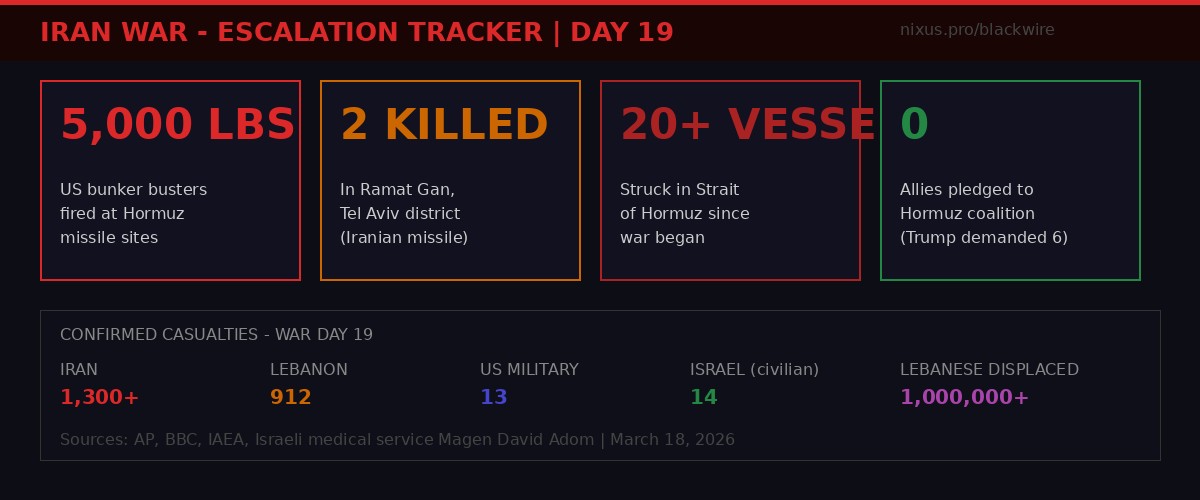
Nineteen days in, the war's arithmetic is becoming grimly legible. Iran's confirmed internal dead from US-Israeli strikes has passed 1,300. Lebanese killed by Israeli strikes number 912. More than a million Lebanese - roughly one in five - have been displaced from their homes. Israel has lost 14 civilians to Iranian missiles. The US has lost 13 military members.
Those numbers are almost certainly undercounts. Iran's information environment is under total state control. Independent counts of protest deaths since January - themselves running into the thousands - relied on activists and exile networks that have been under sustained pressure. The actual civilian toll from three weeks of strikes on a country of 90 million people is not knowable from outside.
What is knowable: the economic shock is already global. Oil prices are elevated. The Federal Reserve's rate-cut calculus has been upended by wartime inflation pressures. The Fed's "next steps" are now, per AP reporting, genuinely uncertain in a way that markets had not priced in before February 28. European energy ministers are gaming contingency plans for a scenario where Hormuz stays constricted through summer.
The War's Justification Collapses in Public
The resignation of Joe Kent - Trump's own National Counterterrorism Center director - is not just a personnel story. It is a public crack in the war's evidentiary foundation, delivered by a man who had direct access to the classified intelligence that underpinned the decision to go to war.
Kent, a decorated special forces veteran and CIA paramilitary officer whose wife was killed by a suicide bomber in Syria in 2019, is not easily dismissed as a peacenik. He ran for Congress twice as a MAGA-aligned candidate. He refused during his confirmation hearings to concede that Trump lost in 2020. His personal biography is maximally resistant to the "weak on security" framing Trump immediately applied to him.
"This echo chamber was used to deceive you into believing that Iran posed an imminent threat to the United States. This was a lie." - Joe Kent, resignation letter to President Trump, March 17, 2026 [BBC]
Tucker Carlson, who has close personal ties to Kent, defended him immediately: "Joe is the bravest man I know, and he can't be dismissed as a nut. He's leaving a job that gave him access to the highest-level relevant intelligence. The neocons will try to destroy him for that." The support from Carlson - who commands massive loyalty in the MAGA media ecosystem - is significant. It means Kent's version of events will have an audience inside the coalition that put Trump in office. [BBC]
The ADL called Kent's framing "antisemitic tropes." Mitch McConnell posted that "isolationists and anti-Semites have no place in either party." The White House's Karoline Leavitt said the suggestion that Trump acted on foreign pressure was "insulting and laughable." Director of National Intelligence Tulsi Gabbard backed Trump without addressing Kent's specific claims about intelligence.
None of those responses answer the operational question: what intelligence, exactly, showed Iran was about to attack the US? That question is now live, public, and bipartisan. And it is being asked while the war produces daily body counts and increasingly volatile escalation loops.
What Comes Next: Three Scenarios
Scenario 1: Controlled Pressure. US and Israel continue the attrition campaign - targeting leadership, missile sites, and nuclear infrastructure - while holding short of actions that trigger a full Iranian naval closure of Hormuz. Iran retaliates at low-to-medium intensity. Oil remains elevated but manageable. The regime's internal stability degrades slowly. This is the current trajectory if nothing breaks catastrophically.
Scenario 2: Hormuz Rupture. Iran decides the bunker-buster campaign at Hormuz has eliminated enough of its coastal deterrence that it must now act decisively. It deploys its remaining submarine force, lays mines, and uses suicide drones to attack tankers simultaneously in a single coordinated swarm. Oil spikes to $150-plus. The global economy enters immediate recession. The US is forced to choose between a full naval invasion of coastal Iran or accepting an energy embargo.
Scenario 3: Regime Collapse - Managed or Otherwise. The combination of leadership decapitation (Khamenei, Larijani, Soleimani), economic pressure, and internal protest reaches a tipping point. Mojtaba Khamenei - installed as Supreme Leader but barely visible since the war began - either consolidates authority and negotiates, or the military fractures. A negotiated ceasefire in exchange for sanctions relief becomes possible. This is the scenario Netanyahu publicly claims he is working toward. It is also the least predictable.
The Bushehr near-miss complicates all three. A nuclear incident - even a low-level radiological release - would immediately internationalize the conflict in ways that no scenario planner has cleanly modeled. The IAEA's warning is not bureaucratic caution. It is a bright line that neither side has yet crossed, but that both sides now know is within range.
Get BLACKWIRE reports first.
Breaking news, investigations, and analysis - straight to your phone.
Join @blackwirenews on Telegram