Dubai in Iran's Crosshairs: Tehran Names UAE as US Launch Base While the War Goes Three-Front
On Day 17, Iran's foreign minister publicly identified the UAE as the staging ground for US strikes on Kharg Island - threatening the region's economic hub for the first time. North Korea fired 10 missiles in the same hour. Six American airmen were named. The Iran conflict is no longer contained.
DUBAI / BAGHDAD / PYONGYANG - Saturday, March 15, 2026, 06:00 CET | Sources: AP, US Central Command, South Korea JCS, DoD
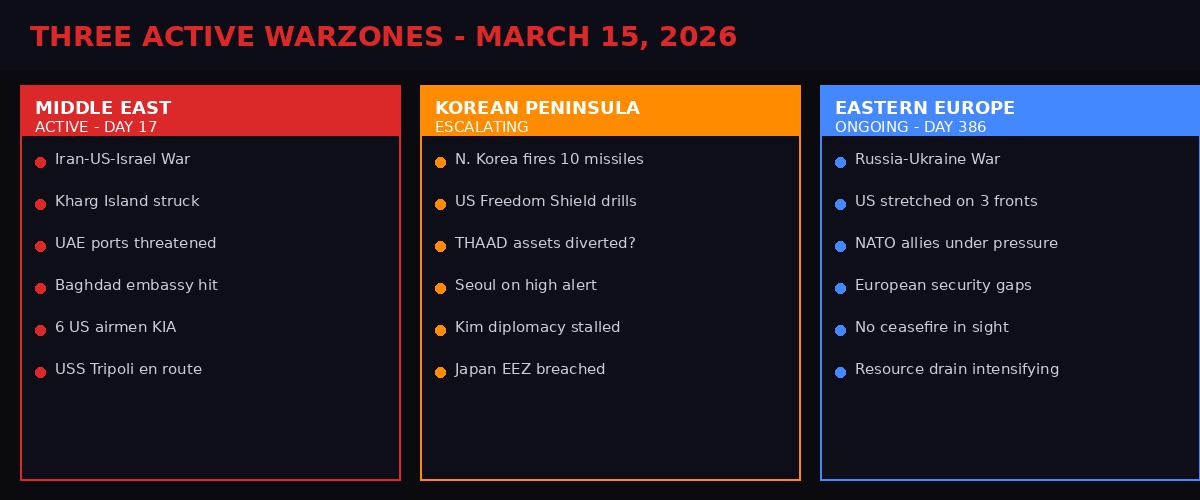
The Iran-US war entered its 17th day Saturday with three simultaneous developments that together mark a qualitative shift in global risk: Iran officially accused the UAE of hosting American military operations and threatened its port infrastructure, North Korea fired a 10-missile volley while US forces are stretched thin, and the Pentagon named six airmen killed in a refueling crash whose deaths had been announced - but whose faces and families only became real today.
Iran Points the Finger at Dubai
For 16 days, Iran directed its rhetorical fury at the United States and Israel. On Saturday morning, it turned to a third target: the United Arab Emirates.
Iranian Foreign Minister Abbas Araghchi went on the record - specifically, on MS NOW television - to claim that American forces had attacked Kharg Island and Abu Musa Island from two locations inside UAE territory: Ras Al-Khaimah and a site he described as "very close to Dubai." He called the use of UAE soil to launch strikes "dangerous" and said Iran would "try to be careful not to attack any populated area" there - a statement that reads as warning more than reassurance.
"The U.S. attacked Kharg Island and Abu Musa Island from two locations in the UAE - Ras Al-Khaimah, and a place very close to Dubai. This is dangerous." - Abbas Araghchi, Iranian Foreign Minister, March 15, 2026 (via AP)
Hours before Araghchi spoke, Iran's joint military command had urged residents to evacuate three UAE ports: Jebel Ali - the Middle East's busiest cargo hub - as well as Khalifa port in Abu Dhabi and the port of Fujairah on the Gulf of Oman. No evidence was provided for the claim that US forces used UAE bases. US Central Command said it had no response.
The UAE's response was carefully calibrated. Anwar Gargash, a senior diplomatic adviser to the Emirati president, posted on social media that the country "has the right to defend itself" but "still prioritizes reason and logic, and continues exercising restraint." That is the language of a government under extraordinary pressure from multiple directions simultaneously.
By early Saturday, no major attack on Jebel Ali or Khalifa port had materialized. But Iranian drone debris struck an oil facility at Fujairah port, sparking a fire. The message had been delivered with fire, not just words.
Jebel Ali handles roughly 15 percent of the Middle East's entire container throughput. It is the logistics backbone of Gulf commerce. An Iranian strike on Jebel Ali would not be a military operation - it would be an economic weapon aimed at the entire region. The fact that Iran issued evacuation warnings rather than launching immediately suggests it is using the threat as leverage, not yet as kinetic force. But that calculus could change.
Baghdad: The Embassy Gets Hit Again
While Iran's threat to Dubai dominated headlines Saturday morning, a missile struck the US Embassy compound in Baghdad. The weapon hit a helipad inside the facility - one of the largest US diplomatic missions on earth. No casualties were reported immediately, and no group claimed responsibility.
This was not a surprise. The Baghdad embassy has been targeted repeatedly throughout the war. Iran-aligned militias operating in Iraq have a well-documented history of rocket and drone attacks against US installations in the country. The State Department issued another warning Saturday urging all American citizens in Iraq to leave "now" and to travel by land because commercial air routes were unavailable.
The embassy compound in Baghdad's Green Zone is a city within a city - a massive US-built structure spanning 104 acres that was constructed after the 2003 invasion. That it is being hit with missiles on what amounts to a weekly basis during this war signals two things: Iran-linked militias have not been neutralized despite weeks of US strikes, and the political cost of keeping Americans in Iraq is rising with every helipad crater.
"Iran and Iran-aligned militia groups may continue to target U.S. citizens, interests and infrastructure." - US State Department Travel Advisory, March 15, 2026
The attack also underscores the geographic sprawl of this conflict. Iran is fighting simultaneously through its own forces - missiles, drones, naval operations - and through a network of proxy militias stretching from Lebanon's Hezbollah through Iraqi armed groups to Yemen's Houthis. Each front requires separate containment. The US is doing all of it at once.
Kharg Island and the Oil Weapon
The strategic centerpiece of the escalation remains Kharg Island - the coral outcrop in the Persian Gulf through which nearly all of Iran's oil exports flow. On Friday, President Trump said the US had "obliterated" military sites on the island and warned that oil infrastructure could be next if Iran continued to interfere with Strait of Hormuz shipping.
Iran's semiofficial Fars news agency pushed back Saturday, claiming the Kharg strikes caused no damage to oil infrastructure and targeted only military facilities: an air defense site, a naval base, an airport control tower, and a helicopter hangar belonging to an offshore oil company. US Central Command said it destroyed naval mine storage, missile bunkers, and "other military sites."
Both cannot be fully correct. The divergence in accounts is standard wartime information fog. What is verifiable: maritime intelligence firm TankerTrackers.com reported multiple tankers still loading at Kharg on Wednesday via satellite imagery, suggesting Iran's oil export capacity had not yet been severed as of mid-week. Iran has exported an estimated 13.7 million barrels since the war began.
JPMorgan's global commodity research team had warned earlier this week that a decisive strike on Kharg would have "major economic implications" - not just for Iran, but for global oil markets. With China buying roughly 90 percent of Iran's crude exports, any disruption to Kharg directly pressures Beijing. That may be why Trump simultaneously called on China to help keep the Strait of Hormuz open - a diplomatic double-bind designed to force Beijing to choose sides.
Iran's parliamentary speaker has said explicitly: strikes on the country's oil infrastructure would trigger "a new level of retaliation." If Kharg burns, the entire Gulf energy corridor becomes a target.
The Six Airmen: Names Behind the Numbers
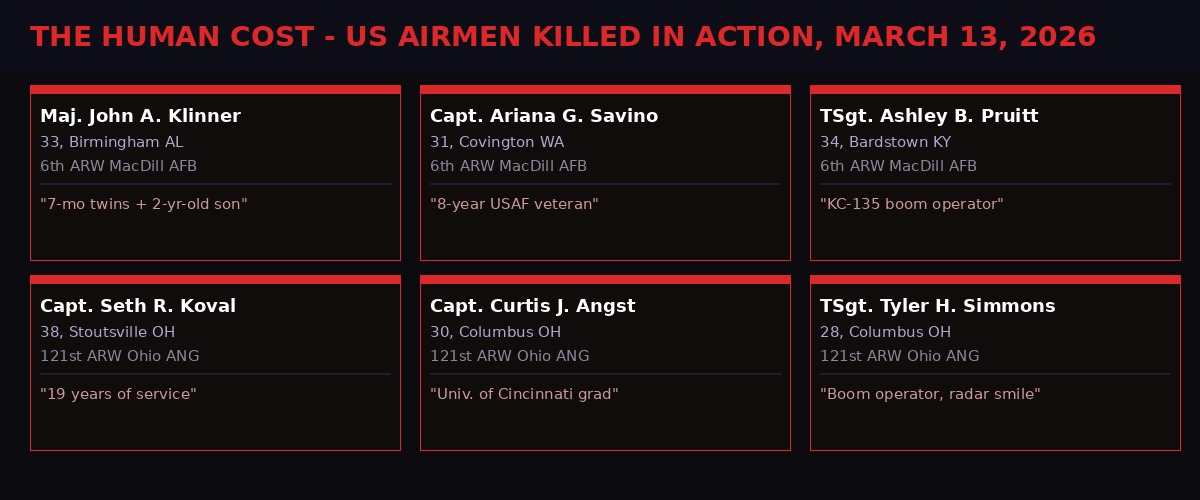
The US Department of Defense on Saturday formally identified the six Air Force personnel killed Thursday when their KC-135 Stratotanker refueling aircraft crashed in western Iraq while supporting combat operations against Iran. The plane went down in "friendly" airspace after an unspecified incident involving a second aircraft. That other plane landed safely.
The six represent a cross-section of American military structure: active-duty Air Force from a major Florida base, weekend warriors from the Ohio National Guard, spanning three states, six families, three pairs of colleagues who trained together and died together in a single refueling aircraft over western Iraq.
The KC-135 Stratotanker is a 1950s-designed aircraft that has been the backbone of US aerial refueling for generations. It does not engage in direct combat - it extends the reach of fighter jets and bombers, keeping them fueled over long-distance missions. Every strike on Iran from ships and carriers in the Arabian Sea, every B-2 run from Diego Garcia, depends on the invisible work of KC-135 crews circling above friendly airspace. Their deaths are an amplifying fact: this war is consuming Americans who never fire weapons, whose only job is to keep the fighters in the sky.
North Korea Fires Ten Missiles
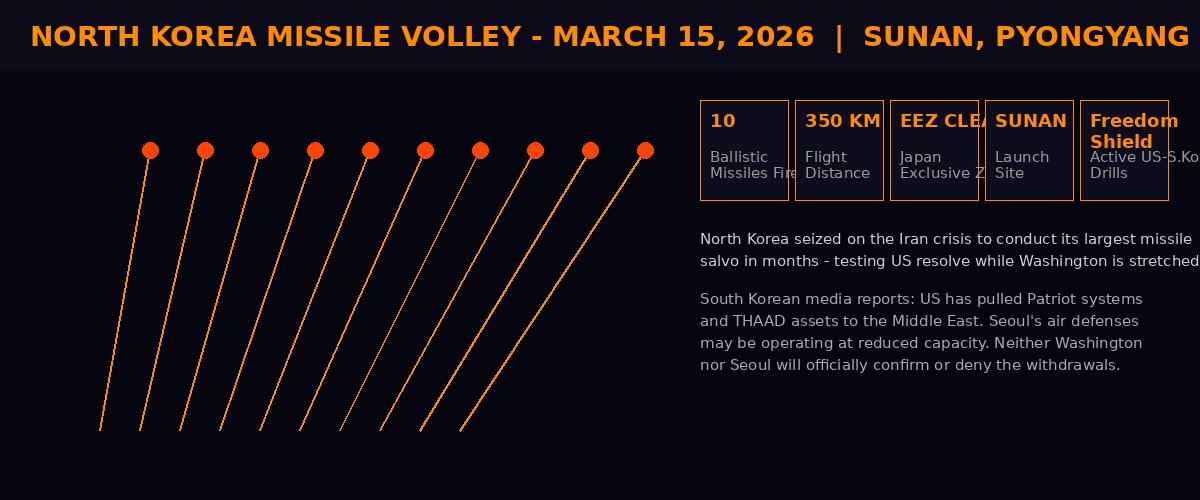
Hours after dawn in Seoul, South Korea's Joint Chiefs of Staff confirmed that North Korea had fired approximately 10 ballistic missiles from the Sunan area near Pyongyang's international airport, into the eastern sea. The weapons flew roughly 350 kilometers before landing outside Japan's exclusive economic zone. Japanese Defense Minister Shinjiro Koizumi confirmed no ships or planes were struck.
The timing was not coincidental. The US and South Korea are currently running Freedom Shield - a major computer-simulated joint exercise involving approximately 18,000 South Korean troops and an undisclosed number of Americans. Freedom Shield runs until March 19. North Korea has long characterized such drills as "invasion rehearsals" and used them as political cover for weapons demonstrations.
But this volley carries a specific subtext that makes it more alarming than routine Pyongyang signaling. South Korean media - citing security camera footage and satellite imagery - has been reporting for days that the US may be relocating Patriot air defense systems and Terminal High Altitude Area Defense (THAAD) components from South Korea to the Middle East to support operations against Iran. Neither Washington nor Seoul will confirm or deny the reports.
South Korean President Lee Jae Myung's office said any relocation of US assets "would not affect the allies' defense posture." That is the mandatory reassurance. What is harder to dismiss is the context: hours before Kim fired his missiles, South Korean Prime Minister Kim Min-seok had met Trump in Washington and expressed hope for renewed diplomatic contacts between Washington and Pyongyang. Pyongyang's response was ten ballistic missiles. Diplomacy, apparently, is not the current order.
The launches also expose one of the deepest structural tensions in US grand strategy. The Iran campaign has pulled enormous military resources toward the Middle East - carriers, destroyers, Marines, aerial assets. The US military is designed to fight one major war while deterring a second. It is now actively running a major war in the Middle East, a deterrence operation in the Pacific, and providing strategic support to Ukraine - all simultaneously, with the same set of ships, planes, and crews.
Trump Calls for a Global Naval Coalition
Against the backdrop of all this, President Trump called on China, France, Japan, South Korea, and the United Kingdom to send warships to the Strait of Hormuz to keep it "open and safe." The request - made Saturday - is extraordinary in its scope.
Britain responded that it was discussing with allies "a range of options" to secure shipping. France and the others had not publicly committed as of Saturday morning.
Iran's Foreign Minister Araghchi dismissed the call immediately, posting on social media that Trump was "begging" and urging Gulf neighbors to "expel foreign aggressors." Araghchi also reiterated that the strait was closed only to "those who are attacking us and their allies" - a formulation that technically keeps it open to China, Europe, and most of the rest of the world, while blocking US and Israeli vessels.
The political geometry of Trump's request is delicate. Asking China to send warships to protect shipping in a body of water near the country it buys oil from is, strategically, asking Beijing to protect its own economic interest. But it also asks China to implicitly align itself with US operations by operating alongside American carriers. Beijing has so far maintained studied neutrality. Whether Chinese warships actually appear in the Strait of Hormuz alongside the USS Abraham Lincoln would be a seismic signal - one way or another.
Israel, separately, continued its own operations. The Israeli Air Force said it struck more than 200 targets in Iran in the prior 24 hours, hitting missile launchers, air defense systems, and weapons production facilities. Israel is running its own campaign in parallel with the American one, coordinating operationally but retaining independent strategic objectives. Lebanon's crisis deepened in parallel - more than 800 dead and 850,000 displaced as Israeli strikes on Hezbollah continued.
Timeline: Day 17, March 15, 2026
Chronology of Events
What Comes Next
The Iran-US war is seventeen days old. It has not expanded to the catastrophic scenarios - no nuclear exchange, no ground invasion, no closure of Hormuz that has actually stopped global shipping. What it has done is create a persistent, escalating state of armed conflict that is reshaping regional alliances, draining US military capacity, and metastasizing outward.
The UAE naming is the flashpoint to watch most closely in the next 24 to 48 hours. Abu Dhabi has been walking a tightrope since the war began: it hosts both American military infrastructure and deep economic ties to Iran and the broader Islamic world. It has tolerated being in the blast radius of this war. If Iran's foreign minister publicly identifying the UAE as a US base crosses a threshold for Abu Dhabi, the Emirates' government may face pressure to ask American forces to reduce their footprint - which would force a strategic reorientation of US operations in the Gulf.
Iran's calculus appears to be: pressure UAE diplomatically, see if Gulf states blink and begin expelling US assets. If that works, the American military logistics position in the region gets significantly harder. If it does not work, Iran still has the option of a Jebel Ali strike - economic nuclear warfare - as a next step.
The North Korea dimension complicates everything. A US military that is fully committed to the Iran campaign has less bandwidth - less hardware, less attention, less credible deterrence - to manage a Korean peninsula that Kim Jong Un appears to be probing actively. Freedom Shield is meant to project strength. Pyongyang's 10-missile response suggests Kim does not see strength. He sees distraction.
And in Washington, the families of six airmen - people who refueled the bombers, who never dropped a single munition - are planning funerals. The human cost of this war is not abstract. It is a father from Birmingham who will not see his twins learn to walk. It is a young pilot from Ohio whose face his colleagues will remember at every Freedom Shield briefing for years to come.
Day 17. The war shows no sign of ending. It is showing signs of expanding.
Get BLACKWIRE reports first.
Breaking news, investigations, and analysis - straight to your phone.
Join @blackwirenews on Telegram