Day 16: Isfahan Bombed, IRGC Launches 50th Wave, Trump Threatens Kharg Again - "Just for Fun"
US-Israeli strikes killed 15 workers at an Isfahan factory in the early hours of Sunday. Iran's IRGC fired its 50th retaliatory wave across four countries. On Truth Social, Trump threatened more Kharg Island strikes - not for military necessity, but for sport.
Sunday, March 15, 2026 - 11:08 UTC | MIDDLE EAST WAR, DAY 16
The Iran war shattered its own precedent on Sunday. US and Israeli forces struck Isfahan, Iran's third-largest city and a centre of aerospace and nuclear research, killing at least 15 people at an industrial factory in the early hours. Tehran's IRGC responded by launching what it called its "50th wave" of retaliatory strikes, simultaneously hitting US military bases in the UAE, Bahrain, and Kuwait while launching fresh barrages of missiles and drones toward Israel. Sirens blared across central Israel at dawn. And in Washington, the president who launched this war on February 28 threatened to bomb Kharg Island again - not because of a military calculation, but, in his own words, "just for fun."
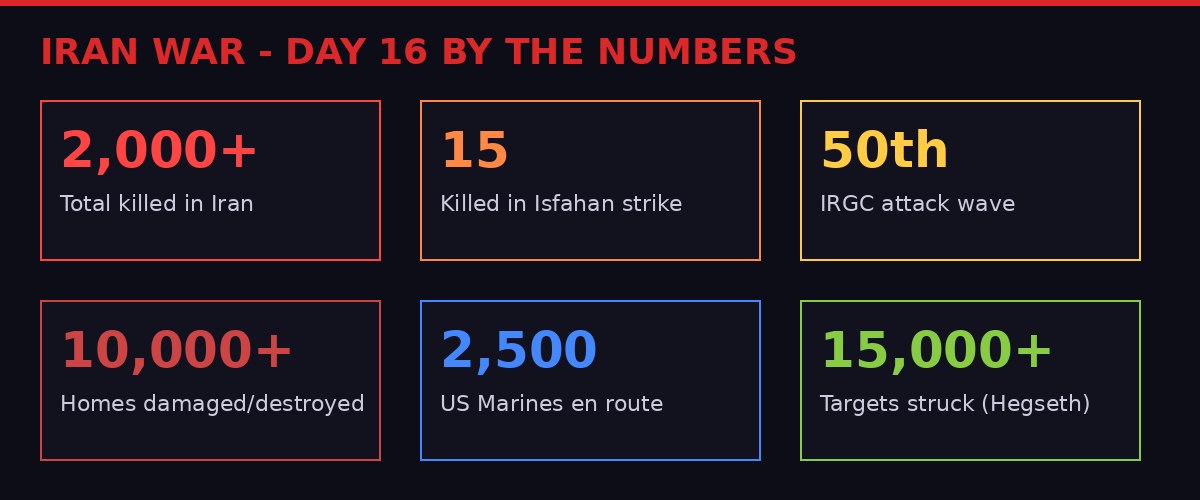
Sixteen days in, the war has killed more than 2,000 people in Iran alone, according to multiple government and state media reports. At least 10,000 residential homes have been "damaged or completely destroyed" by US-Israeli strikes, according to Tehran's governor. The numbers climb each morning. What is changing now is the tone - and the geography. Isfahan marks a shift toward deeper Iranian territory. And Trump's casual threat of recreational bombardment has set a new standard for how openly this administration discusses mass destruction.
Isfahan: Factories, Aerospace, and the Shift to Civilian Infrastructure
Isfahan is not a random target. The city hosts Iran's main nuclear fuel production facilities, a major aerospace research complex, and one of the country's largest military industrial zones. It sits roughly 340 kilometres south of Tehran - far enough from the capital to represent a geographic deepening of the air campaign, close enough to signal that no Iranian city is beyond reach.
Sunday's strike hit what Iranian media described as an "industrial area" of Isfahan. Fifteen workers were confirmed dead. State media reported that the victims were inside a factory when missiles hit the complex in the pre-dawn hours. Tasnim News Agency said a residential and "deprived area" of Shiraz, capital of Fars province, was also attacked in the same overnight operation - a claim the CENTCOM has not confirmed.
Iran's space research facilities in Isfahan were also reported to have sustained severe damage in recent strikes, according to Al Jazeera's reporting citing Iranian sources. The space research angle matters: Iran's ballistic missile program shares significant technical infrastructure with its space launch program, and strikes on that complex carry dual implications - military degradation and symbolic humiliation of one of the few areas of Iranian science that commanded genuine international respect.
Iranian Foreign Minister Abbas Araghchi added another dimension to the strike's political fallout. He revealed that the cruise missiles used against Kharg Island on Saturday were launched from the UAE - specifically from Ras Al-Khaimah and a location he described as being "very close to Dubai." The claim is explosive in regional terms. Abu Dhabi immediately accused Iran of "moral bankruptcy" while insisting it was not a party to the conflict - but the foreign minister's allegation places Emirati territory at the centre of the air war whether UAE officials like it or not. (Source: Al Jazeera, March 15, 2026)
"The US attacked Kharg Island from two locations in the UAE: Ras Al-Khaimah and a place very close to Dubai. This is dangerous. Iran will try to be careful not to attack any populated area there." - Abbas Araghchi, Iranian Foreign Minister, speaking to MS NOW news channel, March 15, 2026
The 50th Wave: IRGC Systematically Expands Its Target List
Iran's Islamic Revolutionary Guard Corps described Sunday's retaliatory operations as its "50th wave" - a designation that carries both military and propaganda weight. The IRGC has been numbering its waves since the opening night of the war on February 28, building a public record of sustained resistance even as much of its conventional military capability has been degraded by relentless US-Israeli air strikes.
The 50th wave hit four countries simultaneously. Missiles and drones targeted the al-Dhafra airbase in the UAE, from which Iran's foreign minister alleged US cruise missiles were launched. Ten missiles and several drones were fired at al-Dhafra according to IRGC statements carried by Iranian state agencies. In Bahrain - home to the US Navy's Fifth Fleet - sirens were activated and residents were ordered to shelter. Bahraini authorities arrested six people on charges of "spreading misinformation" about the attacks, a detail that illuminates the tight information controls operating in the Gulf states.
Kuwait's Ahmad al-Jaber airbase, a major US forward operating location, took two direct missile hits to its perimeter, wounding three soldiers. Drone strikes damaged facilities at Kuwait International Airport, hitting part of a runway in what appeared to be a deliberate economic targeting operation. Airport infrastructure damage creates cascading disruption well beyond the immediate strike site - delayed flights, diverted cargo, insurance surcharges, and psychological pressure on Gulf states to distance themselves from the war.
In Saudi Arabia, the Ministry of Defence reported intercepting four drones in the Riyadh metropolitan area and destroying six ballistic missiles aimed at the al-Kharj governorate. Two people have been killed in Saudi Arabia since Iran's retaliatory strikes began, with twelve injured. Iran has also sustained civilian deaths: the governor of Tehran reported that 10,000 homes have been "damaged or completely destroyed" in US-Israeli strikes since February 28. (Source: Al Jazeera Day 16 explainer, March 15, 2026)
Israel received fresh barrages on Sunday morning. Sirens blared across central Israel as Iran launched multiple salvos of missiles and drones. The extent of damage was not immediately confirmed, but the sustained nature of Iranian missile fire - 50 designated waves over 16 days - demonstrates that whatever degradation US and Israeli forces have inflicted on Iran's military, they have not broken its will or capacity to strike back.
"Just for Fun": What Trump's Kharg Threat Tells You About This War
Late Saturday, US President Donald Trump appeared on NBC News and said the United States might bomb Kharg Island again. He noted that previous strikes had "totally demolished" much of the oil export hub. Then he said something that no US commander in chief has said publicly during a shooting war: "We may hit it a few more times just for fun."
The remark is worth sitting with for a moment. Kharg Island is Iran's primary crude export terminal - the infrastructure through which roughly 90 percent of Iran's oil revenues historically flowed. It is not a military base. It is an energy installation. Striking it inflicts economic pain on Iran and sends oil prices higher globally. Describing further strikes as entertainment, as sport, as something done for the pleasure of it, removes any pretence of proportionality or military justification that international law requires. (Source: Al Jazeera, "Trump says US may hit Iran's Kharg Island again 'just for fun,'" March 15, 2026)
Iranian Foreign Minister Araghchi responded immediately: Iran would retaliate against any further US attacks on its energy facilities. This is not a bluff. Iran has already shown it will hit energy infrastructure in Saudi Arabia, UAE, and Kuwait in response to US actions. The Kharg strikes launched from UAE territory - if Araghchi's claim stands - handed Iran both a military rationale and a political pretext for escalating against UAE energy installations.
Trump simultaneously claimed - in the same set of remarks - that the US had "already destroyed 100% of Iran's military capability." Then, in the next breath, he acknowledged that Iran could still "send a drone or two, drop a mine, or deliver a close-range missile" along the Strait of Hormuz. Analysts noted the logical incoherence: a military reduced to zero capability does not continue launching 50-wave retaliatory strikes across four countries simultaneously.
"It doesn't seem like they had a plan for the Strait of Hormuz to be closed, and it seems like a desperate move in an information campaign to calm markets and that something magical will happen to open the straits." - Andreas Krieg, Middle East security expert, King's College London School of Security Studies, speaking to Al Jazeera, March 15, 2026
Hormuz Standoff: The Coalition Trump Can't Quite Build
The Strait of Hormuz has been effectively closed to US-allied shipping for the 15th consecutive day. On Saturday, Trump posted on Truth Social calling for an international naval coalition to reopen it, naming China, France, Japan, South Korea, and the United Kingdom as countries he "hoped" would contribute warships. The language is telling - hoped, not confirmed.
None of the named countries had publicly committed as of Sunday morning. China's position is particularly delicate: Beijing has deep economic ties to Iran, has been trading with Tehran throughout the conflict, and has no interest in serving as muscle for a US military operation it privately opposed from the start. France has signalled willingness to engage diplomatically but has not committed ships to what would effectively be a US-led naval enforcement operation. Japan and South Korea depend heavily on Gulf oil but are wary of direct military entanglement in a conflict that could easily spill into their energy supply chains.
The USS Tripoli - an amphibious assault ship - and approximately 2,500 Marines are currently en route to the Middle East following a request from US Central Command approved by Defense Secretary Pete Hegseth. That deployment gives the US additional amphibious capacity in the region, but it doesn't reopen the strait. Iran's IRGC Navy commander Alireza Tangsiri stated plainly on Sunday that the strait "has not yet been militarily closed and is merely under control" - a distinction that allows Tehran to claim restraint while effectively denying passage to ships it designates as enemy-affiliated.
Two Indian-flagged tankers carrying liquefied petroleum gas successfully passed through the strait on Saturday morning after Tehran granted a rare exemption following direct talks between Prime Minister Narendra Modi and Iranian President Masoud Pezeshkian. India, facing a critical cooking gas shortage, had invoked emergency powers to protect the 333 million homes that depend on LPG. A Turkish-owned vessel received similar passage earlier in the week after Ankara negotiated directly with Tehran. Fourteen more Turkish vessels remain queued and awaiting clearance. (Source: Al Jazeera, Rajesh Kumar Sinha statement via Ministry of Ports, India, March 15, 2026)
The pattern is becoming clear. The strait is not uniformly blocked - it is selectively controlled. Countries willing to negotiate directly with Iran can get ships through. Countries operating under the US security umbrella cannot. This creates a fracture in the global energy order: the world's most important maritime chokepoint is now a diplomatic instrument of the Islamic Republic of Iran, available to those who call Tehran rather than Washington.
Day 16 - Key Events Timeline (March 15, 2026)
The Leadership Vacuum: Mojtaba's Silence and the IRGC's Autonomy
One of the most consequential unknowns of Day 16 is the status of Iran's new Supreme Leader. Mojtaba Khamenei - son of the late Ali Khamenei, who died in the opening days of the US-Israeli air campaign - has been invisible throughout the war. US officials had earlier claimed he was wounded in an Israeli strike and "likely disfigured." Iranian Foreign Minister Araghchi pushed back on Sunday, stating there is "no problem" with the new supreme leader - but offered no proof of life, no public appearance, no statement attributed to Mojtaba personally.
This matters operationally. The IRGC's ability to launch 50 waves of strikes over 16 days, to coordinate simultaneous attacks across four countries, and to maintain Hormuz control while managing selective passage exemptions for friendly states - all of this suggests a functioning chain of command. Whether that chain runs through Mojtaba or through IRGC commanders acting with delegated or de facto autonomy is an open question. The IRGC has historically been the power centre within the Iranian state, not merely its instrument. If Mojtaba is incapacitated, the IRGC may be functioning as the effective government of Iran.
Iran also confirmed Sunday the killing of Brigadier-General Abdullah Jalali Nasab in an Israeli attack - adding to a senior military roster of dead that already includes Abdolrahim Mousavi (armed forces chief of staff), Aziz Nasirzadeh (defence minister and deputy chief of staff), and Mohammad Pakpour (IRGC commander-in-chief). The decapitation of that level of command structure should, in military doctrine, degrade coordinated response capability. The IRGC's continued high operational tempo suggests either extensive pre-war planning for decentralised command, or rapid replacement of leadership - or both. (Source: Al Jazeera day 16 explainer, March 15, 2026)
The Iranian government separately announced the arrest of twenty people in northwest Iran - West Azerbaijan province - charged with sending location intelligence on Iranian military and security assets to Israel. The prosecution is a window into how the war is being fought in the intelligence dimension: both sides are operating intensive human intelligence and signals operations inside Iran, with some Iranians apparently willing to collaborate with Israel for reasons that may range from financial incentive to political opposition to the regime.
The Food Security Dimension: Hormuz, Fertilizer, and a Slow-Motion Famine Risk
The military narrative dominates the daily dispatches, but a slower catastrophe is building in the background. The Strait of Hormuz is not just an oil chokepoint - it is a critical conduit for liquefied natural gas, and LNG is the primary feedstock for nitrogen-based fertilisers. Those fertilisers support the staple grain and cereal crops that provide more than 40 percent of global caloric intake, according to the Center for Strategic and International Studies.
Every day the strait remains effectively closed to broad commercial shipping is another day that LNG supplies to fertiliser producers are constrained. The disruption has not yet translated into visible food price spikes in Western markets, where large strategic reserves exist. The story is different in South Asia, sub-Saharan Africa, and parts of Latin America, where supply chains are thinner and governments have fewer reserves to buffer price shocks.
UN humanitarian chief Tom Fletcher issued a warning that "millions of people are at risk" if humanitarian cargo cannot pass safely through the strait. India's emergency invocation of powers to protect its 333 million LPG-dependent homes is the most concrete manifestation yet of this cascade. India is not a small, poor country - it is the world's most populous nation with the world's fifth-largest economy. If New Delhi is invoking emergency energy powers, the underlying supply crunch is real and significant. (Source: Al Jazeera, March 14-15, 2026)
The selective passage regime Iran has established - bilateral negotiations required for each ship, exemptions extended to India and Turkey, denied to US-allied tankers - also creates long-term structural damage to global shipping insurance. Lloyd's and other major marine insurers are already pricing in war-zone premiums for any vessel transiting the Gulf region. Those premiums don't vanish when the war ends. They become the new baseline cost of doing business through a strait the world spent 40 years treating as a secure commercial lane.
What Comes Next: The Escalation Ladder Has No Visible Top Rung
Sixteen days of this war have produced a consistent pattern. US-Israeli strikes degrade Iranian infrastructure, kill senior military figures, and push deeper into civilian-adjacent territory. Iran retaliates with 50-wave missile and drone campaigns that are less lethal but geographically expansive and strategically disruptive. Neither side has a visible off-ramp.
Trump claimed Saturday that Iran "wants to make a deal" - but US officials simultaneously said they are "not ready" to make a deal. Hegseth told reporters he doesn't "need to worry about" the strait closure. These two positions cannot both be true operationally: if Iran wants a deal and the US is not ready for one, then the war continues at Iranian initiative plus US intransigence. If Hegseth genuinely believes the strait closure is manageable, the US has no pressure incentive to negotiate. If it is not manageable - and the Indian emergency powers suggest it is not - then Hegseth's dismissal is either disinformation or delusion.
The Kharg Island dynamic is the most volatile single thread. Iran's foreign minister has stated explicitly that further US attacks on Iranian energy infrastructure will trigger Iranian retaliation against regional energy assets. The UAE sits in that crosshairs - as does Saudi Aramco's eastern province infrastructure. A strike that takes out significant Saudi oil export capacity would be an economic event on a different scale entirely from anything this war has yet produced. Oil at $150 per barrel would be a floor, not a ceiling.
Trump's "just for fun" formulation - even if understood as loose talk rather than policy - strips away the language of proportionality that gives other nations cover to stay out of the conflict. If US strikes on Iranian energy infrastructure are recreational rather than military in purpose, European and Asian allies face a harder argument for standing alongside Washington. French, German, and British governments are already navigating extreme domestic pressure over their association with this war. The recreational bombing framing hands their critics a gift. (Source: King's College London's Andreas Krieg, via Al Jazeera, March 15, 2026)
The IRGC's decision to frame its operations in numbered waves - 50 and counting - is its own information operation. Every new wave is a press release: we are still here, we are still fighting, we are not broken. Whether that is accurate or performative, it shapes the political environment in Iran, in the region, and in the international capitals that are watching and calculating their own positions. The war is now in its third week. If it reaches six weeks, the economic, humanitarian, and diplomatic damage will be of a different order of magnitude than what the world has absorbed so far. Nobody in a position of authority appears to have a plan for how it ends.
Get BLACKWIRE reports first.
Breaking news, investigations, and analysis - straight to your phone.
Join @blackwirenews on TelegramSources: Al Jazeera reporting (March 14-15, 2026); Axios; NBC News interview with Donald Trump; Truth Social posts by Donald Trump; Iranian Foreign Minister Araghchi statements via MS NOW; IRGC statements via Tasnim News Agency; Center for Strategic and International Studies; UN humanitarian chief Tom Fletcher statements; Andreas Krieg, King's College London; Indian Ministry of Ports, Shipping and Waterways (Rajesh Kumar Sinha statement); Saudi Arabia Ministry of Defence statements; Bahrain Ministry of Interior.