Hamas Breaks With Iran as War Reaches Dubai's Doorstep
Fujairah burning. Jebel Ali threatened. 2,500 more Marines en route. And the group Iran arms, funds, and trains just publicly told Tehran to stop hitting Gulf states. The Axis of Resistance is cracking.

Fire at Fujairah port after Iranian drone debris struck an oil storage facility on Saturday. The UAE's third-largest port handles a critical share of ship refuelling in the Gulf. (File photo)
Fifteen days into the war between the United States, Israel, and Iran, the conflict crossed a threshold nobody anticipated when the first Tomahawk missiles fell on February 28: Hamas - Iran's most famous proxy, its most politically significant ally in the "Axis of Resistance" - broke publicly with Tehran on Saturday and urged it to stop attacking Gulf neighbors.
The same day, an Iranian drone struck Fujairah port on the UAE's eastern coast, igniting a fire at one of the largest oil storage facilities outside of the Persian Gulf proper. Iran also issued evacuation warnings for Jebel Ali, the Middle East's busiest port, and Khalifa port in Abu Dhabi - the most direct threat yet to the commercial infrastructure that keeps global shipping moving.
No attack on Jebel Ali materialized by evening. But the warning alone sent freight insurance rates surging and forced at least nine shipping companies to reroute vessels away from UAE waters, according to maritime tracking firm Lloyd's List Intelligence.
The Fujairah Strike: Why It Matters

Oil tankers in the Persian Gulf region. The Fujairah port handles refuelling for vessels transiting between the Indian Ocean and Hormuz, making it among the most strategically vital commercial sites in the world.
Fujairah is not a target of convenience. It is the UAE's only emirate without a Persian Gulf coastline, positioned instead on the Gulf of Oman - specifically designed as a bypass route for oil shipments that don't want to transit through the Strait of Hormuz. The Abu Dhabi Crude Oil Pipeline, completed in 2012, terminates there precisely so tankers can load without entering the Strait.
The fire on Saturday was sparked not by a direct hit but by debris from an intercepted Iranian drone falling onto an oil storage facility. That's a distinction without much practical difference when the tanks are burning. The UAE's civil defense responded quickly and fire crews contained the blaze within hours, but the images circulated globally: black smoke rising from the UAE, the supposed stable alternative to a Hormuz-dependent Gulf.
Iran's Foreign Minister Abbas Araghchi said his country was not targeting UAE infrastructure - it was targeting American assets that he claims are sheltered inside UAE territory. He told MS NOW that the U.S. had used "ports, docks and hideouts" in Ras Al-Khaimah and an area "very close to Dubai" to launch the strikes on Kharg Island. He called that "dangerous" but added Iran would "try to be careful not to attack any populated area." (AP, March 14, 2026)
U.S. Central Command gave no response to Iran's claim about launch locations. The UAE issued no statement. That silence from Abu Dhabi is itself significant - the UAE has extensive diplomatic and economic ties with both Washington and Tehran, and its government has been threading a needle throughout the conflict, not formally condemning Iran's strikes on its territory while also not severing ties with Washington.
"The Hormuz Strait is open. It is open only to those who are not attacking us and our allies. All neutral ships can safely pass." - Abbas Araghchi, Iranian Foreign Minister, MS NOW, March 14, 2026
That formulation is doing a lot of work. "Neutral ships" now requires ships to prove non-association with the United States or Israel - a condition that is legally ambiguous, practically impossible to enforce uniformly, and commercially catastrophic for the insurance market. UK Maritime Trade Operations reported 16 ships have been attacked or had near-misses in or around the strait since the war began. Three of those were cargo vessels with no U.S. or Israeli ownership links.
Kharg Island: The Warning Shot That Wasn't
The previous 24 hours had been dominated by one story: the U.S. bombing of Kharg Island. On Friday, President Donald Trump announced that American forces had "obliterated" military sites on the small island 33 kilometers off Iran's coast - the terminal through which nearly all of Iran's oil exports flow.
U.S. Central Command confirmed it destroyed naval mine storage facilities, missile storage bunkers, and "other military sites" on the island. The IDF separately announced its air force had struck more than 200 targets across Iran in the previous 24 hours, including missile launchers, air defense systems, and weapons production facilities.
Iran's Fars News Agency - IRGC-affiliated and often the first to acknowledge military setbacks - said the Kharg strikes caused "no damage to oil infrastructure." It said U.S. bombs hit an air defense facility, a naval base, the airport control tower, and a helicopter hangar belonging to an offshore oil company. (Fars News, March 14, 2026)
What neither side disputed: the oil tanks are still standing. Trump made clear that was a deliberate choice, not a miss.
"Oil infrastructure could be next if Tehran continues to interfere with ships' passage through the Strait of Hormuz." - President Donald Trump, via Truth Social, March 13, 2026
Energy researcher Petras Katinas at the Royal United Services Institute (RUSI) put it bluntly: "It doesn't matter which regime is in power - new or old. If Iran loses Kharg, it loses the ability to function economically. The U.S. knows this. That's why it's being held in reserve." (AP, March 14, 2026)
JPMorgan's global commodity research team had already warned in an investment note this week that a direct strike on Kharg Island oil infrastructure would have major economic implications for global markets - specifically a potential 15-20% supply shock if exports were disrupted for more than 30 days. Iran has exported 13.7 million barrels since the war began, according to maritime intelligence firm TankerTrackers.com, with multiple tankers visible on satellite imagery still loading at Kharg as recently as Wednesday.
The Fracture in the Axis: Hamas Speaks
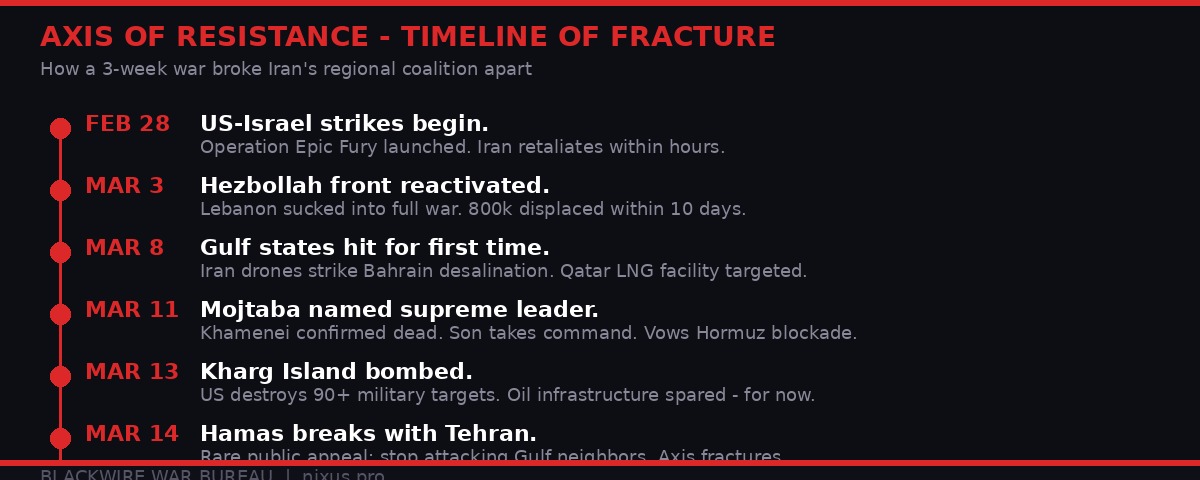
Timeline of the Axis of Resistance fracture from the opening strikes on February 28 to Hamas's unprecedented public break with Tehran on March 14. Each entry marks a threshold crossed.
The most strategically significant development of Day 15 was not the Fujairah fire or the Baghdad Embassy strike. It was a statement from Hamas.
The Palestinian armed group - Iran's most prominent proxy and the organization that Iran has armed, funded, and given political sanctuary throughout the Gaza war and its aftermath - issued a public appeal on Saturday urging its "brothers in Iran" to stop attacking Gulf neighbors. (BBC, March 14, 2026)
Hamas said it had been watching "with deep concern" and called on Tehran to stop targeting neighboring countries. It urged all regional nations to cooperate "to preserve the bonds of brotherhood." And it called on "all states and international organisations to work towards halting [the war] immediately."
The statement was unusual on multiple levels. Hamas almost never publicly contradicts its primary financial backer. The group typically coordinates messaging with Tehran and qualifies any criticism through the language of "solidarity with resistance." This statement was direct.
It was also, notably, self-interested. Turkey and Qatar - both Hamas's significant financial and political supporters - have come under Iranian drone and missile fire in the past week. Qatar hosts the Al-Udeid Air Base, CENTCOM's forward headquarters, which Iran has repeatedly threatened. A strike on Qatar's infrastructure doesn't just hurt Qatar - it hits Hamas's most reliable diplomatic interlocutor.
Hamas simultaneously "affirmed Tehran's right to defend itself against aggression by the US and Israel." So the message was calibrated: Iran is justified to fight, but not like this. Stop hitting our friends.
Iran made no public comment on the Hamas statement. That silence, in this context, is telling. Tehran has spent decades cultivating the Axis of Resistance as a force multiplier - a network of proxies and allies that could project power beyond Iran's borders. Now its most famous member is publicly asking it to stand down.
The "Axis of Resistance" is Iran's loose coalition of allied groups and governments united by opposition to U.S. and Israeli influence in the Middle East. Key members include Hezbollah (Lebanon), Hamas (Gaza), the Houthis (Yemen), various Iraqi militia factions, and Syrian government forces. The Axis provides Iran with strategic depth - the ability to threaten multiple adversaries simultaneously without direct Iranian military engagement. The current war has stress-tested the coalition's coherence for the first time at this scale.
Lebanon: 826 Dead, 800,000 Displaced, Nowhere Near Finished
While the Gulf escalation dominated Saturday's news cycle, Lebanon's collapse continued at a rate that has already generated the largest humanitarian crisis in the country since the 1975-1990 civil war.
The Lebanese Health Ministry reported 826 killed since the war began - and the death toll is rising daily. More than 800,000 people have been displaced from their homes, according to the United Nations. UN Secretary General Antonio Guterres traveled to Beirut on Saturday specifically to show solidarity and call on all parties to respect international law. His statement was notable for its bluntness.
"The Lebanese people did not choose this war. They were dragged into it. And my message to the warring partners is clear - stop the fighting. Stop the bombing." - Antonio Guterres, UN Secretary General, Beirut, March 14, 2026
The IDF announced its sixth wave of strikes against Iran and Hezbollah targets on Saturday alone. Three rounds came within less than two hours in the afternoon. Sirens and explosions were reported in Jerusalem, with two minor injuries from earlier strikes in Eilat. Israel's military says it has hit more than 200 targets in Iran in the previous 24 hours - missile launchers, air defense systems, and weapons production sites.
Hezbollah says it is fighting by order of Iran, coordinating strikes on Israel as part of the broader war effort. The Lebanese government, which has no effective control over Hezbollah's military arm, has been left watching a war on its own soil it did not choose and cannot stop.
BBC correspondent Lina Sinjab, reporting from Beirut, described the position of ordinary Lebanese: "Israel appears to want to finish what it started in 2024 - to eliminate Hezbollah. On the other hand, many see Hezbollah as acting under orders from Iran. This has put Lebanon and its government under immense pressure, as people are forced to live a war they don't want."
The human toll is being distributed unevenly. A BBC crew documented the aftermath of a strike on a house in the Bekaa valley - completely destroyed, eight killed including several children. Yellow flags and pictures of Khamenei indicated a Hezbollah-supporting household. A surviving uncle named Hassan Tahan told reporters: "Israel is wrong if they think that killing children will separate us from the resistance. On the contrary, it makes us more loyal." (BBC, March 14, 2026)
Iranian government spokesperson Fatemeh Mohajerani said more than 200 students and teachers have been killed in Iran since the war began, and 120 schools have been "severely damaged." The Israeli strikes, like the American ones, are generating civilian casualties that Iran is publicizing and that are feeding domestic hardening on both sides.
The Baghdad Embassy: A Symbol Under Fire Again
A missile struck a helipad inside the U.S. Embassy compound in Baghdad on Saturday morning. Nobody immediately claimed responsibility, but the State Department issued a standard-form blame to "Iran and Iran-aligned militia groups." (AP, March 14, 2026)
The Baghdad compound is one of the largest American diplomatic facilities in the world, a fortified city-within-a-city that has been a persistent target since the Iraq War era. It has been hit by rockets and drones dozens of times in the past decade. Saturday's strike was more accurate than most - a missile on the helipad is not a near-miss, it is a direct hit on a functioning piece of military logistics infrastructure.
The State Department again warned all American citizens in Iraq to leave "now" - specifically by land, since commercial flights remain suspended. It added that U.S. forces at the embassy compound "do not constitute a safe zone" for American civilians attempting to shelter there during the conflict.
The warning reflects a genuine assessment. Iraq's government is caught between Washington and Tehran in a position even more uncomfortable than the UAE's. The country hosts both U.S. forces under the Counter-ISIS framework and Iran-aligned Popular Mobilization Forces with seats in parliament. Baghdad has not condemned Iran's strikes on U.S. assets in its territory, but it has also not asked American forces to leave - a political calculation that could change rapidly if casualties mount.
The Troop Buildup: USS Tripoli and 2,500 Marines
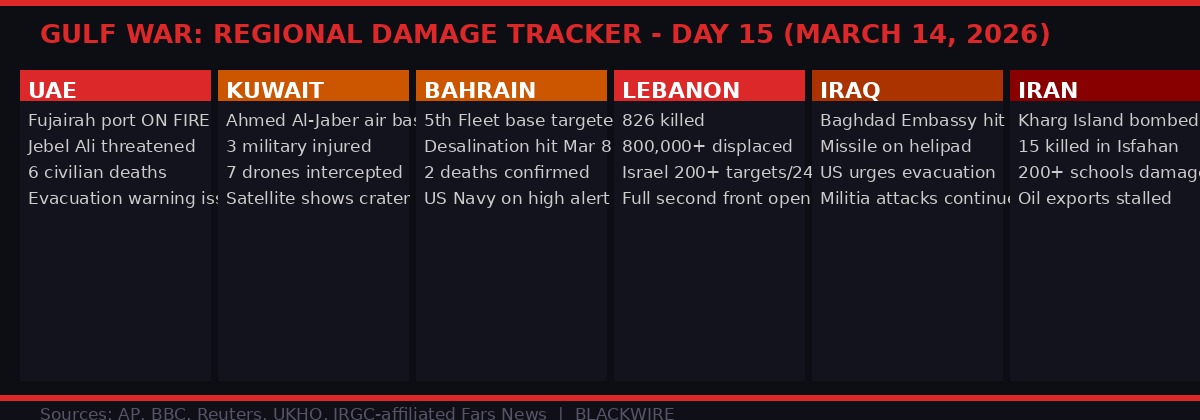
Regional damage by country as of Day 15. Every Gulf Cooperation Council state has either been struck or threatened. The geographic spread of the war has exceeded initial projections.
On Friday, a U.S. official confirmed that 2,500 Marines with the 31st Marine Expeditionary Unit and the amphibious assault ship USS Tripoli are being deployed to the Middle East. The official spoke on condition of anonymity to discuss sensitive military plans. The Wall Street Journal first reported the deployment. (AP, March 14, 2026)
The Tripoli was spotted by commercial satellites sailing near Taiwan as of Friday - putting it more than a week away from waters off Iran. The deployment timeline means it will not be a factor in the immediate crisis. But its composition is instructive: Marine Expeditionary Units specialize in amphibious landings, embassy evacuations, and disaster relief. The 31st MEU is based in Japan precisely because it is configured for rapid regional response across the Indo-Pacific and Middle East arc.
Earlier in the week, the U.S. Navy had 12 ships in the Arabian Sea, including the aircraft carrier USS Abraham Lincoln and eight destroyers. Adding the Tripoli and its attached amphibious group would bring American naval assets in the theater to a level not seen since the early days of the 2003 Iraq invasion. The total number of U.S. service members on the ground across the Middle East theater is not publicly confirmed.
Trump on Saturday called on China, France, Japan, South Korea, and the United Kingdom to send warships to keep the Strait of Hormuz "open and safe." He posted on Truth Social: "One way or another, we will soon get the Hormuz Strait OPEN, SAFE, and FREE!"
Britain responded that it was discussing with allies "a range of options" to secure shipping in the strait. France and Japan had not responded publicly by Saturday evening. China, Iran's largest oil customer and a strategic partner as Araghchi emphasized in his interview, did not respond. South Korea, which depends on Gulf oil for 60% of its energy imports, is unlikely to contribute forces that could draw a Chinese rebuke.
Iran's Araghchi dismissed Trump's call as "begging" in a social media post and urged Gulf neighbors to "expel foreign aggressors." That framing - that the presence of U.S. forces in the Gulf is the cause of the war, not Iran's response - is Iran's core propaganda message and has found some traction in non-aligned nations.
Kuwait: Seven Drones, Two Hits, Three Injured
Kuwait's Defense Ministry reported Saturday that its air defense systems detected seven hostile drones. Two struck the Ahmed Al-Jaber Air Base, causing material damage. Three were shot down. The remaining two fell outside any threat zone. Three Kuwaiti military personnel were injured. (Kuwait Defense Ministry statement, March 14, 2026)
Kuwait has been one of the more cautious Gulf states in its public response to the conflict. It has not formally condemned Iran's strikes on its territory, describing them as targeting "American installations." The Ahmed Al-Jaber base does host U.S. Air Force assets. But Kuwait's position is becoming increasingly untenable - it cannot maintain the fiction of being a non-combatant when Iranian drones are landing on its military installations.
Oman, Saudi Arabia, and Bahrain have each reported two deaths from Iranian strikes since the war began. The death toll across Gulf states from Iranian drones and missiles reached 18 by Saturday, with the UAE and Kuwait accounting for six deaths each. Most victims have been security personnel or foreign workers at targeted facilities.
Isfahan: Industrial Strike, 15 Dead
Inside Iran, the war's civilian toll continued accumulating in less-reported ways. BBC Persian's Ghoncheh Habibiazad reported at least 15 people killed in strikes on an industrial zone in Iran's central Isfahan province. IRGC-affiliated Fars News Agency said the attack hit a "factory producing cooling and heating equipment" while workers were on shift. An unspecified number were also injured. (Fars News Agency via BBC Persian, March 14, 2026)
Isfahan is one of Iran's most important industrial cities - home to steel production, petrochemical facilities, and a major air force base. It is also home to the Natanz nuclear facility, which has been a target of Israeli and American operations for years. Whether Saturday's strike was intended for the factory or for adjacent military infrastructure is unclear. Neither U.S. Central Command nor the IDF claimed the strike.
Iran's government has said more than 200 students and teachers have been killed since the war began. The number is unverifiable from outside Iran - the government has restricted independent media access and social media usage has been intermittent - but the figure of 120 severely damaged schools tracks with satellite imagery showing strike damage in residential and commercial zones adjacent to military targets in Tehran, Isfahan, and Ahvaz.
What Comes Next: Three Possible Trajectories
After 15 days of continuous combat across seven countries, the war is at a decision point. Three trajectories are visible from the current intelligence picture:
Trajectory One - Controlled Escalation to Negotiation: Trump's decision to spare Kharg Island's oil infrastructure reads as a signal - a deliberate calibration that leaves a door open. If Iran responds by reducing drone and missile attacks on Gulf states, both sides have an off-ramp. The U.S. gets to claim it broke Iran's military capacity without destroying the global oil market. Iran's new leadership under Mojtaba Khamenei gets to claim survival. This trajectory requires back-channel communication that several sources suggest is active through Oman and Qatar.
Trajectory Two - UAE Miscalculation: If Iran follows through on its Jebel Ali evacuation warning with an actual strike, the calculation changes completely. Jebel Ali handles 60% of the UAE's imports and is the world's ninth-busiest port. A major strike there would bring European and Asian NATO-adjacent powers into direct confrontation with Iran over shipping security - not as a choice but as an economic necessity. Insurance markets would effectively halt Gulf shipping within 48 hours of a confirmed Jebel Ali strike.
Trajectory Three - Kharg Destruction and Regional Unraveling: If Iran escalates to direct strikes on U.S. naval vessels - which it has threatened repeatedly but not yet executed - Trump's warning about Kharg's oil infrastructure becomes a likely action. The destruction of Kharg's export terminal would remove approximately 1.7 million barrels per day from global markets and trigger emergency IEA reserve releases. Oil at $150-plus would be likely within days. Global recession risk would move from theoretical to near-certain within weeks.
The Hamas statement, whatever else it represents, is a data point suggesting that even Iran's closest allies believe Trajectory Two or Three leads somewhere nobody wants to go. Whether Tehran, under a new supreme leader still consolidating power while managing an active war, has the political flexibility to hear that message is the central question of the third week of this conflict.
Nobody is calling it a ceasefire yet. But the fractures are visible. The question is whether they spread fast enough to matter.
Get BLACKWIRE reports first.
Breaking news, investigations, and analysis - straight to your phone.
Join @blackwirenews on TelegramPrimary sources: Associated Press (March 14, 2026) - Iran war enters third week; BBC World Service live coverage; BBC Persian reporting from Isfahan; Hamas statement via AFP; U.S. Central Command press statements; Kuwait Ministry of Defense official statement; Iranian Foreign Minister Abbas Araghchi interview with MS NOW; Fatemeh Mohajerani government spokesperson statement; IRGC-affiliated Fars News Agency; Lloyd's List Intelligence maritime tracking; TankerTrackers.com; RUSI analyst Petras Katinas; JPMorgan global commodity research team.