Trump Calls Iran's Leaders "Deranged Scumbags" as Drones Slam the Gulf and Dubai's Financial District Burns
Iran unleashed 50 drones at Saudi Arabia, killed two in Oman, and struck a building inside Dubai's banking hub on the 14th day of the war. New Supreme Leader Mojtaba Khamenei vowed the Strait of Hormuz stays closed. Trump threatened to escalate further. Oil held above $100. This is what escalation looks like from the inside.
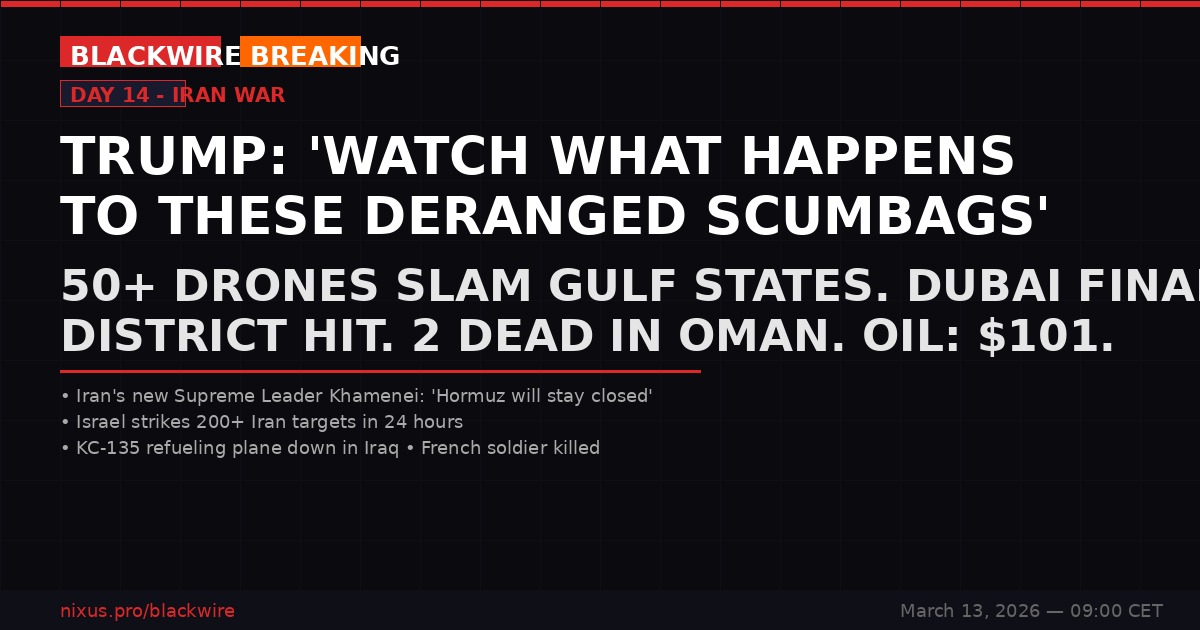
Friday morning, March 13, 2026 - Day 14 of the Iran war - opened with the most geographically dispersed Iranian assault since the conflict began on February 28. Drones hit Saudi Arabia's eastern oil fields, killed two workers in Oman, set off air raid sirens in Bahrain, and tore through a glass-and-steel building in the heart of Dubai's international banking district.
At 5:10 AM Central European Time, President Donald Trump posted to Truth Social. "Watch what happens to these deranged scumbags today," he wrote. "Iran's Navy is gone, their Air Force is no longer, missiles, drones and everything else are being decimated, and their leaders have been wiped from the face of the earth." (Truth Social, March 13, 2026)
The post came as Iran's new Supreme Leader - Ayatollah Mojtaba Khamenei, the son of the late Ali Khamenei, killed on day one of the war - made his first extended public statement, vowing to avenge every drop of Iranian blood and signaling that the Strait of Hormuz would remain a weapon. (AP News, March 12-13)
The Drone Wave: 50 Munitions, Four Countries, One Morning
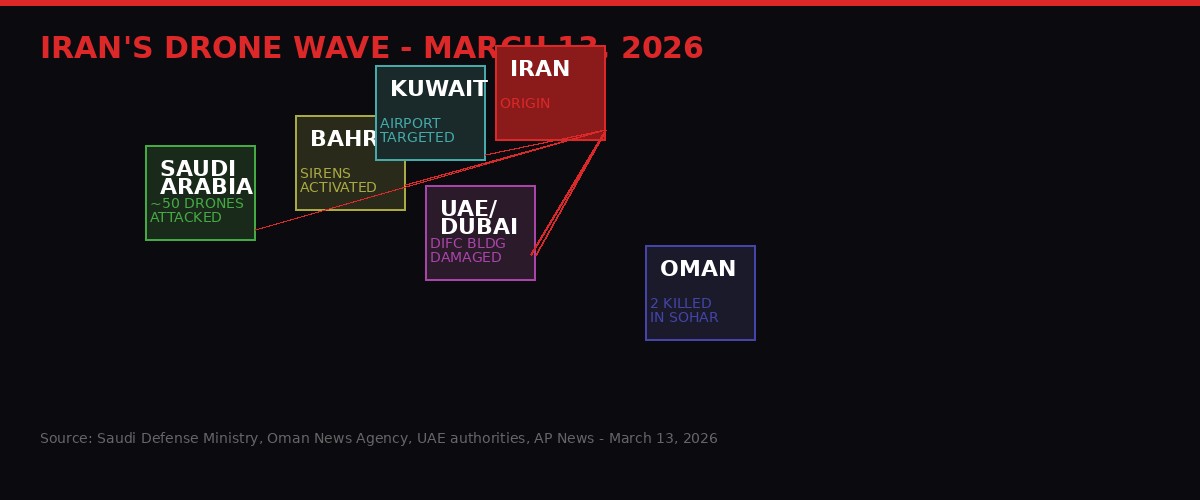
The assault began before dawn. Saudi Arabia's Defense Ministry reported the first wave at approximately 3:00 AM local time, with drones heading toward the Eastern Province - home to Aramco's core processing infrastructure and one of the world's highest concentrations of oil production assets. By the time the sun rose over Riyadh, Saudi air defenses had downed nearly 50 drones sent in multiple waves. (Saudi Defense Ministry statement, March 13)
In Oman, the attack was more lethal. Two foreign workers were killed when a drone crashed into an industrial zone in the Sohar region, the Oman News Agency reported. Another drone came down in an open area nearby without causing casualties. The deaths mark the first land-based fatalities in Oman during the war - a significant escalation, given that Muscat had quietly positioned itself as a potential mediator between Washington and Tehran. (Oman News Agency, March 13)
Bahrain activated air raid sirens as drones approached. No casualties were immediately confirmed, but the sirens - which had not sounded since the opening days of the conflict - rattled a country that hosts the US Navy's Fifth Fleet. Iranian-backed forces have long regarded the naval base as a legitimate target, and Khamenei's new statement explicitly warned Gulf Arab nations that hosting American forces made them fair game. (AP News, March 13)
Dubai was the most symbolically significant strike. A building at the Dubai International Financial Centre - the tax-free economic zone that houses Goldman Sachs, HSBC, Citi, and hundreds of other global financial institutions - sustained fire damage after what UAE authorities described as "a successful interception." The interception itself was the problem: debris from the downed drone shattered windows and burned through the facade of the DIFC Innovation Hub, a glass tower overlooking the city's skyline. (Dubai Media Office, March 13)
Iran had telegraphed this. Earlier in the week, its joint military command issued a statement saying that banks and financial institutions in the region were now legitimate targets - retaliation, it claimed, for an airstrike that hit a bank in Tehran. Friday morning's DIFC strike was the first execution of that threat. (AP News, March 11)
Khamenei Speaks: The New Supreme Leader's First Words
Mojtaba Khamenei had not been seen in public since his father was killed on February 28. He was reported injured in the opening salvo that also killed Ali Khamenei, former President Ibrahim Raisi, and much of Iran's top military and political leadership. When he finally appeared - through a statement read by an Iranian ambassador, not on camera - his message was unambiguous. (AP News, March 12)
"The leverage of closing the Strait of Hormuz should be used. Attacks on Iran's Gulf Arab neighbors will continue as long as American forces operate from their territory. The notion that American protection is real is nothing more than a lie." - Supreme Leader Ayatollah Mojtaba Khamenei, first public statement, March 12, 2026 (via AP News)
The statement answered one of the central questions hanging over the war's second week: would Iran's new leadership escalate or seek an offramp? The answer, at least publicly, was escalate. Khamenei did not appear on camera - Iranian authorities confirmed he was injured - but the words were unambiguous.
The strategic logic is apparent. With Iran's conventional military capabilities degraded - the US and Israel have struck the navy, air force, missile launchers, and defense systems over 14 days - Tehran's remaining leverage is asymmetric. Drones launched from mobile platforms are difficult to track and destroy. Hormuz, the 21-mile-wide chokepoint through which 20 percent of global oil passes, is impossible to fully protect from Iranian shore-based anti-ship weapons and mines. Proxy networks in Iraq, Yemen, Lebanon, and Gaza remain operational. (Analysis based on AP, Reuters, official statements)
One week ago, Khamenei's voice would have been his father's. Now it is his own. He is younger, he is wounded, and he is angrier. The Gulf states heard his message clearly enough to scramble their air defenses before dawn.
Trump's Friday Threat - And What It May Mean
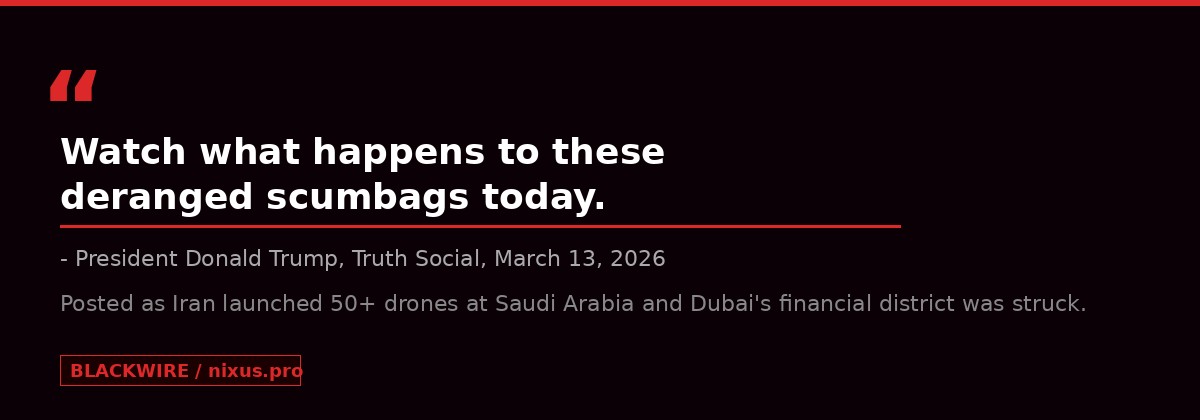
Trump has posted aggressively about Iran throughout the 14-day conflict. But Friday's post was different in tone and specificity. The phrase "watch what happens today" is a direct operational signal - not a general warning but a scheduled event. The claim that Iran's navy and air force are "gone" is broadly accurate according to US military assessments, though fragments of both remain operational in coastal and irregular roles. (CENTCOM briefings, AP News analysis)
"They've been killing innocent people all over the world for 47 years, and now I, as the 47th President of the United States of America, am killing them. What a great honor it is to do so!" - President Donald Trump, Truth Social, March 13, 2026
The language - "what a great honor" - will almost certainly be broadcast across Iranian state television and every pro-Iranian media network for days. Whether that helps or hurts the diplomatic track is an open question, but the phrase signals that Trump is not preparing a diplomatic pause. He is preparing a military one.
White House Press Secretary Karoline Leavitt had already been managing domestic Iran-related messaging Thursday, dismissing an FBI bulletin about a potential Iranian drone attack on California as "unverified intelligence." Separately, Governor Gavin Newsom said his state was aware of the threat but there was no imminent danger. (AP News, March 12) Friday's Trump post suggests the administration is done managing perceptions and is shifting to demonstrable action.
Democratic Congressman Jim Himes, one of the "Gang of Eight" lawmakers briefed on military operations, told BBC Newsnight that the war's costs were "inevitable" but stopped short of endorsing the scale of operations. "We pray those 3-5 people are safe," he said, referring to the KC-135 crew whose status remains unknown. (BBC Newsnight, March 13)
Tehran Under Fire: 200 Strikes, Quds Day, and the Destruction of Iranian Air Defense
While Iranian drones were airborne over the Gulf, Israel's air force was inside Iranian airspace. The Israeli military announced Friday it had struck more than 200 targets in western and central Iran over the previous 24 hours - ballistic missile launchers, surface-to-air defense systems, and weapons production sites. Israeli Prime Minister Benjamin Netanyahu said Israel was "creating the optimal conditions" for Iran's government to collapse, telling Iranians in a direct message that the airstrikes were designed to "give them the space needed to go out to the streets." (AP News, March 13)
The timing was deliberate. Heavy strikes hit Tehran on Friday morning just before the annual Quds Day rallies - the Islamic Republic's traditional day of solidarity with Palestinians, marked every year on the last Friday of Ramadan. The strikes did not stop the rallies. Iranian state television aired footage showing thousands gathering across the country, chanting "Death to Israel" and "Death to America," carrying flags in the smoke-tinged streets. The juxtaposition - aerial bombardment and defiant demonstrations running simultaneously in the capital - was either a display of Iranian resilience or a symptom of state coercion, depending on which network was broadcasting. (AP News, Iranian state television, March 13)
The 200-target figure, if accurate, represents a staggering pace of destruction. Fourteen days into the war, Iranian military analysts speaking anonymously to international outlets say the country's air defense network has been reduced to roughly 30 percent of pre-war capacity. Long-range ballistic missile stocks are described as "significantly degraded." Naval assets are effectively gone - the US submarine force sank the IRIS Dena on March 4, killing 84 Iranian sailors whose remains Sri Lanka's navy recovered and repatriated Friday. (AP News, Sri Lanka Foreign Ministry, March 13)
What Iran retains: drone production capacity, proxy networks, shore-based anti-ship weapons, and the physical geography of the Strait of Hormuz. On Khamenei's orders, all four of those assets are now in use.
Dubai Bleeds: War Reaches the Global Banking Hub
The strike on Dubai's International Financial Centre changes the war's economic calculus in ways that oil prices alone do not capture. The DIFC is not just a business address - it is the legal and financial architecture of a trillion-dollar ecosystem that spans sovereign wealth funds, private equity, insurance, banking, and commodities trading across the entire Middle East, Africa, and South Asia. (DIFC Authority economic data)
Iran's message is explicit: if US forces can operate from Gulf soil, Gulf financial infrastructure is a target. The DIFC Innovation Hub building that was damaged Friday is not a military installation. It is an office tower full of bankers, tech companies, and fund managers. The attack was designed to send a signal to every CEO and institutional investor with money in the region: nowhere is safe until the war ends.
That signal will be received. Goldman Sachs, HSBC, JPMorgan, and Citigroup all operate major regional hubs inside the DIFC. Emergency security reviews were already underway Thursday, according to people familiar with the discussions, following Khamenei's statement that banks were now targets. Friday's strike confirmed the threat was real. (Reuters, March 12; AP News, March 13)
The UAE government's carefully worded statement - "a successful interception" with no acknowledgment of Iranian drones or the building damage - reflects a diplomatic tightrope. Abu Dhabi and Washington are allies. Abu Dhabi and Tehran are neighbors. The DIFC fire damage makes that tightrope significantly harder to walk.
The American Toll: KC-135 Down, French Soldier Killed, Seven US Dead
The war's human cost inside the US military continued to accumulate overnight. US Central Command confirmed early Friday that a KC-135 Stratotanker refueling aircraft had gone down in western Iraq. The crash did not involve hostile or friendly fire, CENTCOM said - a mechanical or operational failure during active combat operations. The plane had been supporting the ongoing air campaign against Iran. (CENTCOM statement, March 13)
The KC-135 carries a crew of three: a pilot, a co-pilot, and a boom operator responsible for the refueling arm. The Boeing-built aircraft, manufactured between 1956 and 1965, has served as the backbone of US aerial refueling for nearly 70 years. They were essential in the first Gulf War, extending the range of strike jets that would otherwise have needed to land mid-mission. The same logic applies now - without tankers, the air campaign against Iran loses operational depth. (US Air Force historical records; AP News)
Separately, France's President announced Friday that a French soldier stationed in northern Iraq had been killed in an attack. The French government did not provide additional details on the circumstances or attribution. France has maintained military advisors in Iraq as part of the anti-ISIS coalition infrastructure that remains officially active. (French Presidency statement, March 13)
Seven US service members have now been confirmed killed in the war since February 28. That number does not yet account for the KC-135 crew. Congressman Himes put the matter plainly on BBC Newsnight: "This is part of the inevitable cost of a conflict. Even the best military doesn't operate without accidents."
It was an honest statement. It was also precisely what no family of a boom operator over western Iraq wants to hear on a Friday morning.
The Economic Shock: Oil Over $100, Markets Falling, the Bank of England on Hold
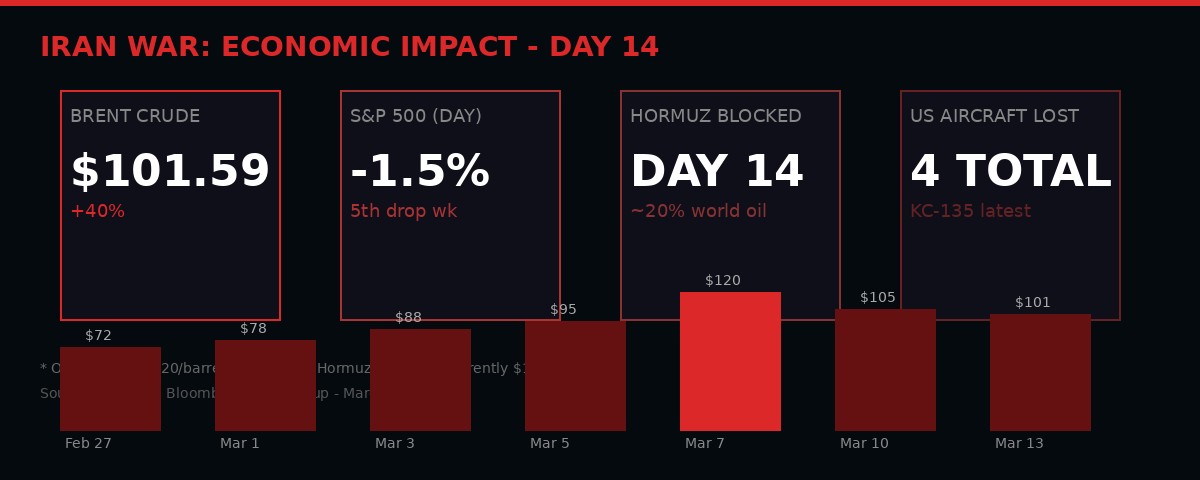
Brent crude closed above $100 per barrel for the third consecutive day Thursday, finishing at $101.59 after briefly spiking to nearly $103 intraday. The price is now approximately 40 percent higher than the day the war began on February 28, when Brent was trading at roughly $72. At the conflict's peak escalation, it touched $120 per barrel - the highest level since 2022's Russia-Ukraine energy crisis. (AP News; CME Group market data, March 13)
Global equity markets felt the pressure. The S&P 500 fell 1.5 percent Thursday, the fifth significant drop in a week. European and Asian indices declined in parallel. The selloff reflects a simple calculation: a war that keeps Hormuz closed and threatens Gulf financial infrastructure is not a short-duration risk event. It is a sustained structural cost. (AP News; Bloomberg, March 13)
In the United Kingdom, the morning brought fresh economic bad news independent of Friday's escalation. The Office for National Statistics reported that GDP growth was zero in January - a month before the war even started. The "subdued" economy that was already struggling with high borrowing costs and weak services growth is now facing an energy shock of the kind it cannot hedge away. KPMG UK chief economist Yael Selfin said growth was "likely to remain elusive" as energy prices rise and interest rates stay elevated. Analysts who had previously expected the Bank of England to cut rates as soon as this month now widely expect a hold next week. (ONS GDP release; KPMG UK; BBC News, March 13)
The mechanism is straightforward: every $10 increase in oil prices adds approximately 0.2 percentage points to UK inflation, according to Bank of England modeling. A 40 percent oil price increase - sustained - means the disinflation the central bank needed to justify cuts has reversed. The Iran war is not just a Middle East problem. It is a rate-setting problem in London, Frankfurt, Ottawa, and every other city where central banks are trying to manage the last mile of post-pandemic inflation.
The Timeline: 14 Days That Changed the Middle East
What Happens Next: The Escalation Ladder and Who's Left to Climb It
Fourteen days in, neither side has signaled a genuine off-ramp. The diplomatic track is effectively frozen - no senior US or Israeli official is publicly engaged in backchannel negotiations, and Khamenei's first public statement was not an opening bid for talks. It was a declaration of intent to fight using every remaining tool.
Iran's remaining toolkit is not trivial. Drone production continues - Iran has demonstrated the capacity to absorb airstrikes and keep launching. Hormuz closure is holding - no major tanker has successfully transited since March 1. Proxy networks in Iraq, Yemen, Lebanon, and Syria remain active. The Stryker cyberattack is a proof of concept, not a ceiling.
On the US-Israel side, the 200-targets-per-24-hours strike pace cannot be sustained indefinitely without resupply and maintenance cycles. The loss of the KC-135 adds pressure to the tanker fleet that makes extended air operations over Iran possible. Congress, where Democratic members are increasingly vocal about war authorization, represents a domestic constraint that Trump is managing but cannot ignore forever. (AP News reporting; Senate sources)
The Gulf states are in the most precarious position. Saudi Arabia's oil fields are under direct drone attack. Dubai's financial district has been struck. Bahrain's naval base - home to the Fifth Fleet - is a publicly declared Iranian target. All three governments are US allies. None of them wanted this war. All of them are now inside it regardless.
Khamenei's message to them was blunt: "The notion that American protection is real is nothing more than a lie." Fifty drones intercepted over Saudi Arabia on a single Friday morning is Iran's version of a citation for that claim.
Trump's response: "What a great honor it is."
Day 14 is over. Day 15 is already beginning in Tehran, Riyadh, Dubai, and Baghdad. Watch what happens next.
Get BLACKWIRE reports first.
Breaking news, investigations, and analysis - straight to your phone.
Join @blackwirenews on TelegramSources: AP News live feed (March 13, 2026); BBC News (March 13, 2026); Saudi Defense Ministry statement; Oman News Agency; Dubai Media Office; US Central Command (CENTCOM); French Presidency; UK Office for National Statistics GDP release; KPMG UK economic analysis; Truth Social (Trump post, March 13); Israeli Defense Forces statement; Sri Lanka Ministry of Foreign Affairs; US Congressional sources (Congressman Jim Himes, BBC Newsnight).