Israel Bombs Al-Quds Day March in Tehran. Six US Troops Dead in Iraq. The Iran War's Day 14.
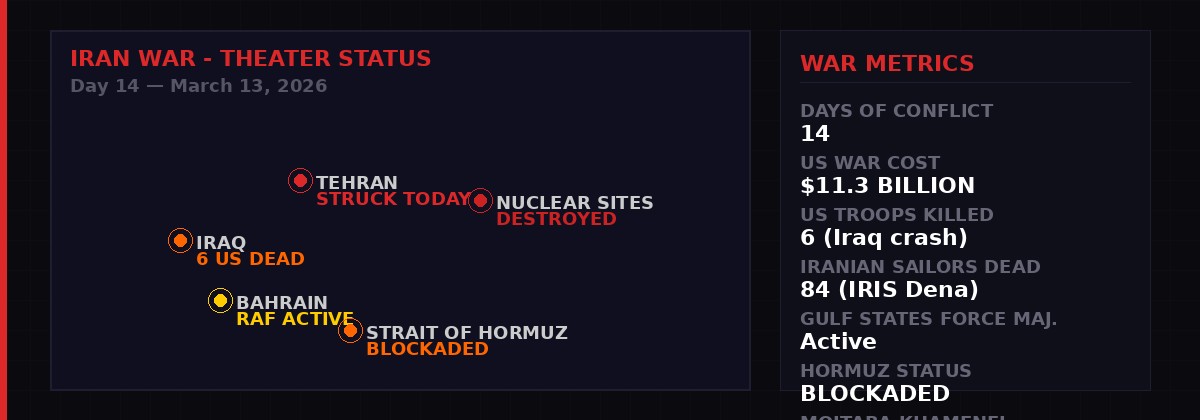
A war that began with precision strikes on nuclear infrastructure has widened into something harder to contain. On Friday, Israel bombed Tehran during al-Quds Day - the annual march of solidarity with Palestinians - killing at least one civilian. Six American military personnel are confirmed dead in a refueling aircraft crash over Iraq. New Supreme Leader Mojtaba Khamenei is reported injured by US Defense Secretary Pete Hegseth. Pentagon briefers have told lawmakers the war has already cost $11.3 billion. It has been two weeks.
Al-Quds Day Under Israeli Bombs
Al-Quds Day is not a random target. Established by Ayatollah Khomeini in 1979, it is the Islamic Republic's flagship expression of resistance - the last Friday of Ramadan, when Iranians and sympathizers worldwide gather in the name of Palestinian liberation. Striking Tehran during al-Quds Day is a calculated message: there is no sanctuary in symbolism.
On Friday, March 13, Israeli aircraft launched what Tel Aviv described as a "wide-scale wave of strikes" against Tehran. Footage circulating online showed a large explosion near a government-organized al-Quds rally in the city. Iran's state broadcaster Press TV confirmed that at least one woman was killed after being struck by shrapnel. [Source: Al Jazeera, March 13, 2026]
Israeli Prime Minister Netanyahu's office did not issue a specific statement about the rally location, but the Israel Defense Forces confirmed the strikes were targeting what they called "Iran's remaining capacity to reconstitute its weapons-grade enrichment program." That framing covers a broad set of targets in a dense city.
The timing is significant. Al-Quds Day 2026 was expected to be the largest in years - Iranian state media had promoted it heavily as a show of national defiance after 14 days of bombardment. Instead, thousands scattered when the air defense sirens sounded. State television cut its live broadcast mid-speech.
"The fact that you can organize a political rally and have it bombed while it's happening - that's a new threshold. This isn't targeting a military installation that happens to be near civilians. This is the city's central political gathering, on its highest symbolic day." - Middle East security analyst, speaking to Reuters on condition of anonymity, March 13, 2026
The Iranian government's response was swift. Senior official Ali Larijani - who has emerged as one of the main public faces of Tehran's war communications - vowed consequences. If the United States escalates further and strikes Iran's power infrastructure, Larijani warned, "the whole region will go dark." The threat is not idle: Iran maintains the capability to hit electricity grids across multiple Gulf states, and its proxy networks in Iraq and Yemen can reach substation-level targets. [Source: Al Jazeera, March 12-13, 2026]
For now, the strikes on al-Quds Day represent a psychological inflection point as much as a military one. Two weeks in, Israel and the United States have demonstrated they will not pause for Iranian national rituals. Tehran has responded by saying it will not pause for American elections, budget debates, or international pressure either.
Six Americans Dead: The Iraq Crash
US Central Command confirmed Friday that all six crew members aboard a US military refueling aircraft that went down over western Iraq were killed. The confirmation ended more than 24 hours of uncertainty following initial reports of the crash - uncertainty that CENTCOM had maintained while families were being notified.
The aircraft has been identified by multiple defense correspondents as a KC-135 Stratotanker, the backbone of US aerial refueling operations across the Middle East theater. No hostile fire has been officially confirmed as the cause. The Pentagon is treating the incident as a crash under investigation, not a shootdown - though CENTCOM declined to specify what evidence had ruled out enemy action at this stage. [Source: AP, BBC, March 13, 2026]
Iraq has been a secondary but increasingly volatile theater in this conflict. Iraqi militia groups aligned with Iran - particularly the Kataib Hezbollah network - have been striking US logistics and basing assets throughout the 14 days of fighting. The US maintains several operational support hubs in Iraq that are essential for the aerial campaign over Iran.
"All six crew members of the US military refueling aircraft that went down over western Iraq have been confirmed killed. The cause of the crash is under investigation." - US Central Command statement, March 13, 2026
The deaths mark a significant moment. Until now, US personnel losses in the conflict had been obscured by ambiguous circumstances or relatively low-profile incidents. Six dead in a single crash, in a theater the White House has been careful not to fully acknowledge as a combat zone, will intensify congressional scrutiny of the war's expanding geographic footprint.
These are the first US fatalities officially confirmed in the Iraq theater of what the Pentagon officially terms "Operation Determined Response." They will not be the last. Every hour that tanker aircraft fly in western Iraqi airspace is an hour that Iranian-aligned forces below can attempt to reach them.
For context: the Iraq war at its peak claimed approximately 904 US lives in a single year (2007). This war is 14 days old and has already claimed six. The trajectory is not predetermined - but it is not reassuring either.
Mojtaba Khamenei: The New Supreme Leader Under Fire
US Defense Secretary Pete Hegseth made a striking claim on Friday: that Mojtaba Khamenei, the man who assumed Iran's supreme leadership after his father Ali Khamenei's death earlier in the war, is "likely disfigured" as a result of strikes on his location. Hegseth did not specify the source or classification level of the intelligence behind this claim.
The statement comes one day after Mojtaba issued his first formal public statement as Supreme Leader - vowing to continue fighting and framing the war as a battle for Islamic civilization. Iranian state media presented the statement as evidence of command continuity. Hegseth's claim, if accurate, complicates that narrative significantly. [Source: BBC, Al Jazeera, March 13, 2026]
Mojtaba Khamenei, 56, was for years the most shadowy figure in Iranian politics - known more for his role heading the Basij's intelligence apparatus than for any public profile. His accession to the Supreme Leadership position was confirmed in a statement from the Assembly of Experts, though the circumstances of his father's death remain disputed. Western intelligence agencies assessed that Ali Khamenei was killed or fatally wounded in the early days of the Israeli strikes on Tehran.
If Mojtaba is now himself incapacitated or disfigured, the question of who actually controls Iran's war decision-making becomes urgent. The visible leadership - Larijani, Foreign Minister Abbas Araghchi, IRGC Commander Hossein Salami - would likely continue managing day-to-day operations. But strategic decisions on whether to close the Strait of Hormuz completely, whether to authorize attacks on US homeland-adjacent targets, or whether to accept a ceasefire framework require someone who holds constitutional legitimacy.
Iran's government has pushed back on all such characterizations. State media published footage on Friday purporting to show senior officials attending al-Quds Day commemorations before the strikes began - a performance of normalcy that carries its own kind of message. But in wars where both sides control information environments, the gap between signal and reality can be enormous.
Gulf Force Majeure: The Oil Shock Nobody's Calling a Shock
Several Gulf nations have now formally declared force majeure on oil and gas shipments - legal protection against contractual liability for failure to deliver energy under extraordinary circumstances. This is not a headline-grabbing event. It is, in financial and commercial terms, more consequential than most of what does make headlines. [Source: Al Jazeera explainer, March 13, 2026]
Force majeure declarations effectively tell buyers: we cannot guarantee delivery. For long-term supply contracts worth hundreds of millions of dollars, this triggers insurance claims, delivery disputes, and spot-market scrambles that ripple outward for months. The buyers sitting in South Korea, Japan, India, and China - the largest importers of Gulf energy - are now operating under conditions of genuine supply uncertainty.
The Strait of Hormuz remains the fulcrum of this crisis. Approximately 20 to 21 million barrels of oil pass through the strait daily in normal conditions - roughly 20 percent of global consumption. Iran has not physically mined or fully closed the strait, but its blockade posture - patrols, warning shots, demonstrated willingness to interdict tanker traffic - has created an effective risk premium that is suppressing commercial passage.
Defense Secretary Hegseth's response to questions about this on Friday was a performance of deliberate nonchalance: "Don't need to worry about it," he said, when asked whether the Hormuz disruption threatened US oil supply chains. [Source: AP, March 13, 2026]
The markets disagree. Oil has been elevated throughout the 14-day conflict, and the force majeure declarations will not calm it. For every government official who expresses confidence that Hormuz disruption is manageable, there is an insurance underwriter quietly tripling maritime risk premiums for Gulf passage.
The deeper problem is what force majeure signals about Gulf state confidence. Countries like Saudi Arabia, the UAE, Kuwait, and Qatar have hedged heavily - maintaining formal neutrality, avoiding explicit alignment with either the US or Iran. The force majeure declarations are those countries protecting themselves legally from the consequences of a war they did not choose and cannot stop.
The $11.3 Billion Bill: Two Weeks, One War
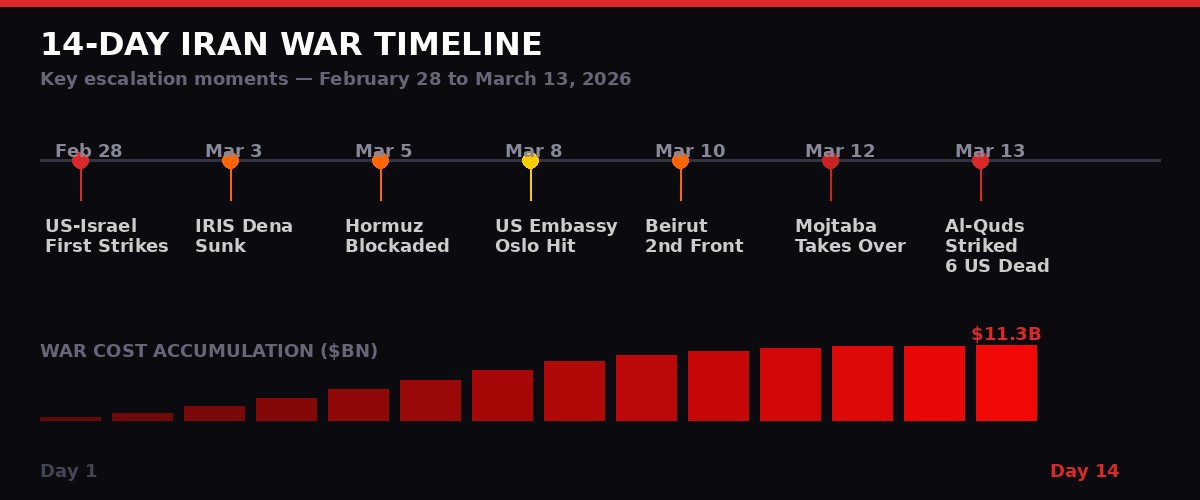
Pentagon briefers told lawmakers Thursday that the US-Israel war against Iran has cost the United States more than $11.3 billion in its first 14 days. That figure covers munitions expended, additional naval deployments, logistics support, and classified items that were described in closed session. The "true price," lawmakers were told, "is unknown." [Source: The Guardian, March 13, 2026]
To put $11.3 billion in 14 days in context: the entire Afghanistan war cost approximately $2.3 trillion over 20 years, or roughly $315 million per day at its peak surge. The Iran campaign is currently burning through approximately $807 million per day. That is not a sustainable burn rate for a war whose endpoint remains undefined.
The munitions expenditure alone is staggering. Each Tomahawk cruise missile costs approximately $2 million. Each GBU-57 Massive Ordnance Penetrator - the bunker-buster used on hardened nuclear sites - costs approximately $3.5 million. The US and Israel have reportedly expended hundreds of these weapons in the first two weeks, before accounting for carrier strike group operating costs, aerial refueling missions, additional base activations across the region, and the intelligence support infrastructure running behind every strike.
Trump told reporters Friday that the US would "hit Iran hard over the next week." That phrasing suggests the campaign is intensifying rather than winding down. At current expenditure rates, the next week alone would add another $5-6 billion to the tab. Congress has not yet been asked for a supplemental appropriation.
"The Pentagon has briefed lawmakers that Iran war costs have topped $11.3 billion, but the true price is unknown." - The Guardian, March 13, 2026, citing congressional sources
Beyond the dollar figure, there is the question of long-term cost. Wars that begin as precision campaigns and expand geographically - which this one has, from Iranian nuclear sites to Iraqi militia targets to Lebanese fronts - tend not to follow projected cost curves. The early precision phase is usually the cheapest part.
The economic bite extends beyond the Pentagon budget. US airlines have rerouted long-haul flights to avoid Gulf airspace, adding hours and fuel costs to routes serving South Asia and East Asia. Global shipping insurance rates have surged. The Federal Reserve is monitoring stagflation risk from the dual impact of elevated energy prices and trade disruption. None of this appears in the Pentagon's $11.3 billion figure.
RAF Typhoons Over Bahrain: Britain Enters the Kinetic Phase
Two RAF Typhoon jets have been confirmed in active operations over Bahrain, intercepting incoming Iranian drones. The disclosure from the British Ministry of Defence marks a meaningful shift - UK forces have moved from a defensive advisory posture to kinetic engagement as part of the anti-drone campaign protecting Gulf allies. [Source: BBC, March 13, 2026]
Britain has approximately 200 troops stationed in Bahrain, 200 meters, it was reported earlier in the conflict, from the operational boundary of Iranian proxy attack corridors. The Typhoons are operating under a Bahraini request for defensive air support - a legal framework that insulates London from direct co-belligerency claims, for now.
The RAF's involvement is a data point in the broader NATO alliance management problem. The United Kingdom has been careful to frame its participation as "defensive operations" - intercepting inbound drones rather than conducting offensive strikes. Australia has been wrestling with the same distinction. Spain's government has explicitly refused basing access. France has issued statements of concern. Germany has called for a ceasefire.
But as the Guardian noted Friday, the line between "defensive operations" and "complicity" becomes difficult to maintain when defensive assets are directly enabling an offensive campaign to continue. An RAF Typhoon that shoots down an Iranian drone over Bahrain is freeing up US and Israeli strike capacity to continue hitting targets inside Iran. The distinction is legally meaningful; strategically, it is thinner.
UK Defence Secretary John Healey has also pointed publicly to what British intelligence believes is Russian involvement in Iran's drone campaign. Healy's statement that "Putin's hidden hand lies behind Iran's drone tactics" is a significant public accusation - asserting that Russia has been providing electronic warfare support and tactical intelligence that is making Iranian drone attacks more effective against coalition defenses. [Source: The Guardian, March 13, 2026]
Moscow has denied involvement. Russia's UN ambassador called the claim "baseless Western warmongering." But the accusation has been documented in at least two separate Western intelligence assessments that have been partially declassified and shared with NATO allies. The Iranian drone program - which has demonstrably improved its evasion and targeting capabilities since the war began - provides circumstantial weight to the claim.
Day 14 Timeline: How We Got Here
Coordinated airstrikes target Fordow, Natanz, Arak, and Parchin nuclear facilities. Iranian air defenses partially degraded. Ali Khamenei believed killed or critically wounded in strike on Tehran command complex.
Iran launches ballistic missile and drone salvos at US bases in Qatar, UAE, and Kuwait. Partial interceptions. Several US service members injured, early Iranian casualties in initial retaliatory strikes. Hormuz passage declared hazardous.
US submarine torpedo confirmed. Iranian frigate IRIS Dena sunk near Sri Lanka with 84 sailors aboard. Iran confirms losses, vows naval retaliation. Indian Ocean becomes secondary theater.
Iran announces all tanker traffic through Hormuz requires inspection and Iranian permission. Commercial passage effectively halted. Oil prices surge to $116/barrel. Gulf states begin force majeure assessments.
Explosion damages US Embassy in Oslo. Iranian proxy network implicated. NATO convenes emergency session. Spain refuses to allow US forces to use NATO base at Rota for Iran operations, creating alliance friction.
Israeli forces strike Hezbollah positions in south Lebanon and Beirut suburbs. Lebanon second front adds pressure on Iran's proxy network. Ukrainian UGV battalion announced - first robot infantry unit - as Russia watches Gulf resources redirected.
Assembly of Experts formalizes Mojtaba Khamenei's position. Iran issues statement in his name pledging to continue war. Western intelligence assesses Iranian nuclear scientist casualties as degrading regeneration capacity significantly.
Iranian President Pezeshkian states Iran will discuss ceasefire if the US and Israel guarantee no future attacks and pay "reparations." White House dismisses terms. Ali Larijani threatens to "make the whole region go dark" if US targets power infrastructure.
Israel strikes Tehran during al-Quds Day rally. At least one civilian killed. All six crew of US KC-135 confirmed dead in Iraq crash. Hegseth claims new Supreme Leader Mojtaba Khamenei "likely disfigured." Gulf states formally invoke force majeure. Pentagon confirms $11.3bn war cost. Trump threatens to "hit Iran hard over next week."
What Comes Next
Trump's Friday statement that the US would "hit Iran hard over the next week" is either a negotiating signal or a genuine operational preview. Given the current pattern - escalation without defined endpoint, casualty confirmation now reaching US forces, civilian deaths during a political rally - the question of what "harder" looks like deserves specific interrogation.
Iran's President Pezeshkian has put formal ceasefire terms on the table: US-Israeli guarantees of non-aggression, reparations payments, and a structured de-escalation. The White House has dismissed these as non-starters. But the existence of terms - even unacceptable ones - is a different situation from a total communication blackout. Diplomatic back-channels, almost certainly running through Oman and Qatar, are reported active.
The power grid threat from Larijani is worth watching. Iran's capacity to strike Gulf electricity infrastructure - directly or through proxies - is real. An attack on Saudi or Emirati power grids would not be a military engagement; it would be an economic catastrophe with humanitarian dimensions that would dwarf anything seen so far in this conflict. Larijani's warning was not rhetorical flourish. It was a specific capability disclosure.
The 84 bodies of Iranian sailors killed when the IRIS Dena was sunk on March 4 are now being repatriated from Sri Lanka. They will arrive in Iranian ports to state funerals, media coverage, and the specific grief that accompanies naval deaths - sailors who had no role in nuclear enrichment, who were doing what sailors do, who died in a torpedo strike far from Iranian shores. These funerals will be on Iranian state television. They will be attended by officials who are also managing a war. The politics of grief and the politics of strategy are not always separable.
Russia's reported role in supporting Iranian drone tactics adds a dimension the US administration has been reluctant to publicly engage. If Putin is actively degrading the effectiveness of American air defenses by providing electronic warfare intelligence to Tehran, the US is not fighting a bilateral conflict - it is fighting a multi-party information war with only one fully acknowledged belligerent. The UK's decision to say this publicly, via Healey, is either a warning or the opening of a new pressure track.
Fourteen days in, the Iran war has cost six confirmed American lives, at least 84 Iranian sailors' lives, an unknown number of Iranian civilian and military deaths, one female protester dead during a political rally in Tehran on a day of religious observance, and $11.3 billion of American taxpayer money - with no exit ramp formally in sight and a new week of heavy strikes explicitly promised by the US President.
The field reporter's question is not whether this war is winnable. The field reporter's question is: what does "won" look like from the perspective of each party, and is there any version of that picture that all three of them can survive reaching?
Nobody has answered that yet.
Get BLACKWIRE reports first.
Breaking news, investigations, and analysis - straight to your phone.
Join @blackwirenews on Telegram