
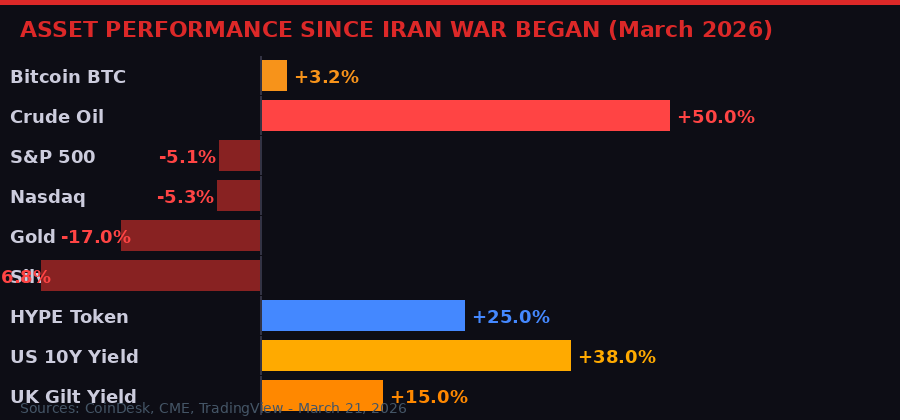
The Iran war that erupted in early March 2026 has not merely raised oil prices. It has stress-tested the entire architecture of global finance, ripped apart the comfortable "rate cut" consensus, and forced traders into round-the-clock markets that traditional exchanges cannot provide. Three weeks in, the numbers are ugly - except for one: Bitcoin, clinging to $70,000 while precious metals crater, bonds sell off hard, and equities bleed out in slow motion.
This is not a "crypto" story. It is a macro story where crypto happens to be the canary that's still alive.
How Oil Moved 50% in Three Weeks

When the first Iranian infrastructure strikes broke over the weekend at the start of March, CME oil futures were closed. Traditional traders had no venue to react. Crude prices gapped violently at Monday open, and the 50% surge that followed compressed what would normally take months into under three weeks of trading.
The mechanics mattered: thin liquidity outside conventional market hours amplified every headline. Supply anxiety compounded with geopolitical uncertainty, and traders who needed oil exposure found their primary venues closed precisely when the news moved fastest.
By mid-March, WTI had printed near $108 per barrel - a level last seen during the 2022 Ukraine energy shock. As of Friday, March 20, the U.S. government was reportedly assessing whether to release sanctioned Iranian oil into the market to relieve pressure, briefly dropping crude below $100 to around $96 before macro jitters dragged risk assets back down. The price relief was real but fragile. (Source: CNBC, March 20, 2026)
The inflationary consequences of a 50% oil surge landed directly on Federal Reserve calculations. February inflation - printed before the war began - showed headline CPI at 2.4% and core at 2.5% annually. Both figures are going to look optimistic by the time March data arrives. Energy feeds into nearly every cost component: freight, manufacturing, food production, heating. The war did not just raise gasoline prices. It reshuffled the entire inflation trajectory.
Goldman Sachs and JPMorgan had, only weeks before the conflict, been publishing estimates showing two to three Fed rate cuts in 2026. That consensus has been obliterated. Markets are now pricing in the possibility of a rate hike as soon as April - a reversal so fast it barely registers as believable unless you watch CME FedWatch in real time.
From Cut Bets to Rate Hike Fears: The Fed's Nightmare Scenario

The speed of this reversal is the real story. According to CME FedWatch data cited by CoinDesk on March 20, the probability of a Fed rate hike at the April meeting has jumped to 12%. Seven days ago that number was zero. Two months ago the debate was not "hike or hold" - it was "two cuts or three?"
That's not a shift. That's a whiplash.
The mechanism is straightforward but brutal. Headline inflation was already running above the Fed's 2% target before March. Oil at $96+ adds persistent upward pressure to CPI for at least two to three months. If the war drags on and supply constraints persist, the Fed faces a textbook stagflation setup: prices rising, growth weakening, and no clean policy lever.
The long end of the bond market is already screaming. The 10-year US Treasury yield hit 4.38% on Friday, up another 10 basis points in a single session, climbing from under 4.0% at the start of March. That 38 basis point move in under three weeks is significant - bond math says every 100 basis points on the 10-year destroys roughly $1 trillion in notional value across fixed income portfolios globally. The March move has effectively wiped hundreds of billions in paper wealth from pension funds, insurance books, and sovereign wealth holdings. (Source: CoinDesk, March 20, 2026)
The selloff is not confined to the United States. UK 10-year gilt yields surged above 5.0% for the first time since 2008. That comparison alone is damning - 2008 was the year Lehman collapsed and global credit markets froze. British pension funds, which nearly imploded in September 2022 when gilt yields spiked during the Truss budget disaster, are facing analogous pressure. The Bank of England is being watched closely for any emergency intervention signal. (Source: CoinDesk, March 20, 2026)
"For now, surging oil prices and persistent geopolitical tensions are driving inflation fears and weakening traditional safe-haven assets." - CoinDesk Markets, March 20, 2026
The irony is thick. In every prior crisis - COVID, Ukraine, 2022 rate hike cycle - bonds served as the ballast. Equities would fall, bonds would rally, and the 60/40 portfolio would survive. In March 2026, that correlation has broken again, as it did in 2022. Stocks are down. Bonds are down. Cash is being destroyed by inflation. The traditional safe-haven playbook has failed its users at the exact moment they needed it most.
Gold Crashed 18%. Bitcoin Didn't.

This is the data point that rewrites the narrative. Gold hit $5,500 per ounce at the start of March, an extraordinary run fueled by war-premium buying and safe-haven flows. It is now trading at $4,569. That's an 18% collapse in three weeks. Silver went from $95 to $69.50 - a 27% drop. (Source: CoinDesk, March 20, 2026)
Why? Precious metals are reflexively sensitive to real interest rates. When bond yields surge and inflation expectations shift, gold's appeal as a non-yielding asset diminishes against treasury paper that now pays 4.38%. The same dynamic that hammered gold in 2022 is repeating in 2026 - but faster, because the rate reversal happened faster.
Bitcoin, by contrast, has gained approximately 0.8% since the war began. Measured against the carnage elsewhere, that is an extraordinary relative performance. The S&P 500 is down more than 5% since late February and heading for its fourth consecutive weekly loss. The Nasdaq has shed similarly. Gold is down 18%. Bonds are down. Oil is up 50% but that's a liability for consumers, not an investable profit for most.
"Bitcoin has once again acted as the canary in the macro coal mine. At current levels, bitcoin is already pricing a recession, while many traditional assets are not." - Andre Dragosch, European Head of Research at Bitwise
The Dragosch thesis is worth unpacking. If Bitcoin is "pricing a recession" at $70,000, that implies the asset absorbed its forward-looking risk adjustment earlier in the cycle - during the February drawdown from prior highs - and is now equilibrating while traditional assets haven't yet priced the slowdown. Whether that reading is correct depends heavily on whether the war-driven inflation spike translates into genuine demand destruction. But the relative performance data doesn't lie: Bitcoin is the only major financial asset that hasn't suffered a significant directional loss since the shooting started.
Hyperliquid and the 24/7 Market Infrastructure Problem

The single most important structural story to emerge from this crisis is not about Bitcoin. It is about what happens when traditional markets close at the worst possible time.
JPMorgan's research team, led by analysts including Nikolaos Panigirtzoglou, published a report on March 19 flagging a surge in oil trading on Hyperliquid, the decentralized exchange. The bank's analysis is blunt: when CME oil futures were closed over the conflict weekend, traders with exposure to crude had nowhere to go in traditional markets. Hyperliquid's CL-USDC perpetual contract stayed open. Price discovery continued 24/7. Traders flooded in.
"Oil trading exploded on the Hyperliquid exchange early this month when the Iran war erupted as CME traders were unable to react when Iranian infrastructure strikes broke over the weekend." - JPMorgan analysts, Nikolaos Panigirtzoglou et al., March 19, 2026
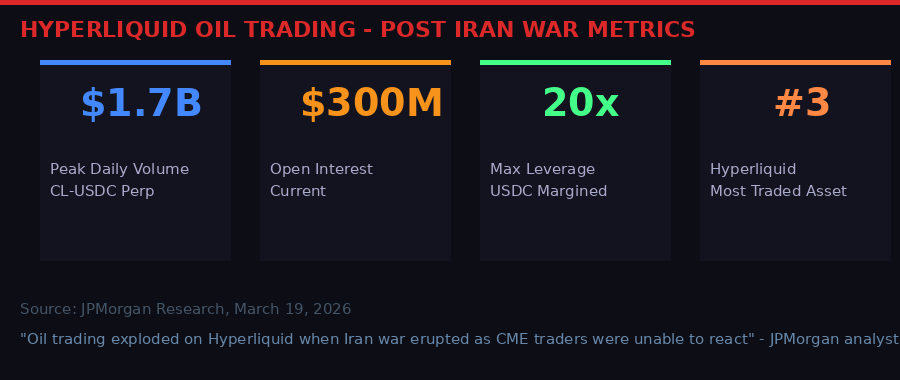
The numbers JPMorgan cited: the CL-USDC perpetual hit $1.7 billion in peak daily volume. Open interest climbed to approximately $300 million. The contract is now Hyperliquid's third-most traded product. Before the Iran conflict, oil barely registered on crypto derivatives venues.
This is not a marginal development. A bulge-bracket bank is explicitly telling its institutional clients that decentralized exchanges offer something traditional markets cannot: uninterrupted access during geopolitical shocks. The contract structure - USDC margined, up to 20x leverage, using funding rates to track spot - mirrors traditional futures architecture but removes the market-hours constraint that left traders stranded on that first war weekend.
The broader JPMorgan thesis extends beyond oil. The analysts argued that demand for 24/7 access to traditional assets is accelerating interest in DEXs across the board. Hyperliquid's onchain order book model - sub-second finality, portfolio margining, spreads that compete with centralized venues - is attracting institutional flow specifically because it solves problems that closed weekends and fixed settlement cycles create.
Hyperliquid's HYPE token has gained roughly 25% year-to-date, making it one of the best-performing large-cap crypto assets in the period. The market is pricing the structural advantage. If the next geopolitical shock hits on a Sunday afternoon - and most do, because that's when adversaries choose to strike - Hyperliquid will not be closed. CME will be.
Coinbase moved on the same structural insight independently. On March 20, the exchange announced stock perpetual futures for non-US customers: contracts on Apple, Microsoft, Tesla, S&P 500 ETFs, and Nasdaq-tracking products, trading 24/7, cash-settled in USDC, with up to 10x leverage on single stocks and 20x on ETF products. (Source: CoinDesk, March 20, 2026). Coinbase's CEO Brian Armstrong has been explicit about building the "Everything Exchange" - one venue for equities, crypto, commodities, and derivatives that never closes.
The Iran war just provided the most compelling product demo this infrastructure could have asked for. Traders who couldn't hedge on CME remember exactly where they could.
BTC Derivatives: What the Smart Money Is Actually Doing

Bitcoin holding at $70,000 does not mean traders are relaxed. The derivatives data tells a far more anxious story beneath the surface calm.
Bitcoin open interest has stabilized at $16.9 billion, close to the prior week's $17 billion, per Coinglass data cited in CoinDesk's March 20 markets summary. That stabilization follows a period of sharp positioning reduction, which means speculative excess has been partially cleared - reducing the risk of a cascade but also removing the fuel for an explosive rally.
Funding rates have returned to neutral (0-10% annualized) after briefly going negative earlier in the week. Negative funding is significant: it means short sellers were paying longs to hold their positions, an extreme bearish signal. The normalization suggests some short squeeze has already occurred, absorbing downward pressure, but the overall positioning remains defensive.
The options market is where the real signal lives. The 24-hour call-to-put volume ratio shifted to 43/56 - put options are dominating. Traders are buying downside protection, not upside exposure. The one-week 25-delta skew - a measure of how much more expensive put options are versus calls - jumped from 9% to 14%. That's a 56% increase in the cost of downside hedging in one week. Institutional desks are paying up to protect against a sudden drop. (Source: CoinDesk, March 20, 2026)
The implied volatility term structure has spiked at the front end, moving into "backwardation" - near-term implied volatility is higher than longer-dated IV. This pattern typically appears when traders expect an imminent high-impact event. The structure says: something is coming, and it's coming soon. Long-dated IV remains anchored near 50%, suggesting the market doesn't expect permanent volatility elevation - just a near-term shock.
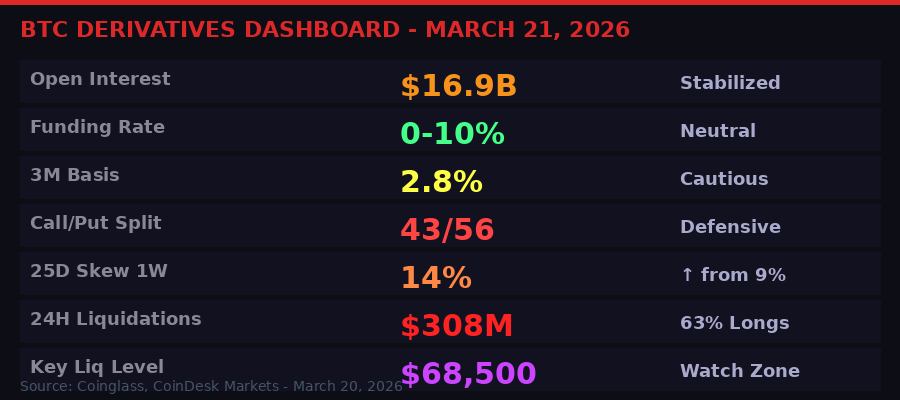
The $68,500 level is the key number to watch. Coinglass liquidation heatmap data shows a cluster of long positions with liquidation triggers in that zone. A drop through $68,500 would cascade: forced selling from liquidated longs would amplify any downward move. The $308 million in 24-hour liquidations recorded on March 20 - 63% from longs - shows that kind of forced de-levering is already happening at the margins. (Source: CoinDesk / Coinglass, March 20, 2026)
Altcoins meanwhile are showing selective resilience. Quant (QNT) gained 7.5% after Robinhood listed it on spot. AI token FET extended its recent run with a 6.5% gain. The CoinMarketCap Altcoin Season Index sits at 46/100 - well off February's lows near 20 but not in the "altseason" territory above 75. The market is selectively risk-on in pockets while keeping macro hedges elevated. That's a sophisticated positioning, not blind optimism.
Nasdaq Goes Onchain: Wall Street Wants 24/7 Markets Too

Against this backdrop of war-driven volatility and 24/7 DEX adoption, the SEC delivered what may be the decade's most consequential regulatory move for market structure: approval of Nasdaq's tokenized securities framework on March 18, 2026.
The framework allows Nasdaq to test a system where certain stocks and ETFs can be issued and settled as blockchain-based tokens, tradeable alongside traditional shares. Clearing and settlement runs through DTCC - the same institution that handles all US equity settlement today. What changes is the record-keeping layer: instead of DTCC ledgers alone, blockchain becomes an alternative ownership record. (Source: CoinDesk, March 19-20, 2026)
Nasdaq has tapped Kraken, via its tokenized stock platform xStocks, to distribute these tokens globally. That partnership is telling: the largest traditional exchange in the world chose a crypto-native company for the distribution layer of its blockchain experiment. The capital market infrastructure handshake between TradFi and crypto just became formal and very public.
"This is a clear signal the $126 trillion equity market will be shifting onto blockchain rails - a future where stock ownership becomes 24/7 and global." - Val Gui, General Manager, Kraken xStocks
The $126 trillion number is the one to hold. US equities alone are valued at approximately $62 trillion according to SIFMA data. Global equity markets sit at roughly twice that. If tokenization enables 24/7 access, near-instant settlement, and fractional ownership at scale, the implications for capital allocation globally are enormous - particularly for investors in time zones locked out of US market hours by the 9:30 AM to 4:00 PM Eastern schedule.
But critics are already sharpening their knives. Maylea Ma, deputy general counsel at decentralized exchange aggregator 1inch, described Nasdaq's approach as "ring-fencing the benefits of blockchain within the existing TradFi stack." The tokenized shares still trade through brokers, still clear through DTCC, still operate inside a permissioned system with the same intermediaries. The efficiency gains - faster settlement, flexible ownership features - are real, but they're incremental inside an inherited structure, not transformational. (Source: CoinDesk, March 19, 2026)
Jesse Knutson at Bitfinex Securities pointed out that Kazakhstan's AIFC, El Salvador, Switzerland, and the UAE already operate tokenized securities frameworks with fewer legacy constraints. The world's largest equity market is moving - but it started late and is moving carefully. The Iran war has made that careful approach look slower by contrast: DEXs didn't need SEC approval to handle the weekend oil shock. They just stayed open.
The Crypto Clarity Act: One Step Forward, Multiple Obstacles Remain

While markets burned and DEXs hummed with war-driven volume, US lawmakers were quietly making progress on the legislation that could define crypto's regulatory future for a generation.
On March 20, senators Thom Tillis (R) and Angela Alsobrooks (D) announced an "agreement in principle" on the most contentious provision in the Digital Asset Market Clarity Act: stablecoin yield. (Source: Politico, CoinDesk, March 20, 2026)
The stablecoin yield question had divided the bill's supporters for months. Banks argued that stablecoins that pay interest on holdings would effectively compete with bank deposits - potentially triggering deposit flight and threatening the lending capacity that underpins the US banking system. Crypto advocates countered that stablecoin yields are a legitimate feature of decentralized finance that should not be artificially suppressed to protect legacy institutions.
"Sen. Tillis and I do have an agreement in principle. We've come a long way. And I think what it will do is to allow us to protect innovation, but also gives us the opportunity to prevent widespread deposit flight." - Senator Angela Alsobrooks, March 20, 2026
The compromise language, according to Alsobrooks' communications director Connor Lounsbury, would bar rewards on passive stablecoin balances - a formulation that protects active yield-generating DeFi activity while preventing stablecoins from straightforwardly mimicking bank deposit interest. Industry stakeholders were told details would circulate for feedback starting Monday, March 23. Full legislative text was not released publicly on Friday.
The path forward remains obstacle-laden. Outstanding issues include the bill's treatment of decentralized finance - where some Democrats remain uneasy about illicit finance exposure - as well as ethics provisions and broader bipartisan vote arithmetic. Senator Cynthia Lummis, chair of the Banking Committee's crypto subcommittee, indicated a committee hearing could happen in the latter half of April. A Senate floor vote could theoretically arrive in May, though floor time is contested by unrelated Republican priorities including a voter-ID bill. (Source: CoinDesk, March 20, 2026)
Prediction market firm Kalshi, meanwhile, received its own regulatory blow on March 20: a Nevada court issued a 14-day temporary restraining order halting Kalshi's sports, entertainment, and election contracts in the state. A federal appeals court earlier cleared the way for Nevada Gaming Control Board to pursue the order after Kalshi argued unsuccessfully that the case belonged in federal court. The CFTC's chair Mike Selig has publicly insisted federal jurisdiction supersedes state gambling laws - but the courts will ultimately settle that boundary, and Kalshi now faces active legal action in multiple states including Arizona, which charged it with running an unlicensed gambling business this week. (Source: CoinDesk, March 20, 2026)
The prediction market sector has become a live test case for regulatory jurisdiction. With Kalshi's valuation reportedly doubling to $22 billion in its latest funding round despite the regulatory storms, investors are clearly betting the CFTC wins the jurisdiction argument. That is not a certainty.
Timeline: Six Weeks That Changed Global Finance
The Forward View: What Comes Next

Four inflection points will determine the trajectory from here.
Oil price resolution. The US government's assessment of releasing sanctioned Iranian crude is the most immediate lever. If that supply hits the market, WTI retreats toward $80. Inflation expectations ease. Rate hike probability drops. Risk assets breathe. If the diplomatic effort fails or the war escalates, oil goes back toward $110-120 and the macro pressure intensifies at every level. Watch for OPEC+ emergency response signals and any Iranian escalation language around nuclear assets.
April Fed meeting. The April FOMC meeting is now genuinely in play as a potential hike. That was science fiction two months ago. If the next inflation print - March CPI, due in mid-April - comes in hot (likely given the oil surge timing), the Fed faces a credibility test. A hike would confirm the "rate pain is back" narrative and pressure both equities and crypto. A hold with hawkish language would be the most likely compromise, but even that scenario damages the bull case for risk assets.
Crypto Clarity Act timeline. April Senate Banking Committee hearing is the next milestone. If the bill clears committee with the Tillis-Alsobrooks stablecoin compromise intact, it advances toward a potential May floor vote. US crypto regulatory clarity - particularly on market structure - would represent a significant structural tailwind for the industry at a moment when crypto is already outperforming traditional assets. The DeFi treatment language remains the wildcard; progressive Democrats' concerns about illicit finance could still delay or dilute the bill.
Hyperliquid and the 24/7 infrastructure race. The oil-trading episode has permanently changed the conversation about DEX legitimacy. JPMorgan writing explicitly about Hyperliquid volume is a publication event - it tells every institutional trader that these venues are real, liquid, and worth monitoring. Coinbase's stock perpetuals move signals that the same 24/7 demand extends beyond commodities to equities. The question is whether existing regulatory frameworks treat these products as futures (CFTC jurisdiction) or something else entirely. A regulatory clarification that legitimizes 24/7 perpetual markets on DEXs would be a massive unlock for the sector.
The Bottom Line
Bitcoin at $70,668 is not cheap. It is not a screaming buy against the backdrop of Fed hike risk, bond carnage, and equity decline. What it is, unambiguously, is the best-performing major financial asset across a three-week war that has wrecked precious metals, hammered bonds, and put the S&P 500 on track for its worst month since 2022.
The deeper signal is infrastructure. The Iran war made a permanent argument for 24/7 markets that no marketing campaign could ever have achieved. Hyperliquid's oil trading boom, Coinbase's stock perpetuals, Nasdaq's tokenization framework, and the Crypto Clarity Act are all, at root, about the same thing: traditional finance has a weekend problem, and crypto solved it. The war just made everyone notice.
The $68,500 liquidation zone is your risk marker. A break below that level in the next week signals the macro headwinds are winning. Hold above it, and Bitcoin's relative strength thesis survives another cycle.
Get BLACKWIRE reports first.
Breaking news, investigations, and analysis - straight to your phone.
Join @blackwirenews on Telegram