America Alone: Trump's Iran War Has No Allies, No Exit, and No Plan

Day 23. The Strait of Hormuz is still blocked. Oil is trading at $108 a barrel. Iran's intelligence minister is dead, its South Pars gas field is burning, and its missile forces just deployed multiple-warhead weapons over central Israel. And the United States is doing all of this alone.
Every major ally Washington asked for help has refused. Britain said no. France said not yet. Germany said never. The EU said it was "not consulted." China simply ignored the request. And rather than acknowledge the strategic miscalculation, President Trump is cycling between calling it a "short-term excursion" and threatening to hit Iran "twenty times harder."
There is no coalition. There is no timeline. There is no exit. According to AP News, when Defense Secretary Pete Hegseth was asked about the war's duration, he said it was "up to Trump whether it's the beginning, the middle, or the end." That is not a strategy. That is a press conference answer from a man who doesn't know the answer.
The Global Raspberry: Why Every Ally Said No

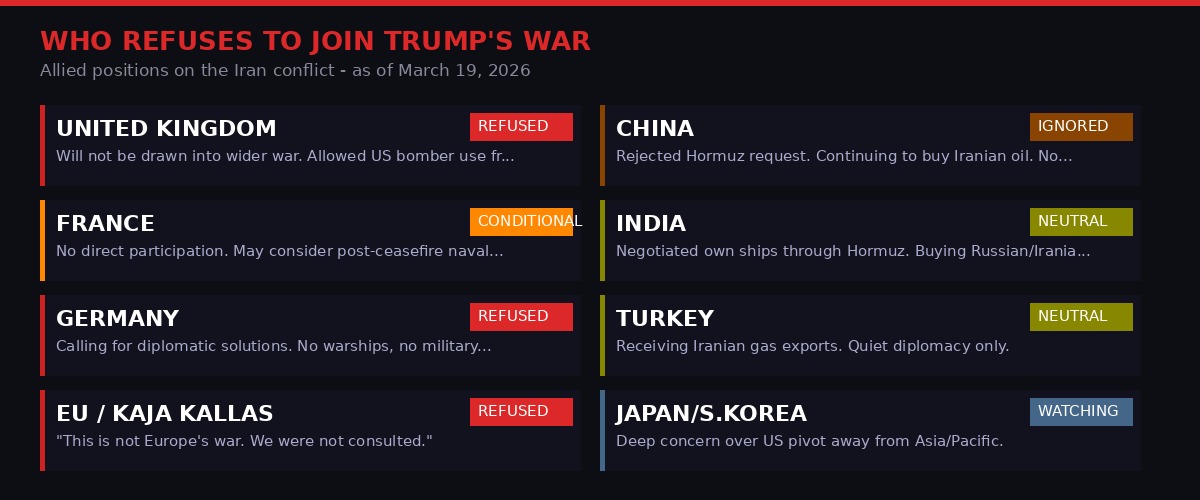
Veteran French defense analyst Francois Heisbourg called it a "global raspberry." The phrase is accurate. Trump demanded - in his own words, demanded, not requested - that allies send warships to help reopen the Strait of Hormuz. He leaned on decades of U.S. security guarantees as leverage. The reply was uniform: no.
The United Kingdom, which Trump himself called "the Rolls-Royce of allies," told him to go it alone. Prime Minister Keir Starmer said British involvement requires "international law and a proper thought-through plan." The implication was clear: neither was in place before Operation Epic Fury launched. Starmer had cultivated a working relationship with Trump, reached an early trade deal, even allowed U.S. bombers limited use of RAF bases for strikes on Iran's ballistic missile program. But joining the war itself was a line he held.
France's Emmanuel Macron envisions possible naval escorts once fighting dies down. That condition - ceasefire first, help second - essentially means France is offering nothing for the foreseeable future. Germany's Boris Pistorius was blunter: "It is not our war. We want diplomatic solutions and a swift end to the conflict. Sending more warships to the region will certainly not contribute to that."
EU foreign policy chief Kaja Kallas cut to it plainly. "This is not Europe's war. We didn't start the war. We were not consulted." That last part - not consulted - is the wound that won't close. Washington launched Operation Epic Fury without NATO coordination, without UN authorization, without the multilateral groundwork that gave the 1990 Gulf War its international legitimacy. Trump's America-first framework, applied to the most consequential military operation since Iraq 2003, has produced America-only consequences.
"President Trump's request to delay his long-awaited summit with President Xi Jinping underscores how significantly he underestimated the fallout from Operation Epic Fury. A show of U.S. force that was meant to intimidate Beijing has instead served to puncture the illusion of U.S. omnipotence: Unable to reopen the Strait of Hormuz alone, Washington now needs its principal strategic competitor to help it manage a crisis of its own making." - Ali Wyne, International Crisis Group
Retired Lt. Gen. Ben Hodges, former commanding general of U.S. Army Europe, said allies are "looking at the United States in a way that they never have before. And this is bad for the United States." He added that European leaders who previously used flattery to manage Trump are "starting to realize there's no benefit or value in it."
South Pars Burns: Israel Strikes the World's Largest Gas Field

On March 18 - Day 23 of the war - Israeli aircraft reportedly struck Iran's South Pars natural gas field near Asaluyeh on the Gulf coastline. Iranian state media confirmed facilities were on fire. Iranian President Masoud Pezeshkian warned of "uncontrollable consequences" that "could engulf the entire world."
South Pars is not simply a strategic asset. It is Iran's primary source of domestic energy - the field supplies roughly 80% of Iran's natural gas, which the country burns for cooking, home heating, electricity generation, and industrial production. Iran is the world's fourth-largest consumer of natural gas, consuming heavily despite an economy dwarfed by the three nations ahead of it. The country has suffered rolling power shortages for years even without a war disrupting supply.
The field under the Gulf is the world's largest gas reserve. It is shared by Iran and Qatar - South Pars on the Iranian side, North Field on the Qatari side. Israel's strike therefore hit not just Iran's domestic backbone, but rattled Qatar, which has already watched its Ras Laffan LNG export facility take Iranian missile fire. QatarEnergy confirmed on March 18 that a missile hit Ras Laffan, sparking a fire that caused "extensive" damage. The company had already halted production there.
"The attack is a serious escalation which threatens retaliatory strikes on Gulf and Israeli production facilities." - Andres Cala, geopolitical analyst, Montel News
The global energy ripple was immediate. European natural gas prices jumped 7% on news of the South Pars strike. Brent crude extended its surge past $108 per barrel - up nearly 50% since the first U.S.-Israeli strikes on Iran in late February. Saudi Arabia is routing oil via pipeline across the country to Red Sea ports, bypassing the strait entirely. Iraq has reached a deal to export 250,000 barrels per day via pipeline through Kurdish-controlled northern Iraq to a Turkish port.
Iran hit back the same day. Missiles struck Saudi Arabia's Eastern Province - home to much of Riyadh's oil infrastructure - as well as Kuwait, Bahrain, and the United Arab Emirates. None of these Gulf states are combatants. They are bystanders absorbing damage from a war they did not choose.
MIRV Missiles Over Israel: Iran's New Anti-Interception Weapon

The military escalation on March 18 introduced a significant new weapons development. Iran's Revolutionary Guard announced it had attacked central Israel with multiple independently targetable reentry vehicle (MIRV) missiles - a configuration designed specifically to overwhelm and defeat missile defense networks. AP journalists filmed at least one missile releasing a cluster of munitions over Israel.
Two people were killed near Tel Aviv. The attack was framed by Tehran as retaliation for the killing of Ali Larijani - the top Iranian security official and de facto leader of the country following Supreme Leader Khamenei's death in the opening strikes of the war. Larijani had been coordinating with Oman mediators on nuclear talks just two weeks before the war began. He was killed by an Israeli strike on March 17.
The MIRV deployment is not symbolic. Israel's Iron Dome, Arrow, and David's Sling systems are designed to intercept single-warhead ballistic missiles. A missile that releases multiple warheads over the target area - each on a separate trajectory - multiplies the interceptor demand. If Iran has significant stocks of MIRV-capable weapons, Israeli air defense is under a new kind of pressure.
The same day Larijani died, Israel also killed the head of the Revolutionary Guard's Basij force, Gen. Gholam Reza Soleimani. The following day - March 18 - Israeli Defense Minister Israel Katz confirmed the killing of Intelligence Minister Esmail Khatib, promising "significant surprises" to come. Iran's leadership is being systematically eliminated. But 23 days in, Iran's military continues to fire, its oil still moves through backdoor channels, and its proxy networks remain active.
IRAN LEADERSHIP ELIMINATED - WAR SCORECARD
- Supreme Leader Ali Khamenei - Killed, late February 2026 (US-Israel opening strikes)
- Ali Larijani, National Security Council head - Killed March 17 (Israeli strike)
- Gen. Gholam Reza Soleimani, Basij commander - Killed March 17 (Israeli strike)
- Esmail Khatib, Intelligence Minister - Killed March 18 (Israeli strike)
- Morteza Larijani (Ali's son) - Killed March 17 (confirmed by SNSC)
- Iranian navy - "Effectively destroyed" per US military assessment
- Iran missile/drone capacity - "Significantly degraded" per Pentagon
- Iran's response: 200+ ballistic missiles, MIRV strikes, regional energy attacks
The Strait of Hormuz: Selectively Open, Strategically Weaponized

The Strait of Hormuz is not fully closed. It is selectively closed - a nuance that matters enormously and that Washington has struggled to address militarily.
According to maritime data firm Lloyd's List Intelligence, about 89 ships crossed the strait between March 1 and 15 - down from the pre-war average of 100 to 135 passages per day. More than a fifth of those 89 vessels were Iran-affiliated. Chinese and Greek-affiliated ships also transited. The Pakistan-flagged crude oil tanker Karachi passed through on a Sunday. Indian LPG carriers Shivalik and Nanda Devi crossed around March 13-14 after India's foreign minister negotiated passage with Tehran.
Iran has "effectively created a safe corridor" for specific vessels, said Lloyd's List editor-in-chief Richard Meade. The corridor appears to track diplomatic relationships. India talks to Iran, India's ships get through. China has deep economic ties with Tehran, Chinese ships move. Iran's own oil tankers are moving: trade analytics platform Kpler estimates Iran exported well above 16 million barrels of oil since the war began, with China the dominant buyer.
The U.S. Treasury Department effectively acknowledged this reality by announcing it would allow Iranian oil tankers to transit the strait. "The Iranian ships have been getting out already, and we've let that happen to supply the rest of the world," Treasury Secretary Scott Bessent said.
This means the United States launched a war whose primary stated objective - denying Iran revenue and coercing regime change - is being undermined by the same strait it cannot reopen. Iran is selling oil. The revenue is flowing. The blockade is more selective than total, and the selectivity favors Tehran's geopolitical allies over Washington's.
"Iran has managed to profit from oil sales and also 'preserve its own export artery' by using control over the chokepoint." - Kun Cao, Reddal consulting
A top British military official, Armed Forces Minister Al Carns, said reopening the strait is "a long way off because of threats that include mines, attack boats and drones." Mines particularly complicate any naval operation - the US does not have sufficient minesweeping assets forward-deployed in the Gulf, and the allies who do - Britain, Belgium, the Netherlands - have all declined to participate.
China Watches, Waits, and Benefits

China's response to Trump's request for help in the Strait of Hormuz: a non-answer repeated call for "parties to immediately stop military operations." That is diplomatic boilerplate for "we are not helping you." Beijing has not committed warships, has not pressured Iran to de-escalate, and has not confirmed or denied whether a long-planned Trump-Xi state visit - originally scheduled for March 31 - will be rescheduled.
Analysts describe China's position as strategically rational. Every week the Iran war continues is a week the United States is tied down in the Middle East, burning resources, burning goodwill, and burning attention that would otherwise be focused on the Indo-Pacific. The transfers of military assets from the Pacific region to the Gulf - including a significant Marine rapid-response unit and an anti-missile defense system - have already raised alarm in Tokyo and Seoul about American commitment to Asia.
"The longer this war continues, and the more forces that are shifted out of Asia, the more it will feed Asian allies' concerns about U.S. distraction and resource constraints," said Zack Cooper, senior fellow at the American Enterprise Institute. A delay in the Trump-Xi summit also likely delays arms sales to Taiwan - hardware the self-governing island needs to deter any Chinese military action.
Sun Yun, director of the China program at the Stimson Center, framed it cleanly: "I think the Iran request is now going to be less pressing for China to fulfill." Translation: Beijing sees no reason to bail Washington out. Meanwhile, Chinese diplomats have been touring Middle Eastern capitals, pledging constructive roles in easing tensions. After the bombing of the Shajarah Tayyebeh elementary school in Minab, China delivered a $200,000 humanitarian aid package to Iran through the Red Cross, with its ambassador publicly condemning the attack. Beijing is positioning itself as the responsible party while Washington is the warmonger.
The strategic irony is sharp. Operation Epic Fury was designed in part to intimidate China - to signal that the U.S. could and would use force to achieve objectives. Instead, it has demonstrated that the U.S. cannot force a chokepoint open, cannot bring allies along, and cannot suppress a country of 90 million people through air power alone. "A show of U.S. force meant to intimidate Beijing has instead served to puncture the illusion of U.S. omnipotence," said Ali Wyne of the International Crisis Group.
Trump's Shifting Goalpost: From "Unconditional Surrender" to "We Don't Know"
The absence of a consistent objective is not a minor communications failure. It is a strategic void that now defines the entire conflict.
Since launching Operation Epic Fury, Trump has stated the following goals at various times: unconditional surrender of Iran's leadership; destruction of Iran's nuclear program; reopening the Strait of Hormuz; regime change; Iran trading "one hard-line ayatollah for another"; a "short-term excursion"; and "we haven't won enough." These positions are not compatible. They cannot all be true simultaneously, and the administration has not explained which, if any, is the actual benchmark for ending operations.
Sen. Mark Kelly (D-Ariz.) summarized the problem: "They didn't have a plan. They have no timeline. And because of that, they have no exit strategy." Trump ally Newt Gingrich - a former Republican House Speaker - said the administration should have moved to secure the strait on Day One of the conflict. It did not.
The domestic political picture is deteriorating. A Quinnipiac poll conducted the weekend of March 15-16 found 53% of registered voters oppose U.S. military action against Iran; only 40% support it. A separate Ipsos poll also found more Americans disapprove than approve of the strikes. The majority of Americans in multiple polls expect the conflict will last at least "months." A large majority are worried about rising gasoline prices - prices that have already jumped substantially since the war began and are now driven by $108 Brent crude.
Republicans remain largely supportive of the president, but polls show unease about any scenario involving U.S. ground troops. Trump campaigned explicitly on ending "forever wars" and putting "America first." The Iran conflict is threatening to become exactly the kind of open-ended Middle Eastern entanglement he promised never to start. Gingrich's warning - "if they can't keep it open, this war will in fact be an Americ-" was left mid-sentence by the AP transcript, but the word completing it is obvious.
WAR ECONOMICS: THE COST CLOCK
- Brent crude, Feb 23 (pre-war): ~$72/barrel
- Brent crude, March 18 (Day 23): $108/barrel (+50%)
- US gas prices: Surging nationally, months of pain expected
- European LNG prices: +7% in single day on South Pars strike
- Qatar Ras Laffan LNG facility: "Extensive damage," halted production
- Saudi Arabia Eastern Province: Iranian missiles struck March 18
- Iran oil exports since war began: 16+ million barrels (Kpler estimate)
- Treasury response: Easing Venezuela oil sanctions to compensate supply
- Iraq pipeline deal: 250,000 bpd via Turkey, bypassing Hormuz
The West Bank Bleeds Too: Four Killed in the Occupied Territories

On March 18, four people were killed in the occupied West Bank town of Beit Awa. The Palestinian Red Crescent confirmed the deaths, attributing them to Iran's missile strikes on Israel - either from direct impact or debris from interception. At least six others were injured.
These were the first fatalities in the occupied West Bank during the Iran war, even though missile debris has damaged homes and businesses in the territory throughout the conflict. The West Bank is not a combatant. Its Palestinian population did not choose this war. They are absorbing it anyway, killed by munitions raining down in a conflict between states none of which represents their interests.
The casualty expands a count that already spans Gaza (ongoing Israeli operations continue separately), Lebanon (Israeli strikes on Beirut were reported during the same period), Iran's civilian population, Gulf state nationals living near targeted energy facilities, and now West Bank Palestinians. The war is radiating outward. Every escalation cycle adds another population to the casualty list.
Iran's strategy of striking Gulf neighbors' energy infrastructure - Saudi Arabia, Qatar, Kuwait, Bahrain, UAE - is partly economic pressure, partly designed to fracture the Gulf's quiet tolerance of US operations. None of those states support Iran. All of them host US bases or have security relationships with Washington. But they are also watching their own territory burn. The UAE had already paused some oil exports due to the war. Qatar's LNG revenues - which fund a massive sovereign wealth fund - are being directly threatened.
The Endgame Nobody Has

Twenty-three days in, the United States has destroyed Iran's navy, killed most of its top leadership, and degraded its missile and drone infrastructure. Iran has responded by blocking the world's most important oil chokepoint, striking energy facilities across the Gulf, deploying MIRV missiles against Israeli cities, killing civilians in four countries, and continuing to sell oil to China at volumes that partially offset US pressure.
Neither side is winning cleanly. Neither side has defined what winning looks like. Iran's new supreme leader - whoever emerges from the power vacuum left by Khamenei's death - has every incentive to appear resolute. Iran's religious and political structure has historically absorbed enormous punishment while refusing to capitulate. The Iran-Iraq War lasted eight years and killed hundreds of thousands. The Islamic Republic did not fall.
Trump's original calculation - that Iran would fold quickly under overwhelming airpower, regime leaders would abandon their posts, and oil would flow freely through Hormuz within days - has not materialized. The U.S. military's assessment that the navy is "effectively destroyed" and missile capacity "significantly degraded" is operationally accurate but strategically insufficient. Destroying a navy does not open a strait if mines and shore-based anti-ship missiles remain. Killing leaders does not end a state.
The allies who might have helped build a legitimate international framework around this conflict were never brought into the planning. The legal authorities that might have made Hormuz an international enforcement action rather than a US-Israel military operation were never sought. The diplomatic channels through which Iran might have been coerced or bought toward a negotiated exit were closed, not opened, by the strikes. Larijani had traveled to Oman just two weeks before the war to meet with mediators. He is now dead.
What comes next is a war that has outlasted its original timeline, isolated the United States from its allies, destabilized global energy markets, and produced no clear victory condition. The administration's options are narrowing. Escalate further and risk a regional conflagration Iran's president already warned about - one that could, in Pezeshkian's words, "engulf the entire world." Seek talks without having defined what a settlement looks like. Or simply continue bombing and hope Iran breaks first, at a cost no one has calculated and a timeline no one has set.
There is a reason allies refused. Not because they support Iran. Because they looked at this operation and could not identify the exit door. Three weeks later, neither can anyone in Washington.
Get BLACKWIRE reports first.
Breaking news, investigations, and analysis - straight to your phone.
Join @blackwirenews on Telegram