$200 Billion and No Authorization: The Iran War's Reckoning Arrives on Day 21
The Pentagon wants $200 billion from a Congress that never voted to go to war. Trump's own counterterrorism chief just resigned calling the whole thing a manufactured conflict. And somewhere in Tehran, a new supreme leader hasn't been seen in public. This is where the Iran war stands at three weeks.
Three weeks ago, US and Israeli aircraft launched coordinated strikes on Iran with no warning, no Congressional authorization, and no publicly stated timeline for how this ends. On Day 1, Supreme Leader Ayatollah Ali Khamenei was killed in the opening salvo. Since then, the bombings have continued every day. Iran has fired back at Israel, the Gulf states, and US bases across the region.
Now comes the bill.
The Pentagon is requesting $200 billion in emergency supplemental funding - a figure so large it has stunned members of Congress from both parties. The request lands in a legislature that has never formally authorized the war, in a political environment where the national debt has already crossed $39 trillion, and in a week when the president's own top counterterrorism official resigned publicly accusing the administration of lying about why the war started. [AP News, March 20, 2026]
This is the moment of maximum political and military stress. The bombs are still falling. The missiles are still flying. And the foundations of the American war effort are cracking from within.
The $200 Billion Number - What It Means
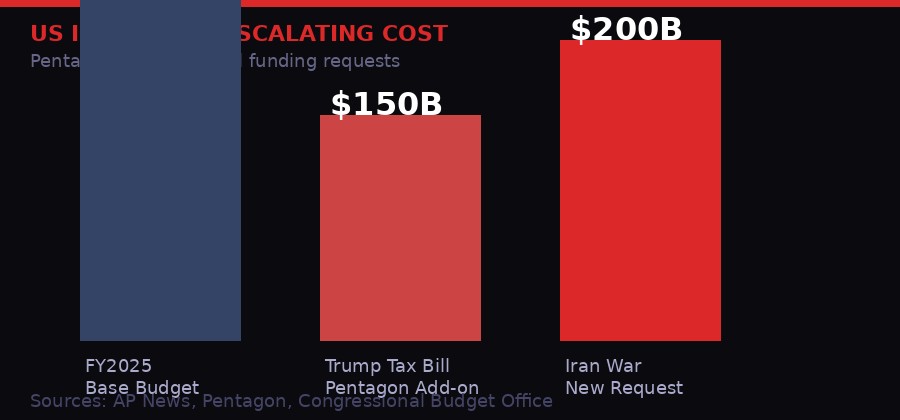
Put $200 billion in context. The entire US defense base budget for FY2025 was $886 billion - already the largest in American history. Trump's tax and spending bill last year added another $150 billion to the Pentagon's coffers. And now this: $200 billion more, requested after just three weeks of fighting. [AP News, Pentagon, Congressional Budget Office]
Defense Secretary Pete Hegseth declined to confirm the exact figure at a press conference Thursday, but his answer was revealing.
"It takes money to kill bad guys."
- Defense Secretary Pete Hegseth, March 19, 2026 (AP News)
Trump, speaking from the Oval Office, framed the request as broader than Iran alone. "This is a very volatile world," the president said. He described the emergency spending as "a very small price to pay" to maintain the US military's operational capability. [AP News]
But $200 billion is not a small number. It works out to roughly $9.5 billion per day of conflict so far - more per day than the US spent in the peak years of the Iraq and Afghanistan wars combined, when adjusted for inflation.
The request faces enormous political obstacles. Rep. Betty McCollum of Minnesota, the ranking Democrat on the House Appropriations subcommittee with defense oversight, delivered a direct warning. [AP News, March 20, 2026]
"This is not going to be a rubber stamp for the president of the United States."
- Rep. Betty McCollum (D-MN), House Appropriations Committee
McCollum pointed out that Congress is still waiting for the administration to account for where the $150 billion it already received through Trump's tax bill was spent. Now it's being asked to authorize another $200 billion on top of that - for a war it never authorized in the first place.
Even some Republicans are balking. Conservative fiscal hawks in the House and Senate have shown little appetite for emergency military spending at this scale. Rep. Ken Calvert of California, the Republican chair of the House defense appropriations subcommittee, acknowledged the request was coming but was careful not to pre-approve the full amount. "That's where we're at," Calvert said, one of the least enthusiastic endorsements a major military spending request has ever received. [AP News]
The Resignation That Shook the War's Legitimacy
The $200 billion request might have been manageable political news on its own. What made this week's reckoning different was Joe Kent.
Kent served as director of the US National Counterterrorism Center - the government's top civilian counterterrorism post, overseeing intelligence fusion, threat assessment, and coordination across the entire intelligence community. He was a 45-year-old Special Forces combat veteran, a Trump loyalist who had defended the president through two election challenges, Jan. 6, and years of conservative media advocacy. If there was anyone inside this administration who would know whether Iran posed a genuine imminent threat to the United States, it was him.
On Tuesday, he resigned. And he explained why in public.
Iran "posed no imminent threat to our nation." The war was launched "due to pressure from Israel and its powerful American lobby." High-ranking Israeli officials and influential members of the American media deployed "a misinformation campaign" to push the US toward war with Iran.
- Joe Kent, resignation statement, March 18, 2026 (AP News)
This is not a statement from a political opponent or a foreign critic. This is the man Trump appointed to run the National Counterterrorism Center - whose job, literally, was to assess whether threats were real. His conclusion: they were not. The war was engineered. [AP News, March 18, 2026]
Trump responded dismissively. "He was wrong about Iran," the president said to reporters. Director of National Intelligence Tulsi Gabbard - whose office oversaw Kent's work - was more careful, neither confirming nor denying the intelligence picture. She wrote on social media that "President Trump concluded that the terrorist Islamist regime in Iran posed an imminent threat and he took action based on that conclusion." She did not state her own view. [AP News]
That omission is significant. The intelligence community's second-highest civilian official declined to publicly contradict the assessment of her own subordinate.
The Kent resignation also surfaced uncomfortable background details the administration would prefer stay buried: during his Senate confirmation, Kent acknowledged a call that included Nick Fuentes, a far-right influencer with documented antisemitic statements. Kent's resignation letter invoked language about Jewish Americans' political influence that tracks with antisemitic tropes - even as it raised legitimate questions about the role of Israeli government lobbying in the push for war. [AP News]
The contradiction leaves the administration's war rationale in a strange position: the person who resigned making the accusations is credibly tainted, but the accusations themselves remain unrefuted by the intelligence apparatus that was supposed to prove the threat was real.
The Battlefield - Day 21 State of Play
Whatever the war's origins, it is intensifying. On the ground and in the air, Day 21 is one of the most active since the opening strikes.
This morning, the IRGC spokesman was killed in a US-Israeli missile strike - the latest in a systematic decapitation campaign targeting Iran's military and political leadership. Israeli Prime Minister Benjamin Netanyahu claimed at a press conference Thursday that Iran "can't enrich uranium anymore" and that its "command and control structure is in utter chaos." [Al Jazeera, AP News, March 20, 2026]
The numbers suggest the campaign has inflicted serious damage. According to the Iranian Red Crescent Society, more than 18,000 civilians have been injured since the war began, and at least 204 children have been killed. Total Iranian deaths stand above 1,400. [Al Jazeera, March 20, 2026]
Iran, in turn, launched a new wave of missile and drone attacks on US bases and across central and southern Israel overnight - including strikes targeting Tel Aviv, Haifa, and Jerusalem. The IRGC announced the attacks publicly, a signal of continued offensive intent despite the losses. Iranian leadership also warned of "zero restraint" if its energy facilities are struck again, following Israel's attack on the South Pars gasfield and Iran's retaliatory strike on Qatar's Ras Laffan LNG facility. [Al Jazeera, March 20, 2026]
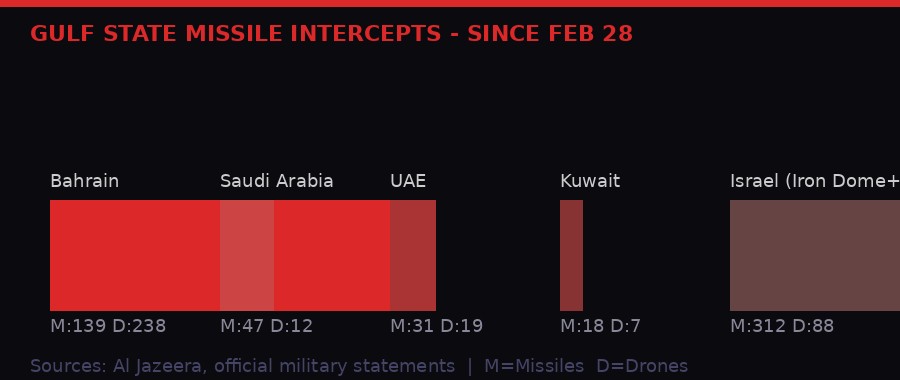
The Gulf is in defensive mode. UAE and Kuwaiti air defenses are actively engaging incoming threats today. Saudi Arabia's Ministry of Defense reported intercepting and destroying 10 drones in the country's east and one in the north. Bahrain's total intercept count since February 28 stands at 139 missiles and 238 drones - an extraordinary volume for a small island nation. [Al Jazeera, March 20, 2026]
Seven US service members have been killed as of Friday, according to AP. The Pentagon has not provided a full accounting of wounded.
The Energy War - Hormuz and the Global Economy
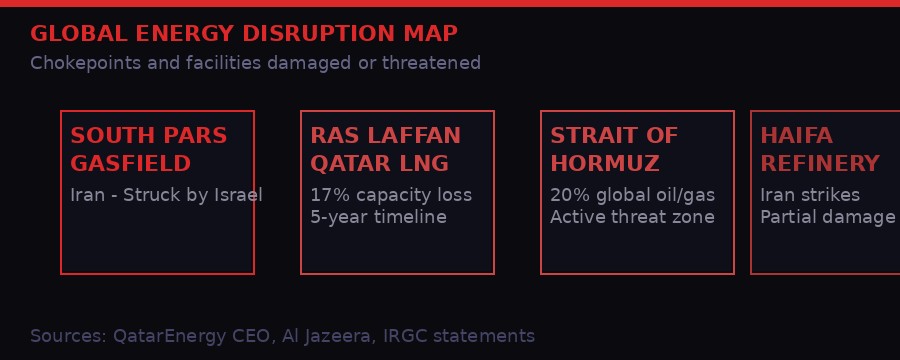
The most consequential dimension of this war for people who live nowhere near the Middle East is energy. Every missile that lands near a refinery, every drone that approaches a tanker, every day the Strait of Hormuz remains under threat - it translates directly into fuel prices, heating costs, and industrial inputs across Europe, Asia, and the Americas.
Israel's strike on Iran's South Pars gasfield - the world's largest natural gas field, shared with Qatar's North Dome structure - triggered Iran's strike on Qatar's Ras Laffan LNG facility. The CEO of QatarEnergy confirmed the damage was serious: approximately 17 percent of Qatar's LNG capacity is offline, potentially for up to five years. Qatar supplies roughly 20 percent of the world's LNG. Force majeure declarations are expected on contracts with Belgium, Italy, South Korea, and China. [Al Jazeera, QatarEnergy CEO statement, March 2026]
Sharp fuel price increases have been reported across the United Kingdom and Europe in the 48 hours following the Ras Laffan attack. Global oil markets spiked when news of the South Pars strike broke.
Through the Strait of Hormuz - the 33-kilometer-wide chokepoint between Oman and Iran - flows approximately 20 percent of the world's oil and gas. Iran has the capacity to threaten this corridor with mines, fast boats, and shore-based anti-ship missiles. The US Fifth Fleet and coalition partners have been working to keep the strait open, but the risk premium in shipping insurance has risen dramatically.
French President Emmanuel Macron announced Friday he would consult United Nations Security Council members on a framework to secure navigation in the Strait of Hormuz. He was careful to condition the proposal on "once fighting subsides" - an acknowledgment that no diplomatic solution is imminent. [Al Jazeera, March 20, 2026]
Qatar's prime minister and Turkey's foreign minister held a joint news conference condemning Iran's Ras Laffan attack as a "dangerous escalation" - even as both countries try to maintain diplomatic channels with Tehran. The diplomatic architecture of the Gulf is fracturing along lines of proximity to the fighting and economic exposure to the energy war.
Who Is Running Iran?
The question is not rhetorical. Israel has spent three weeks systematically killing Iran's leadership, and the answer to "who is in charge" is genuinely unclear.
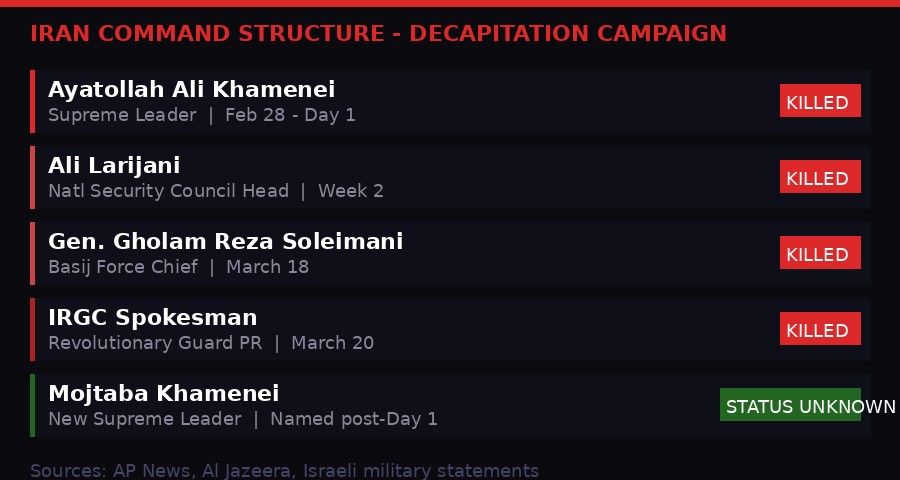
Supreme Leader Ayatollah Ali Khamenei was killed on Day 1 of the war - the first strike, the defining act of an operation that Israeli and American planners had clearly prepared for. His replacement, 56-year-old son Mojtaba Khamenei, was quickly named to the position. But Mojtaba has not been seen in public since his appointment. [AP News, March 19, 2026]
Netanyahu drove the uncertainty home at a press conference Thursday. "I'm not sure who's running Iran right now," the Israeli prime minister said. "Mojtaba, the replacement ayatollah, has not shown his face. Have you seen him? We haven't, and we can't vouch for what exactly is happening there." Netanyahu added that Mojtaba's wife was also killed in the strike that killed his father, and that US and Israeli officials believe Mojtaba himself may have been wounded. [AP News]
Beyond the supreme leader, Israel killed Ali Larijani - secretary of Iran's Supreme National Security Council and one of the most powerful men in the country - in week two of the war. On Tuesday, the Basij Force Chief, General Gholam Reza Soleimani, was killed. Today, the IRGC spokesman. The systematic elimination of Iran's command structure continues.
And yet - the missiles keep flying. The Basij keeps operating its checkpoints. The IRGC keeps launching drone swarms. The operational capacity of Iran's military has been degraded, but it has not been broken. Defense analysts at the Royal United Services Institute noted that the Basij, specifically, is built for exactly this kind of attrition - it is "the most decentralized force within an already highly decentralized system," operating in units that function semiautonomously. [AP News, quoting RUSI analyst Hamidreza Azizi]
Killing the top commander does not stop the machine. The machine was designed to run without a commander.
The Human Cost - Nowruz in the Ruins
Today is Nowruz - the Persian New Year, the spring equinox, the oldest and most celebrated holiday in Iranian culture, marking the turn from winter to the season of renewal. In ordinary years, families gather, tables are spread with traditional symbolic items, and cities across Iran fill with celebration.
This year, the bombs have been falling for 21 days.
In Paris, an Iranian woman named Shayan Ghadimi is trying to reach her 70-year-old mother, who returned to Iran late last year to witness the protests that swept the country before the war began. Communications have been largely severed - Iran's internet blackout has made contact with people inside the country almost impossible. [AP News, March 20, 2026]
"Now, she is all alone at home, with no way to stay in contact, watching the sky. I cannot imagine the state she is in."
- Shayan Ghadimi, Paris (AP News)
Iranian cultural centers in Paris and cities across the world have canceled or scaled back Nowruz celebrations. In the United States, Iranian-American communities have gone quiet. An Iranian makeup artist in Paris named Shakiba Edighoffer described the emotional toll of trying to track family members through the bombardment. "I had a friend who managed to connect very briefly on Instagram a few days ago," she said. "I think it's been about 20 days now since the war started, and that was really the only time I was able to speak with him a little." [AP News]
The Iranian Red Crescent's numbers give the scale: 18,000 civilians injured, 204 children killed, over 1,400 total dead - in 21 days. That is an average of 67 deaths per day, sustained across three weeks, in a country of 88 million people who are simultaneously sealed off from the outside world by their own government's internet blackout and by the chaos of war.
In Tehran, security forces - Revolutionary Guard, Basij, police - remain visibly deployed across the city. The crackdown that followed January's nationwide protests, in which thousands were killed, never fully stopped. It has intensified under the cover of war. Residents report that security agents are targeting anyone who films missile strikes or attempts to circumvent the internet blackout to contact family abroad. [AP News, March 20, 2026]
There is no sign of the popular uprising that US and Israeli planners may have hoped their strikes would catalyze. The people of Iran are not rising against the Islamic Republic. They are sheltering from the bombs.
Timeline: How Three Weeks of War Unraveled
DAY 1
Supreme Leader Ayatollah Ali Khamenei killed in opening salvo. Trump invokes national security justification - Iran posed "imminent threat." No allies notified in advance.
WK 1-2
Mojtaba Khamenei named new supreme leader. Ali Larijani, head of Supreme National Security Council, killed. Iran hits targets in Israel, Gulf states. Bahrain begins recording intercept counts.
WK 2-3
Israel expands strikes to Basij checkpoints across Tehran. Iranian internet blackout deepens. 7 US service members killed. Pentagon begins internal budgeting for long campaign.
DAY 19
17% of Qatar LNG capacity damaged or destroyed. QatarEnergy CEO: 5-year timeline for repairs. Joe Kent resigns as NCTC director, calls war "manufactured." Basij Force Chief Gen. Soleimani killed.
DAY 20
Defense Secretary Hegseth: "It takes money to kill bad guys." Trump references Pearl Harbor to Japanese PM while defending surprise attack. Netanyahu says Iran "can't enrich uranium" - IRGC command "in chaos."
DAY 21
UAE and Kuwait air defenses engaging active threats. Macron seeks UNSC framework for Hormuz. Congressional opposition to $200B request hardens. 18,000+ Iranian civilians injured; 204 children killed. Mojtaba Khamenei still not seen in public.
Congress, Accountability, and the War Nobody Authorized
The constitutional dimension of this war has been present since Day 1 and is becoming impossible to ignore. Article I of the United States Constitution gives Congress, not the president, the power to declare war. Trump launched strikes on a sovereign nation with no Congressional authorization, no formal war declaration, and apparently no advance notice to key allies. [AP News, Congressional statements, March 2026]
The last formal US declaration of war was in 1942. Presidents have used executive authority and the 2001 Authorization for Use of Military Force - written in the weeks after September 11, targeting al-Qaeda and Taliban - to justify military actions ever since. The AUMF does not mention Iran.
Congress has been "bracing for a new spending request" according to AP, but individual members are drawing lines. Rep. McCollum's statement that this will not be a "rubber stamp" reflects a bipartisan unease that has been building since the first night of strikes. [AP News]
The war's legal foundation is a presidential assertion that Iran posed an imminent threat - the same assertion that Joe Kent, the man whose job was to assess such threats, has publicly rejected as false. The administration has not produced the underlying intelligence. The intelligence community has not publicly contradicted Kent. Congress has not been given classified briefings sufficient to evaluate the claim independently, according to Democratic members. [AP News, Congressional statements]
The request for $200 billion now forces a confrontation that has been deferred since February 28. Congress must either appropriate the money - implicitly ratifying a war it never authorized - or deny it, creating a fiscal crisis in an active military campaign. Neither option is clean. Both carry enormous political consequences heading into the 2026 midterm elections.
What Hegseth's "kill bad guys" formulation obscures is the more uncomfortable question: what does success look like, and when does it end? The Pentagon has provided no exit criteria, no operational timeline, no defined objective short of "targeting Iran's missile systems" and military leadership - goals that appear increasingly elastic as the war enters its fourth week. [Al Jazeera, quoting Hegseth, March 19, 2026]
What Comes Next
The war is three weeks old and shows no signs of de-escalation. The key variables in the coming days:
NUCLEAR FACILITIES
Netanyahu claims Iran "can't enrich uranium anymore" - suggesting nuclear sites have been struck. If confirmed, Iran's red lines around those facilities were presumably already crossed. The question is whether remaining enrichment infrastructure exists and whether Iran will attempt to reconstitute it.
GROUND COMPONENT
Netanyahu has signaled there "could be a ground component" to the war. Any Israeli or US ground operation inside Iran would represent a fundamental escalation - moving from aerial bombardment to occupation or direct territorial engagement. The Pentagon's $200B request suggests planning for exactly this.
MOJTABA KHAMENEI
Iran's new supreme leader hasn't appeared in public. Netanyahu suggested he may be wounded. A leadership vacuum in Tehran - combined with a decapitated IRGC command structure - creates unpredictable decision-making dynamics. Who actually authorizes Iran's next escalation step?
HORMUZ CLOSURE
If Iran decides to mine or physically block the Strait of Hormuz, the global economic consequences would dwarf anything seen so far. The EU, US, and China would all face severe energy shocks. Macron's UNSC initiative suggests European capitals are treating this as a near-term possibility.
CONGRESSIONAL FUNDING VOTE
The $200B request will force a vote in the coming weeks. If Congress denies the funds - or attaches conditions requiring authorization or an exit strategy - it could create the first genuine political check on the war's expansion. If it passes cleanly, the blank check is signed.
IRANIAN CIVIL POPULATION
18,000 injured, 204 children dead, internet blackout, security crackdown. The humanitarian toll is accelerating. International pressure for a humanitarian corridor or ceasefire is building, though neither the US nor Israel has indicated openness to one.
The arithmetic of this war is brutal. Three weeks of strikes have killed Iran's supreme leader, gutted its military command, set back its nuclear program, damaged Gulf energy infrastructure with global consequences, killed seven Americans, triggered a $200 billion funding crisis, and produced a damning insider accusation that the whole thing was built on manufactured intelligence. Iran, meanwhile, is still firing missiles every day.
That is not the profile of a war that is going well. It is the profile of a war that is going deep.
The bombs falling on Nowruz are the same bombs that will be falling when Congress votes on $200 billion. The families sheltering in Tehran are the same families who will be sheltering when that vote occurs. The war's rationale is in dispute. Its end is not in view.
What the next 21 days look like depends on whether any of those variables break - a Congressional refusal to fund, a Hormuz closure that triggers international intervention, a visible appearance by Iran's missing supreme leader, or a ground operation that redefines the entire conflict. Any of them could happen. None of them are guaranteed. The one guarantee is that more people will die before any of them do.
Get BLACKWIRE reports first.
Breaking news, investigations, and analysis - straight to your phone.
Join @blackwirenews on TelegramSources: AP News (March 19-20, 2026) - Pentagon $200B request, Joe Kent resignation, Iran leadership profile; Al Jazeera (March 20, 2026) - Day 21 explainer, live updates, Nowruz coverage; QatarEnergy CEO statement via Al Jazeera; Israeli PM Netanyahu press conference via AP/Al Jazeera; Iranian Red Crescent Society via Al Jazeera; RUSI analyst Hamidreza Azizi via AP News. All casualty figures reflect available reporting as of 12:15 CET March 20, 2026.