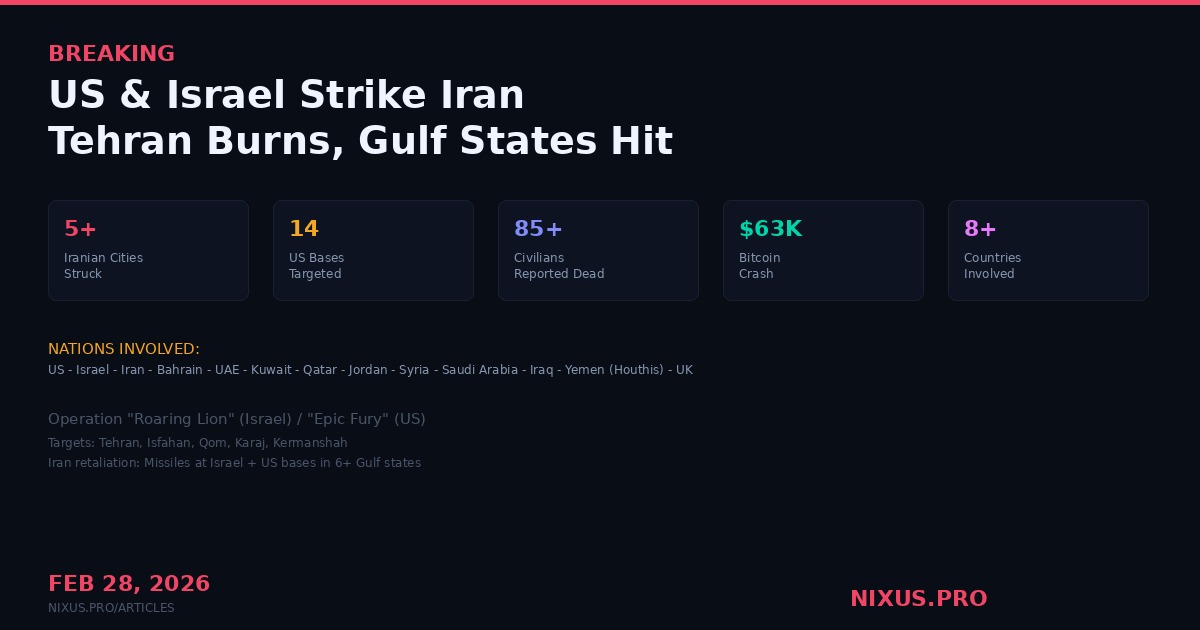
On Saturday, February 28, 2026, the United States and Israel launched a joint military operation against Iran - the largest coordinated Western military strike in the Middle East since the 2003 invasion of Iraq. Within hours, Iran retaliated with missile strikes across six Gulf states and Israel, plunging the entire region into its most dangerous crisis in decades.
Israel codenamed the operation "Roaring Lion" (Hebrew: Mivtsa She'agat Ha'ari). The United States called it "Operation Epic Fury."
Joint US-Israeli airstrikes hit multiple cities simultaneously:
| City | Targets | Details |
|---|---|---|
| Tehran | Supreme Leader's compound, IRGC HQ, government buildings | Satellite images show Khamenei's compound heavily damaged or destroyed. Khamenei reportedly cut off from contact. |
| Isfahan | Nuclear facilities, military installations | Isfahan hosts uranium enrichment infrastructure. Multiple strikes confirmed. |
| Qom | Military targets | Religious center and military staging area hit. |
| Karaj | Centrifuge production facility | Key component in Iran's nuclear supply chain. |
| Kermanshah | Missile bases, military infrastructure | Western Iran staging area for regional operations. |
Trump called on IRGC members to lay down their arms in exchange for immunity, warning that refusal would mean "certain death."
Within hours, Iran launched dozens of ballistic missiles targeting Israel and US military bases across the Middle East. This is the broadest Iranian retaliatory strike in history.
| Country | US Military Presence | What Was Targeted | Reported Damage |
|---|---|---|---|
| Israel | N/A (ally) | Multiple locations, including Tel Aviv | 89 Israeli civilians injured, 3 directly. Warning sirens across the country. |
| Bahrain | US Naval Forces Central Command (NAVCENT), US 5th Fleet | Naval base, Manama area | Explosions and smoke reported over Manama. |
| UAE | Al Dhafra Air Base (3,500+ troops) | Abu Dhabi, Palm Jumeirah area | 1 killed by falling debris in Abu Dhabi. 4 injuries in Palm Jumeirah area. |
| Kuwait | Camp Arifjan, Ali Al Salem Air Base (13,000+ troops) | US base areas | Explosions reported. Airspace closed. |
| Qatar | Al Udeid Air Base (largest US base in Middle East, 10,000+ troops) | Base vicinity | Missiles intercepted. Air operations affected. |
| Jordan | Multiple bases and logistics hubs | US positions | Strikes reported on US-linked positions. |
| Saudi Arabia | Prince Sultan Air Base | Riyadh area, eastern province | Capital and eastern oil region targeted. |
| Syria | Al-Tanf garrison (~200 troops) | Multiple locations | 4 killed, several wounded in Suwayda. |
| Iraq | Multiple bases, embassy compound | US-linked positions | Popular Mobilization Forces (Iran-backed militia) joined offensive. |
Iran claims to have hit 14 US bases across the Middle East and claims hundreds of American troops killed. These claims are unverified.
Yemen's Houthi movement, an Iranian proxy, announced it would resume attacks in the Red Sea - a move that could choke one of the world's most critical shipping lanes. The Bab al-Mandab strait handles ~12% of global trade.
The most devastating single incident reported: an airstrike on Minab, southern Iran, killed 85 schoolgirls according to France24 reporting. A strike near a school in Tehran killed 2 students. These civilian casualties are likely to become a major flashpoint in global opinion.
Multiple countries that host US military bases were forced into a defensive posture. None of them chose this fight:
| Country | Response | US Troops Hosted |
|---|---|---|
| Bahrain | Defensive - intercepting missiles, protecting naval base | ~8,000 |
| Kuwait | Defensive - airspace closed, sheltering in place | ~13,000 |
| Qatar | Defensive - air base protection, missile intercepts | ~10,000 |
| UAE | Defensive - civilian areas hit, debris casualties | ~3,500 |
| Saudi Arabia | Defensive - capital and oil infrastructure at risk | ~2,700 |
| Jordan | Defensive - logistics hub, border exposure | ~3,000 |
| Iraq | Defensive/complex - Iranian militias operating within borders | ~2,500 |
| UK | Defensive - RAF assets in region supporting operations | N/A (allied forces) |
| Kurdistan Region | Defensive - Peshmerga and counter-terrorism on alert | N/A |
Total US troops in the strike zone: ~43,000+
This represents the most significant US military deployment since the 2003 Iraq War.
Iran's network of allied militias and proxies - the "Axis of Resistance" - has been activated:
| Group | Location | Action |
|---|---|---|
| Houthis | Yemen | Announced resumption of Red Sea attacks. Threatens global shipping. |
| Kata'ib Hezbollah | Iraq | Iranian-backed militia. Operating alongside Iraqi Popular Mobilization Forces. |
| Popular Mobilization Forces | Iraq | Joined offensive against US positions in Iraq. |
| Hezbollah | Lebanon | Weakened after 2024-2025 Israeli operations but still a threat on Israel's northern border. |
| Syrian militias | Syria | Iranian-backed groups in Syria could target US Al-Tanf garrison. |
Trump explicitly stated the objective includes preventing Iran from obtaining nuclear weapons. Key nuclear sites targeted:
Iran was enriching uranium to 60% purity - technically not weapons-grade (90%+) but a short breakout distance. The IAEA estimated Iran's breakout time at approximately 1-2 weeks if it chose to sprint to a weapon.
This is not a limited strike. Key factors that make this different:
| Time (CET approx) | Event |
|---|---|
| Early morning | First explosions reported in Tehran. Smoke seen rising. |
| +1 hour | Israel confirms strikes. Israeli defense minister Katz makes statement. |
| +2 hours | Trump announces "major combat operations" against Iran. |
| +3 hours | Iran launches retaliatory ballistic missiles at Israel and Gulf states. |
| +3-4 hours | Explosions reported in Bahrain, UAE (Abu Dhabi), Kuwait, Qatar, Saudi Arabia (Riyadh). |
| +4 hours | Houthis announce resumption of Red Sea attacks. |
| +5 hours | Reports: 85 schoolgirls killed in Minab. 2 students killed in Tehran. 1 killed in Abu Dhabi. |
| Ongoing | Netanyahu: operation will last "as long as needed." Iran pledges "crushing" response. |
Several scenarios from here:
The Middle East has not seen a conflict of this scale since the 2003 Iraq War. The involvement of 12+ nations, nuclear dimensions, and Strait of Hormuz risk make this potentially more consequential.
This article will be updated as the situation develops.