World's Largest Gas Field Attacked, Oil Hits $108: Iran War Day 19 LIVE
Israel strikes South Pars - shared by Iran and Qatar, the world's single largest gas reserve. Iran retaliates with multi-warhead ballistic missiles over central Israel and hits energy facilities across five Gulf states. Brent crude tops $108 a barrel, up 50% since the war began. Iran's new supreme leader has issued a rare direct statement signaling escalation.

Energy infrastructure attacks have become the defining weapon of the Iran war. (Pexels)
The Iran war crossed a threshold on Wednesday that energy analysts have feared since the first day of fighting: the destruction of the world's largest natural gas field. Israeli aircraft struck South Pars on Iran's Gulf coastline - a resource so vast it underpins the energy supplies of two nations and, through Qatar's liquefied natural gas exports, heats and powers buildings from Tokyo to London.
Iran answered within hours. Multi-warhead ballistic missiles streaked toward central Israel. Iranian strikes hit energy infrastructure in Qatar, Saudi Arabia, Kuwait, Bahrain, and the United Arab Emirates. Two people were killed near Tel Aviv. The Strait of Hormuz, through which one-fifth of the world's traded oil normally moves, remained nearly impassable for a nineteenth consecutive day.
Brent crude surged another 5% to over $108 a barrel on international markets - up roughly 50% from the $72 level it traded at on February 27, the day before the U.S. and Israel launched what the Trump administration called "Operation Epic Fury." American drivers are paying a national average of $3.84 per gallon of regular gasoline, the highest price in two and a half years, according to motor club AAA.
In Washington, the Federal Reserve held its benchmark interest rate unchanged and signaled it may not cut rates until September at the earliest. The war has handed the Fed its worst-case scenario: rising inflation from energy costs, combined with rising risk of a recession that would normally demand cuts.
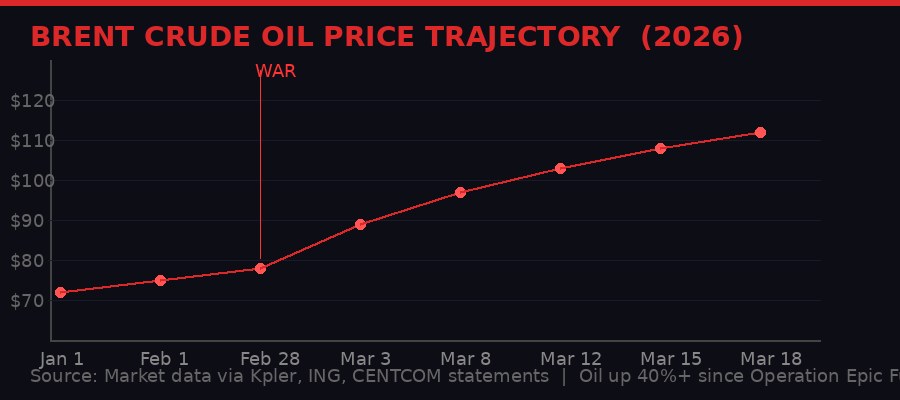
Brent crude price surge since the start of the Iran war. Source: AP market reports, March 18, 2026.
The South Pars Strike: Hitting Iran Where It Lives

Gas field flare. South Pars supplies 80% of Iran's domestic natural gas. (Pexels)
South Pars is not primarily an export facility. It is Iran's domestic lifeline. According to the Center on Global Energy Policy at Columbia University, Iran is the fourth-largest consumer of natural gas in the world - behind the U.S., China, and Russia - and 80% of that gas comes from South Pars. The field heats homes through winter, runs power plants, and keeps factories operating in a country that already struggles with chronic electricity shortages.
Iranian state media confirmed facilities near Asaluyeh on Iran's Gulf coastline were burning Wednesday. The Israeli military did not immediately claim responsibility in public, but a person familiar with the matter told AP that the U.S. was informed about Israel's plans in advance and did not participate. Whether the Trump administration actively endorsed the strike was not disclosed.
The strategic logic is brutal. Israel has spent three weeks systematically eliminating Iran's top leadership and degrading its military infrastructure. Wednesday's strike shifts to something more intimate: Iran's ability to keep the lights on at home. If South Pars infrastructure sustains serious long-term damage, Iran faces power blackouts and fuel shortages regardless of what happens on the battlefield.
"This will complicate the situation and could have uncontrollable consequences, the scope of which could engulf the entire world." - Iranian President Masoud Pezeshkian, via post on X, March 18, 2026
Even Iran's Gulf neighbors - who have been absorbing Iranian attacks on their own energy facilities - condemned the South Pars strike. The UAE Foreign Ministry called it "a dangerous escalation." Oman called it a threat to regional security and energy supplies. Qatar, which shares the same underground gas reserve under its own North Field designation, said it was "absolutely worried" about further attacks on its own Ras Laffan facility, according to Anne-Sophie Corbeau, global research scholar at Columbia's energy policy center.
Those fears were immediately realized. An Iranian missile hit Ras Laffan - Qatar's massive LNG processing and export complex - sparking a fire that QatarEnergy described as causing "extensive" damage. The company had already halted production at the facility due to earlier Iranian attacks. Qatar's LNG output represents roughly one-fifth of global supply. Europe, which has been scrambling to replace Russian gas since 2022, is now competing harder than ever for a shrinking pool of available cargoes.
Leadership Decapitation: Five Dead in Nineteen Days
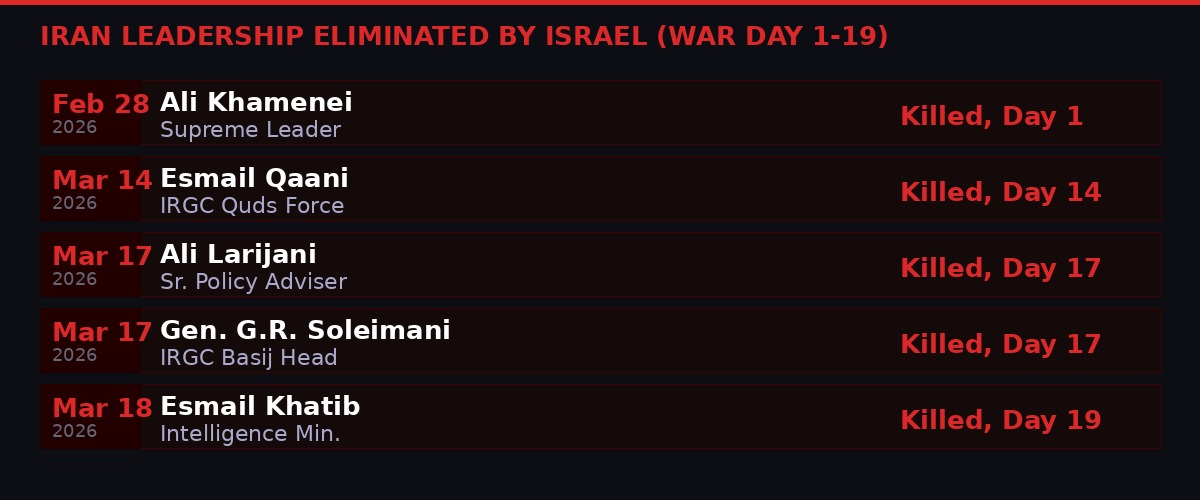
Iranian officials and commanders killed by Israeli strikes since the war began February 28. Source: AP.

Israel's targeting of Iranian commanders has accelerated dramatically in week three of the war. (Pexels)
Wednesday's killing of Iranian Intelligence Minister Esmail Khatib extended a pattern that has no modern precedent: the systematic elimination of a functioning government's leadership structure while that government continues to wage war. In nineteen days, Israel has killed Iran's supreme leader, the Quds Force commander, a senior presidential adviser, the head of the IRGC Basij paramilitary force, and now the intelligence minister.
The day before, Israel killed Ali Larijani - a senior policy adviser to the late Supreme Leader Ali Khamenei on strategy in nuclear talks with the Trump administration - and General Gholam Reza Soleimani, head of the Basij force. The Basij is Iran's domestic security and mobilization arm, responsible for suppressing internal dissent and organizing volunteer fighters.
Following Larijani's death, the new Supreme Leader Ayatollah Mojtaba Khamenei - the younger son of the late Ali Khamenei, who was himself killed on the first day of the war - issued a written statement that Iranian media described as unusually direct. "Undoubtedly, the assassination of such a person shows the extent of his importance and the hatred of the enemies of Islam towards him," the statement said. The statement, while framed as a condolence, was read by analysts as a signal that major retaliation is being prepared.
Israeli Defense Minister Israel Katz, responding to the kills, promised "significant surprises" to come. The Israeli posture reflects a calculated bet: that decapitating Iran's decision-making capacity faster than Tehran can adapt will eventually produce either a collapse of the war effort or a negotiated exit. So far, that bet is not paying off on any visible timeline.
Iran's Revolutionary Guard responded to Larijani's killing by announcing it had attacked central Israel with multiple-warhead missiles specifically designed to penetrate missile defense systems by releasing a cluster of munitions in flight. AP journalists on the ground filmed at least one such missile dispersing its payload over Israel. Two people were killed near Tel Aviv in Wednesday's strikes.
The Hormuz Chokehold: No Exit in Sight

Tanker traffic through the Strait of Hormuz has collapsed since the war began. (Pexels)
The Strait of Hormuz - an 8-mile-wide chokepoint at the mouth of the Persian Gulf through which one-fifth of the world's traded oil normally flows - has been functionally closed to Western-aligned shipping since the first week of the war. Iran has deployed a combination of sea mines, armed fast boats, and drone swarms to make transit lethally dangerous for tankers with ties to the U.S. or its allies.
A handful of ships have gotten through. Some Iranian vessels. Vessels from India, Turkey, and a few other non-aligned countries have managed passage. Iran insists the strait is open - just not to the U.S. or countries it considers hostile. In practice, the risk profile for most commercial shipping remains prohibitive.
Trump posted on social media Tuesday: "WE DON'T NEED THE HELP OF ANYONE!" - a defensive reaction to the fact that no U.S. ally has offered to join a military operation to reopen the waterway. Britain's Armed Forces Minister Al Carns said Wednesday that any reopening of the strait was "a long way off" because of what he called "asymmetric threats" including mines, attack boats, and drones.
The Trump administration has been pressing China to help reopen the strait. Beijing's response has been, in the diplomatic language of its Foreign Ministry, "a nonanswer" - a call for "parties to immediately stop military operations" that commits China to nothing. Analysts at the International Crisis Group have been blunter. "A show of U.S. force that was meant to intimidate Beijing has instead served to puncture the illusion of U.S. omnipotence," said Ali Wyne, senior research and advocacy adviser at the ICG. "Unable to reopen the Strait of Hormuz alone, Washington now needs its principal strategic competitor to help it manage a crisis of its own making."
Trump's planned state visit to Beijing, originally scheduled for March 31, has been postponed. China has indicated willingness to reschedule. Both governments appear relieved by the delay - the U.S. because it is hard to conduct a state visit while managing active military operations, and China because more time allows it to better understand what Trump wants and continue expanding its regional influence through its competing diplomatic track.
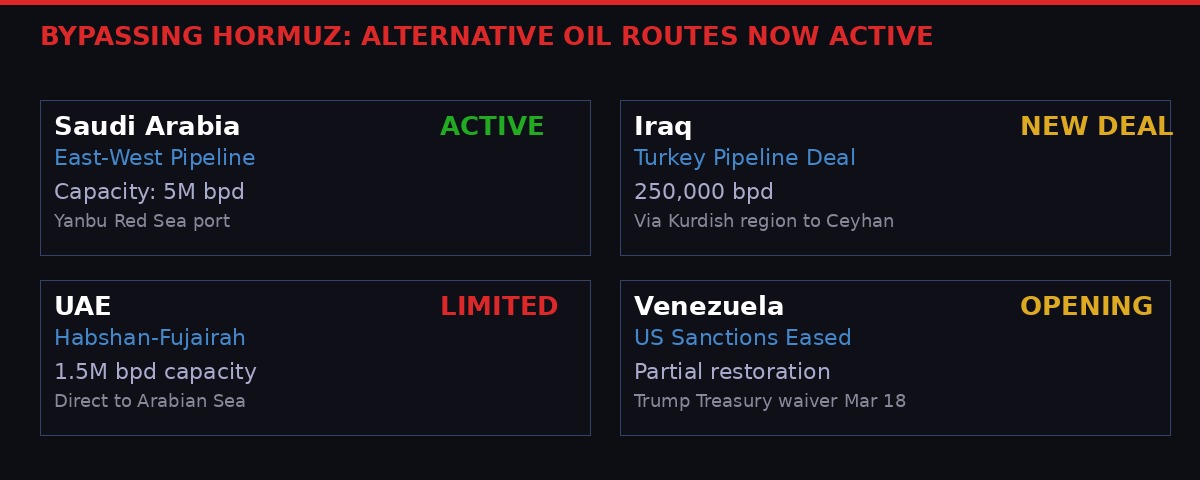
Alternative oil export routes being activated as Hormuz remains blocked. Sources: AP, Reuters reporting.
The Global Energy Shock: Prices, Pipelines, and Panic
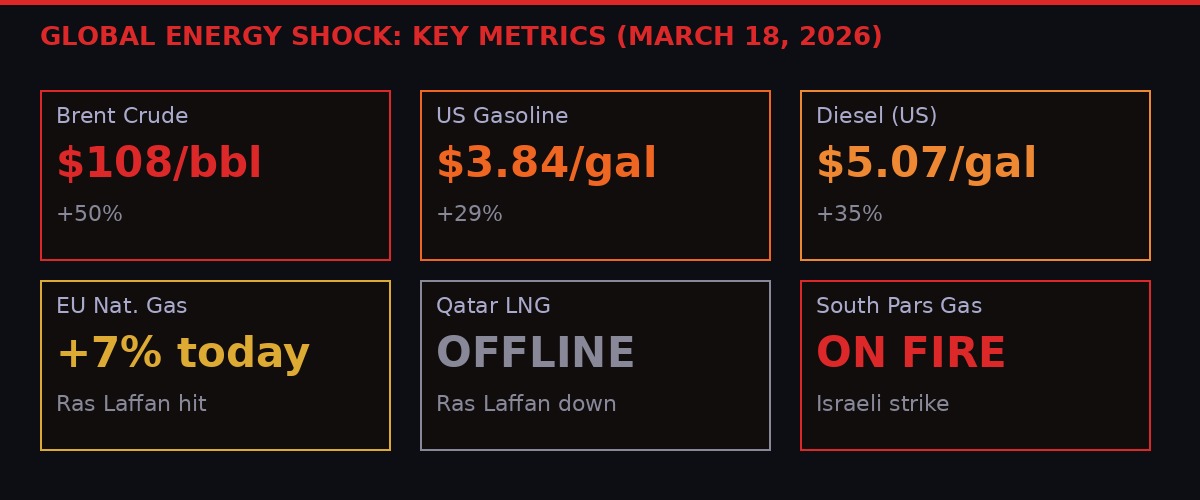
Key energy price metrics as of March 18, 2026. Sources: AAA, AP markets reporting, ICE/CME data.

American consumers face the highest gas prices since September 2023. (Pexels)
The energy shock is no longer abstract. At a gas station in Mississippi, a woman named Thelma Williams exclaimed in shock when her meter hit more than $60 for a tank. "I would love to see the war end," she told AP. "I would love to see the gas prices go down because everybody might not be financially able to meet the demands of these high prices." Williams is a veteran who served in the Army Reserves as a medic.
The U.S. national average for regular gasoline hit $3.84 per gallon Wednesday, according to AAA - up from $2.98 before the war started. Diesel hit $5.07 per gallon, its highest since 2022, up from $3.76 per gallon in late February. For trucking, logistics, and anyone who moves goods across the country, the costs are compounding daily.
In Europe, natural gas prices jumped 7% on Wednesday alone on news of the South Pars attack - not because Iran exports gas to Europe directly, but because the global LNG market operates as a single interconnected pool. When Qatar's Ras Laffan goes offline and South Pars burns, every buyer competing for scarce cargoes pays more.
Retail chains and consumer goods companies have begun warning of price increases. The National Retail Federation said consumer spending is showing strain. Oil at $108 a barrel eventually becomes more expensive clothes, food, and freight at every step of every supply chain.
The Trump administration is scrambling for relief valves. The Treasury Department announced Wednesday that it was easing sanctions on Venezuela, saying U.S. companies would be allowed to do business with the country's state-owned oil and gas company PDVSA. Venezuela has the world's largest proven oil reserves and produced around 900,000 barrels per day before the heaviest sanctions bite. The waiver is a measure of desperation - Venezuela's oil industry has been so degraded by years of sanctions and mismanagement that ramping production meaningfully will take months, if not years.
Saudi Arabia is routing some of its oil production via pipeline across the country to the Red Sea port of Yanbu, bypassing Hormuz entirely. Iraq announced Wednesday that it has struck a deal with the Kurdish Regional Government to begin exporting 250,000 barrels per day via pipeline through Turkey to the Mediterranean port of Ceyhan. Both are meaningful but partial fixes for a market that has lost access to millions of barrels of daily flow.
The Federal Reserve's Worst-Case Scenario

The Federal Reserve concluded a key policy meeting Wednesday, choosing to hold rates unchanged. (Pexels)
The Federal Reserve held its benchmark interest rate unchanged Wednesday after concluding a key policy meeting - the only decision it could make given the circumstances. The Iran war has handed the 12-member rate-setting committee led by Chair Jerome Powell a scenario that central bank models struggle to process cleanly: a supply-side inflation shock hitting simultaneously with rising recession risk.
The logic of the bind is straightforward. Higher oil prices push up inflation, which normally demands that the Fed keep rates high or raise them further. But if the oil spike is severe and sustained enough to kill consumer spending and business investment, the economy may require rate cuts to avoid a sharp downturn. The Fed cannot do both at once.
"With Iran and the oil shock, I think the committee's room for maneuver here is pretty limited. I think they've got to wait and see how this plays through." - Nathan Sheets, chief global economist at Citi and former senior Fed economist, to AP
In December, the Fed had forecast inflation cooling to 2.6% by end-2026 and one interest rate cut during the year. That baseline is now shattered. Core inflation - excluding food and energy - was already running at 3.1% in January before the war started, the biggest increase in more than two years. With oil adding to the pressure, economists like Tim Duy of SGH Macro are now forecasting core inflation to hit at least 2.8% by year-end. Many economists project the first rate cut now no earlier than September.
For ordinary Americans, this means high borrowing costs for mortgages, auto loans, and credit cards remain in place through the summer at minimum. The compounding effect - high gas prices, high inflation, high interest rates, tariff pressures already in the pipeline from Trump's trade policy - is building a significant consumer squeeze heading into the second half of 2026.
Trump, who once made low gas prices a centerpiece of his economic messaging, has pivoted to a new argument. "When oil prices go up, we make a lot of money," he said last week, pointing to the U.S. position as the world's largest crude producer. Oil companies and drilling towns in Texas and the Gulf states are indeed seeing an investment surge. But the distribution of those gains is sharply unequal - and voters in Mississippi gas stations and Pennsylvania truck stops are not feeling them.
The War's Geopolitical Fallout: Allies Missing, China Watching

The war is reshaping global power alignments in real time. (Pexels)
Three weeks into the war, the U.S. has failed to assemble any meaningful coalition. No major ally has offered military assets to reopen the Strait of Hormuz. The UK has deployed 200 personnel near Bahrain and has HMS Prince of Wales on standby but has declined to join offensive operations. France, Germany, and the rest of NATO are watching from the sidelines - unwilling to commit to a war they were not consulted about and do not believe was strategically necessary.
The military math is increasingly unfavorable. The U.S. has shifted significant assets from the Indo-Pacific - Marines, anti-missile defense systems - to the Middle East theater. Zack Cooper, a senior fellow at the American Enterprise Institute, told AP: "The longer this war continues, and the more forces that are shifted out of Asia, the more it will feed Asian allies' concerns about U.S. distraction and resource constraints."
Taiwan is explicitly watching. Trump's postponement of the Beijing summit potentially delays any arms sales to the island aimed at deterring Chinese pressure. Beijing, which has vowed to take Taiwan by force if necessary, is under no obligation to accelerate any timeline while the U.S. is busy elsewhere.
China's diplomatic positioning has been methodical. While refusing to help the U.S. reopen Hormuz, Beijing delivered $200,000 in humanitarian aid to Iran via the Red Cross - specifically for families of children killed in the Israeli bombing of the Shajarah Tayyebeh elementary school in Minab. The Chinese ambassador publicly condemned the school attack. China is running a parallel diplomatic track in the Middle East, positioning itself as the constructive peace broker while the U.S. is the belligerent.
Iran's Gulf neighbors - Saudi Arabia, the UAE, Qatar, Kuwait, Bahrain, and Oman - are in an increasingly uncomfortable position. They are absorbing Iranian missile and drone attacks on their energy infrastructure despite not being parties to the war. Saudi Arabia's Eastern Province, home to the bulk of its oil fields, was struck again Wednesday. These countries have privately urged Washington to seek a ceasefire while publicly attempting to maintain neutrality that Iran is not respecting.
Timeline: Nineteen Days That Reshaped the World
What Comes Next: The Escalation Ladder Has More Rungs

The conflict is entering a new and potentially more destructive phase. (Pexels)
The South Pars strike is a qualitative change in the nature of the conflict. Previous Israeli strikes hit military assets, command nodes, leadership figures, and export infrastructure. South Pars is domestic civilian energy supply. Hitting it means accepting that Iranian civilians - already under pressure from sanctions, economic collapse, and wartime disruption - will suffer power cuts and heating shortages in the weeks ahead.
Iran's response options remain substantial. The country still possesses a significant ballistic missile arsenal, drone production capacity, and the ability to direct Hezbollah, the Houthis, and other proxy forces in ways that have only been partially activated. The multi-warhead missile technology demonstrated Wednesday - releasing clustered munitions in mid-flight to defeat iron dome-style intercept systems - represents a meaningful escalation in technical capability that Israel's defense establishment will need time to develop countermeasures for.
The new Supreme Leader's statement signals that the Iranian system, despite losing its founder and multiple top officials in nineteen days, has not collapsed into paralysis. It has instead accelerated into a mode of existential resistance in which the normal calculation of costs versus benefits has been suspended. This is not an adversary looking for an off-ramp. It is one looking for a weapon capable of changing the terms of the war.
For global markets, the path forward is treacherous. At $108 a barrel, oil is already high enough to significantly damage consumer spending and industrial activity in Europe and Asia. If South Pars infrastructure is seriously damaged and Iran follows through on threats to escalate attacks on Gulf energy facilities, the next price level is not $115 or $120. It is the level where major importers - Japan, South Korea, India, China, Germany - face genuine supply shortfalls, not just expensive supply.
The Venezuela sanctions waiver is a first-order emergency measure. Saudi Arabia's East-West pipeline and Iraq's Turkey pipeline deal are meaningful but slow to ramp. The U.S. strategic petroleum reserve has been drawn on but is finite. There is no quick fix that replaces the volume of oil and LNG that the Strait of Hormuz normally carries. The world built its energy infrastructure around that assumption of open passage, and dismantling it even temporarily has costs that accumulate by the day.
In Washington, the political pressure is building. Trump's coalition includes suburban voters who care intensely about gas prices and agricultural communities whose input costs are rising fast. The "we make money when oil is high" argument may hold in Lubbock, Texas. It is less convincing in the swing districts of Pennsylvania and Michigan that decide presidential elections.
The question now is not whether a diplomatic opening exists. Multiple channels remain - European backchannel contacts, Turkish mediation offers, Omani proximity talks - all running at low intensity. The question is whether anyone with real authority on either side has the political standing to reach for one while missiles are still in the air over Tel Aviv and fires burn on the Persian Gulf coast.
The answer, on Day 19, is no.
Get BLACKWIRE reports first.
Breaking news, investigations, and analysis - straight to your phone.
Join @blackwirenews on Telegram