Israel Kills Iran's Top Nuclear Scientists: Netanyahu Claims Atomic Program Decapitated in Fresh Tehran Strikes
Israeli Prime Minister Benjamin Netanyahu announced Thursday that Israeli airstrikes have killed Iran's leading nuclear scientists - a potentially decisive blow to Tehran's weapons program, landing hours after Iran's new and secretive supreme leader Mojtaba Khamenei broke his silence with a defiant public statement vowing to press on with the fight.
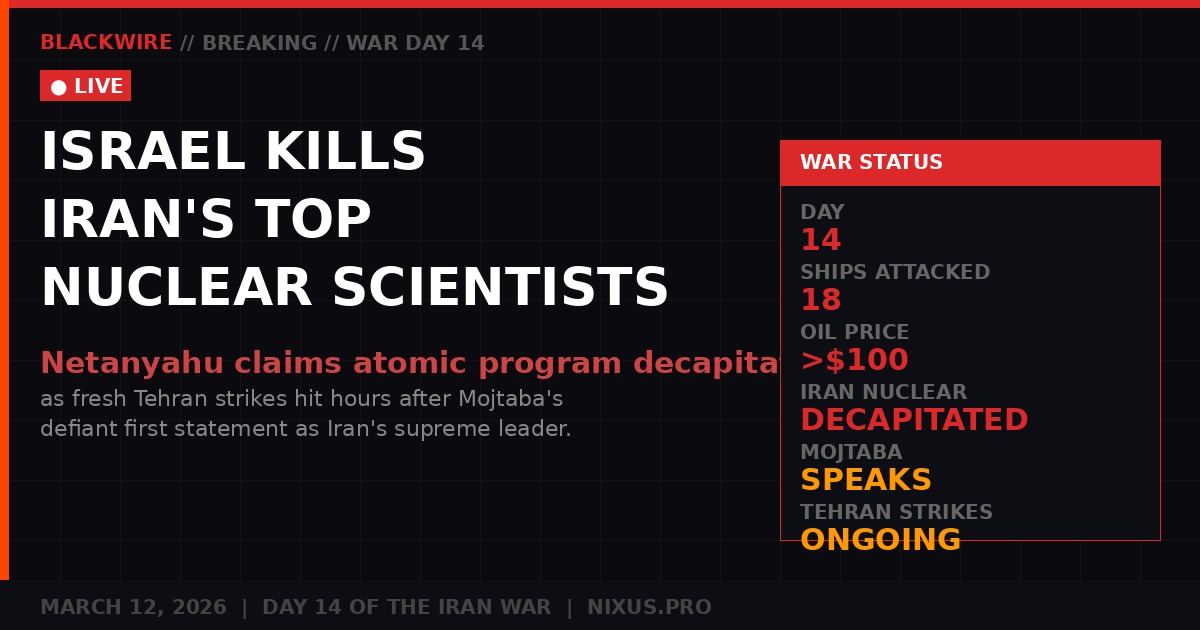
Day 14 of the Iran war brings its most strategically significant development yet: the reported elimination of Iran's top nuclear scientists. // BLACKWIRE
The Strikes and the Claim
Thursday evening, as darkness settled over Tehran and sirens cut through neighborhoods already hollowed by two weeks of war, Benjamin Netanyahu made a statement that reverberated from Washington to Beijing: Israeli airstrikes had killed Iran's top nuclear scientists.
The Associated Press confirmed the claim was being treated as live breaking news as of 8 PM Central European Time on March 12. Netanyahu offered no names, no targeting coordinates, no timeline of the strikes. What he gave the world was a declaration of strategic intent made real - that Israel had not merely been suppressing Iran's missile batteries and air defenses. It had been hunting the people who built them, and specifically the people who might build what came next.
The announcement transformed the nature of the war in a single sentence. For thirteen days, the conflict between the US-Israel coalition and Iran had been understood primarily as an air campaign to suppress Iran's conventional military capabilities - its missile stockpiles, its naval assets in the Gulf, its air defense radar network. But the targeting of scientists signals something else entirely. This is decapitation of institutional memory. You can rebuild a centrifuge factory. You cannot rebuild a physicist with thirty years of classified knowledge in his head.
Israeli officials in Jerusalem did not provide independent confirmation of which scientists were targeted or the extent of casualties. Iran's state media made no reference to any such deaths as of press time, which is consistent with Tehran's historical practice of suppressing news of its own losses - particularly losses in the nuclear program. It took weeks for Iran to officially acknowledge the 2020 killing of Mohsen Fakhrizadeh, the architect of their weapons-adjacent research, even after global media had confirmed it. (AP, March 12, 2026)
What makes Thursday's claim credible to Western intelligence watchers is its timing. The strikes arrived within hours of Mojtaba Khamenei issuing his first public statement since being appointed supreme leader - a moment of maximum Iranian political visibility, when every intelligence apparatus in the region would have been tracking movements of regime-linked figures.
What We Know - March 12, 9 PM
- Netanyahu claims Israeli strikes killed Iran's "top nuclear scientists" - AP running LIVE
- Fresh Israeli strikes hit Tehran hours after Mojtaba Khamenei's first statement
- Mojtaba's statement was read by an Iranian state TV presenter - he has not appeared in public
- Iran's new leader vowed to "keep up attacks" against US-Israeli coalition
- 18 ships total attacked in Gulf since February 27 start of war
- UK troops at Iraq base confirmed they shot down two Iranian drones overnight
- California governor issued warning over possible Iran drone attack on US soil
- Michigan synagogue attacked by vehicle-ramming - suspect killed by security
Iran's Nuclear Brain Trust: A Decades-Long Hunt
Israel's campaign against Iran's nuclear scientists predates this war by fifteen years. The shadow war over Tehran's atomic ambitions has been running through assassinations, sabotage, and cyberattacks since at least 2010 - and Thursday's claim suggests it has now entered its most lethal phase.
The most famous casualty of this campaign before 2026 was Mohsen Fakhrizadeh, killed in November 2020 in what Iranian officials called an Israeli operation. Fakhrizadeh had led the AMAD Program - Iran's covert nuclear weaponization effort - for decades. His name appeared in a 2015 United Nations report as a key figure the IAEA wanted to interview. He never gave that interview. A remote-controlled machine gun mounted on a truck killed him on a highway outside Tehran. The killing was attributed to Mossad.
After Fakhrizadeh, the question Western intelligence agencies obsessed over was: who were his lieutenants? Who had inherited the institutional knowledge? The Atomic Energy Organization of Iran (AEOI) is not a transparent institution. Its senior figures do not give press conferences. Many operate under cover identities or are known only to Iranian state security.
Thursday's claim by Netanyahu - that multiple "top" scientists have now been killed - suggests Israel believes it has gone further down that list than ever before. The combination of the air campaign, which has provided unprecedented access to Iranian territory, and the ground-level intelligence Israel and its partners have gathered over the preceding days has apparently allowed for precision targeting of people, not just buildings.
The strategic implications are staggering. Iran's nuclear program has survived sanctions, sabotage, assassinations, and cyberattacks. It survived Stuxnet. It survived Fakhrizadeh. But there is a limit to institutional resilience when you lose the senior researchers who carry the most sensitive technical knowledge. A facility can be rebuilt in five years. The people who understood the exact specifications of the implosion lens designs, the metallurgical properties of the weapons-grade material, the precise mathematics of the detonation sequencing - they cannot be replaced on the same timeline.
Netanyahu knows this. The announcement was not merely a military update. It was a message to Iran's leadership - including Mojtaba Khamenei, who has been presumed by Western analysts to be a strong advocate for the nuclear program - that the war is being fought on a level that transcends conventional military exchange. (AP, Reuters, historical context via IAEA reports)
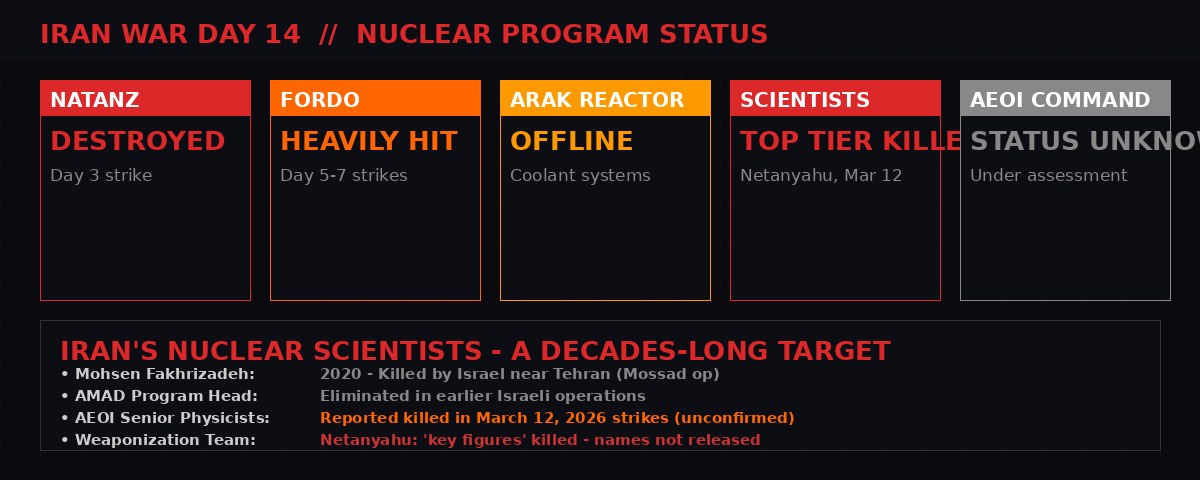
Iran's nuclear infrastructure has been under sustained assault since the first strikes on February 27. The killing of key scientists on Day 14 represents a shift from targeting facilities to targeting human capital. // BLACKWIRE
Mojtaba's Defiant First Words - And Israel's Response
The sequence of events on Thursday is striking in its own right. First came the statement. Then came the bombs.
Iran's new supreme leader - Mojtaba Khamenei, 56, the son of the late Ali Khamenei, elevated to the position in the chaotic days after his father's death in the opening phase of the war - broke his silence on March 12. The statement was not delivered in person. It was read aloud by a presenter on Iranian state television, marking Mojtaba's first public communication since being appointed. He has not been seen in public since taking power. (BBC, March 12, 2026)
The content of the statement was defiant to the point of recklessness. Mojtaba vowed that Iran would "keep up attacks" against its enemies. He gave no ground on the Strait of Hormuz, which Iran has been using as a chokepoint to weaponize global energy markets. He made no gesture toward negotiation.
"Iran's secretive top leader vows to keep up attacks in his first statement since being appointed." - AP News headline, March 12, 2026
The statement confirmed two things Western analysts had been uncertain about. First, that Mojtaba is actually exercising power - or at least that elements of the Iranian state are using his name to project continuity of leadership. Second, that the new leadership has chosen confrontation over any hint of off-ramp.
Israel's response, according to the BBC's live blog, was to launch fresh strikes on Tehran "hours after" the statement was released. The timing suggests Israeli intelligence was watching for exactly this moment - a window when Mojtaba's statement would draw out regime-connected figures or when the coordination required to produce and distribute the statement would concentrate key people in communication nodes that Israel had already mapped.
Whether the nuclear scientists were killed in strikes connected to this sequence, or in separate operations targeting known locations, is not yet clear. What is clear is that Thursday represents the most politically charged day of the war since the opening hours on February 27. A new supreme leader speaks for the first time. Within hours, his country's top nuclear scientists are reportedly dead.
The symbolism is not lost on anyone. Mojtaba has been characterized by former Iranian officials and Western intelligence analysts as among the most hawkish figures in the regime on the question of nuclear development. If Israel's goal is to ensure that Iran cannot reconstitute a weapons-capable program after this war ends, killing the scientists is the most direct path. And doing it on the day the new leader announces defiance sends a message that transcends military calculation. (BBC, AP, Reuters)
Day 14: War Expands on Every Front
The nuclear scientists story is the headline, but it sits atop fourteen days of relentless escalation across multiple theaters simultaneously. Thursday's full picture is almost overwhelming in its scope.
Israel resumed bombing Beirut's southern suburbs after Hezbollah launched a rocket barrage into northern Israel. Some of the Israeli strikes hit other parts of the Lebanese capital. At least eight people were reportedly killed along the seafront - a grim echo of scenes from previous Lebanon conflicts. The Beirut front, which had seemed like it might remain secondary to the main Iran theater, is reopening with fresh ferocity. (BBC, March 12, 2026)
In Iraq, British Defence Secretary John Healey confirmed that UK troops stationed at a base in Iraq shot down two Iranian drones overnight. The confirmation marks the first explicit acknowledgment that British forces have been directly engaged in Iran's drone campaign - not merely present in the region, but actively fighting. (BBC, March 12, 2026)
Iran's own offensive operations are intensifying rather than diminishing despite the losses. Reports from the Gulf on Thursday cited Iranian attacks on two foreign fuel tankers near Iraq, in Bahrain, and around Oman. This pattern - broader geographic spread, targeting civilian shipping rather than just military assets - suggests Iran's operational commanders are trying to demonstrate that they can still project power even as their country absorbs punishment from above.
Trump held a press briefing Thursday and said the war would be over "very soon" but "not this week." He described the operation as a "tremendous success" and said he wants to ensure Iran cannot develop nuclear weapons - a statement that takes on pointed new meaning given the same-day claim that Netanyahu just killed the scientists who were the closest thing Iran had to a nuclear weapons program leadership.
The Pentagon, meanwhile, confirmed it has blocked photographers from attending Hegseth's briefings on the Iran war - a move that has infuriated press freedom advocates and prompted questions in Congress about what is being hidden. Democrats have separately written to Hegseth demanding answers about whether the US was responsible for the Minab school strike that killed 168 people, including 110 children, on February 28. Questions about that strike - the most morally contested episode of the war so far - have not gone away. (AP, BBC, March 12, 2026)
The Gulf Shipping Crisis: 18 Ships, $100 Oil, No End in Sight
The economic pressure created by Iran's campaign in the Strait of Hormuz has now reached a threshold that is distorting global markets in ways that may outlast the war itself.
The BBC's live tracker confirmed that 18 ships have been attacked in the Gulf since February 27. Six were reportedly attacked in less than 48 hours ending Thursday - the highest concentration of maritime attacks in any single period of the conflict. The cumulative effect is a near-complete paralysis of normal commercial shipping through the world's most critical oil chokepoint. (BBC, March 12, 2026)
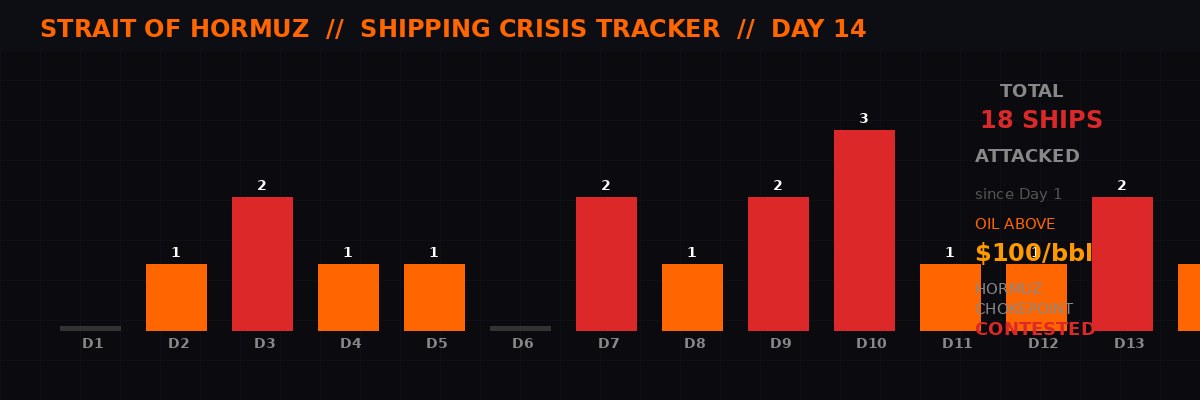
18 ships attacked in the Gulf since the war began February 27. The pace is accelerating even as Iran absorbs heavy losses on land. // BLACKWIRE
Crude oil has held above $100 per barrel since Day 9. The International Energy Agency has declined to release strategic reserves on the scale markets are demanding, partly because the situation remains too volatile for any intervention to have a stabilizing effect. Shipping insurance rates for Gulf transit have become effectively prohibitive for most commercial operators. Vessels that do attempt the passage are doing so with skeleton crews and at severe economic risk.
The human cost of the energy crisis is spreading beyond the Gulf. Britain's government confirmed last week that it had gas reserves for approximately two days in a worst-case scenario - a figure that caused public alarm before being walked back by officials who said it referred to a specific type of storage, not total supply. Europe's dependency on Gulf energy routes, assumed to be manageable through diversification after the Russia-Ukraine war, has proven more brittle than policymakers admitted.
Trump's claim that the war will be over "very soon" has provided markets with brief moments of relief, but the president's credibility on war timelines has been eroding. He made similar statements on Days 7, 9, and 11. The Strait remains contested. Oil remains above $100. The tankers keep getting hit. (AP, IEA statements, Reuters)
Iran's tactic here is a form of economic hostage-taking. Every day that Hormuz remains a contested zone is a day that the global economy sustains damage that no peace agreement can immediately repair. Supply chains have re-routed. Contracts have been broken. Insurance and freight markets have been repriced. Even if a ceasefire happens tomorrow, the financial scars will persist for months.
Iran's police chief added to the internal pressure picture Thursday, warning that anyone who takes to the streets "at the enemy's request" will be treated as an enemy combatant. The statement acknowledges what Iranian officials have tried to deny: that there is a significant segment of the Iranian population that might welcome, or at minimum not mourn, a regime change. The BBC spoke to Iranians crossing into Turkey who described empty streets and a population sheltering in place, uncertain whether to cheer or grieve.
The Home Front: California Alert, Michigan Attack
The war came closer to American soil on Thursday in two separate, disturbing ways.
California Governor Gavin Newsom addressed the public to say there was "no imminent threat" to his state - but that statement only emerged because there had been a warning about a possible Iranian drone attack on California soil. Newsom did not elaborate on the nature of the threat or its source. The California governor's office later said federal authorities had issued the alert and that the situation was being monitored. (AP, March 12, 2026)
The possibility of Iranian drone attacks inside the United States has been treated as a fringe scenario by most analysts since the war began. Iran's demonstrated drone capabilities have been focused on Gulf shipping and regional military targets. But the California alert suggests that US domestic security agencies are taking seriously the possibility that Mojtaba's new leadership - desperate to demonstrate that it can project force - might attempt something on American territory. The IRGC has publicly threatened US interests inside America before, though it has never acted on those threats at scale.
Meanwhile, in West Bloomfield, Michigan - a suburb of Detroit with one of the largest Jewish populations in the United States - an armed man rammed a vehicle into Temple Israel and was fatally shot by security staff. An AP source confirmed the attack. A security guard was injured. Children present at the synagogue were reported safe. (AP, CNN, Detroit Free Press, March 12, 2026)
Police said they were looking for others potentially connected to the attack, suggesting investigators were not treating it as a lone-wolf event. Michigan lawmakers, including Representative Rashida Tlaib, issued statements reacting to the synagogue attack. No motive had been officially confirmed as of press time.
The attack lands in a charged context. Just last week, BLACKWIRE reported that British police arrested an Iranian spy cell that had been conducting surveillance on Jewish institutions and community leaders in London. The MI5 assessment described a systematic effort to identify and potentially harm members of the Jewish diaspora in Western countries. That arrest followed a pattern of Iranian-linked threats against Jewish communities that accelerated after the start of the war.
No confirmed connection between the Michigan attack and Iran has been established. But the convergence of a California drone threat and a synagogue vehicle ramming on the same day - Day 14 of a war in which Iran has been explicit about expanding its target set - will be the subject of intensive federal investigation. The FBI was not publicly listed as involved as of early evening on March 12, but their involvement in any synagogue attack of this nature is standard protocol.
Can Iran's Nuclear Program Survive the Decapitation?
The hardest question Thursday raises is the one that matters most for what comes after: if Netanyahu's claim is accurate, how badly has Iran's nuclear program actually been damaged?
The answer depends on who was killed and what they knew. Iran's nuclear program is compartmentalized by design - a lesson learned from the way Stuxnet and the Fakhrizadeh assassination penetrated earlier security structures. After 2020, the AEOI and the IRGC's nuclear-adjacent units adopted stricter information segregation. No single individual was supposed to carry the entire picture. Knowledge was divided, distributed, and redundant.
But that redundancy has limits. The most senior physicists - the ones who bridged theoretical design with practical engineering, who had worked on the program continuously since the 1990s - are not replaceable through the redundancy protocols designed for middle management. Those individuals, if they are among the dead, represent a generational loss. Iran trained them in the shadow of sanctions, across decades of secrecy. Training their replacements will take time that the Islamic Republic, in its current configuration, may not have.
The parallel to Israel's strategy against Hezbollah's leadership is instructive. For years, Israel assassinated Hezbollah commanders with limited strategic effect because the organization had built robust succession systems. But when Israel killed Hassan Nasrallah and the top leadership tier within days of each other in 2024, the organization entered a period of genuine disorientation. It did not collapse, but it was temporarily unable to coordinate at the level it had previously. Iran's nuclear program does not have Hezbollah's paramilitary resilience - it is fundamentally an intellectual enterprise dependent on specific human expertise.
The counterargument: Iran has already dispersed significant nuclear-related knowledge to hardened underground sites and, according to some Western intelligence assessments, possibly to proxy storage in allied countries. The scientists who are dead cannot share what they knew. But if their work was documented in hardened archives, other scientists - perhaps less senior, perhaps foreign-trained - could eventually reconstruct it. Iran has also been recruiting nuclear expertise through unconventional channels for years. (Historical context via IAEA reports, Bellingcat, Reuters)
What Thursday's claim does, regardless of the precise technical damage inflicted, is change Iran's negotiating position for any eventual peace. If Iran's nuclear program has been set back by five years, ten years, or permanently - that changes what Tehran can plausibly demand in a settlement. It also changes what Israel will accept. Netanyahu has been explicit that his minimum condition for ending the war is a permanent end to Iran's nuclear weapons ambitions. Thursday suggests he may be trying to make that condition a physical reality rather than a diplomatic one.
Trump's War and the Clock That Won't Stop
"Very soon, but not this week." That was Trump's answer Thursday when asked when the war would end. The phrase is becoming a signature of this conflict - optimistic enough to prevent a market panic, vague enough to commit to nothing. (AP, March 12, 2026)
Behind the scenes, the picture is more complicated. The AP reported earlier Thursday, in a separate story, that "outdated intel likely led the US to carry out a deadly strike on an Iranian elementary school" - a story BLACKWIRE has covered in depth. That story has not disappeared. Democrats in Congress have been pressing Hegseth for answers, and the Pentagon's decision to block photographers from Hegseth's briefings is being read as an attempt to control the visual narrative of an operation that is generating serious moral and legal questions.
The war's political costs inside the United States are beginning to register. Oil above $100 means gas prices are climbing toward levels that cause genuine electoral pain for the president's party. Inflation, which had been slowly retreating before February 27, is now trending in the wrong direction. The Fed is in a bind - rate cuts risk adding to inflation, rate holds risk tipping a supply-shock economy into recession.
Iran's sports minister announced Thursday that the country cannot take part in the 2026 World Cup because of US attacks - a statement that reflects the war's reach into every corner of Iranian public life, but also one that Trump addressed directly. He said Iran is "welcome" to be at the World Cup but that it is "not appropriate" for them to be there given the circumstances. The exchange is almost absurd in its normalcy against the backdrop of a war that has killed thousands and destabilized global energy markets.
The California drone threat, the Michigan synagogue attack, the killing of nuclear scientists, Mojtaba's first defiant statement - all of this arrived on a single Thursday in mid-March. The war is not slowing down. It is, by most available measures, still accelerating. Trump says it will be over soon. Netanyahu is killing scientists. And somewhere in Tehran, a new supreme leader who has never been seen in public since taking power is reading a statement of defiance.
Key Events - March 12 (Day 14)
What Happens Now
The pattern of this war - each day producing a development that would have been headline-of-the-year material twelve months ago - shows no sign of breaking on Day 15.
The killing of nuclear scientists, if confirmed by independent sources, will trigger a diplomatic firestorm at the United Nations. Russia and China will call for emergency sessions. European allies, already quietly uneasy about the scope of the US-Israeli campaign, will face renewed pressure from their own publics to distance themselves from operations that now include the targeted killing of academics and scientists, however military-adjacent those scientists were. The legal and moral lines around targeting scientific personnel - even those engaged in weapons-related research - are not clean in international humanitarian law.
Iran's response will be the critical variable. Mojtaba has spoken, and the language he used was not that of a man preparing a ceasefire. But the killing of the nuclear scientists - if he is told that is what happened - changes the calculus. Continuing a war in which your country is losing not just territory and infrastructure but the irreplaceable human knowledge base of your most prized strategic program is a different decision than continuing a war where you still believe you have cards to play.
Mojtaba Khamenei is 56 years old. He was elevated to supreme leader during a crisis, without the years of religious and political preparation his father had. He has never been seen in public since taking the job. He issued his first statement through a television presenter rather than in person. His state television is reporting no dead nuclear scientists. The gap between what his government is telling Iranians and what is actually happening on the ground may be, by now, almost impossible to close.
The war that started on February 27 has, by Day 14, killed an unknown but significant number of people, destabilized global energy markets, brought drone threats to California, triggered a synagogue attack in Michigan, put UK troops in direct combat in Iraq, reopened the Lebanon front, and now apparently killed the scientists who were the guardians of Iran's nuclear future. It will be over very soon. But not this week.
BLACKWIRE will update this report as new information is confirmed. Follow @blackwirenews on Telegram for real-time dispatches.
Get BLACKWIRE reports first.
Breaking news, investigations, and analysis - straight to your phone.
Join @blackwirenews on Telegram