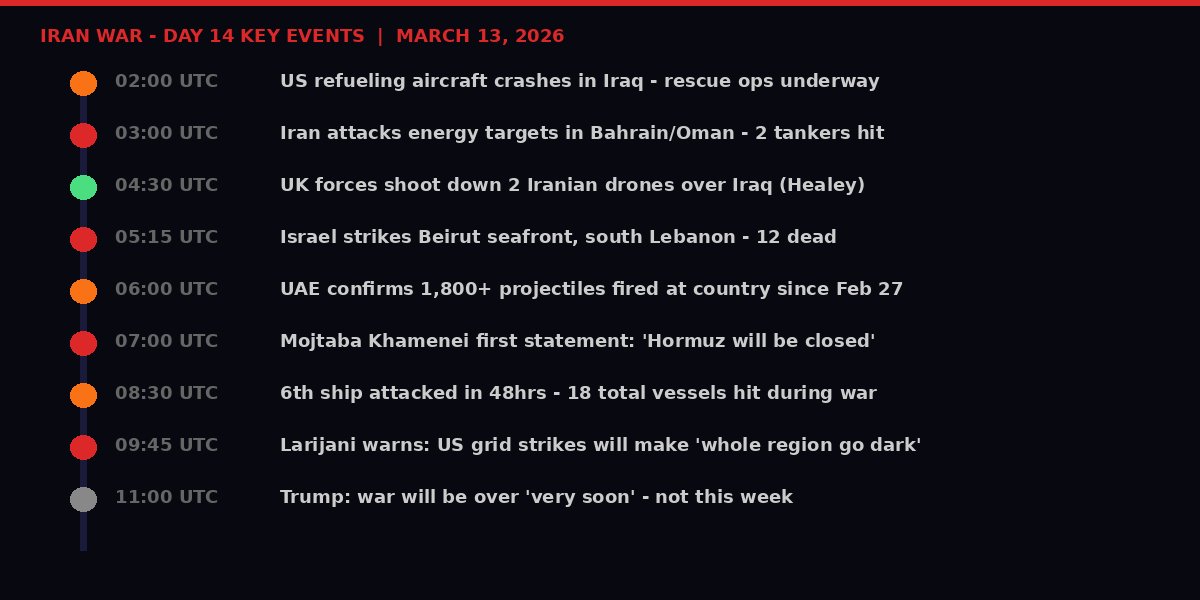
Iran's new supreme leader has spoken for the first time since inheriting a country under bombardment. His message: the Strait of Hormuz will close, US bases will keep taking fire, and the fight continues. Six ships were attacked in the last 48 hours. A US refueling aircraft crashed in Iraq. Israel hit central Beirut. Day 14 of a war with no visible exit strategy on either side.
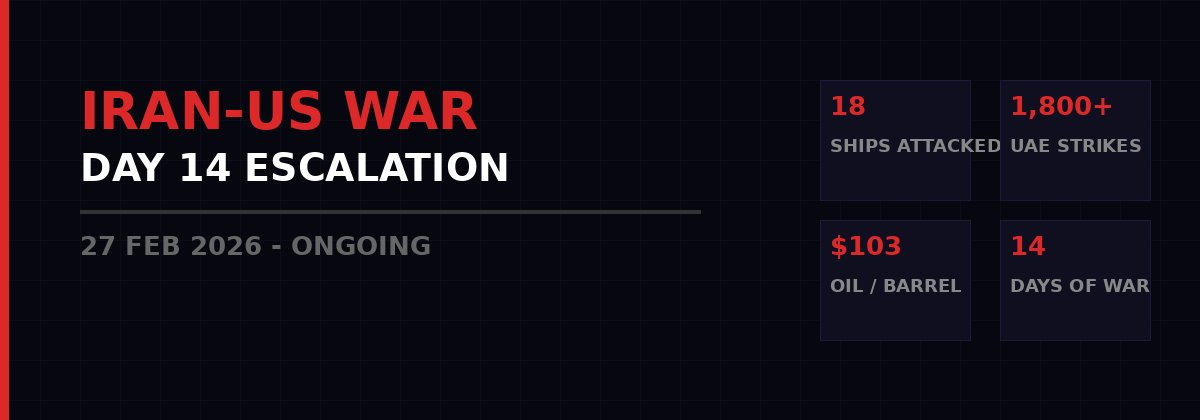
For over a week since Ali Khamenei's death, Iran had a new supreme leader who said nothing publicly. Mojtaba Khamenei - the son of the former supreme leader, installed in an emergency clerical session days after US-Israeli strikes began on February 27 - maintained silence as American aircraft pounded nuclear sites and Israeli jets leveled Revolutionary Guard command posts.
That silence ended on the morning of March 13. A statement attributed to Mojtaba Khamenei, released through Iranian state media and verified by BBC News, carried a message designed to signal continuity, not capitulation.
"The Strait of Hormuz will be closed. US bases across the region remain valid targets. The Islamic Republic does not negotiate with a gun pointed at its head. The aggressor nations have made a grave miscalculation."
The statement - short, precise, deliberately confrontational - answers the question Western analysts have been asking since the leadership transition: would Mojtaba, younger and less battle-tested than his father, blink? The first public answer is no. (Source: BBC News, March 13, 2026.)
What this means operationally is less clear. The Strait of Hormuz has been partially disrupted since the war began, with Iran attacking tankers and threatening naval passage. But a formal declaration of closure - backed by mines, anti-ship missiles, and small boat swarms - would represent a categorical escalation. It would remove approximately 20-21 million barrels of oil per day from global circulation, roughly 21 percent of total world oil trade. (Source: US Energy Information Administration, 2024 data.)
Mojtaba Khamenei, 57, is a cleric with little public profile before this war. He is widely described by Iran analysts as a hardliner, a loyalist to his father's ideology, and someone who built influence through the Basij paramilitary network rather than through formal government channels. The IRGC backed his accession to the supreme leadership post. That backing tells you something about the direction of travel.
Al Jazeera also reported that former Iranian parliament speaker Ali Larijani responded separately to US threats to hit Iran's power infrastructure. His statement was blunter than Mojtaba's carefully worded communique: if the United States targets Iran's electrical grid, "the whole region will go dark." Larijani said this was not a threat but a statement of operational fact - implying Iranian forces have pre-positioned capabilities to strike Gulf state power infrastructure simultaneously. (Source: Al Jazeera, March 12, 2026.)
Together, the two statements constitute Iran's most explicit escalation signaling since the war began. They came as the battlefield itself was delivering its own messages.
The Strait of Hormuz is 33 kilometers wide at its narrowest point. Through that narrow passage flows the bulk of Saudi, Emirati, Kuwaiti, Iraqi, and Qatari oil exports. It is also the transit route for roughly one-third of global liquefied natural gas. There is no viable alternative for most of this volume - the Saudi Petroline pipeline can carry about 5 million barrels per day, a fraction of the strait's flow.
Iran has threatened to close Hormuz in multiple past crises and has never followed through completely. What's different in March 2026 is that Iran has already demonstrated willingness and capability to strike vessels in the strait and in Gulf waters far beyond it. Eighteen ships attacked in 14 days is not a threat - it is an ongoing naval campaign.
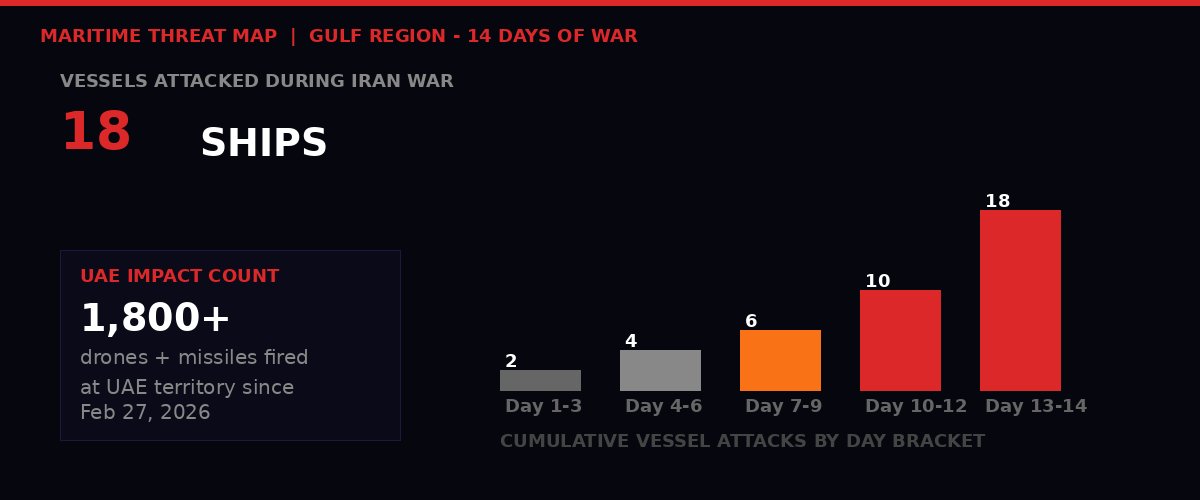
The UAE confirmed this reality with hard numbers on March 13. An Emirati minister told BBC News that more than 1,800 drones and missiles had been fired at the country since the war began on February 27. That figure - 1,800 projectiles in 14 days, averaging 128 per day - makes the UAE the most intensively targeted Gulf state in the conflict. The minister said Iran must end its strikes on the Gulf or the UAE would be forced to formally request NATO Article 5-equivalent protections through bilateral agreements with the US and UK. (Source: BBC News, March 13, 2026.)
The 1,800 figure also speaks to Iranian inventory. Western intelligence estimates before the war placed Iran's stockpile of drones and ballistic/cruise missiles at somewhere between 3,000 and 5,000 deliverable systems. If 1,800 have been fired at the UAE alone - in addition to missiles targeting Saudi Arabia, Kuwait, Oman, Bahrain, and direct US military assets - Iran has burned through a significant portion of its pre-war inventory in two weeks. This creates a strategic paradox: Iran's ability to sustain the pressure at this tempo is time-limited, which is precisely why a Hormuz closure declaration now makes sense. Mining a strait is cheaper than firing missiles indefinitely.
Oil markets responded immediately to Mojtaba's statement. Brent crude climbed to $103 per barrel by mid-morning European trading on March 13, adding $4 in a single session. (Source: AP News, March 13, 2026.) The $100 psychological threshold has now been breached multiple times and is holding as a floor rather than a ceiling.
Iran's 1,800-projectile figure at the UAE alone suggests cumulative Gulf state strikes are approaching or exceeding 4,000 total. Pre-war inventory estimates placed Iran's full stockpile at 3,000-5,000 systems. At current burn rate, Iran's long-range strike capacity may degrade significantly within 30-45 days - which explains the push for a Hormuz mining declaration now.
Six vessels were attacked in Gulf waters in a 48-hour window ending on the morning of March 13. That brings the total number of ships struck during the 14 days of war to 18 - roughly one vessel hit per day, with the rate accelerating in the second week. (Source: BBC News tracking report, March 13, 2026.)
The attacks in the latest 48-hour window were concentrated near Iraqi waters and around Bahrain and Oman. Two of the six were described by BBC News as "foreign fuel tankers" - meaning flagged by non-regional nations, with non-Iranian, non-American crews aboard. The nationalities of the affected vessels and their crews were not immediately released, though AP News reported that rescue efforts were underway for at least one ship with casualties.
A BBC News tracker published on March 13 showed the geographic spread of the 18 attacks: six in the approaches to the Strait of Hormuz, five in the central Gulf, four near Bahraini waters, two near Oman's coast, and one in waters adjacent to Iraq's Faw Peninsula oil terminal zone. The pattern suggests Iran is deliberately targeting the distribution network rather than production infrastructure - the oil gets pumped, but it cannot move.
For sailors aboard civilian vessels currently in the Gulf, the BBC reported conditions that defy easy categorization. A correspondent speaking to crew members described the experience as "drones, cruise missiles, and fighter jets as a common sight" for ships that cannot leave due to contracts, insurance freeze-outs, and port closures. One mariner's quote captured the situation: "There's no hiding place on a ship." (Source: BBC News, March 13, 2026.)
The maritime insurance industry has effectively suspended normal coverage for Gulf transits. Lloyd's of London and the International Group of P&I Clubs have not formally declared the Gulf a war zone in the insurance legal sense - which would void virtually all existing cargo and hull coverage - but premiums have risen 800-1,200 percent for vessels willing to transit. Most shipping companies have suspended operations. The ones still running are either state-owned vessels from non-aligned nations, energy companies with contractual obligations, or operators willing to accept the premium. An estimated 40 percent of pre-war Gulf shipping volume has stopped or rerouted via the Cape of Good Hope - adding 10-12 days to transit times. (Source: Industry reports, Lloyd's Market Association, March 2026.)
The six latest attacks also represent a tactical shift. In the first week of the war, most maritime strikes targeted vessels linked to Israeli or American commercial interests. In the second week, the targeting has expanded to include ships carrying fuel for Gulf state militaries and civilian electrical generation. Hitting those tankers does not just raise oil prices - it starts to affect the ability of Gulf states to keep their own lights on and their own air defense systems powered. This aligns with Larijani's "whole region goes dark" threat: it may not require direct grid strikes if the fuel supply to power plants can be severed at sea.
Early on the morning of March 13, the US military confirmed that a refueling aircraft had gone down in Iraq. Rescue efforts were underway, with the military declining to provide immediate details on crew numbers or status. The statement released by US Central Command specified, explicitly, that the aircraft was "not brought down by hostile fire or by friendly fire." (Source: AP News, BBC News, March 13, 2026.)
That carefully worded clarification - unprompted and immediate - is standard practice when an aircraft goes down in a combat zone and the military wants to prevent a hostile attribution narrative from forming before facts are established. In practical terms, it means the preliminary assessment is mechanical failure, pilot error, or environmental conditions. It does not mean the investigation is complete.
The type of aircraft was not officially confirmed. The US operates KC-135 Stratotankers, KC-46 Pegasus tankers, and MC-130 variants in the region - all capable of aerial refueling missions. Refueling aircraft are among the most operationally critical platforms in a sustained air campaign of this kind; losing one affects sortie rates for strike aircraft operating from distant carriers or airbases. They are not combat aircraft - they do not carry weapons - but they are mission-enabling infrastructure.
Iraq is complicated terrain for this war. US forces maintain a reduced presence at Al Asad Air Base and other Iraqi installations under a 2024 security cooperation framework. Iraqi militia groups aligned with Iran - particularly Kataib Hezbollah and the Islamic Resistance in Iraq - have conducted drone and rocket attacks on US positions since the war began, though CENTCOM has not publicly attributed major damage to those attacks. The Iraqi government, meanwhile, is caught between its formal security partnership with the United States and its deep political, economic, and religious ties to Iran. Prime Minister Mohammed Shia' al-Sudani has called for a ceasefire repeatedly and has not publicly authorized the use of Iraqi airspace for strike operations - though strike operations have been conducted from or through Iraqi-adjacent airspace regardless.
The crash adds to a casualty picture that has remained deliberately opaque in American official communications. CENTCOM has confirmed deaths among US personnel in the theater but has not provided a comprehensive accounting. Independent tracking by military analysts at the Costs of War Project and the Stimson Center suggests US military fatalities from all causes - combat, accidents, and medical emergencies - have reached into double digits. (Source: Costs of War Project, Brown University, March 2026.) The crash in Iraq will add to that count depending on rescue outcomes.
Israel expanded its military campaign into Lebanon dramatically in the 24 hours before March 13 morning. Following a Hezbollah rocket barrage into northern Israel, Israeli jets struck suburbs south of Beirut and conducted what the Israeli military described as precision operations against Hezbollah command infrastructure in south Lebanon. Twelve people were killed along the Beirut seafront in what witnesses described as strikes hitting a commercial district in central Beirut - not a Hezbollah-controlled zone. (Source: BBC News, Al Jazeera, March 13, 2026.)
The expansion into central Beirut is a significant escalation from Israel's earlier Lebanon strikes, which were largely confined to the Dahieh suburb (a Hezbollah stronghold south of the city) and to southern Lebanese villages. Hitting the seafront kills civilians in an area populated by middle-class Lebanese families, international hotel guests, NGO workers, and foreign correspondents. It also hits the economic arteries of a country that has been in financial crisis since 2019 and barely survived the 2020 port explosion.
"We visited the city of Nabatieh - we witnessed the pace and scale of Israel's bombing. Every ten minutes, a new column of smoke." - BBC correspondent, south Lebanon, March 13, 2026.
The Lebanese Health Ministry confirmed 12 dead and over 40 wounded from the seafront strikes. The Israeli military said it was targeting Quds Force operatives who had relocated to the area - a characterization Iran immediately rejected, calling the dead "diplomats." This dispute over victim identity mirrors the pattern established in Gaza, where Israeli claims of targeting militants and casualty counts from health authorities diverge systematically.
Hezbollah's rocket barrage - the trigger for the Israeli response - was itself a response to Israeli strikes on Dahieh that killed several senior Hezbollah military commanders earlier in the week. The escalation loop is running: each strike provokes a response which provokes a further strike. The Lebanese armed forces have remained out of the fighting. The Lebanese government has made ceasefire appeals to the United Nations Security Council, which has been unable to pass a binding resolution due to American and Israeli vetoes of draft texts.
Iran's involvement in Lebanon has grown since the war started. Intelligence reports cited by Reuters in early March indicated that IRGC Quds Force officers were embedded with Hezbollah units to improve rocket and missile targeting. That claim is consistent with the pattern of escalating accuracy in Hezbollah's longer-range strikes on Israeli population centers. (Source: Reuters, March 8, 2026.)
The opening of the Lebanon front stretches Israeli air defense resources and creates geographic pressure from multiple directions simultaneously: Iran in the east, Hezbollah in the north, and residual Hamas cells in Gaza in the south. Israeli air defense batteries have been operating near capacity, and the monthly burn rate for Tamir interceptors (Iron Dome missiles) has reportedly exceeded pre-war production rates, creating a slow depletion dynamic that Israel's defense industry is racing to address. (Source: Defense News, March 2026.)
UK Defence Secretary John Healey confirmed to the House of Commons on March 13 that British forces based in Iraq had shot down two Iranian drones overnight. The confirmation was notable for its specificity - Healey named the location (British-operated facilities in Iraq), the weapon type (drones), and the outcome (both destroyed). He did not specify casualties or system damage from the drones before interception.
British forces in Iraq operate under a different mandate than US forces. The UK mission is technically a training and advisory operation supporting the Iraqi Security Forces. Shooting down Iranian drones over Iraqi territory is a defensive act, but it also represents British forces taking direct kinetic action against Iranian military assets - a significant threshold. The UK has been involved in the wider coalition campaign through HMS Prince of Wales operations in the Arabian Sea and through logistics and intelligence support, but this is among the first confirmed direct UK-Iran engagements.
The British government's position on the Iran war has been cautious. Healey and Prime Minister Rishi Sunak have expressed support for the US-Israeli campaign's stated objective of preventing Iranian nuclear weapons development but have stopped short of committing British strike aircraft to offensive operations. The drone shootdown forces a more direct accounting of British exposure to the conflict - and raises the question of whether British personnel in Iraq are now legitimate targets under Iranian targeting doctrine.
Iraq's fragile sovereignty sits at the center of this question. Iraqi officials have protested the use of their territory for Iranian drone launches, but have limited capacity to stop militia groups operating outside formal government authority. The Iraqi parliament passed a non-binding resolution demanding US forces withdraw, though no deadline was set and enforcement mechanisms do not exist. The US ambassador has indicated that American forces will remain in Iraq for the duration of "active operations." What active operations means, and when they end, is undefined. (Source: AP News, Reuters, March 2026.)
Ali Larijani's statement deserves careful parsing. He was responding to a specific US threat - reports circulating in Washington defense circles that CENTCOM was considering strikes on Iran's electrical grid and telecommunications infrastructure as a means of degrading Iran's command-and-control capacity. Larijani said explicitly: if you do that, the "whole region will go dark."
He framed this not as retaliation but as operational consequence - suggesting that Iran has already pre-positioned capabilities to strike Gulf state power infrastructure, and that destroying Iran's grid would trigger those assets automatically, by design. This is deterrence theory expressed as a tripwire: the threat is credible precisely because it removes human decision-making from the equation. You hit our grid, our systems respond, no order needs to be given.
The Gulf states' electrical grids are not hardened military infrastructure. Saudi Arabia's national grid, the UAE's interconnected power system, and Qatar's LNG export facilities rely on civilian power infrastructure that is geographically concentrated and not designed to absorb kinetic strikes. Taking down the Saudi grid does not just turn off lights - it disables desalination plants in a country that gets over 70 percent of its potable water from desalinated seawater. (Source: Saudi Water Authority, 2024.)
The US has not confirmed or denied the strike planning that Larijani was responding to. A Pentagon spokesperson said on March 12 that the US had "a full range of options available" but would not "telegraph operations." The non-denial is as informative as the non-confirmation.
Whether Larijani's warning reflects actual pre-positioned capability or is deterrence theater is unknowable from open sources. What is certain is that it has landed. Gulf state leaders are privately conveying to Washington that they need the war to end - that the 1,800 projectiles, the oil disruption, and now the credible threat to their electrical grids represent an existential pressure they cannot absorb indefinitely. (Source: Al Jazeera diplomatic sources, March 12, 2026.)
BBC News published interviews with Iranian civilians on March 13 - teachers, engineers, and shopkeepers in Tehran and other urban centers - under the headline "What if we're left with ruins?" The piece is notable because these are not dissidents or regime critics. These are people who, in some cases, supported the war's initial framing: resistance against US imperialism, defense of Iranian sovereignty, pride in survival against a militarily superior enemy.
What they are expressing now is doubt. Fear of the country falling into chaos. Anxiety that the war is destroying the physical and economic fabric of Iran faster than any political victory could restore it. The streets are near-empty by evening in major cities. Young Iranians are sheltering at home, the BBC reported, "rarely venturing out."
"We don't understand what the goal is anymore. We resist, and then what? We are still here, the bombs are still coming. What do we get at the end?" - Tehran engineer, interviewed by BBC, March 13, 2026.
Iran's police chief issued a warning in the days before Mojtaba's statement that anyone taking to the streets "at the enemy's request" would be treated as an enemy. The language suggests the regime is aware of domestic pressure building. The police chief's framing - attributing protest impulse to foreign instigation rather than genuine internal discontent - is the standard authoritarian playbook. The fact it was deployed suggests they see a real threat.
Meanwhile, BBC reported on Iranians crossing the Turkish border at northwest Iran - a flow that has accelerated since the war began. Interviews at the crossing captured people describing the war as "America and Israel killing Iran," alongside others who said they supported the regime's stance but feared surviving the war with nothing left. The mix is not simple opposition to the government - it is more complex and arguably more destabilizing: people who share the ideology but are losing faith in the strategy. (Source: BBC News field report, March 13, 2026.)
On the US side, Americans polled by AP News expressed a different kind of fatigue. Eighteen months before mid-term elections, and with the Iran conflict consuming the domestic economic narrative that was supposed to define the second Trump term, six US voters asked by BBC to describe the situation offered a question rather than an answer: "What if this turns into a forever war?" Trump's response to the question of timeline - "very soon, but not this week" - did not quiet the concern. (Source: BBC News US voter interviews, March 13, 2026.)
Fourteen days in, the operational picture has resolved into something neither side publicly planned for: a multi-front attritional war with no clear decision point on the horizon. The US-Israeli campaign has achieved significant damage to Iran's nuclear program, degraded IRGC command structures, and imposed enormous economic pain. It has not produced a ceasefire, a political transition, a capitulation, or a negotiated off-ramp.
Iran has not collapsed, has not surrendered, has not lost its ability to project force into the Gulf. It has, however, burned through significant missile and drone inventory, lost multiple senior commanders, watched its economy contract sharply, and experienced the first fissures of public doubt about war leadership. It has also installed a new supreme leader whose first statement was escalatory rather than conciliatory - which either reflects Iran's genuine strategic position or is deliberate posturing to prevent appearing weak in the opening days of a new leadership.
The path to ending this war runs through several obstacles simultaneously. A Security Council ceasefire resolution is blocked by US and Israeli vetoes. Direct US-Iran talks are politically impossible for the Trump administration domestically and strategically difficult for Iran's new leader to accept without appearing to validate his predecessor's approach. A regional mediation by Qatar or Oman - which has historically served as a back-channel - is available in principle, but neither side has signaled receptiveness.
Trump's "very soon" comment is either operational certainty - he knows something is coming, militarily or diplomatically - or it is pressure management, keeping domestic audiences from souring on a war that is already adding $15-20 a tank to American gas prices. The difference matters enormously, and there is no public way to distinguish between them.
Mojtaba Khamenei's first statement chose confrontation. That choice constrains his own options going forward - backing down from a Hormuz closure declaration, once made, carries domestic political cost in Iran. He has committed himself to a position that requires either follow-through or a face-saving diplomatic arrangement that does not yet exist.
The six ships attacked in 48 hours suggest Iran has made no operational concessions to diplomatic pressure. The 18 total vessels represent a naval campaign that is still accelerating. The US aircraft crash in Iraq adds to an accumulating casualty picture that the American public is beginning to process with anxiety rather than support. And in Beirut, 12 people died on a seafront that was, not long ago, a destination for tourists from across the Middle East.
Day 14. The war has an owner now. His name is Mojtaba. He has spoken. He chose escalation. The Gulf is burning, oil is at $103, and neither side has found the door marked exit.
Get BLACKWIRE reports first.
Breaking news, investigations, and analysis - straight to your phone.
Join @blackwirenews on Telegram