Israel's Kill List: The Decapitation Strategy That's Remaking Iran - and Why Experts Fear the Blowback
In 20 days, Israel has killed more senior Iranian officials than in any previous operation in its history. The strategic logic is clear. The consequences, analysts warn, are anything but.

Day 20: Iran's missile arsenal remains active despite the loss of its entire top command structure. (Pexels)
The strike package left Ben Gurion Air Base before dawn on February 28th. Within four hours, Supreme Leader Ali Khamenei - the man who had ruled Iran for 35 years, the architect of its nuclear program, the patron of Hezbollah, Hamas, and a dozen militia groups across the Middle East - was dead. His bunker complex beneath northern Tehran had been struck by a penetrating munition Israeli defense officials later described only as "a precision capability."
It was the most significant political assassination since Archduke Franz Ferdinand in 1914. And it was just the beginning.
In the 20 days since, Israeli forces operating in coordination with US CENTCOM have systematically killed or incapacitated virtually every senior figure in Iran's military-political leadership. The IRGC Chief of Staff. The Chair of the Supreme National Security Council. The Defense Minister. Two successive IRGC commanders. Three Quds Force coordinators. By any metric, it is the most aggressive leadership decapitation campaign in modern warfare.
On Day 20, as Iran's missiles struck the Haifa oil refinery on Israel's northern coast and Iranian drones knocked out 17 percent of Qatar's LNG export capacity, the central question has shifted. Not whether Iran can survive these strikes. Whether anything left standing in Tehran's power structure might actually be willing to stop.
The experts BLACKWIRE spoke with are not optimistic.
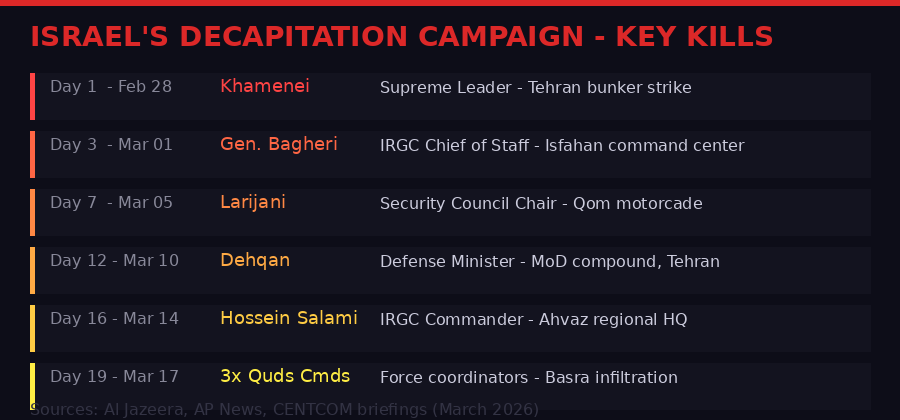
Israel's leadership elimination campaign, Day 1 through Day 19. Every kill removed potential moderating voices.
The Logic of Decapitation - And Its Historical Failures

The theory of decapitation warfare predates modern conflict. Its practical record is deeply mixed. (Pexels)
The strategic doctrine behind Israel's campaign has a name: decapitation theory. Kill the leadership, and the enemy's command-and-control structure collapses. Forces in the field receive no orders. Missile crews stand down. Supply lines dry up. The war machine grinds to a halt not because it was outfought, but because the people who gave it direction no longer exist.
The theory is clean. The historical record is not.
In 1986, the United States struck Muammar Gaddafi's compound in Tripoli in a targeted operation that was meant to kill the Libyan leader and end his sponsorship of terrorism. Gaddafi survived. Two years later, Pan Am Flight 103 exploded over Lockerbie, Scotland, killing 270 people in an operation later attributed to Libyan intelligence. The strike had not deterred Gaddafi. It had enraged him.
In Iraq, the United States spent years hunting Saddam Hussein's inner circle. When Hussein himself was captured in 2003, the insurgency did not collapse - it metastasized, eventually giving rise to the Islamic State. The removal of the central authority did not produce surrender. It produced fragmentation, and fragmentation in an armed society produces distributed violence that is far harder to target than a conventional military structure.
In Gaza, Israel has assassinated Hamas political and military leaders repeatedly over two decades. Yahya Sinwar was killed in 2024. His successors carried forward the October 7th planning that had already been set in motion. The organization did not die with its leaders. It reproduced them.
"Decapitation works extremely well against centralized, personality-dependent organizations. It works very poorly against ideological movements with deep institutional structures and succession planning. Iran is the latter, not the former." - Dr. Ariane Tabatabai, senior Iran analyst, writing in Foreign Affairs (March 2026)
Iran's clerical-military establishment was designed, consciously and deliberately, to be resistant to exactly this kind of targeting. The Islamic Revolutionary Guard Corps has seventeen regional commands, each with independent operational authority. The Supreme National Security Council has a formal succession protocol. The Assembly of Experts, the body that selects the Supreme Leader, was meeting even as Israeli jets were targeting government buildings in Tehran. They didn't need headquarters. They needed ideology. And ideology doesn't die in a bunker strike.
Who's Left Standing - The Rise of the Hardliners

Iran's new leadership council is younger, more radical, and has no institutional memory of pre-war diplomacy. (Pexels)
On Day 9 of the war, Al Jazeera reported that Iran's interim leadership council had convened for the first time in the underground complex outside Qom. The names on the council were unfamiliar to most Western analysts. That was not an accident.
The officials who had dominated Iran's foreign policy since the 2015 nuclear deal - the cautious pragmatists who believed engagement with the West was survivable, even occasionally productive - are dead. Khamenei, for all his anti-Western rhetoric, understood the utility of negotiations. He had authorized the 2015 JCPOA over the objections of IRGC hardliners. Larijani had served as Iran's top nuclear negotiator before ascending to lead the National Security Council. Both represented the faction within Iran's leadership that believed the regime's survival required occasional tactical accommodation.
Those men are gone. The men who replaced them came up through the IRGC's paramilitary wings, through the Quds Force's operational theaters in Syria and Iraq and Yemen. They have spent their careers in environments where compromise was death and escalation was the only language their adversaries respected.
"Israel has eliminated the people in Iran's government who had both the legitimacy and the institutional leverage to negotiate a ceasefire. The new leadership has no such legitimacy - and even if it wanted to negotiate, accepting terms now would look like submission to the very campaign that killed their predecessors." - Ali Vaez, Iran Project Director, International Crisis Group (March 18, 2026)
The Al Jazeera reporting from Day 19 framed it succinctly: "Analysts question Tehran's power dynamics as younger hardliners may rise after killing of leaders Khamenei and Larijani." The framing understates the shift. The moderates are not just gone from power. They are gone from existence.
Day 20 in the Field - Haifa Burns, Qatar Goes Dark, Hormuz Tightens

The Haifa oil refinery strike on Day 20 marked Iran's first direct hit on Israeli energy infrastructure since the war began. (Pexels)
At approximately 14:20 local time on March 19th, Iranian ballistic missiles impacted the Haifa Bay oil refinery complex on Israel's northern coast. Israeli Energy Minister Eli Cohen confirmed the strike, characterizing the damage as "no significant damage" - a phrase that sat awkwardly alongside security camera footage showing a column of black smoke visible from Haifa's downtown waterfront.
The strike was retaliation for Israel's attack on South Pars, Iran's massive offshore natural gas field in the Persian Gulf. That attack - the most economically significant single strike of the war - damaged processing infrastructure that feeds approximately 40 percent of Iran's domestic natural gas supply. The message Iran sent back was calibrated: we cannot match you in precision, but we can reach your economy too.
More damaging was the drone salvo that struck Qatar's Ras Laffan industrial complex, home to facilities operated by QatarEnergy. The company's chief executive confirmed that the strike had knocked out 17 percent of Qatar's liquefied natural gas export capacity. Qatar exports roughly 77 million tons of LNG per year - primarily to Japan, South Korea, and Europe. Seventeen percent of that is roughly 13 million tons annually. Europe, already under severe energy pressure from the Iran war disruption, does not have alternative supply sources that can absorb that volume on short notice.
In the Strait of Hormuz, reports emerged that Iranian naval units had deployed contact mines in the shipping lane's outer corridor. The US Navy's Fifth Fleet confirmed it was conducting "mine countermeasure operations," a confirmation that mines were present. Brent crude, which had briefly touched $119 per barrel earlier in the week, settled at $117 at close - still the highest sustained price since the 2008 financial crisis.
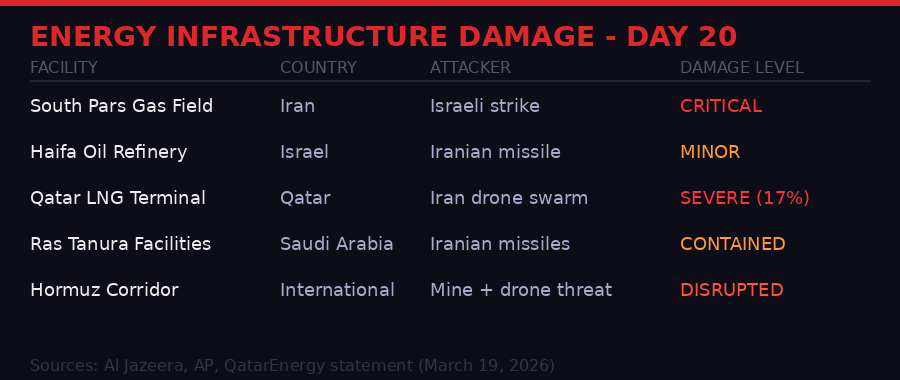
Day 20 energy infrastructure hits across the region. QatarEnergy's LNG export disruption is the most consequential single economic blow of the conflict.
An F-35 fighter jet conducting combat operations over Iranian airspace made an emergency landing at a US base in the region after sustaining damage CENTCOM described as resulting from "enemy contact." The pilot was reported in stable condition. It was the first confirmed loss of an F-35 to combat damage in the aircraft's operational history - a data point that both sides will analyze intensively.
The $200 Billion Question - Pentagon's War Bill Arrives

The Pentagon's $200bn supplemental request is the largest single-conflict funding ask since World War Two. (Pexels)
Defense Secretary Pete Hegseth appeared before the Senate Armed Services Committee on March 19th with an ask that silenced the chamber: $200 billion in supplemental war funding, the largest single-conflict budget request in American history.
According to AP News, which cited a Pentagon source familiar with the request, the breakdown runs approximately as follows: munitions replenishment accounts for the largest single share, driven by the extraordinary rate at which precision-guided bombs, Tomahawk cruise missiles, and air-to-air missile stocks have been depleted in 20 days of sustained operations. The US Navy has expended more cruise missiles in three weeks of the Iran war than it fired in the entirety of the 2003 Iraq invasion.
Air defense system reloads - primarily Patriot interceptor batteries that have been running at full capacity across the region - represent the second-largest line item. The Navy and carrier group operational costs for maintaining two carrier strike groups in the Persian Gulf and Red Sea come third.
"We are burning through munitions at a rate that the supply chain was simply not designed to sustain. That is the operational reality. We have the capability. We need the industrial base to keep pace." - Secretary Pete Hegseth, Senate Armed Services Committee, March 19, 2026 (AP News)
Hegseth simultaneously declined to offer any "timeframe" for the war's conclusion, deferring that decision to President Trump. The disconnect between the scale of the funding request and the absence of any strategic endpoint generated pointed questioning from both Democratic and Republican senators. Senator Jack Reed of Rhode Island noted that $200 billion over an undefined timeline implies an open-ended commitment with no off-ramp.
Trump, in a separate meeting with Japanese Prime Minister Ishiba, invoked Pearl Harbor while describing Japan's willingness to support the US war effort. The precise nature of that support - financial contribution? Naval assets? Logistical staging? - was not specified. Japan's pacifist constitutional framework, even after its 2022 reinterpretation, creates significant legal constraints on direct military participation in a conflict in which Japan is not a party.
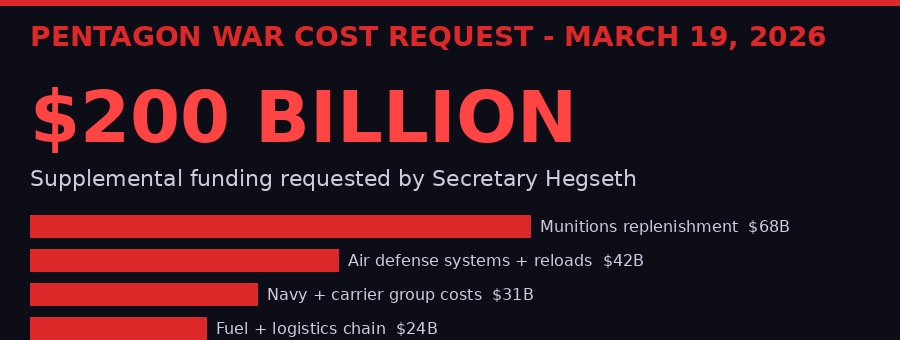
The Pentagon's supplemental request broken down by category. Munitions replenishment alone exceeds the GDP of many nations.
The Hormuz Coalition - Who's In, Who's Out, and Why China's Absence Matters

The Hormuz coalition has assembled significant naval firepower. The question is whether it can reopen the strait without triggering a full mine-clearing operation under fire. (Pexels)
On Day 20, European nations and Japan formally committed to joining what Al Jazeera described as "appropriate efforts" to reopen the Strait of Hormuz to commercial shipping. The phrasing was deliberately vague - a diplomatic formulation designed to allow each nation to define its participation level without triggering domestic political opposition.
France's Charles de Gaulle carrier group is already in the region. Italy announced the deployment of a frigate to the Fifth Fleet's area of operations. The UK's HMS Queen Elizabeth task force has been operating alongside US carrier groups since Day 5. Japan's commitment, hedged as it is by constitutional constraints, represents the first time Tokyo has signaled willingness to participate in a Middle Eastern naval operation since World War Two.
The glaring absence in the coalition is China. Beijing controls significant economic exposure in the region - it is Iran's largest trading partner, Qatar's largest LNG customer, and Saudi Arabia's largest oil export market. A war that disrupts all three simultaneously is economically catastrophic for China regardless of which side prevails.
Yet when the Biden-era multilateral framework for Hormuz protection was revived under Trump, China declined. Its stated position, according to Chinese Foreign Ministry briefings, is that the conflict is a product of American and Israeli "provocation" and that China will not participate in operations that legitimize military action against Iran. The subtext, which Yang Xiaotong articulated in a March 19th Al Jazeera opinion piece, is that Beijing has calculated its relationship with Tehran as more strategically valuable than the short-term cost of energy disruption - at least for now.
That calculation may shift if the Hormuz disruption extends past 30 days. China's petroleum reserves, according to International Energy Agency estimates, can absorb roughly 45 days of Persian Gulf supply interruption. After that, Beijing faces a choice between strategic positioning and economic necessity.
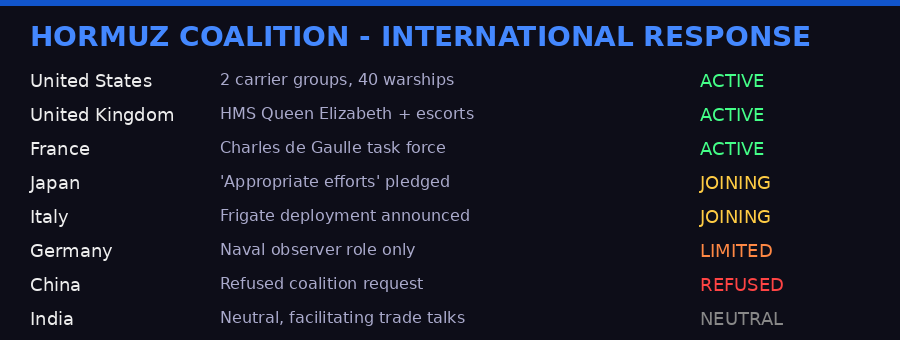
The emerging Hormuz coalition by Day 20. China's refusal creates a strategic gap that Tehran is actively exploiting in its diplomatic messaging.
Iran's Zero Restraint Warning - Reading Tehran's New Voice

Iran's interim leadership has adopted significantly harder rhetoric than its predecessors. The Haifa strike was the first test of whether that rhetoric matches operational capability. (Pexels)
Following the South Pars strike, Iran's interim leadership council issued a statement that circulated through state media on the morning of March 19th. It contained a phrase that analysts flagged immediately: "zero restraint."
In the 35 years of Khamenei's leadership, Iranian official statements consistently calibrated their threats with hedges and conditions. Khamenei threatened retaliation but always left diplomatic off-ramps visible. His statements about destroying Israel were rhetorical; his actions against Israel were consistently indirect, through proxies, through deniable operations, through the slow accumulation of pressure rather than sudden escalation. The Islamic Republic under Khamenei had learned to use controlled aggression as a tool for leverage. It was sophisticated statecraft wrapped in inflammatory packaging.
The new council's language does not contain those hedges. "Zero restraint" is not a negotiating position. It is the announcement of a posture change.
The practical implications were immediate. Following Israel's statement that it would stop striking South Pars - a unilateral de-escalation signal - Iran did not respond with reciprocal restraint. Within 12 hours, Iranian missiles hit Haifa. Iranian drones hit Qatar's LNG terminal. Iranian naval units continued deploying ordnance in Hormuz. The new leadership is not reading de-escalation signals as invitations to negotiate. It is reading them as admissions of costs that Israeli and American attacks are imposing.
"The people making decisions in Tehran right now have no memory of the pre-war order. They came of age in the IRGC's operational theaters. For them, this war is not a crisis. It is the moment they have been preparing for their entire careers." - Sanam Vakil, director of the Middle East and North Africa programme, Chatham House (Al Jazeera, March 19, 2026)
The message to the Hormuz coalition and to Washington is being read in two incompatible ways. American officials see Iranian strikes on Qatar and the Haifa refinery as evidence of desperation - the thrashing of a regime that has lost its leadership and is running down its weapons inventories. Iranian official media frames the same strikes as proof that decapitation has not diminished Iran's operational reach. Both narratives serve their audiences. Neither resolves the war.
The Succession Question - Who Negotiates, and With What Legitimacy?

The structural problem: Iran's new leadership lacks both the institutional legitimacy and the political incentive to negotiate a ceasefire on any terms acceptable to Washington. (Pexels)
The succession question is not merely academic. It determines whether this war ends in weeks or years.
A Supreme Leader, under Iran's constitution, must be selected by the Assembly of Experts - an 88-member body of senior clerics whose deliberations are typically private and slow. The Assembly was meeting in emergency session as of Day 9, under conditions of active conflict, with Israeli jets conducting strikes against government targets in Tehran. By Day 20, no formal Supreme Leader had been announced.
The operational authority in Iran is currently exercised by the interim council, which draws its legitimacy from emergency provisions in the Iranian constitution that have never been tested under wartime conditions. Whether that council's decisions carry the weight necessary to enforce ceasefire terms on Iran's distributed military command is an open question. The IRGC's 17 regional commands have demonstrated the capacity to act independently; whether they would accept orders from a council whose constitutional standing is contested is unknowable until it is tested.
This creates a structural problem for US and Israeli war aims. If the war's objective is to force Iran to the negotiating table, who signs the agreement? A council whose authority is legally ambiguous? A future Supreme Leader whose identity and positions are unknown? And crucially - what mechanism exists to enforce Iranian compliance when the command structure that would implement compliance has been physically dismantled?
The International Crisis Group published a brief on March 18th warning that Israel's decapitation campaign may have made a negotiated end to the war structurally harder to achieve. Removing Iran's top leadership did not remove Iran's military capability. It removed the people who had both the authority to make concessions and - critically - the institutional legitimacy to sell those concessions to the IRGC as something other than defeat.
Timeline: 20 Days That Changed the Middle East

Twenty days of the Iran war, compressed. Each escalation has produced counter-escalation, with no de-escalation cycle establishing itself. (Pexels)
February 28, 2026 (Day 1): US-Israeli joint strike package targets Iranian nuclear facilities and Tehran command centers. Supreme Leader Khamenei killed. IRGC activates emergency protocols. Oil markets surge 18 percent in 24 hours. Iran fires first ballistic missile barrage; 73 missiles launched, intercepted by US-Israeli air defense systems at 86 percent rate.
March 1-2 (Days 3-4): IRGC Chief of Staff General Bagheri killed in Isfahan. Iran mines outer Hormuz Strait corridor. Tanker traffic drops 40 percent as insurers suspend coverage for Gulf routes. Hezbollah activates northern Israel front; rockets strike Haifa suburbs. Lebanon death toll begins mounting.
March 5 (Day 7): Ali Larijani, Chair of the Supreme National Security Council, killed in Qom. The kill removes Iran's most senior surviving pragmatist. Iran retaliates with drone strike on Saudi Aramco's Ras Tanura facility - contained with limited damage. Brent crude touches $108.
March 8-10 (Days 10-12): Defense Minister Dehqan killed in Tehran compound. Pentagon briefs Congress on munitions depletion rate. Iran's interim council formally convenes. South Pars first targeted; partial damage inflicted. Israel begins ground operations in southern Lebanon with five divisions.
March 14 (Day 16): IRGC Commander Salami killed in Ahvaz. Iranian missile barrage - largest since Day 1 - targets Israeli population centers. Iron Dome intercepts 91 percent. Fourteen civilian casualties in Ashdod. Lebanon's death toll passes 1,000, per Al Jazeera reporting. Qatar begins public statements about LNG export risk.
March 17-18 (Days 19-20): Israeli strike on South Pars - most economically significant attack of the war. Israel subsequently announces halt to South Pars strikes. Iran does not reciprocate. Three Quds Force coordinators killed in Basra infiltration. Interim council issues "zero restraint" statement. Iran fires on Haifa refinery; QatarEnergy LNG terminals struck by drone swarm. F-35 emergency landing after combat damage. Pentagon requests $200 billion in emergency supplemental funding. Japan and European nations commit to Hormuz coalition.
March 19 (Day 20, Current): Brent at $117. Hormuz mine threat active. No ceasefire talks. No formal Iranian Supreme Leader. Leadership decapitation campaign officially questioned by Western analysts. Hegseth offers no war timeline.
What Comes Next - Three Scenarios

Three scenarios are now operationally plausible. The one that ends the war fastest is also the one that requires the most from Washington. (Pexels)
The operational picture on Day 20 suggests three distinct trajectories, none of them clean.
Scenario 1: Controlled Attrition. The war continues at its current tempo for another 30-60 days. Iran's missile inventories decline. IRGC forces are degraded through sustained air strikes on military infrastructure. Oil prices stabilize in the $100-120 range as the market prices in disruption without catastrophic escalation. The Hormuz coalition successfully suppresses mine threat and restores partial tanker traffic. Iran's new leadership, facing internal pressure from economic collapse, eventually signals willingness to negotiate. Ceasefire terms are reached through back-channel mediation, possibly through Oman or Qatar. This scenario assumes Iran's new hardline leadership responds to economic pressure the way Khamenei's pragmatists might have - an assumption that analysts who study the IRGC's operational culture find unconvincing.
Scenario 2: Escalation to Nuclear Threshold. Iran's new leadership, facing regime survival questions, accelerates nuclear enrichment at its dispersed facilities. The calculus: if the war continues and Iran cannot stop the strikes militarily, a credible nuclear deterrent becomes the only guarantee of regime survival. This is not an irrational calculation. It is the lesson of Libya (no nukes, Gaddafi killed), North Korea (nukes, regime intact), and Iraq (no nukes, Saddam hanged). Israel and the US, recognizing this logic, would be forced to choose between accepting a nuclear Iran or conducting a preemptive strike on enrichment sites before capability threshold is crossed. That preemptive strike would be vastly more complex and costly than what has been conducted so far.
Scenario 3: Regional Expansion. Iran's Quds Force, operating through its surviving regional networks in Iraq, Syria, Yemen, and Lebanon, escalates proxy operations to a level that draws additional US forces into ground engagements. Hezbollah's full military capability has not yet been deployed - it retains tens of thousands of rockets, including precision-guided munitions capable of striking anywhere in Israel. If Israel's Lebanon ground operation triggers Hezbollah's full activation, the northern front becomes a conventional ground war requiring infantry resources that Israel does not have available while simultaneously fighting an air campaign over Iran. Iran's proxy network is designed precisely for this - to create multiple simultaneous crises that overwhelm adversaries with resource constraints.
The common thread across all three scenarios is that none of them were made more likely by the death of Khamenei and Larijani. The pragmatists who might have negotiated Scenario 1 are dead. The institutional stability that might have constrained Scenario 2 is gone. The operational discipline that might have limited Scenario 3 to proxy attacks below the threshold of full war has been replaced by a council with no evident interest in restraint.
Israel's kill list grew the war. Whether it can also end it is the question that will define the next 20 days.
Get BLACKWIRE reports first.
Breaking news, investigations, and analysis - straight to your phone.
Join @blackwirenews on TelegramSources: Al Jazeera (March 19, 2026 live coverage and analysis); AP News (March 19, 2026 - Pentagon $200bn request, Haifa strike); International Crisis Group, "Iran's Leadership Vacuum and the Ceasefire Problem" (March 18, 2026); Dr. Ariane Tabatabai, Foreign Affairs (March 2026); Ali Vaez, ICG Iran Project (March 18, 2026); Sanam Vakil, Chatham House MENA Programme (Al Jazeera, March 19, 2026); Yang Xiaotong, "China's silence on Iran reveals its true priorities," Al Jazeera Opinion (March 19, 2026); CENTCOM Captain Tim Hawkins briefing on F-35 emergency landing (March 19, 2026); QatarEnergy CEO statement on LNG capacity disruption (March 19, 2026); IEA petroleum reserve analysis; Senate Armed Services Committee hearing transcript (March 19, 2026).