Cluster Munitions Over Tel Aviv: Iran Deploys Khorramshahr-4 to Avenge Larijani
Iran fired its most advanced multi-warhead ballistic missiles at central Israel on March 18, with AP footage confirming cluster munition release over Ramat Gan. Two civilians died. The same day, a projectile struck the Bushehr nuclear power plant complex. The war has entered its most dangerous technical escalation yet.

File image: Aerial bombardment scene. On March 18, 2026, Iranian Khorramshahr-4 missiles released cluster munitions over Ramat Gan, east of Tel Aviv. Two civilians were killed. (AP Photo/file)
The salvo came before dawn. Iran's Islamic Revolutionary Guard Corps announced it had fired Khorramshahr-4 and Qadr multiple-warhead ballistic missiles at central Israel - weapons specifically engineered to split into multiple independently targeted reentry vehicles and defeat layered missile defense systems. The IRGC framed the strike as direct revenge for Israel's killing of Ali Larijani, the head of Iran's Supreme National Security Council, the previous night.
Footage filmed by The Associated Press showed a missile releasing its cluster payload over Israeli territory. Israel's emergency medical service confirmed two people were killed in Ramat Gan, a dense residential city immediately east of Tel Aviv. Multiple others were wounded. The country's air defense reported at least two incoming salvoes.
Hours later, a separate projectile struck the grounds of Iran's Bushehr nuclear power plant on the Persian Gulf coast. The International Atomic Energy Agency confirmed the hit and said no radiation was released and no plant systems were damaged. But the proximity of active warfighting to an operational nuclear reactor - the only one in the Middle East - triggered immediate alarm from the IAEA's director-general.
Together, these two events mark the sharpest weapons escalation of the 19-day war between the United States, Israel, and Iran. The Khorramshahr-4 is not a standard ballistic missile. It is a countermeasure. And it worked.
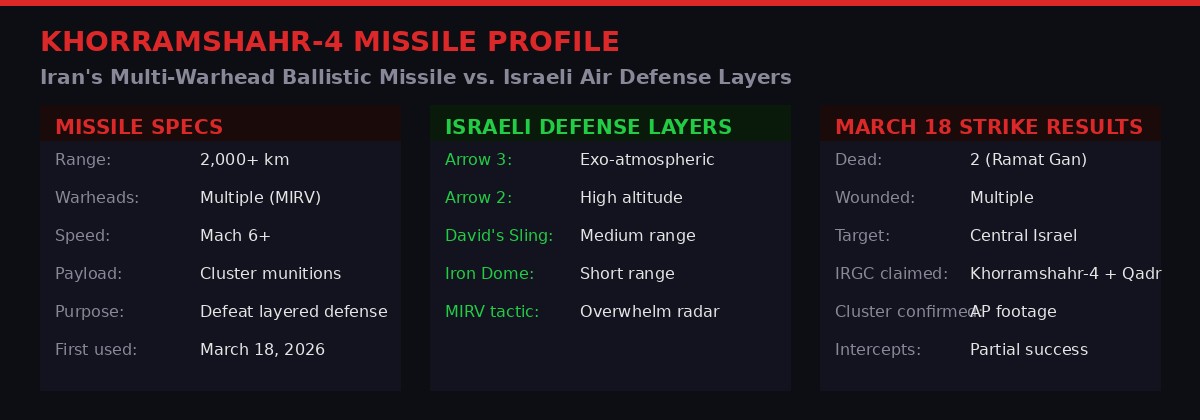
BLACKWIRE infographic: Khorramshahr-4 specifications vs. Israeli multi-layer air defense. The MIRV warhead design is intended to overwhelm radar tracking and intercept capacity simultaneously.
The Missile Iran Has Been Saving
The Khorramshahr-4 - also called the "Kheibar Shekan" or "fortress buster" in earlier variants - is Iran's most advanced domestically-produced ballistic missile. Its defining feature is the multiple independently targetable reentry vehicle, or MIRV, system. A single launch produces several warheads that separate and follow distinct trajectories to different targets or the same target from different angles.
The logic is simple and brutal: missile defense systems like Israel's Arrow-2, Arrow-3, and David's Sling can track and intercept incoming warheads at a rate limited by their radar and launcher capacity. A single missile with one warhead is a manageable problem. A single missile that becomes four or five warheads spreading across a wide area simultaneously is an entirely different calculus.
Iran unveiled the Khorramshahr-4 in 2022 as a strategic deterrent. Iranian military officials at the time claimed a range exceeding 2,000 kilometers, sufficient to reach any part of Israel from launch sites deep inside Iran. The missile's speed - estimated at Mach 6 or higher during terminal phase - gives defense systems less reaction time than slower cruise missiles or drones.
The Qadr missile, also used in Wednesday's barrage, is an older liquid-fueled intermediate-range ballistic missile, but it can also carry cluster munitions. The IRGC's use of both simultaneously suggests a coordinated saturation strategy designed to maximize the probability that at least some warheads break through.
"The Revolutionary Guard said the force launched the Khorramshahr-4 and Qadr multiple-warhead missiles to avenge Larijani's killing. Footage filmed by The Associated Press showed at least one missile releasing cluster munitions over Israel." - Associated Press, March 18, 2026
Israel reported at least two salvoes of incoming fire. The country's multilayer defense system, which has been the most tested air defense network in history over the past three weeks of this war, achieved partial intercepts. But "partial" in a cluster munition context means that even intercepted warheads can scatter lethal submunitions across populated areas. Two people died in Ramat Gan. That number is likely to rise as first responders work through the debris.
Who Was Ali Larijani - and Why Iran Fired Back Like This
Iran does not deploy its most advanced weapons for routine retaliation. The Khorramshahr-4 salvo signals how seriously Tehran viewed the loss of Ali Larijani.
Larijani was not merely a senior official. He was the effective operational brain of Iran's war government. After Supreme Leader Ayatollah Ali Khamenei was killed in the first American-Israeli airstrikes on February 28, Iran's leadership entered a crisis. Mojtaba Khamenei, Ali's son, was installed as new Supreme Leader but has not been seen in public since early in the war - Israel believes he was wounded. In that vacuum, Larijani, as Secretary of the Supreme National Security Council, was widely understood to be the man actually coordinating Iran's military strategy and its parallel diplomatic pressure campaign.
His family background made him one of the Islamic Republic's most politically formidable figures. His brother Sadeq Larijani served as head of Iran's judiciary. Another brother, Mohammad Javad, spent decades as a senior diplomatic adviser. Ali himself served as parliamentary speaker from 2008 to 2020, ran Iran's state broadcasting organization, and wrote six philosophy books - three on the work of Immanuel Kant. He was, by any measure, the most intellectually serious figure in Iran's war government.
He was also the man Trump's negotiators had been trying to reach. Just two weeks before the war began, Larijani traveled to Oman to meet with mediators on behalf of Tehran in nuclear talks with the Trump administration. He was the last point of possible diplomatic contact between Iran and Washington. Israel killed him in an overnight strike on March 17.
"Israeli Prime Minister Benjamin Netanyahu said the killings were aimed at 'undermining this regime to give the Iranian people the opportunity to remove it.' But there have been no signs of anti-government protests since the war began, as many Iranians shelter from the American and Israeli strikes." - Associated Press, March 18, 2026
The same Israeli strikes also killed Gen. Gholam Reza Soleimani - a different man from the more famous Qasem Soleimani killed by Trump in 2020, but equally consequential. Gholam Reza Soleimani headed the Basij, the IRGC's all-volunteer internal security force of potentially hundreds of thousands of members. The Basij was the primary instrument used to violently suppress Iran's nationwide protests in January 2026. Killing its commander removes a key pillar of domestic control.
Iran confirmed both deaths through official state media and the IRGC. Larijani's son Morteza was also killed in the same strike, according to the Supreme National Security Council's own announcement.
The Nuclear Plant That Should Not Have Been Hit
The strike on Bushehr is the detail that has nuclear security experts most alarmed this morning.
Bushehr Nuclear Power Plant sits on Iran's Persian Gulf coast, roughly 750 kilometers south of Tehran. It is the only operational nuclear power plant in the Middle East. Russia's state nuclear corporation Rosatom built and still operates it, using Russian-made low-enriched uranium to generate approximately 1,000 megawatts - enough to power several hundred thousand Iranian homes and businesses.
Russia's Rosatom CEO Alexey Likhachev confirmed the hit through Tass news agency Tuesday night, saying "a strike hit the area adjacent to the metrology service building located at the Bushehr Nuclear Power Plant site, in close proximity to the operating power unit." He emphasized that no Rosatom personnel were killed and radiation readings remained normal.
Iran's Atomic Energy Organization issued its own statement confirming "no financial, technical, or human damage occurred and no part of the plant was harmed." The IAEA issued a carefully worded statement: "The IAEA has been informed by Iran that a projectile hit the premises of the Bushehr NPP on Tuesday evening. No damage to the plant or injuries to staff reported."
IAEA Director-General Rafael Grossi, who has been raising alarms throughout the conflict, reiterated his call "for maximum restraint during the conflict to prevent risk of a nuclear accident."
What hit Bushehr remains unknown. CENTCOM has not responded to questions about whether U.S. forces struck the area. Shrapnel from missile interceptions - air defense systems firing interceptors that then fall back to earth - has caused collateral damage across the region throughout this war. The UAE, Saudi Arabia, and Kuwait have all reported damage from falling interceptor debris. Bushehr sits in a region with active air defense systems given its proximity to the Strait of Hormuz.
But Iran is also using nuclear ambiguity as leverage. If Tehran can credibly claim its nuclear infrastructure is under threat, it gains pressure on Washington and European capitals to demand restraint from Israel and push for a ceasefire. Russia's Rosatom statement - coming from the Kremlin-aligned state corporation - amplifies that pressure, giving the incident international resonance beyond what Iranian state media alone could achieve.
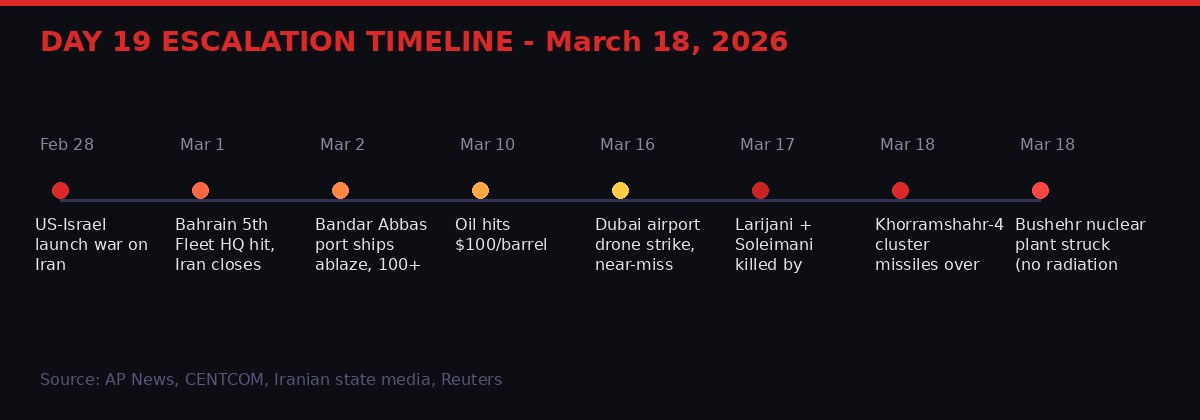
BLACKWIRE: Timeline of key escalation events from war start (February 28) through Day 19 (March 18, 2026). The Khorramshahr-4 deployment and Bushehr strike represent the sharpest single-day escalation since the war began.
The Gulf Is Still Burning
Wednesday's strikes on Israel were not the only Iranian military action of the day. The same morning, Iran launched fresh waves of missiles and drones against Persian Gulf neighbors.
Saudi Arabia's defense ministry shot down a ballistic missile targeting the Prince Sultan Air Base, which hosts American aircraft and personnel. Two drones targeting Riyadh's diplomatic quarter - which houses the U.S. Embassy and other foreign missions - were also intercepted. Kuwait, Bahrain, Qatar, and the UAE all faced incoming fire. Missile alerts sounded repeatedly over Dubai.
Australia's Prime Minister Anthony Albanese confirmed that an Iranian projectile struck near Al Minhad Air Base in Dubai, causing a small fire but no injuries. Al Minhad is used by Western nations as a transit hub for military logistics across the Middle East. AP journalists on the ground in Dubai heard explosions consistent with Albanese's account.
In Iraq, the U.S. Embassy compound in Baghdad came under fire for the second consecutive day. Two Iraqi security officials confirmed the strike to AP on condition of anonymity. A day earlier, a drone had crashed inside the compound. Pro-Iran militia groups in Iraq have been attacking American targets regularly since the war started.
U.S. Central Command announced it had fired multiple 5,000-pound deep-penetrator bombs against Iranian missile sites along the coastline near the Strait of Hormuz the previous day. These GBU-57 Massive Ordnance Penetrators are the largest bombs in the U.S. conventional arsenal, designed to destroy hardened and deeply buried targets. Their use against coastal missile sites signals that CENTCOM is trying to degrade Iran's capacity to threaten shipping through the strait.
It is not working yet. Iran continues to control the Strait of Hormuz in practical terms. A handful of ships - some carrying Iranian goods, others from India, Turkey, and neutral states - have gotten through. But vessels flagged to U.S. allies remain blocked. Roughly 20 ships have been struck since the war began. Brent crude oil held above $100 per barrel in early trading Wednesday - up more than 40 percent from the day before the war started.

File: Oil tanker in the Persian Gulf. Iran's effective blockade of the Strait of Hormuz - through which a fifth of global oil transits - has driven Brent crude above $100/barrel for the first time since 2022. (Pexels)
Kent Resigns: The Crack Inside Trump's War Cabinet
The military escalation on the ground is now matched by political rupture inside Washington.
Joe Kent, director of the National Counterterrorism Center, resigned Tuesday with a public statement that directly challenged the legal and intelligence basis for the war. "Iran posed no imminent threat to our nation, and it is clear that we started this war due to pressure from Israel and its powerful American lobby," Kent wrote in a statement posted to social media.
Kent's background makes this resignation structurally different from a routine dissenter. He is a former Green Beret with multiple combat deployments, confirmed by the Senate 52-44 in July 2025. He was not a Biden-era holdover. Trump praised him as a man who had "hunted down terrorists and criminals his entire adult life" when nominating him. He was, in theory, part of Trump's ideological coalition.
His resignation forces a question that Republicans have so far refused to answer: what was the actual intelligence justification for attacking Iran?
Trump has offered shifting explanations. House Speaker Mike Johnson told reporters the White House believed Israel was determined to act alone, leaving Trump with "a very difficult decision." That framing - America acted to manage an ally's unilateral strike, rather than on independent intelligence of an imminent threat - is legally significant under the War Powers Resolution.
"I strongly disagree with many of the positions he has espoused over the years, particularly those that risk politicizing our intelligence community. But on this point, he is right: There was no credible evidence of an imminent threat from Iran that would justify rushing the United States into another war of choice in the Middle East." - Sen. Mark Warner (D-VA), Senate Intelligence Committee, responding to Kent's resignation
Director of National Intelligence Tulsi Gabbard, whose office oversaw Kent's work, declined to state her own assessment of whether Iran was an imminent threat. She deferred entirely to Trump's judgment in a social media post, writing that the president "concluded that the terrorist Islamist regime in Iran posed an imminent threat and he took action based on that conclusion." She did not say whether the intelligence supported that conclusion.
Trump responded to Kent's resignation by dismissing him personally - calling him "weak on security" and saying people who don't believe Iran was a threat "are not smart people, or they're not savvy people." A year ago, he praised the same man effusively.
Kent's departure follows heightened concern about domestic terrorism. In New York City, federal authorities arrested two men allegedly inspired by the Islamic State group who were carrying powerful homemade bombs to a far-right protest. The FBI, which Trump's administration has gutted through mass firings, is the primary agency responsible for detecting and interdicting such plots.
The Alliance Is Gone - America Is Fighting Alone
The war Trump is now conducting is a war without allies. That is not spin from critics - it is the operational reality on the ground.
Trump demanded that NATO and partner nations send warships to help secure the Strait of Hormuz. He publicly stated that most allies had refused. Then he posted on social media: "WE DON'T NEED THE HELP OF ANYONE!" The European Union's top diplomat, Kaja Kallas, told EU lawmakers explicitly: "This is not Europe's war. We were not consulted."
The implications of solo American engagement are severe. The U.S. military is operating carrier strike groups in the Gulf while simultaneously sustaining operations in Ukraine, maintaining deterrence in the Pacific, and now absorbing Iranian proxy attacks in Iraq and Syria. The logistics chain that runs through Al Minhad in Dubai - now a strike target - and through Bahrain's 5th Fleet headquarters, which sustained major damage to its facilities in the first days of the war, is under sustained pressure.
Satellite imagery from Planet Labs, released with a two-week delay per the firm's stated policy, shows the scale of physical damage already sustained. Ships burned at Iran's Bandar Abbas port on March 2. A major building at the 5th Fleet headquarters in Bahrain was destroyed in the first days of fighting. Two radomes - geodesic domes protecting radar systems used for secure communications - were wiped out. At France's Camp de la Paix naval base in Abu Dhabi, two large hangar buildings were destroyed.
These are not symbolic strikes. They degrade real operational capacity in a theater where that capacity is already stretched.

File: U.S. Navy warship. America is operating carrier strike groups in the Gulf without allied naval support. The 5th Fleet headquarters in Bahrain sustained significant physical damage in the first days of the war. (Pexels)
What Happens Next: The War's Decision Points
Nineteen days into this war, several decision points are converging simultaneously.
Iran's strategy is becoming clearer. Tehran is not trying to win a conventional military confrontation with the United States and Israel. It cannot. Instead, it is waging an attrition campaign designed to: drive oil prices high enough to create economic and political pain in Washington; destroy enough allied infrastructure in the Gulf to make the region ungovernable for U.S. forces; and demonstrate that the cost of regime change is too high for any American politician to sustain through midterm elections in November 2026.
The Khorramshahr-4 deployment is part of this strategy. Every time Iran demonstrates that its missiles can penetrate Israeli air defenses - even partially - it undermines the confidence of Gulf Arab states that they can shelter under the American-Israeli security umbrella. If the UAE or Saudi Arabia concludes that American protection is insufficient, the political pressure on Washington to negotiate intensifies dramatically.
On the Israeli side, Netanyahu's stated goal - undermining the Iranian regime enough to give its people a chance to remove it - is not happening. Domestic protests that might have destabilized the theocracy have not emerged. Iranian civilians are sheltering from American and Israeli bombs, not taking to the streets against their government. The decapitation strategy has killed Khamenei, Larijani, Soleimani, and multiple other officials. The IRGC is still firing missiles.
The killing of Larijani specifically may have been counterproductive from a diplomatic standpoint. He was the last senior Iranian official who had been in active contact with Western mediators. His death removes that channel entirely - assuming any channel still existed after three weeks of intensive bombing.
For the United States, the political picture is deteriorating. Joe Kent's resignation on the grounds that there was no imminent threat and the war was started at Israel's behest is the most significant internal dissent yet. It gives Democrats a credible former Trump official to cite in their case against the war. It gives MAGA voters - who traditionally resist foreign entanglements - a reason to question whether this war serves American interests.
Trump is aware of the political clock. He has cited midterm elections in his private and public framing of the war. A prolonged conflict with no allied support, rising oil prices feeding domestic inflation, and a nuclear plant that nearly became an international incident does not strengthen his position going into the 2026 campaign cycle.
The Khorramshahr-4's cluster munitions over Ramat Gan are not just a military event. They are a signal: Iran has more escalation capacity than it has used, and it will use it. The war is not winding down. It is winding up.
Sources
- AP News - Iran attacks Israel and Gulf neighbors as Israel hits Beirut (March 18, 2026)
- AP News - Who was Ali Larijani (March 18, 2026)
- AP News - Israel killed two top Iranian security officials (March 17, 2026)
- AP News - Joe Kent resigns over Trump's Iran war (March 18, 2026)
- AP News - What to know about Iran's Bushehr nuclear plant (March 18, 2026)
- AP News - Satellite photos show damage in Iran war (March 18, 2026)
- International Atomic Energy Agency - Statement on Bushehr NPP (March 18, 2026)
- Russian state media (Tass) - Rosatom CEO statement on Bushehr strike
- U.S. Central Command - Statement on 5,000-pound penetrator bombs (March 17, 2026)
- Iranian Revolutionary Guard Corps - Statement on Khorramshahr-4 launch
Get BLACKWIRE reports first.
Breaking news, investigations, and analysis - straight to your phone.
Join @blackwirenews on Telegram