IRGC Strikes Dubai: Iran Hits UAE and Kuwait Bases as Gulf States Scramble

File image: Air base perimeter lighting at night. Al-Minhad and Ali Al-Salem bases were targeted in Saturday's IRGC strike. (File)
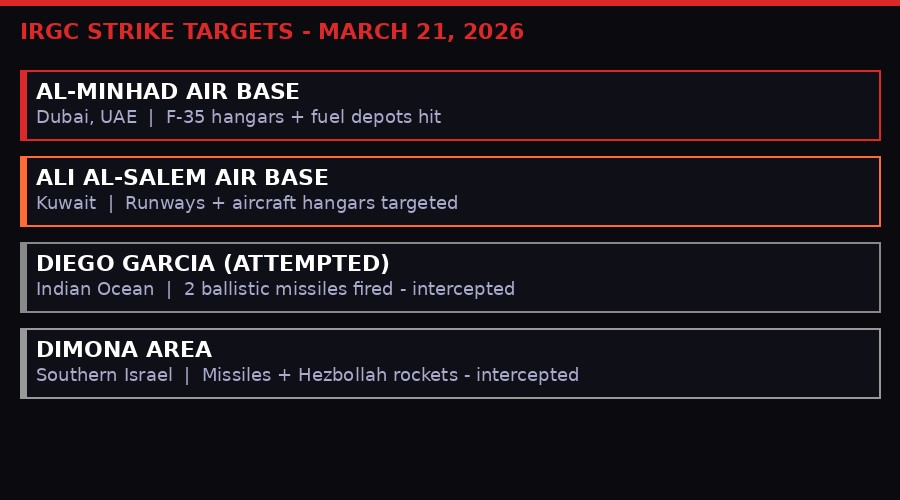
BLACKWIRE graphic: IRGC-claimed strike targets on March 21, 2026. UAE and Kuwait directly hit for first time in this conflict. (BLACKWIRE/Reuters)
What the IRGC Claims It Hit
IRGC Navy Commander Alireza Tangsiri announced the strikes on X (formerly Twitter), claiming his forces had hit "the facilities of the two Al-Minhad and Ali Al-Salem air bases, the hangars, and the fuel depots of American-Zionist aircraft with a massive volume of ballistic missiles and suicide drones."
Tangsiri identified both bases as "the origin of the aggression" against Iran - a significant statement. Al-Minhad Air Base sits 35 kilometers south of Dubai city center, deep inside UAE territory. Ali Al-Salem is a Kuwaiti military facility that has hosted US forces throughout multiple Middle East operations, including the 2003 Iraq War and the current campaign against Iran.
The IRGC has rarely named Gulf host nations directly in this conflict, preferring language about "American-Zionist forces" to avoid forcing the UAE and Kuwait into explicit political corners. Saturday's direct naming changes that calculation. Tehran is now explicitly holding Abu Dhabi and Kuwait City accountable for the operations conducted from their soil.
"We pounded the facilities of the two Al-Minhad and Ali Al-Salem air bases - the hangars and the fuel depots of American-Zionist aircraft - with a massive volume of ballistic missiles and suicide drones. These bases were the origin of the aggression against Iran."
- IRGC Navy Commander Alireza Tangsiri, via X, March 21, 2026
Independent verification of damage at the bases was not immediately available. Both the UAE military and the US Central Command declined to provide immediate detail on the strikes. The Pentagon has maintained a policy throughout this conflict of limiting public disclosure of damage to US military assets in the region.
UAE Declares Air Defense Emergency

Dubai's skyline under normal conditions. The UAE National Emergency Authority issued a public air defense warning Saturday afternoon. (File/Reuters)
The UAE's National Emergency Crisis and Disaster Management Authority issued an unusual public statement on Saturday, confirming that the country's air defenses were responding to an active missile threat. The authority told residents to "remain in a safe location and follow official channels for warnings and updates."
Public air defense warnings are rare in the UAE, a country that has built its global brand on stability and security. Dubai - home to one of the world's busiest international airports and a major financial hub - has seen flights diverted and some commercial air traffic interrupted since the Iran-Israel-US war began on February 28.
The UAE has tried to walk a careful diplomatic line throughout the conflict. Abu Dhabi has not publicly endorsed the US-Israel campaign against Iran and has quietly continued some trade relationships with Iranian-linked entities. But the IRGC has apparently run out of patience with that neutrality, deciding that hosting US aircraft for offensive operations into Iran was justification enough for a direct strike.
Residents near Al-Minhad reported hearing multiple explosions and seeing interception trails in the sky. Social media video purporting to show the strikes was circulating on X within hours, though its authenticity could not be independently confirmed by BLACKWIRE at time of publication.
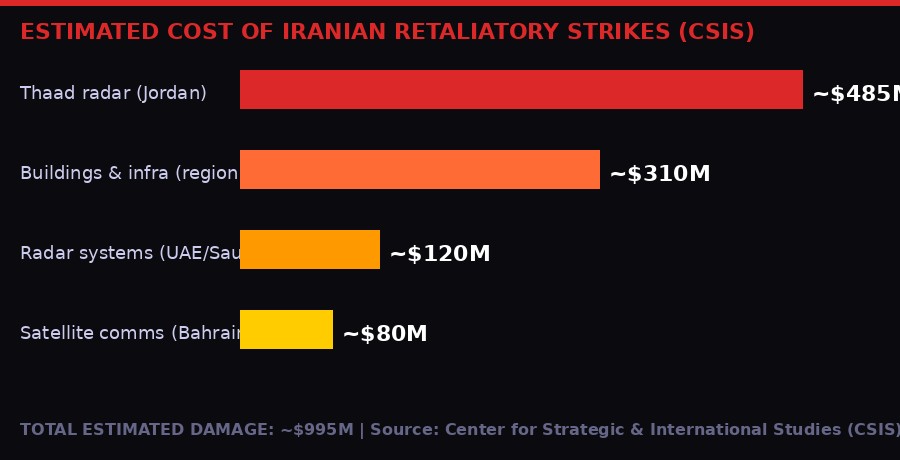
BLACKWIRE graphic: Estimated costs of Iranian retaliatory strikes on US military infrastructure, based on CSIS/BBC Verify analysis. Total exceeds $995 million through Day 26. (CSIS/BBC Verify/BLACKWIRE)
The Hormuz Calculation: Why Iran Struck Now
The timing of Saturday's strikes carries strategic weight. Just hours earlier, US Central Command commander Admiral Brad Cooper released a video message claiming the US had "degraded" Iran's ability to threaten the Strait of Hormuz. Cooper said the US had bombed an underground facility where Iran stored cruise missiles and weapons used to monitor and threaten shipping.
"We not only took out the facility, but also destroyed intelligence support sites and missile radar relays that were used to monitor ship movements. Iran's ability to threaten ships in the Strait of Hormuz has been degraded."
- Admiral Brad Cooper, US Central Command, March 21, 2026
The IRGC's strike on Gulf bases appears to be a direct response - both a show of continued capability and a warning to regional hosts that cooperation with the US carries real costs. Iran cannot currently contest the Strait on the same terms as before, according to Centcom. But it still has missiles, drones, and the will to use them against bases that have not previously been struck in this conflict.
The escalation toward Gulf state capitals follows a pattern military analysts have tracked throughout the conflict. When US and Israeli forces have bombed Iranian capability - missile factories, radar systems, command facilities - the IRGC has widened its response radius rather than narrowing it. The degradation of its Hormuz capability appears to have prompted a broadening of targets to include the Gulf hosts who enabled the degradation.
Rachel Ziemba, adjunct senior fellow at the Center for a New American Security, had warned earlier this week that the global oil market was in an "every-barrel-counts situation." The US was already scrambling to offset supply disruptions from the Hormuz near-closure, releasing strategic reserves and suspending Russian oil sanctions. Strikes on Gulf bases add a new variable: if the UAE or Kuwait begin to limit or deny US operational access under pressure, the entire basing posture for the Iran campaign comes into question.
Israel, Diego Garcia, and a War That Keeps Widening

File: Missile defense interception trails photographed over the region. Iran fired at Israel and Diego Garcia on Saturday, in addition to the Gulf state strikes. (File/Reuters)
Saturday's IRGC strikes were not limited to the Gulf. The Israel Defense Forces reported missiles launched from Iran toward Israeli territory, with defensive systems activated. Local media in Israel reported sirens across southern Israel, including the city of Dimona - home to Israel's Negev Nuclear Research Center, which Israel has never officially acknowledged as a nuclear weapons facility. No casualties were reported and the IDF said people could leave protected spaces after interceptions were completed.
Simultaneously, Iran claimed to have launched ballistic missiles at the Diego Garcia joint US-UK military base in the Indian Ocean - a facility 2,350 miles from Iran's coast. Two missiles were reportedly fired; one failed in flight and the other was intercepted by a US warship. Neither reached the base.
The Diego Garcia attempt, reported by CNN and the Wall Street Journal citing US officials, represents an extraordinary escalation in terms of range. There have been doubts throughout the conflict about whether Iran possessed missiles capable of reaching the base. The IRGC's Khorramshahr-4 missile is believed by some analysts at Israel's Alma Research and Education Center to have a range of up to 1,800 miles - still short of Diego Garcia. Either Iran is claiming a range capability it doesn't fully possess, or its most advanced variants are capable of ranges not previously confirmed in combat conditions.
The UK Ministry of Defence responded sharply: "Iran's reckless attacks, lashing out across the region and holding hostage the Strait of Hormuz, are a threat to British interests and British allies." UK Foreign Secretary Yvette Cooper called the Gulf strikes "reckless" and said Tehran was targeting shipping, allies, and British interests across the region.
Cooper added that the UK wants a "swift resolution" and "regional stability" but would "not be drawn into a wider conflict" - a delicate phrase given that the UK only recently expanded the authorized target list for US strikes conducted from British bases to include Iranian sites threatening Hormuz.
The CSIS Numbers: $800 Million in Damage and Counting
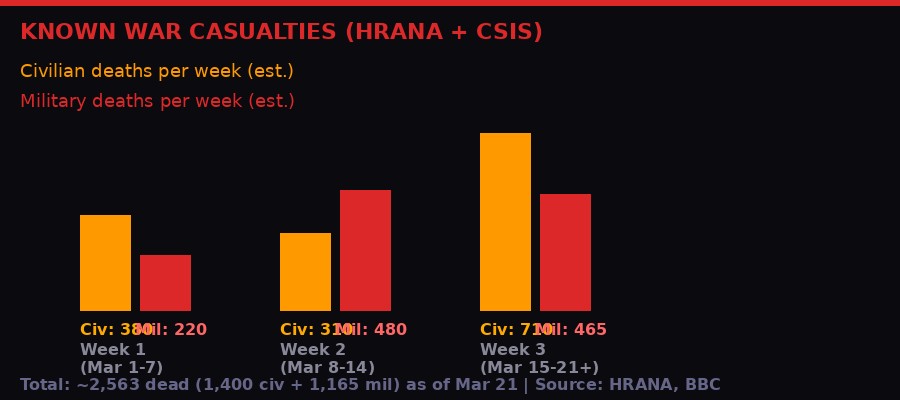
BLACKWIRE graphic: Estimated civilian and military casualties from the Iran-Israel-US war, broken down by week. Total exceeds 2,500 dead. (HRANA/CSIS/BLACKWIRE)
A joint analysis published Friday by the Center for Strategic and International Studies (CSIS) and BBC Verify found that Iranian retaliatory strikes on US military infrastructure had caused approximately $800 million in damage in just the first two weeks of the conflict - a figure described as likely understated given classification restrictions on damage assessments.
The single largest component was the destruction of an AN/TPY-2 radar system in Jordan - the backbone of a Thaad missile defense battery - valued at approximately $485 million. Additional damage to buildings, facilities, and infrastructure on US and allied bases across the region accounted for approximately $310 million more.
"The damage to US bases in the region has been underreported. Although that appears to be extensive, the full amount won't be known until more information is available."
- Mark Cancian, CSIS Senior Adviser, BBC report, March 20, 2026
Satellite imagery analyzed by BBC Verify identified three bases - Ali Al-Salim in Kuwait, Al-Udeid in Qatar, and Prince Sultan in Saudi Arabia - that show fresh damage from multiple rounds of strikes over different phases of the conflict. Iran has hit the same facilities more than once, targeting specific systems for cumulative degradation.
US forces have lost 13 service members since the campaign began on February 28, according to Pentagon figures. The broader death toll estimated by the Human Rights Activists News Agency (HRANA) now stands at approximately 2,563 total deaths - roughly 1,400 civilians and 1,165 military personnel - with an additional 657 individuals not yet classified as either. At least 210 children are confirmed among the dead.
Saturday's strikes add new casualties and damage figures to those totals. The final assessment of the Al-Minhad and Ali Al-Salem strikes was not available by publication time.
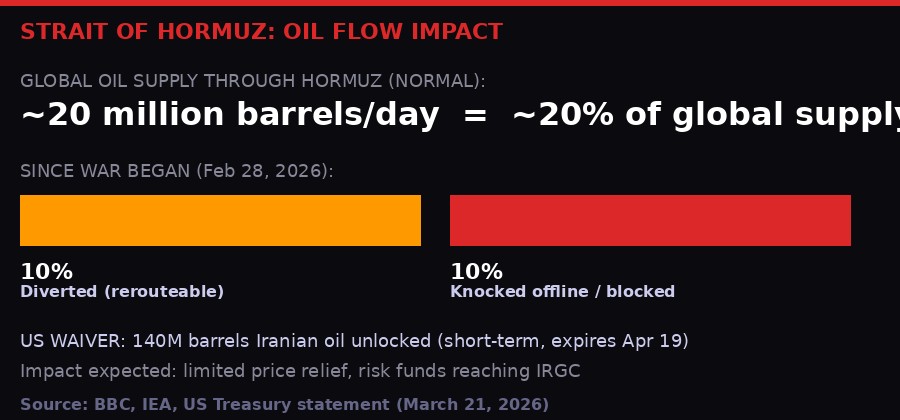
BLACKWIRE graphic: Impact of the Iran war on global oil flows through the Strait of Hormuz. Around 10% of global supply remains knocked offline. (IEA/BBC/BLACKWIRE)
The Oil Sanctions Reversal: "Bananas" but Necessary
Hours before the IRGC strikes on Gulf bases, US Treasury Secretary Scott Bessent announced an extraordinary policy reversal: the US would lift sanctions on some Iranian oil currently stranded on vessels at sea, permitting the sale of approximately 140 million barrels of Iranian crude to global markets.
The authorization is narrowly tailored and expires on April 19. Bessent described it as a measure to quickly add supply to a market shocked by the near-closure of the Strait of Hormuz. Before the war, Iran was selling roughly 1.5 million barrels per day, primarily to China at steep discounts necessitated by sanctions. Bessent suggested the waiver could divert some of that supply away from China and toward price-stressed nations like India, Japan, and Malaysia.
The reaction from specialists was swift and skeptical. David Tannenbaum, director of Blackstone Compliance Services, called the idea "bananas" on grounds that it would allow Iran to sell oil whose proceeds could flow back into the IRGC war effort - the very forces currently bombing US bases. "Essentially we're allowing Iran to sell oil, which could then be used to fund the war effort," he told the BBC Thursday.
Rachel Ziemba from the Center for a New American Security described it as unlikely to be a "game changer" for prices while raising significant enforcement questions: "The US government is definitely in an every-barrel-counts situation because of the scale of the supply shock. They're looking to find additional oil wherever they can."
Former World Bank president David Malpass offered a more favorable interpretation on X, calling the waiver "a narrow action that should cause downward pressure on oil prices outside China." He framed it as one of several concurrent supply-side measures including Jones Act waivers and strategic reserve releases.
The fundamental tension: the US is simultaneously bombing Iran's military infrastructure and unlocking Iranian oil revenue. Whether those two actions can coexist without contradicting each other is a question the Treasury Department left unresolved. Bessent said Iran would have "difficulty accessing" any revenue from the oil sales, but experts noted the practical enforcement mechanisms remain unclear.
Putin Calls Iran a "Loyal Friend" as the Coalition Calculus Shifts
Russian President Vladimir Putin sent a message to Iran's new Supreme Leader Mojtaba Khamenei and President Masoud Pezeshkian on Saturday, marking the Iranian new year. The message was pointed: Moscow remains "a loyal friend and reliable partner to Tehran during this difficult time," Putin wrote, and he expressed hope that the Iranian people would "overcome these difficult trials with dignity."
The message, released by the Kremlin on the occasion of Nowruz, came as French naval forces intercepted a Russian shadow fleet tanker in the Mediterranean. The vessel Deyna, flying the flag of Mozambique and carrying oil from the Russian port of Murmansk, was boarded by the French navy and escorted to Marseille. French President Emmanuel Macron called the tanker "a war profiteer" seeking to finance Russia's war effort against Ukraine, and said France would not allow it to happen.
The interception, occurring on the same day as Iran's Gulf strikes, illustrated the multi-front nature of Europe's security challenges. NATO members are simultaneously trying to enforce Ukrainian war sanctions on Russia while navigating the Iran conflict that has split alliance opinion on how far to go. The US has suspended some Russian oil sanctions in recent weeks to offset Hormuz supply disruptions - a move that EU leaders condemned as strengthening Putin's regime and prolonging the Ukraine war.
Russia has been accused throughout the Iran conflict of sharing intelligence on US military positions in the region with Tehran. CSIS satellite analysis cited in BBC Verify's reporting found that Iran's strikes had targeted radar systems and satellite communication infrastructure specifically - the kind of precise targeting that benefits from intelligence on exactly which systems are where. The US government has declined to comment on the intelligence-sharing allegations.
Where This Goes: The Gulf States' Impossible Position

File: Gulf city skyline. UAE and Kuwait have now been directly targeted by Iran for hosting US military operations - a line crossed on Day 26. (File)
For three and a half weeks, the UAE and Kuwait maintained a fragile buffer. They hosted American forces and largely stayed quiet about it, relying on calculated ambiguity to avoid becoming explicit targets. Saturday ended that ambiguity. The IRGC named them, struck them, and delivered a message: there is no neutral ground in this war.
The Gulf states now face a choice that has no clean answer. Continuing to host US forces invites more Iranian strikes on soil they have built extraordinary wealth and reputation on keeping stable. Restricting US access - even partially - undermines the American campaign at a moment when Centcom is claiming progress in degrading Iranian military capability. Either path carries risk that Gulf leaders were desperately hoping to avoid.
Kuwait's government has not yet issued a formal statement on the strikes at Ali Al-Salem. The UAE's official response was limited to the air defense emergency declaration. Both countries' foreign ministers have in recent weeks sought to position themselves as potential mediators rather than combatants - an effort that the IRGC appears determined to undermine.
Military analysts have noted throughout the conflict that Iran's strategic logic relies partly on fracturing the coalition that enables US operations. If the Gulf hosts start reducing cooperation, the practical costs to the US campaign multiply. The IRGC has now delivered the clearest possible message that it intends to keep raising the price of hosting American forces - regardless of what that does to the Iranian military's own shrinking capabilities.
Centcom's claim that Iran's Hormuz threat has been "degraded" may be accurate in a narrow technical sense. Saturday's mass strike on two Gulf capitals suggests the IRGC is finding other ways to impose costs. A degraded Hormuz threat paired with missiles falling on Dubai is not a simpler problem for Washington - it is a different and potentially harder one.
Day 26 - Fast Facts
- Bases struck: Al-Minhad (UAE, near Dubai) + Ali Al-Salem (Kuwait) - named by IRGC as targets
- Weapons used: Ballistic missiles + suicide drones, per IRGC Navy Commander Tangsiri
- UAE response: National air defense emergency declared, civilians told to shelter
- Israel: Missiles from Iran intercepted, Dimona-area sirens, no casualties reported
- Diego Garcia: Two Iranian missiles fired - one failed, one intercepted by US warship
- IRGC strikes total: At least 640 across 17 Iranian provinces as of Friday (HRANA)
- US oil waiver: Bessent lifts sanctions on 140M barrels Iranian oil stranded at sea (expires Apr 19)
- Hormuz status: US claims Iran's ability to threaten shipping "degraded" - but not eliminated
- War dead: ~2,563 total (1,400 civ + 1,165 mil), per HRANA - 210 children confirmed
- US infrastructure damage: ~$800M in first two weeks alone, per CSIS analysis
- Putin message: Kremlin reaffirms Russia is Iran's "loyal friend" on Nowruz
Timeline: How Day 26 Unfolded
War Day 26 ends with the conflict's geographic footprint larger than at any prior point. Three weeks in, Iran is firing at bases in the UAE, Kuwait, Israel, and the Indian Ocean on the same day. The US is simultaneously claiming military progress and reversing sanctions to stabilize oil prices. The UAE and Kuwait are weighing what comes next. None of these are signs of a war contracting toward resolution.
Get BLACKWIRE reports first.
Breaking news, investigations, and analysis - straight to your phone.
Join @blackwirenews on Telegram