Iran's $2M Toll Road: The IRGC's Hormuz Vetting Racket
The Strait of Hormuz is no longer closed. It is now a pay-to-play corridor controlled by the Islamic Revolutionary Guard Corps. Ships are paying $2 million per transit. The IRGC spokesman who went on live TV to defend the operation was killed before sunrise. This is how a blockade becomes a shakedown.

A tanker navigates open water. Through the Strait of Hormuz, passage now requires IRGC approval - and a significant payment. (Pexels)
Traffic through the Strait of Hormuz has collapsed 95 percent since the US-Israel war on Iran began February 28. A new IRGC vetting system is emerging for "approved" vessels. One tanker has reportedly paid $2 million for clearance. At least nine ships have used the corridor. The IRGC spokesman who defended Iran's missile program on national TV Thursday night was dead by Friday dawn - killed in a joint US-Israeli strike on eastern Tehran.
The Chokepoint Becomes a Cash Register

Global shipping has been thrown into crisis by Iran's stranglehold on the Strait of Hormuz. (Pexels)
Twenty percent of the world's oil. Seventeen percent of global LNG supplies. All of it flows through a 33-kilometer-wide channel between Iran and Oman. For three weeks, that channel has been effectively closed to anyone Tehran considers an enemy.
Now, three weeks into the US-Israeli war on Iran, the IRGC appears to be moving from blunt blockade to something more sophisticated - and more profitable. According to maritime intelligence service Lloyd's List, Iran is developing a formal vetting and registration system for ships seeking passage through the Strait.
The mechanics are crude but functional. Ships that want to use a "pre-approved route" running through Iran's territorial waters must communicate "extensive details" to the IRGC in advance - vessel ownership, destination, cargo. That information is being filtered through Iran-affiliated intermediaries operating outside the country, Lloyd's reported on Wednesday.
At least nine ships have used the corridor. One tanker is reportedly understood to have paid $2 million for the right to transit. Whether others paid similar fees is unknown.
Iran's Foreign Minister Abbas Araghchi gave the diplomatic framing earlier this week: the Strait was "open, but closed to our enemies." That is one way to describe a system where India, Pakistan, Iraq, Malaysia and China are all in direct negotiations with Tehran for transit rights.
Alex Mills, an international trade and maritime law expert who spoke to Al Jazeera, was skeptical that the system would function at scale. "I remain unconvinced this would enable vessels to operate due to insurance, operating safety and security, and existing sanction regimes," he said. "But as the conflict continues it might become a risk worth taking for some companies and vessels."
The deeper problem: maritime supply chains are locked in months in advance. Even if Iran opens the corridor tomorrow, the logistics adjustments are already baked in. Refineries that needed Gulf crude in March arranged alternatives weeks ago. The economic damage is compounding regardless of whether a few tankers sneak through.
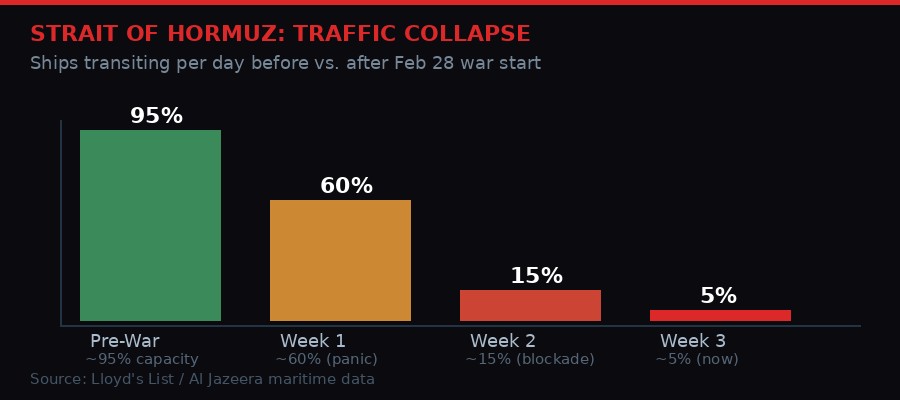
Strait of Hormuz traffic has fallen approximately 95 percent since the war began February 28. (BLACKWIRE / Data: Lloyd's List, Al Jazeera)
The Man Who Said There Was Nothing to Worry About

US-Israeli strikes on eastern Tehran continued through the night of March 19-20. (Pexels)
On Thursday evening, Iranian state television broadcast an interview with Brigadier General Ali Mohammad Naini, the 68-year-old spokesman for the Islamic Revolutionary Guard Corps. His message was defiant.
"Our missile industry deserves a perfect score... and there is no concern in this regard, because even under wartime conditions we continue missile production." - Ali Mohammad Naini, IRGC Spokesman, Thursday March 19, 2026 - his final public statement
By dawn on Friday, Naini was dead. The IRGC confirmed he was killed in overnight strikes carried out jointly by the United States and Israel, targeting eastern Tehran. The statement described it as a "criminal cowardly terrorist attack by the American-Zionist side."
The timing was not incidental. Naini appeared on state television just hours before Israeli Prime Minister Benjamin Netanyahu stated publicly that "Iran no longer has the capacity to enrich uranium and manufacture ballistic missiles." The assassination of the man tasked with rebutting that claim, within hours of the broadcast, was a pointed message.
Naini was the latest in what has become a systematic targeting of Iran's entire command and communications apparatus. Since the war began February 28, US-Israeli strikes have killed: Supreme Leader Ayatollah Ali Khamenei (Day 1), Basij Commander Gholamreza Soleimani, Intelligence Minister Esmail Khatib, senior IRGC Basij intelligence figure Esmail Ahmadi, and on Tuesday, Ali Larijani - the powerful secretary of the Supreme National Security Council - along with his son and several aides.
On Friday, US Defense Secretary Pete Hegseth made no effort to conceal Washington's satisfaction. He said the "last job anyone in the world wants right now" is a senior leadership role in the IRGC or Basij.
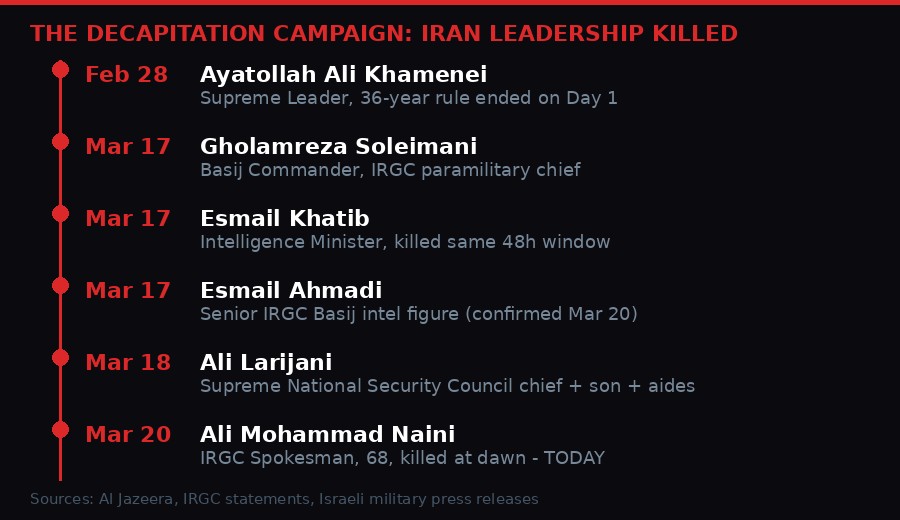
Six senior Iranian figures killed since February 28. The campaign has targeted military, intelligence, and political leadership simultaneously. (BLACKWIRE)
The Question of Who Leads Iran Now

Iran's political structure faces unprecedented leadership gaps after three weeks of targeted assassinations. (Pexels)
Mojtaba Khamenei has been announced as the successor to his assassinated father as Supreme Leader. US officials claim he is wounded. Analysts note he has never held an executive role in his life.
That leaves a genuine command vacuum at multiple levels of the Iranian state. Historian and Iran analyst Reza H. Akbari told Al Jazeera that the sheer number of assassinations might push Iran toward less transparency about who holds power - specifically to avoid creating new targets.
"It might be in Iran's interest not to name a successor to Larijani, since that would just be putting a target on his back." - Barbara Slavin, Stimson Center, speaking to Al Jazeera
The figures analysts identify as potentially influential in the vacuum include Mohammad Bagher Ghalibaf (parliament speaker), Saeed Jalili (former national security adviser), and Mohsen Rezaie (former IRGC chief, now named senior adviser to Mojtaba Khamenei).
Iranian Foreign Minister Abbas Araghchi has consistently pushed back against the idea that leadership kills destabilize Iran's system. "The presence or absence of a single individual does not affect this structure," he said this week. But the decapitation campaign has done something arguably more damaging than disrupting the chain of command: it has killed the people who knew how to negotiate.
Larijani was one of the officials who had experience in Western nuclear negotiations. Akbari observed that killing him removed a potential "off-ramp" - someone with the authority and relationships to de-escalate. Who fills that role now is unclear. And some analysts warn that younger IRGC figures - those who cut their teeth in Syria and Iraq rather than the Iran-Iraq War - may have far less appetite for compromise.
Netanyahu's stated logic is that persistent killing will "give Iranians a chance to take their fate into their own hands" - regime change without US boots on the ground. Most independent analysts call this wishful thinking. "There's always another leader," said Mohamad Elmasry of the Doha Institute. "I don't think this is going to suggest any kind of collapse of the Iranian regime."
Ukraine's Drone Advisers in the Gulf - and What It Reveals

Ukrainian drone expertise - developed over four years of war with Russia - is now being deployed to defend Gulf states against the same Shahed systems Iran exports. (Pexels)
One of the more unexpected developments of the past week: Ukraine has sent more than 200 military experts to Gulf countries to help them defend against Iranian drone attacks.
President Volodymyr Zelenskyy confirmed this to the British Parliament on Tuesday. Ukraine was preparing to send nearly three dozen more advisers, he said. The countries receiving help: the United Arab Emirates, Qatar, Saudi Arabia, and Kuwait.
The logic is direct. The Shahed-type drones Iran has been raining on Gulf states are the same drones Iran sold to Russia in 2022. Russia has since produced thousands under licence. Ukraine has spent four years shooting them down. It now has a success rate approaching 90 percent, targeting 95 percent. Last month alone, Ukraine shot down 3,238 Shahed-type drones - a monthly record.
"What is happening around Iran today is not a faraway war for us - because of the cooperation between Russia and Iran. And we do not believe we have the right to be indifferent." - President Volodymyr Zelenskyy, addressing British Parliament, March 17, 2026
The economics tell the real story. Fabian Hoffmann, a missile expert at Oslo University, explained that Gulf states have focused their defenses on high-altitude systems to intercept ballistic missiles. Low-altitude drone threats were largely ignored. The result: they are now absorbing Shahed strikes that a Ukrainian-style layered defense would catch.
A US Patriot interceptor missile costs up to $10 million per shot. A Ukrainian intercept drone designed to kill a Shahed costs roughly $3,000 - to stop a $50,000 Shahed. The math alone makes Ukraine's offer worth taking.
Zelenskyy also said Ukraine was capable of producing at least 2,000 effective intercept drones per day. It needs roughly 1,000 daily for its own defense - meaning it can spare at least 1,000 per day for allies. He offered to protect British bases in Cyprus - which were struck by a Shahed on March 2 - by placing intercept teams, radars and acoustic sensors around the installations.
Meanwhile, on the front lines of the actual Ukraine-Russia war, Zelenskyy says Ukrainian forces have begun counterattacks in the south. His army claims to have recaptured 400 square kilometers of territory since January. Ukrainian drones have struck the Afipsky Oil Refinery, the Aviastar aircraft manufacturing plant in Ulyanovsk, and multiple oil depots inside Russia's Krasnodar Krai region - the area on Russia's Black Sea coast that has increasingly become a logistics hub for the war.
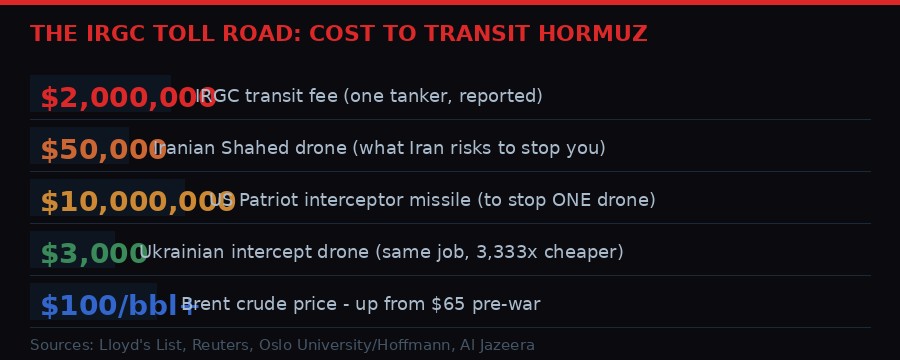
The economics of the Hormuz chokepoint. Tanker operators are weighing a $2M IRGC fee against insurance voids and the risk of being targeted mid-transit. (BLACKWIRE)
Russia's Windfall: How the Iran War Became a Sanctions Vacation

Oil refineries worldwide are scrambling for alternative crude supplies as Gulf exports remain effectively frozen. Russia has emerged as the primary swing supplier. (Pexels)
While US and Israeli warplanes target Tehran and Iranian drones hunt Gulf energy infrastructure, one party is watching quietly from the sidelines and counting its money: Russia.
The closure of the Strait of Hormuz has "walled in" roughly 20 million barrels of Gulf oil per day, according to George Voloshin, an independent energy analyst based in Paris who spoke to Al Jazeera. That created an immediate global shortage. The US response was to waive Russian oil sanctions - temporarily - to fill the gap.
The result: Urals crude, which had been trading below $60 per barrel under Western sanctions, is now trading at approximately $90 per barrel. Brent crude - the international benchmark - has risen above $100 per barrel, compared to roughly $65 before the war began. Analysts are openly discussing whether oil could hit $200 a barrel.
According to figures from the Centre for Research on Energy and Clean Air (CREA), Russia earned an additional 672 million euros in oil revenues in just the first two weeks of the war. The Financial Times estimated that by mid-March, Russia had already earned an extra $1.3 billion to $1.9 billion - a figure that could reach $4.9 billion by month end.
US Senator Adam Schiff put it bluntly on NBC News: "We are now giving Russia $140 million a day by releasing them from these sanctions. The Trump administration is rewarding Russia at Ukraine's expense."
Robin Brooks at the Brookings Institution noted that Russia's windfall now exceeds what it saw in 2022, following the initial invasion of Ukraine when oil prices last spiked.
At least seven tankers carrying Russian oil originally bound for China have changed course mid-voyage to India, according to Bloomberg's reporting of Vortexa data. India was the first country to receive a time-limited exemption from the US Treasury to import Russian oil already at sea. India's purchases of Russian crude have surged since the war began.
Turkey is also aggressively buying Russian crude to stabilize its domestic market amid gas shortages caused by Israeli strikes on Iran's South Pars gasfield.
The geopolitical irony is tight. Trump spent much of last year threatening India with additional tariffs for buying Russian oil. He is now granting India an exemption to buy more of it.
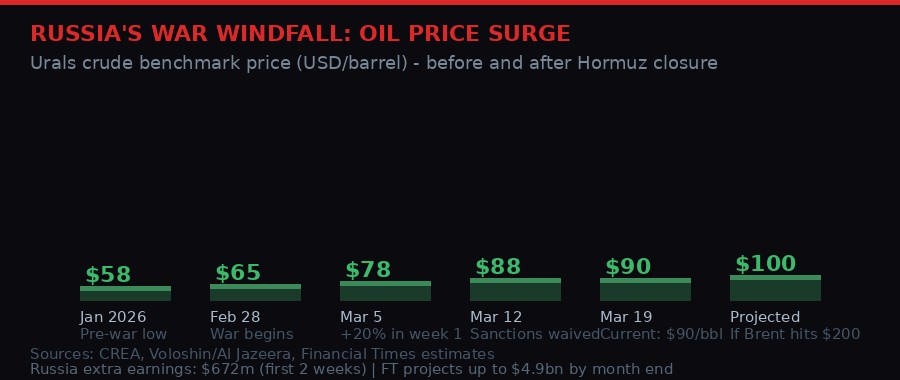
Urals crude has risen approximately 80 percent since the start of 2026. Russia is the primary beneficiary of a war it has no formal role in. (BLACKWIRE / Data: CREA, FT, Al Jazeera)
Energy War: Qatar's Ruined LNG Train and the Threat of Zero Restraint

Qatar's Ras Laffan industrial complex - the world's largest LNG facility - sustained significant damage in Iranian strikes this week. (Pexels)
Israel struck Iran's South Pars gasfield this week - the field that provides 80 percent of Iran's domestic natural gas. Iran's response was immediate and aimed directly at the Gulf's energy infrastructure.
Iranian strikes hit Qatar's Ras Laffan Industrial City, home to the world's largest liquefied natural gas processing complex. QatarEnergy CEO Saad al-Kaabi told Reuters that two of Qatar's 14 LNG trains - the equipment used to liquefy natural gas - and one of two gas-to-liquids facilities were damaged. The repairs will sideline 12.8 million tonnes of LNG production per year, he said, for three to five years. That represents an estimated $20 billion in lost annual revenue and threatens LNG supplies to Europe and Asia.
"I never in my wildest dreams would have thought that Qatar would be - Qatar and the region - in such an attack, especially from a brotherly Muslim country in the month of Ramadan, attacking us in this way." - QatarEnergy CEO Saad al-Kaabi, speaking to Reuters
Saudi Arabia intercepted multiple waves of Iranian drones on Friday morning. Kuwait Petroleum Corporation confirmed that the Mina al-Ahmadi refinery had been targeted by early-morning drone attacks, forcing some units to shut down.
Iranian Foreign Minister Araghchi's response to questions about further energy strikes: "Our response to Israel's attack on our infrastructure employed a FRACTION of our power. ZERO restraint if our infrastructures are struck again."
Trump intervened to stop the energy escalation, writing on Truth Social that he had told Israel not to repeat strikes on Iranian natural gas infrastructure. Netanyahu said publicly that Israel "acted alone" in the South Pars strike but would hold off at Trump's request.
The US and Israeli war aims are visibly diverging. Director of National Intelligence Tulsi Gabbard told the House Intelligence Committee this week that US and Israeli objectives "are different." She said Israel has been "focused on disabling the Iranian leadership," while Trump's goals are to destroy Iran's ballistic missile capabilities "and their navy."
That divergence matters. Israel's assassination campaign removes potential Iranian negotiators and hardwires escalation. The US wants to preserve enough Iranian state capacity to eventually make a deal - specifically a deal that ends the Hormuz blockade and brings oil prices down. Those objectives are structurally incompatible.
Timeline: 21 Days of War on Iran
US-Israeli strikes on Tehran kill Supreme Leader Ayatollah Ali Khamenei and other senior figures. Mojtaba Khamenei announced as successor. Iran fires first retaliatory missiles.
First strike on a NATO-linked target outside the Gulf. UK reviews defensive commitments.
US temporarily lifts sanctions on shipped Russian oil. Urals price begins surging. Senator Schiff says US is "giving Russia $140m a day."
Viktor Orban reverses approval of EU loan package, citing the damaged Druzhba pipeline. Ukraine says repair is impossible under ongoing Russian strikes.
Basij Commander, Intelligence Minister, and senior IRGC intelligence figure all killed within a 48-hour window. Larijani killed same day in separate strike.
The war shifts to energy infrastructure. Qatar estimates $20bn in annual revenue losses and three-to-five years of reduced LNG capacity.
Lloyd's List reports Iran is developing a formal ship vetting system for Hormuz transit. At least nine ships have used the corridor. One paid $2m.
Naini appeared on national TV Thursday night defending Iran's missile production. He was killed in overnight strikes on eastern Tehran. Iran's Persian New Year (Nowruz) coincides with Eid al-Fitr - the streets of Tehran are "hushed," no festivity visible.
What Happens Next: Three Scenarios

The US Fifth Fleet based in Bahrain sits at the center of the Gulf military standoff. Options for escalation or de-escalation remain on the table. (Pexels)
The war is in a phase where the next move could determine the next six months. Three scenarios are credible.
Scenario One: The IRGC Toll System Stabilizes. Iran quietly formalizes the vetting process, allows approved tankers - particularly from India, China and Pakistan - to transit at a price. Oil prices remain elevated but stop climbing toward $200. The US takes this as a partial win. The Hormuz "closure" becomes a managed chokepoint that lines IRGC coffers while giving Trump something to call de-escalation. Russia continues cashing checks. This scenario requires Iran not to escalate on energy infrastructure further - which its own foreign minister has threatened to do at "zero restraint" if struck again.
Scenario Two: Leadership Vacuum Produces Dangerous Miscalculation. With the IRGC's spokesman dead, Basij commander gone, intelligence minister killed, and the Supreme National Security Council chief assassinated, Iran's chain of command is operating through second and third-tier figures with less experience and less to lose. A IRGC unit commander acts autonomously - hitting a US warship, a Western civilian tanker, or a target that produces mass casualties. The response bypasses any remaining diplomatic channel because the people who knew those channels are dead.
Scenario Three: Diplomatic Reset Through Energy Pressure. Oil heading toward $200 creates enough economic pain in Europe, Asia and the United States that political pressure forces a pause. Ukraine's Russia talks, paused due to the Iran distraction, resume. A framework for Hormuz reopening is negotiated - possibly through Qatar as intermediary. Iran retains the vetting system as face-saving leverage while effectively lifting the blockade. This scenario requires both sides to have decision-makers willing to take it. The assassination campaign is actively eliminating those people on the Iranian side.
The most honest assessment: none of these are clean. The war is generating cascading effects across multiple theaters simultaneously - energy markets, the Ukraine-Russia front, global food supplies, EU political cohesion (see Hungary's blocking of Ukraine aid). Each of these has its own momentum. They are not being managed in an integrated way by any single actor.
On Nowruz - the Persian New Year - and Eid al-Fitr combined, the streets of Tehran are silent. Al Jazeera's correspondent described the mood as "hushed," with none of the customary celebrations visible. The city marks both holidays simultaneously, under air strikes, having lost its Supreme Leader, its security council chief, its intelligence minister, and now its military spokesman in 21 days.
The man who said there was "no concern" about missile production is dead. The corridor through Hormuz costs $2 million per ship. The oil price analysts once called catastrophic now looks optimistic. Day 21. The trajectory is not improving.
Get BLACKWIRE reports first.
Breaking news, investigations, and analysis - straight to your phone.
Join @blackwirenews on TelegramSources: Al Jazeera (multiple reports, March 19-20, 2026), Lloyd's List via Al Jazeera, Centre for Research on Energy and Clean Air (CREA), Voroshin/energy analyst interviews, Financial Times estimates, QatarEnergy CEO statement to Reuters, Institute for the Study of War (ISW), Oslo University/Fabian Hoffmann, Stimson Center/Barbara Slavin, Doha Institute/Elmasry, US Senate statements (Schiff/NBC News), Brookings Institution (Robin Brooks), IRGC official statements, Israeli military press releases, Ukrainian General Staff statements.