Hormuz on Fire: 16 Ships Hit, UAE Port Burns, Trump's Coalition Fractures
Fifteen days after the US and Israel opened their war against Iran, the Strait of Hormuz has become the world's most dangerous 33-mile corridor. Sixteen vessels have been attacked. The port of Fujairah in the UAE - a critical east-coast oil terminal - was burning on Saturday after a drone strike. Iran is firing on Saudi Arabia, Kuwait, Bahrain, Qatar, and Oman. And the international coalition Trump demanded to open the strait? It is, as of Sunday morning, nonexistent.

The Strait No One Will Defend
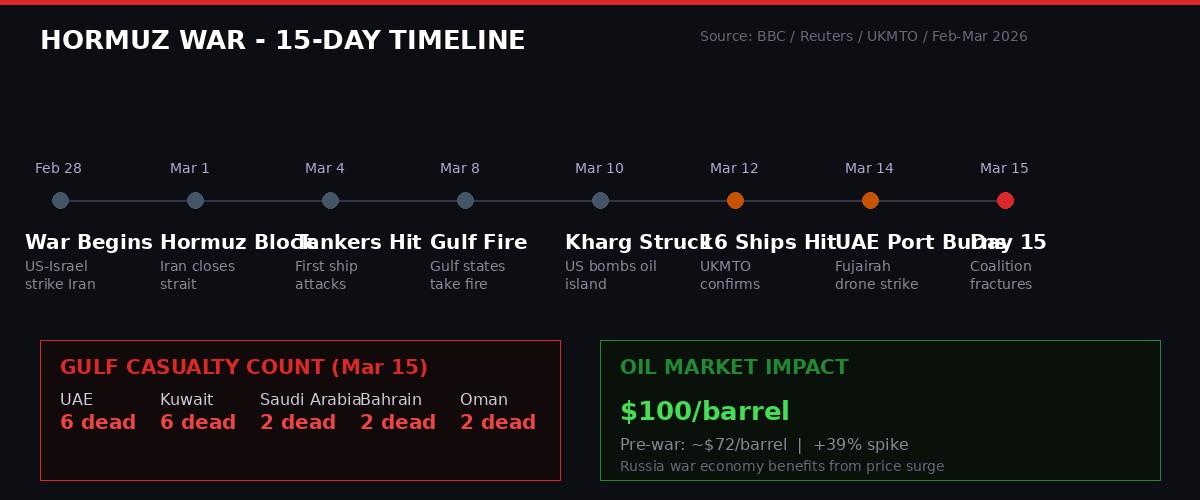
The United Kingdom Maritime Trade Operations authority - the body that monitors commercial shipping across the Gulf region - confirmed in its March 12 update that 16 vessels had been attacked in and around the Strait of Hormuz since the war began on February 28. The figure has almost certainly grown since then. (Source: UKMTO, March 12 update)
What makes those 16 attacks particularly damning is the footnote buried in the UKMTO briefing: not even the US Navy is currently escorting commercial tankers through the passage. The world's busiest oil chokepoint - through which roughly 20 percent of global oil supplies normally flow - is operating without armed protection for civilian vessels. (Source: BBC, March 15, 2026)
Iran has been explicit about its strategy. Tehran announced on Thursday that any tanker bound for the US, Israel, or their partners is a legitimate military target. That declaration transforms every oil ship attempting to move through the strait into a floating conflict zone, regardless of flag, owner, or crew nationality.
The consequences extend far beyond the strait itself. On Saturday, a drone struck the port of Fujairah on the UAE's eastern coast - a facility specifically designed to bypass the Hormuz chokepoint by allowing supertankers to offload oil on the Gulf of Oman side. That Fujairah was hit signals that Iran is targeting the workarounds, not just the strait itself. The port fire sent plumes of black smoke visible from miles offshore. (Source: AFP/BBC, March 14-15, 2026)
"We will be bombing the hell out of the shoreline, and continually shooting Iranian boats and ships out of the water. One way or the other, we will soon get the Hormuz Strait open, safe, and free." - President Donald Trump, Truth Social, March 14, 2026
Trump's words read as confident. The operational picture does not match them. If the US is actively clearing the shoreline and waterway, the tanker attacks have not stopped. The port of Fujairah burned anyway.
The Coalition That Isn't
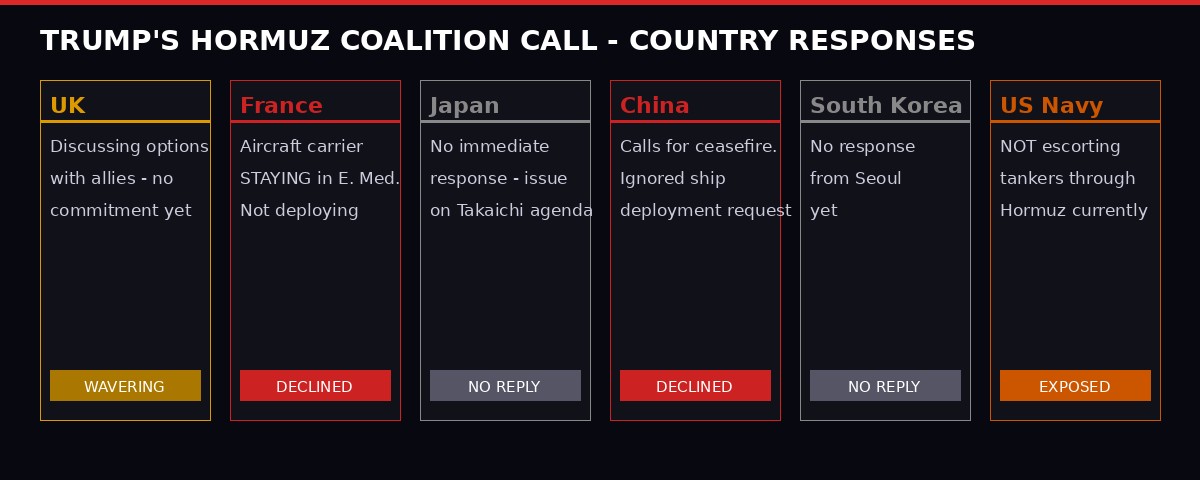
On Saturday, Trump posted a direct appeal on Truth Social naming five countries - China, France, Japan, South Korea, and the UK - and calling on them to send warships to the strait. He extended the request to all nations that receive oil through Hormuz. He promised "a lot" of US support. He framed it as a global economic imperative. (Source: Trump/Truth Social, March 14, 2026; BBC, March 15)
Here is what came back.
The Liberal Democrat leader in Britain, Sir Ed Davey, said on Saturday that Prime Minister Keir Starmer must "rule out deploying British ships just because Trump tells him to," noting that Trump had declared victory just a week ago. "We mustn't let him push the UK around now," Davey said. (Source: BBC, March 15, 2026)
This is the operational reality: fifteen days into a war that Trump says has "100% destroyed" Iran's military capability, not a single allied warship is in the Hormuz corridor. Iran is still attacking tankers. The port built to bypass the problem just burned.
Gulf Neighbors Take Fire: 18 Dead and Counting
Iran insists its retaliatory strikes target "American installations on Gulf soil" rather than the neighboring states themselves. The casualty count tells a different story.
As of Saturday, at least 18 people have been killed across Gulf Cooperation Council member states since the conflict began. Six died in the United Arab Emirates. Six more in Kuwait. Saudi Arabia, Bahrain, and Oman each recorded two deaths. The casualties are predominantly security personnel and foreign workers - the people who keep Gulf infrastructure operating around the clock. (Source: BBC/AFP, March 14-15, 2026)
The overnight picture going into Sunday was acute. Saudi Arabia's defence ministry reported it intercepted 26 Iranian drones over its territory - primarily near Riyadh and in the eastern oil regions. The UAE announced at approximately 03:30 GMT that its air defence systems were responding to incoming missile and drone attacks. Bahrain sounded sirens and ordered residents to shelter. Kuwait's National Guard confirmed it had shot down five Iranian drones over the previous 24 hours. Qatar reported repelling multiple attacks throughout Saturday. (Source: BBC live coverage, March 15, 2026)
The breadth of that list matters. Iran is not targeting one adversary. It is fighting every state that hosts US military infrastructure, which in the Gulf means practically every state. The geography of American forward basing has turned the entire Gulf into a target matrix.
"Iran's retaliatory drone and missile strikes have been felt by many of its Gulf neighbours over the past two weeks." - BBC News, March 14, 2026
The Fujairah port strike on Saturday deserves particular attention. Fujairah sits on the Gulf of Oman coast - the other side of the Oman peninsula from the Persian Gulf. It was designed as a strategic hedge precisely because tankers loading there do not have to transit the Strait of Hormuz at all. Supertankers can fill up and head directly into open ocean. Iran targeting Fujairah shows that Tehran's goal is not merely to hold Hormuz. It is to shut down every viable oil export route from the Gulf region, full stop.
Hamas Breaks Ranks - Tells Iran to Stop
In a development that would have been unthinkable six months ago, Hamas issued a public statement on Saturday calling on its principal backer to stand down from attacking Gulf neighbors.
The Palestinian group - which depends on Iran for funding, weapons, and political support - urged its "brothers in Iran to avoid targeting neighbouring countries," saying regional nations should cooperate "to preserve the bonds of brotherhood." Hamas said it was following the war with "deep concern" and called on "all states and international organisations to work towards halting it immediately." (Source: BBC / AFP, March 14, 2026)
Hamas simultaneously affirmed Iran's right to defend itself against US and Israeli strikes. The dual message - stop hitting Gulf states, keep fighting the Americans and Israelis - reflects the position of Qatar and Turkey, which also provide significant support to Hamas and have themselves come under Iranian attack.
Iran has not publicly responded to Hamas's appeal. Tehran's position has been consistent: its strikes hit American installations, not sovereign neighbors. The distinction has become academic for the families of the 18 people killed across the Gulf so far.
The fracture between Hamas and Iran - however measured and diplomatically worded - represents a strain on the "axis of resistance" that Israel and the US have spent years trying to engineer. The war has achieved it in two weeks, though not in a way anyone planned.
Russia's Dividend: Ukraine Bleeds While the World Looks Away
On the other end of the global attention span, Russia launched approximately 500 drones and missiles into Ukraine overnight into Saturday. At least five people were killed. The main target was the energy infrastructure of the Kyiv region. Residential buildings, schools, and civilian businesses were also hit. A separate Russian strike near Zaporizhzhia killed one more person and wounded 18. (Source: Zelensky statements / BBC, March 15, 2026)
Ukrainian President Volodymyr Zelensky was direct about the strategic calculation: "Russia will try to exploit the war in the Middle East to cause even greater destruction here in Europe, in Ukraine."
"Russia will try to exploit the war in the Middle East to cause even greater destruction here in Europe, in Ukraine." - Volodymyr Zelensky, social media, March 15, 2026
The exploitation is not abstract. Air-defence missiles that would normally have been routed to Ukraine have been diverted to the Gulf theater. The US-Israeli war with Iran has consumed Patriot interceptors and other systems at a pace that leaves Ukraine's own air-defence networks thinner. Zelensky explicitly called on partners to deliver more air-defence systems "as quickly as possible," framing Ukrainian protection as a "daily necessity" regardless of what was happening in the Gulf. (Source: BBC / Reuters, March 15, 2026)
The economic dimension compounds the military one. Oil prices have spiked to around $100 a barrel since the Hormuz blockade began. The Trump administration, scrambling to contain energy price inflation, temporarily lifted sanctions on Russian oil already loaded onto vessels at sea. Russia - the country whose war Trump has claimed to be ending - is now benefiting from the price surge. Its war economy gets a revenue injection precisely at the moment when its main adversary's patron is distracted. (Source: BBC / Reuters, March 15, 2026)
Peace talks on Ukraine, which the US had been brokering, have stalled. The Iran war derailed them. No timeline has been set for their resumption.
The Media Front: Trump Threatens Broadcast Licenses
Alongside the physical conflict, a quieter battle is escalating over how the war gets reported inside the United States.
Federal Communications Commission chairman Brendan Carr posted on social media Saturday accusing American broadcasters of "hoaxes and news distortions" during coverage of the Iran conflict. Carr threatened to revoke broadcast licenses if the industry does not "correct course." He told CBS News that "people have gotten used to the idea that licenses are some sort of property right, and there's nothing you can do that can result in losing their license," adding that he intended to "reorient" that assumption. (Source: BBC / CBS News, March 15, 2026)
The statement came attached to a Trump Truth Social post complaining about "misleading" and "terrible reporting" on the conflict. The FCC threat is not a regulatory action - no proceeding has been opened - but the signal is clear: broadcasters who report adversarially on the war face the possibility of license challenges.
Why This Matters
The FCC does not control cable news or internet platforms - only over-the-air broadcast licensees. But the threat is designed to create a chilling effect across the broader media ecosystem. A press that self-censors during wartime produces a public that cannot evaluate what it is being asked to support. That is not a side note. It is the story.
Timeline: 15 Days That Changed the Gulf
Conflict Timeline - February 28 to March 15, 2026
What Comes Next: Escalation Calculus
Trump said Sunday that the US is "not ready to make a deal" with Iran. He had previously told NBC that Tehran "appeared ready" to negotiate but that "the terms weren't good enough." Iran denied being ready to negotiate at all. Both sides are managing domestic audiences, which means both sides need to appear unready to blink. (Source: BBC live, March 15, 2026)
Israel's Defence Minister Israel Katz said on Saturday that the war was entering a "decisive phase" that would "continue as long as necessary." The language of decisive phases has a body count. It is the language used before major escalations, not before ceasefires.
The Hormuz coalition failure is not merely a diplomatic embarrassment. It has practical military consequences. If commercial ships cannot transit the strait safely, the global oil supply disruption will deepen. The $100 barrel could become a $120 barrel. At those prices, the political cost of the war in consuming democracies - the US, UK, France, Japan, South Korea - becomes harder to sustain.
Tehran understands this arithmetic. The Fujairah strike was not random. It was a message that Iran can extend the economic pain beyond Hormuz itself, into every alternative route the market tries to open. Each escalation by Iran raises the price of continuing the war for countries that did not sign up for it.
Ukraine is caught in the crossfire of attention. Russia's overnight 500-drone salvo on Kyiv was not an accident of timing. It was a test of whether the world's defensive resources and political bandwidth have been saturated enough to allow a major Ukrainian infrastructure strike to pass without significant response. The answer, so far, appears to be yes.
The Lebanon front reopening compounds the resource question. Every Patriot battery firing at Hezbollah rockets over northern Israel is a battery not available for Ukrainian cities. Every interceptor used in the Gulf is one not on a ship heading to Odesa.
The FCC threat against US broadcasters adds a dimension that will not show up in casualty tallies but will matter enormously if the war drags into months rather than weeks. A public that cannot access critical coverage cannot hold its government accountable for a war's costs. That has historically been a feature, not a bug, of wartime media pressure.
Field Assessment: The Silence at Sea
The defining image of Day 15 is not a burning port or an intercepted drone. It is an empty stretch of water.
The Strait of Hormuz - 33 miles across at its narrowest, carrying a fifth of the world's oil - has no allied warships escorting the commercial traffic that is supposed to flow through it. Not American. Not British. Not French. Not any nation Trump named. The strait that the US has spent decades declaring vital to global security is currently being defended by exactly one country: Iran, which is mining it, targeting tankers in it, and hitting the ports built to bypass it.
Sixteen ships have been attacked. Eighteen people have been killed across five Gulf states. The Fujairah port fire is still being assessed. Ukraine took 500 projectiles overnight and lost five more people. Russia's war economy is getting an oil windfall. Hamas is telling its patron to stop. And every nation Trump called on Saturday to join him at Hormuz found reasons to say no, wait, maybe, or nothing at all.
"One way or the other," Trump wrote, "we will soon get the Hormuz Strait open, safe, and free." He may be right. But on the morning of March 15, it is none of those things.
Get BLACKWIRE reports first.
Breaking news, investigations, and analysis - straight to your phone.
Join @blackwirenews on Telegram