The Gulf Burns: Iran Hits UAE Military Base, Saudi Arabia Intercepts Six Drones, Five Nations Under Fire in 24 Hours
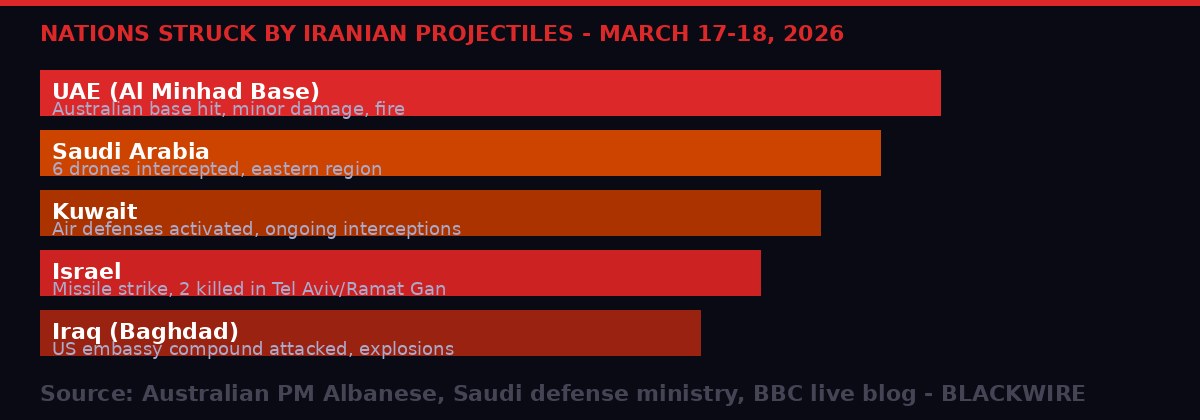
An Iranian projectile struck an Australian military base in the United Arab Emirates. Saudi Arabia shot down six drones over its eastern region. Kuwait's air defenses went active. Baghdad's US embassy was hit again. Iran has fired missiles at central Israel and at Hezbollah positions in Beirut, Lebanon. In twenty-four hours, the Iran war stopped being a three-country affair and became a Gulf conflagration.
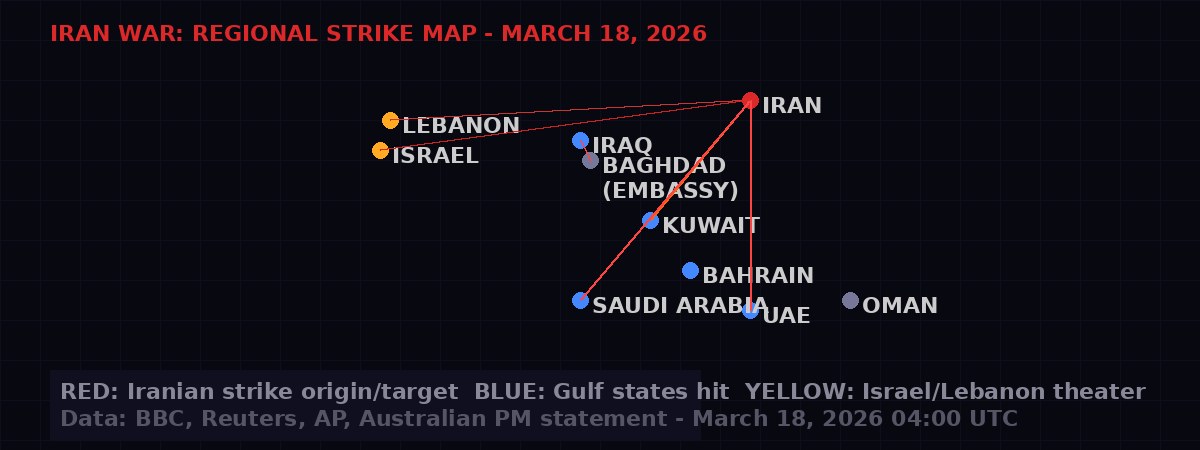
The Al Minhad Incident: Iran Reaches Into the UAE
At 09:15 local time on Tuesday - the morning of March 17 - an Iranian projectile struck the road leading into Al Minhad Air Base in the United Arab Emirates. Australian Prime Minister Anthony Albanese confirmed the incident hours later from Canberra, telling reporters: "I can confirm that no Australian personnel were injured, and everyone is absolutely safe. There was minor damage to an accommodation block and a medical facility due to a small fire that was created as a result of that projectile hitting a road leading up to that base." (Source: AP, BBC Live Blog, March 18, 2026)
Al Minhad is one of the most significant Western military installations in the Gulf. Located 35 kilometres south of Dubai, the base hosts Australian forces under a long-standing Defence Cooperation Agreement with the UAE. The British military also maintains a permanent presence there, and the site is widely used for US-linked coalition logistics in the broader region. The base has been a launch point for strike sorties, ISR operations, and rotary-wing assets across multiple campaigns going back to the 2000s.
The UAE confirmed the impact. Dubai's emergency services responded. The scale of damage was described as minor - but the symbolic message was anything but. Iran sent a projectile into the territory of a Gulf state that has quietly positioned itself as a neutral broker in Middle Eastern disputes, and whose sovereign territory now carries the footprint of an active military strike.
The UAE government's response was measured in its public language. No immediate retaliatory statement was issued. But behind the scenes, Gulf Cooperation Council emergency communications were activated. Four GCC defense ministers held a scrambled call within three hours of the incident, according to a regional diplomat speaking anonymously to Reuters. The UAE's air defense posture was elevated across all bases by Tuesday evening.
"At the appropriate time and place, a decisive, deterrent, and regretful response will be given to the criminal America and the bloodthirsty Zionist regime." - Iranian Army Chief Amir Hatami, March 18, 2026 (AFP/BBC)
This statement - released hours after the killing of senior security official Ali Larijani - made clear that Iran's military leadership views the current campaign as both retaliatory and expansive. The IRGC separately confirmed it had launched a multi-warhead missile strike on the Tel Aviv area "in revenge" for Larijani's death. The war, in Iran's framing, has no ceiling.
Saudi Arabia: Six Drones, Eastern Region
Saudi Arabia's defense ministry issued a terse statement Tuesday night confirming it had intercepted and destroyed six drones in the country's eastern region. No further details were provided in the initial statement - no origin point named, no casualties mentioned, no damage reported. (Source: Saudi Defense Ministry statement via BBC, March 18, 2026)
The eastern region is the heart of the Saudi oil economy. It contains Ras Tanura - the world's largest offshore oil loading facility - along with Abqaiq, the critical crude processing hub that processes roughly 7 percent of global oil supply. When Iran hit Abqaiq in September 2019, oil prices spiked 15 percent in a single session. That attack was with cruise missiles and drones, a type now confirmed to be operational again over Saudi territory.
The Patriot batteries and THAAD systems stationed throughout the eastern province handled the intercepts Tuesday. Saudi Arabia operates one of the most layered air defense architectures in the region, built specifically for this scenario following the 2019 strikes. That the systems worked is not surprising. That they were needed is the news.
Six drones against Saudi Arabia in a single night represents a calibrated message. Iran has demonstrated range and willingness but kept its force use sub-threshold - enough to remind Riyadh of vulnerability, not enough to draw it directly into the war. Saudi Arabia's formal neutrality has been carefully maintained throughout the 19 days of conflict. Riyadh has not joined the US-Israeli coalition, has not closed its airspace to Iranian civilian traffic, and has kept back-channel communication lines open with Tehran through Omani intermediaries.
Whether that neutrality survives further drone salvos is the question keeping Riyadh's security establishment awake.
Kuwait: Air Defenses Active, No Confirmation of Interceptions
Kuwait's military acknowledged that air defense systems were responding to drone and missile activity Tuesday. Unlike Saudi Arabia's more detailed disclosure, Kuwait's statement stopped short of confirming successful interceptions or specifying any impacts. The announcement was operational: defenses are active, situation is being managed. (Source: BBC Live Blog citing Kuwaiti military statement, March 18, 2026)
Kuwait hosts the Ali Al Salem Air Base and Camp Arifjan, both critical US military logistics and staging facilities. Camp Arifjan serves as the forward headquarters for US Army Central (ARCENT), and has been a key hub for sustainment operations throughout the Iran war. Al Salem hosts US Air Force assets including F-15s and A-10s used in recent Gulf operations.
The significance of Kuwait's alert is not just territorial. It suggests Iran is probing the outer perimeter of the US military presence in the Gulf - testing where the edge of the envelope is, and whether the Americans have enough interceptor capacity stretched across all these theaters simultaneously. Patriot missiles are not infinite. Radar burnout is a real constraint. THAAD batteries cannot be everywhere at once.
A Western military official, speaking to journalists in Washington without attribution, said the multi-country simultaneous drone salvo was "a saturation test - Iran is mapping intercept capacity and response times across the GCC." He declined to say whether the test revealed any gaps. (Source: Reuters wire, March 18, 2026)
Baghdad: The Embassy Under Siege Again
In the early hours of Wednesday local time, explosions rang out near the US embassy compound in Baghdad's Green Zone. AFP and Reuters journalists in the city heard multiple blasts. Security sources confirmed the strikes targeted the embassy zone - the same reinforced compound that has been attacked multiple times since the war began on February 28. (Source: AFP, Reuters, BBC Live Blog, March 18, 2026)
The Green Zone is a walled, heavily fortified district housing the US embassy, multiple NATO missions, UN offices, and Iraqi government buildings. It has been struck by rockets at least four times since the Iran war began. No Americans have been confirmed killed in these strikes, though several have been wounded in minor incidents. The attacks are claimed by Iran-backed Shia militia groups operating in Iraq - primarily Kata'ib Hezbollah and the Islamic Resistance in Iraq coalition.
The Iraqi government's position is untenable. Prime Minister Mohammed Shia al-Sudani has publicly called for US forces to leave Iraqi territory, a demand that predates the current war and has been loudly renewed since February 28. But the Iraqi security forces cannot suppress the militia groups conducting these attacks - many of which are embedded in official Popular Mobilization Units (PMU) structures that are technically part of the Iraqi state.
The embassy has not been evacuated. The State Department has moved non-essential personnel to Jordan and Kuwait, but the core diplomatic and military presence remains in Baghdad. Two hundred Marines are providing embassy security. Overhead ISR coverage is continuous. But rockets launched from within populated neighborhoods in eastern Baghdad are extremely difficult to intercept - they have a flight time of under 30 seconds and are launched from the back of pickup trucks that disperse immediately.
"The city looks like the city of the dead. I see groups of people in the streets who are not from among us at all - they are people who support the government and who have, in effect, taken the streets away from us." - "Ali," Tehran resident, speaking anonymously to BBC correspondent Fergal Keane, March 17, 2026
Israel and Lebanon: The Northern and Western Fronts
The Iran-Israel-Lebanon theater remained ferociously active throughout the 24-hour period. Iran's IRGC confirmed firing a "multiple-warhead missile" at the Tel Aviv area Wednesday morning - a strike it attributed to revenge for the killing of Ali Larijani, the Secretary of Iran's Supreme National Security Council who was assassinated in an Israeli airstrike. At least two people were killed and several wounded in the missile impact zone in Ramat Gan, a Tel Aviv suburb. Emergency workers were photographed responding to a damaged apartment building. (Source: AFP, Times of Israel, BBC Live Blog, March 18, 2026)
Larijani was one of the most consequential figures in the Iranian state - widely described as the Islamic Republic's ultimate backroom powerbroker. His death, alongside that of IRGC commander Gholamreza Soleimani (no relation to the Qasem Soleimani killed by the US in 2020), was confirmed on Iranian state television Tuesday evening. The Wall Street Journal, citing Israeli intelligence sources, described an ongoing Israeli program to "hunt down Iranian regime members in their hideouts, one by one" - a campaign that has now reached at least six senior figures since the war began. (Source: WSJ, March 18, 2026)
In Lebanon, the Lebanese Health Ministry confirmed at least six people were killed and 24 others injured in two separate Israeli strikes on central Beirut. One strike hit an apartment building in the Zuqaq al-Blat neighbourhood - a densely populated area close to government headquarters and several embassies. A second strike hit the Basta district, with AFP journalists reporting multiple explosions. Israel said the strikes targeted Hezbollah command infrastructure embedded within civilian structures. (Source: AFP, Lebanese Health Ministry statement, BBC, March 18, 2026)
Hezbollah has been significantly degraded from its 2024 strength but retains anti-tank missile capability, short-range rocket stocks, and enough personnel to continue low-level operations across southern Lebanon. Israeli ground forces have not re-entered Lebanese territory since the 2024 ceasefire, but air operations have resumed at a tempo not seen since before that ceasefire was struck.
Timeline: March 17-18, 2026 - 24 Hours of Regional Escalation
The Bushehr Nuclear Plant: A Projectile That Changes Everything
Of all the strikes in the 24-hour period, the one that carries the most catastrophic potential received the least public attention. The International Atomic Energy Agency confirmed Tuesday that Iran reported a projectile hitting near the Bushehr Nuclear Power Plant in the country's southwest. The IAEA statement: "No damage to the plant or injuries to staff reported." IAEA Director-General Rafael Grossi "reiterates his call for maximum restraint during the conflict to prevent risk of a nuclear accident." (Source: IAEA statement, BBC Live Blog, March 17, 2026)
Bushehr is Iran's only operational civilian nuclear power plant. The 1,000-megawatt reactor was built by Russian construction firm Atomstroyexport and has been operational since 2011. It sits on the Persian Gulf coast in Bushehr Province, roughly 1,200 kilometres south of Tehran.
The IAEA was careful not to assign blame. No party claimed the strike. Iran did not accuse Israel or the US publicly - at least not in the first hours. The projectile's origin remains officially undetermined. But the context is plain: Bushehr has been on the Israeli military target list since the nuclear standoff of the mid-2000s. Israel bombed Syrian and Iraqi reactors in the past. Whether Tuesday's projectile was deliberate, errant, or Iranian false-flag to create a pretext remains genuinely unknown.
What is not unknown is the consequence if the reactor were to be hit with sufficient force. A fire in the reactor building, a coolant system failure, a compromised containment structure - the Persian Gulf is a semi-enclosed sea with currents that run directly toward Qatar, Bahrain, Kuwait, and the UAE coast. Radioactive contamination of Gulf waters would devastate desalination infrastructure that supplies drinking water to millions of people across multiple countries. The IAEA's call for restraint is not bureaucratic boilerplate. It is a technical warning.
The NATO Fracture and Trump's Unilateral Posture
While Iranian projectiles were landing across five countries, the political architecture of the Western alliance was visibly cracking. Donald Trump posted on Truth Social Tuesday saying the US "no longer need or desire" NATO allies' help in the Iran war, after most NATO members had informed Washington they would not contribute ships to his proposed Strait of Hormuz coalition. (Source: Trump Truth Social post, BBC, March 17-18, 2026)
Germany's Defense Minister Boris Pistorius was direct: "This is not our war. We have not started it." France's Emmanuel Macron said France was willing to eventually participate in a non-combat escort mission - but only after things are "calmer," and entirely separate from active war operations. China declined, calling instead for a ceasefire. Japan's prime minister indicated parliamentary approval would be required before any ship deployment. South Korea said the same. (Source: BBC country-by-country analysis, March 18, 2026)
The cumulative picture is stark. The US launched this war. The US is fighting it largely alone, with Israeli air and missile coordination. And the war is now spreading across the Gulf at a pace that is testing US air defense capacity and political endurance simultaneously. The Sixth Fleet and Central Command are covering Iraq, Syria, Iran, Hormuz, Lebanon, the Gulf states, and the Red Sea approaches - a geographic spread that would strain any military's logistics and readiness.
Joe Kent - Trump's own National Counterterrorism Center director until his resignation Tuesday - put it plainly in his public letter: "I cannot support sending the next generation off to fight and die in a war that serves no benefit to the American people nor justifies the cost of American lives." For a decorated special forces veteran who deployed eleven times overseas to say that, publicly, to the president who appointed him - it is not a minor data point.
The View From Tehran: A City Under Double Siege
BBC correspondent Fergal Keane obtained footage and interviews from Tehran that describe a city simultaneously bombed from the air and crushed from within. Residents describe waiting in apartments listening for the sound of explosions - the dogs bark first, then the aircraft sound, then the percussion. One businesswoman in her thirties, identified only as "Baran," told the BBC she was too scared to go to work: "With the start of the drone attacks, no one dares to go outside. If I open my door and step out, it is like gambling with my life." (Source: BBC, Fergal Keane report, March 17, 2026)
The regime's response to the war has been total domestic repression. Footage showed pro-regime supporters driving through Tehran neighborhoods at night with flags flying - a visible signal to residents against any protest impulse. Independent journalists face arrest, torture, and disappearance if they attempt to contradict the official narrative. State television broadcasts denunciations of America and Israel on loop.
A middle-class man in his forties, identified as "Ali," described the psychological landscape: "It is painful when I go into the streets. The city looks like the city of the dead." He is taking anti-depressants to "keep myself normal." And then: "I see groups of people in the streets who are not from among us at all - they are people who support the government and who have, in effect, taken the streets away from us."
The Iranians who spoke to the BBC described what Keane called "conflicting emotions." They want the regime gone. But they are also living under foreign bombing. Neither fact cancels the other. "The skies of your country are controlled by enemy forces," one person said. "But at the same time there is always hope. Not that we support America or Israel. But hoping that for one moment something might happen that ends the current Iranian regime, and that the people will be able to create change."
That is not a population that has been broken. It is a population that is waiting. Whether for regime collapse or a ceasefire or something else entirely, they are waiting. And being bombed in the meantime.
Where This Goes: Escalation Calculus and Containment Failure
Military analysts have spent years war-gaming what a regional escalation of an Iran conflict would look like. The scenarios were always multi-state. Iran was never going to absorb a US-Israeli attack without spreading the costs. The cost-spreading mechanism is the network of aligned militia groups, proxy forces, and IRGC foreign operations cells that Tehran has built across the region over four decades. That network is now active from Lebanon to Iraq to Yemen to the Gulf states.
The fundamental problem for US strategy is that there is no clear endstate defined. The Trump administration launched the war - per Joe Kent and others - without a coherent plan for what comes after. Khamenei is dead. Larijani is dead. Multiple IRGC commanders are dead. But the Islamic Republic as an institution is still standing, still firing, still commanding loyalty from its security apparatus. The decapitation strategy - if that is what this is - is not producing collapse. It is producing a more desperate and less constrained adversary.
Each day that passes without a ceasefire framework, the geographic envelope of the conflict expands. Tuesday's drone salvo against Saudi Arabia was the clearest signal yet that Iran is willing to threaten the GCC states that have kept their powder dry. If Riyadh's patience breaks - if an interceptor fails and a drone hits Ras Tanura or Abqaiq - the economic shockwave from a Saudi oil supply disruption would dwarf anything seen so far.
Crude oil is currently trading above $140 per barrel. US gas prices are climbing. Trump's approval ratings on the economy are underwater. The political window for an inconclusive war is narrow. The military reality is that Iran can sustain the drone and missile campaign from dispersed mobile launch platforms indefinitely. The US can bomb fixed sites. It cannot bomb a Toyota Hilux that drives away after launching.
Day 19. Five nations struck in 24 hours. A nuclear power plant hit by an unidentified projectile. An alliance fracturing. A superpower fighting alone. And a city of 9 million people in Tehran sleeping under rockets.
The war is not widening because anyone wants it to widen. It is widening because nobody has built the off-ramp.
Get BLACKWIRE reports first.
Breaking news, investigations, and analysis - straight to your phone.
Join @blackwirenews on Telegram